
US companies report 40-60% cost savings using nearshore engineers in Latin America. But 2024 industry data shows fewer than 1 in 4 companies rated their first nearshore partnership “highly successful.”
Nearshore partners can be evaluated across six dimensions: technical capability, security and compliance, IP protection, talent stability, cultural alignment, and commercial model. LATAM’s 1.2-1.4 million developers grow at 10-12% CAGR through 2027, trained at universities like Tecnologico de Monterrey, UBA, and Universidad de los Andes in Bogota and Medellin.
This guide gives CTOs a concrete scorecard to use before signing any MSA. It covers live code assessment protocols, SOC 2 and ISO 27001 verification steps, IPRI contract clauses, attrition benchmarks, and a 30-60-90 day onboarding framework.
Why Do Most CTOs Regret Their First Nearshore Partner Choice?
ISG’s 2023 Provider Lens data shows roughly 60% of failed nearshore engagements trace back to selection error, not execution. Deloitte’s Global Outsourcing Survey found that 40% of outsourced engagements fail within the first two years. Fewer than 1 in 4 companies rated their first nearshore partnership as “highly successful” per a 2024 nearshore industry report.
The fix is to stop evaluating nearshore partners like SaaS vendors and start evaluating them like VP of Engineering hires: depth of technical judgment, retention infrastructure, cultural operating model, and alignment on quality standards.
What Does a Bad Nearshore Vendor Decision Actually Cost?
Replacing a single developer costs $50,000 to $90,000 in fully loaded costs. That includes recruiting spend, 12-20 weeks of lost productivity, and onboarding overhead (SHRM, 2023). US time-to-hire for a software engineer runs 45-60 days. For specialized senior roles, it stretches past 90 days (Hired, 2024).
McKinsey’s 2023 developer productivity research found that teams with turnover rates above 20% annually ship 2-3x more post-release defects than stable teams. Fixing those defects costs 5-10x more than catching them during initial development.
What Selection Bias Traps Should You Watch Out For?
Three patterns explain most selection errors.
RFP Theater: Vendors respond with polished, template-driven answers that reveal nothing about actual delivery capability.
Reference Laundering: Sophisticated vendors maintain a curated list of 3-5 reference clients while never surfacing churned accounts.
Demo-Day Engineering: The senior architect who leads the technical assessment staffs the first two sprints, then rotates to the next sales engagement, leaving junior engineers to deliver your roadmap.
Six dimensions separate durable nearshore partnerships from expensive false starts: technical capability, security and compliance posture, IP protection mechanisms, talent stability, cultural alignment, and commercial model transparency.
How Do You Evaluate Technical Capability Beyond the Portfolio Deck?
1.2 to 1.4 million software developers work across Latin America as of early 2024. Brazil leads with approximately 500,000-600,000 developers, the 3rd fastest-growing developer community globally per GitHub. Mexico follows with 225,000-275,000, Argentina with 135,000-150,000, and Colombia with 100,000-120,000. That pool grows at a 10-12% CAGR through 2027, fueled by government STEM initiatives and universities like ITESM in Guadalajara, UBA in Buenos Aires, EAFIT in Medellin, and Platzi’s scaled tech education platform.
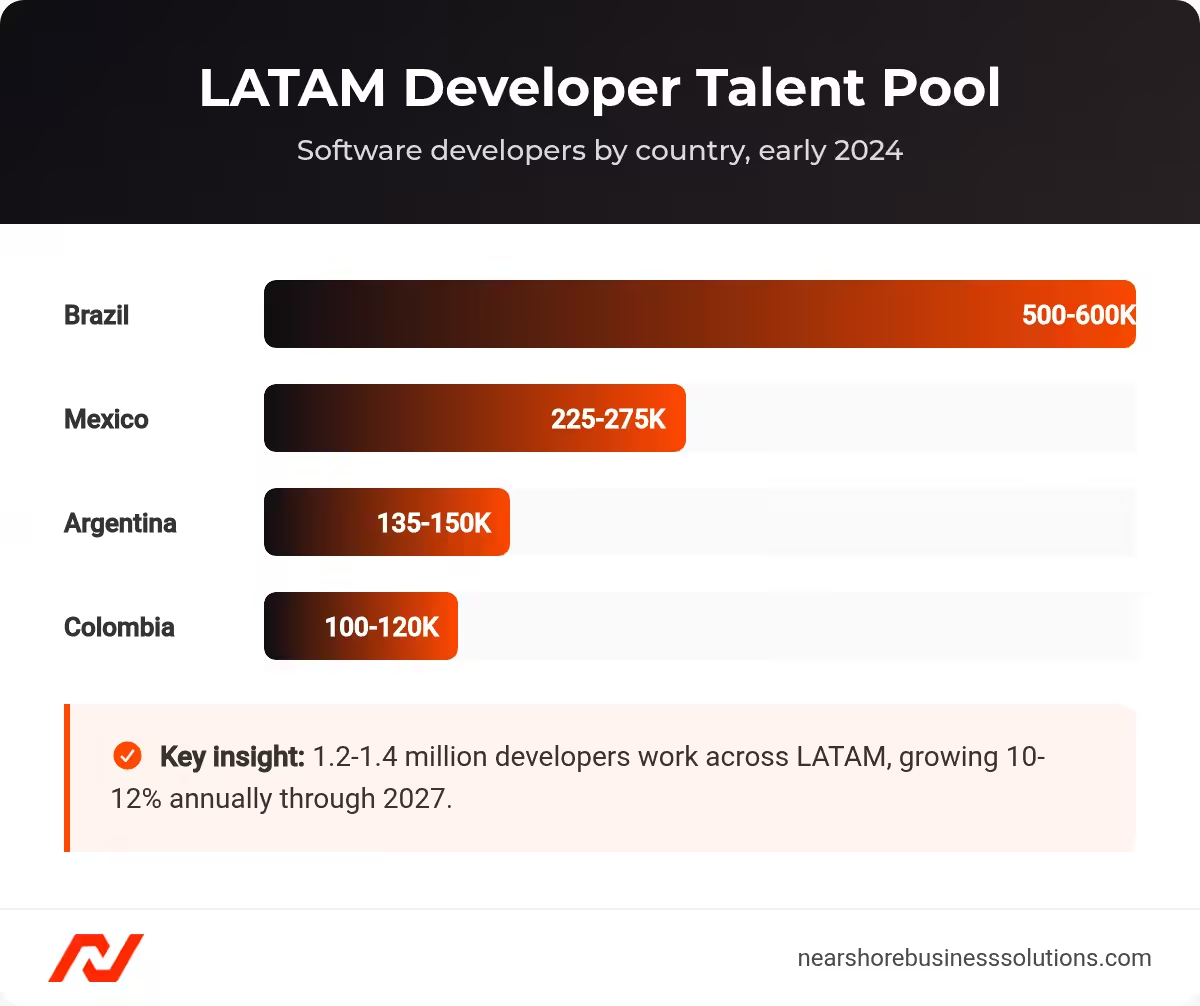
Software developer population across four Latin American countries as of early 2024.
For more on how to vet individual engineers from this pool, see our developer vetting process guide.
What Code Assessments Actually Reveal Skill?
A resume confirms what someone claims to have built. This six-step protocol confirms what they can actually deliver.
- Pair-programming session on your codebase (under NDA). 60-90 minutes in your IDE on a real feature branch. Signal: how quickly they orient to unfamiliar code and whether they write tests before or after implementation. Red flag: cannot navigate without hand-holding or skips tests entirely.
- System design whiteboarding. Present a scaled-down version of an actual design challenge your team faces. Signal: trade-off reasoning. Strong engineers articulate why they chose one approach over another. Red flag: buzzword architectures disconnected from constraints.
- Pull request review exercise. Hand the candidate a real (sanitized) PR containing 2-3 intentional issues: a race condition, a missing edge-case test. Signal: whether they catch the functional bug, the maintainability issue, or both. Red flag: focuses only on style nits.
- CMMI maturity verification. Request the current appraisal certificate and 12 months of delivery data: cycle time, escaped defect rate, sprint completion percentage. CMMI Level 3 is the minimum defensible benchmark. SEI found that Level 3 organizations achieved a median 35% increase in productivity and a 39% decrease in post-release defects. Approximately 150-200 companies across Latin America hold Level 3 or higher.
- CI/CD pipeline walkthrough. Screenshare a live pipeline on an active project. Walk through build triggers, automated test gates, static analysis, deployment targets, and rollback procedures.
- Incident response playbook review. Request three recent post-mortem documents. A partner that conducts blameless post-mortems and tracks remediation items to completion treats reliability as an engineering discipline.
This protocol demands 8-12 hours of your engineering team’s time per finalist partner. That is a fraction of the $50,000-$90,000 cost of a single bad-hire replacement cycle. LATAM nearshore teams achieve 90-100% of US team productivity when properly integrated, significantly higher than typical offshore engagements at 60-75%.
What Stack-Specific Red Flags Should You Watch For?
Ask these questions before a partner submits a single candidate profile. Evasive or vague answers are disqualifying.
- CI/CD maturity: “Walk me through your pipeline stages and average build-to-deploy time.” Strong: specific tooling, automated gates, sub-30-minute deploy times. Weak: “We use Jenkins” with no elaboration.
- Test coverage: “What minimum threshold do you enforce, and how?” Strong: concrete number (80%+ line coverage), pipeline gates that block merges. Weak: “We encourage developers to write tests.”
- Observability: “What SLIs do you track for production services?” Strong: names specific tools and SLIs including p99 latency, error rate, saturation. Weak: “We check the logs.”
- On-call and escalation: “Describe your on-call rotation for a Sev-1 at 3 AM.” Strong: defined rotations, explicit escalation timelines, named incident commander role. Weak: incidents routed to the client’s US team by default.
- Technical debt: “How do you track and prioritize tech debt?” Strong: dedicated backlog, 15-20% of sprint capacity allocated. Weak: “We address it when we have time.”
- Code review standards: “What is your average time-to-review for a PR?” Strong: every PR reviewed by a non-author, median turnaround under 4 hours. Weak: 24-48 hour review cycles or unreviewed code shipped to production.
- Infrastructure as code: “What percentage of your infrastructure is codified?” Strong: Terraform/Pulumi/CDK, codification above 90%. Weak: infrastructure provisioned through console clicks.
A partner scoring below 3 on more than two of these questions lacks the engineering infrastructure your team requires, regardless of their portfolio deck.
How Do You Verify Security, Compliance, and IP Protection?
43% of data breaches in 2023 involved third-party vendors. The average cost of a third-party-originated breach reached $4.76 million (IBM, 2023). For a CTO handing source code and infrastructure credentials to an external team in another jurisdiction, security and IP protection are existential risk vectors.
For an in-depth look at certification requirements, see our guide on nearshore staff augmentation.
What Do SOC 2 and ISO 27001 Actually Tell You?
SOC 2 Type II and ISO 27001 are minimum thresholds, not differentiators. Here is what each covers and what it costs:
| Attribute | SOC 2 Type II | ISO 27001 |
|---|---|---|
| What it is | Attestation report on effectiveness of controls | Certification of information security management system |
| Audit cadence | Annual attestation | 3-year certification with annual surveillance audits |
| Cost to achieve | $25,000-$80,000+ | $20,000-$60,000 |
| LATAM vendor adoption | Less than 15% of all firms; over 50% among US-enterprise-focused firms | 20-25% of mid-to-large IT firms |
A vendor displaying both certifications is table stakes for any deal involving PII or regulated data. Neither guarantees controls apply to your specific engagement. Always request the audit scope document.
Three verification steps: (1) Request the bridge letter confirming no material control changes since the last audit period. (2) Verify the audit scope matches your engagement. A SOC 2 report scoped to the vendor’s internal HR application tells you nothing about your project environment. (3) Confirm the certifying body’s accreditation against the IAF MLA signatory list.
How Do IPRI Scores and Contract Clauses Protect Your Codebase?
The International Property Rights Index scores by country reveal enforcement risk before you sign. The World Bank’s “Enforcing Contracts” indicator sharpens the picture further.
| Country | 2023 IPRI Score (out of 10) | Global Rank (out of 125) |
|---|---|---|
| United States | 7.93 | 10 |
| Brazil | 5.34 | 74 |
| Mexico | 5.28 | 77 |
| Colombia | 5.17 | 81 |
| Argentina | 4.29 | 111 |
Mexico ranked 43rd on contract enforcement, Brazil 49th, Argentina 73rd, and Colombia 177th. Colombian court disputes stretch past 1,200 days on average. That asymmetry makes the contractual layer load-bearing.
Every nearshore engagement contract must include six provisions:
- IP Assignment Clause: All IP belongs exclusively to the client from the moment of creation. Reject “license-back” language. Verify local labor law does not override contractual assignment.
- Confidentiality and NDA: Binding every individual developer, not just the partner entity. Surviving termination by at least 24 months.
- Data Processing Agreement (DPA): Defines data residency, sub-processor approval, 72-hour breach notification, and deletion rights upon termination. Aligns with Brazil’s LGPD and Colombia’s Law 1581 where applicable.
- Choice of Law and Venue: Governance by Delaware or New York law, disputes resolved through US courts or binding arbitration (AAA or JAMS). This single clause neutralizes Colombia’s 177th-place enforcement ranking.
- Code Escrow: Source code with a neutral third party, release conditions defined for bankruptcy or material breach. Cost: $2,000-$5,000 annually.
- Quarterly Audit Rights: Right to audit security controls, penetration test results, and background checks, with third-party auditor access at client discretion.
Resistance on IP assignment, choice of law, or audit rights is a disqualifying red flag regardless of technical scores.
How Do You Assess Talent Stability and Retention?
A team turning over every 9 months never exits the ramp phase. Sprint velocity plateaus at 60-70% of its potential because at least one engineer is always orienting rather than delivering. Domain knowledge evaporates with every departure and rebuilds slowly with every replacement.
What Attrition Benchmarks Should You Demand from a Nearshore Partner?
Developer attrition varies sharply by region. Here are the benchmarks you need to evaluate a partner:
| Region / Source | Annual Developer Attrition | Benchmark Notes |
|---|---|---|
| US Domestic | 15-20% | Baseline comparison |
| LATAM Nearshore | 12-18% | Can be lower in well-managed partner firms |
| India Offshore | 20-30% | Higher due to intense local competition |
| Target for your partner | Less than 15% | Above 20% is a major red flag |
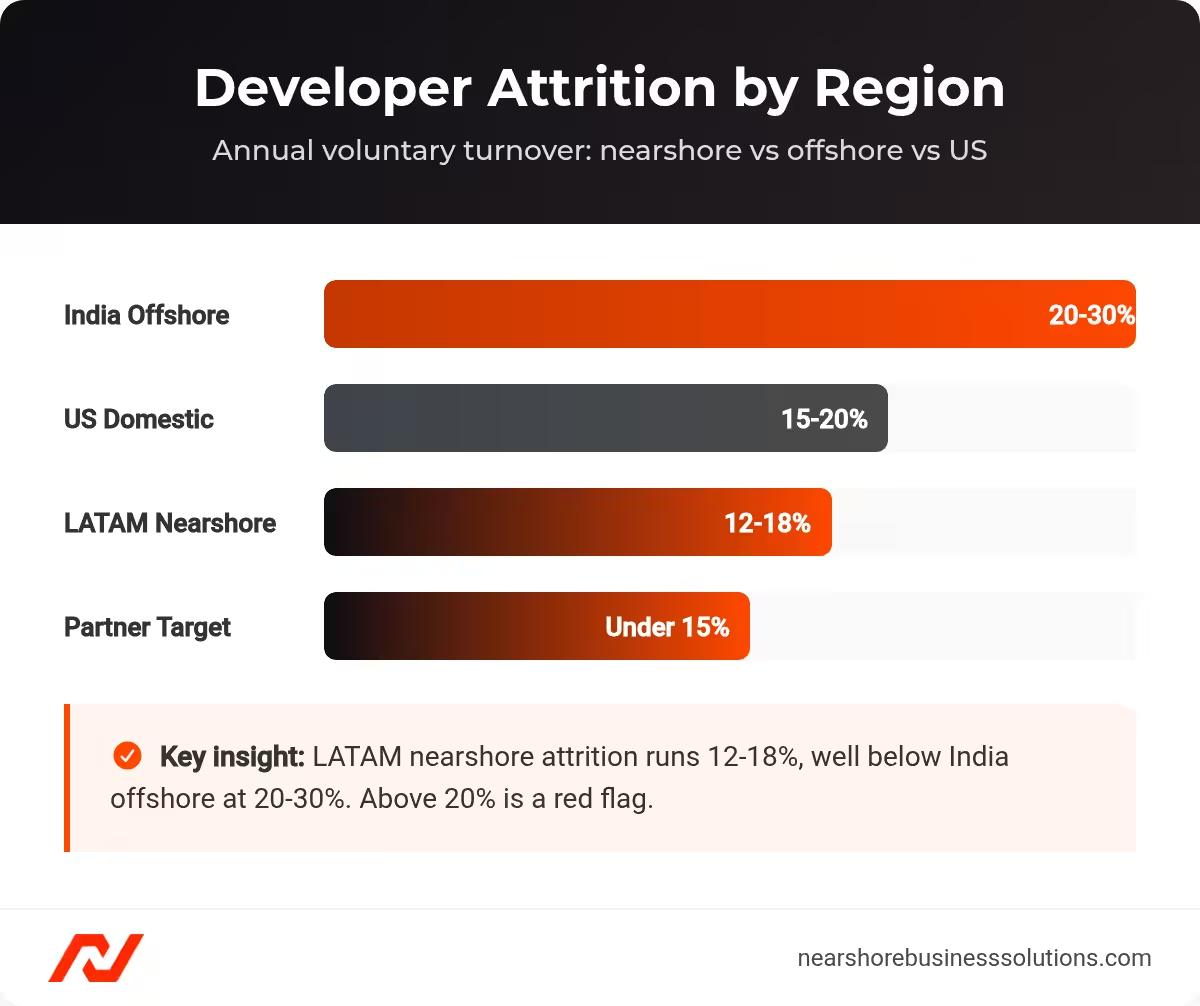
Annual developer attrition benchmarks across nearshore, offshore, and US hiring.
A 2023 global hiring report notes that Argentina, Brazil, and Mexico are among the fastest-growing countries for global hiring. Increased competition drives attrition when partners don’t invest in retention.
Ask for three numbers: annual voluntary attrition rate (target: below 15%), employee Net Promoter Score (target: above +50, where the B2B IT services average is +41 per Retently), and client retention rate (target: 90%+ logo retention, 100%+ net revenue retention). A partner that won’t share these numbers is telling you something.
How Do You Prevent Bait-and-Switch on Staffing?
Contractually require that engineers presented during evaluation staff the engagement for a minimum of 12 months. Include a right to reject replacements below the demonstrated skill level. Require a replacement SLA of equivalent or higher seniority within 10 business days.
Conduct 1:1 interviews with every proposed team member. Verify English proficiency individually. National averages (Argentina: High, Brazil: Moderate, Mexico/Colombia: Low per EF EPI 2023) do not reflect the candidate sitting across the table. An estimated 30-40% of developers in Mexico and Colombia have B2+ English proficiency, but you need to verify individually.
A good nearshore partner presents qualified, pre-vetted candidates in 1-2 weeks and has a developer start in 3-4 weeks, compared to 45-60 days for US-based hiring.
What Should a CTO Ask in the Final Round Before Choosing a Partner?
The final-round evaluation needs a scoring system so your engineering managers assess independently before calibrating together. This reduces groupthink and surfaces disagreements early.
How Do You Score and Weight Evaluation Responses?
Five dimensions, weighted by criticality, determine the go/no-go decision:
| Evaluation Dimension | Weight | Go/No-Go Threshold |
|---|---|---|
| Security and Compliance | 25% | Must score 4 or above; automatic no-go if below 3 |
| Technical Capability | 25% | Must score 3 or above |
| Talent Stability | 20% | Must score 3 or above |
| Cultural Alignment | 15% | Must score 3 or above |
| Commercial Model | 15% | Must score 3 or above |
Minimum overall weighted score of 3.5 to proceed. Any single dimension scoring below its go/no-go threshold is automatic disqualification regardless of overall score.
What Does a Rigorous Reference-Check Protocol Look Like?
Request the last three clients who ended engagements, not just current happy clients. Use back-channel reference checks via LinkedIn mutual connections rather than vendor-provided contacts.
Benchmark against proven outcomes. Blackboard maintained approximately 100 engineers with Encora (formerly PSL Corp) for over 10 years in Medellin. Nextdoor cited a 30% acceleration in product roadmap delivery working with a nearshore partner. Cars.com achieved a 40% increase in feature development velocity with Encora. Ask prospective partners for references of similar scale, tenure, and outcome specificity.
How Do You Structure the First 90 Days to Validate Your Evaluation?
Harvard Business Review research found that distributed teams with at least 4-5 hours of daily overlap were far more effective at resolving complex dependencies. Eastern US teams get 7-8 hours of overlap with Mexico City, Bogota, Buenos Aires, and Sao Paulo. Pacific US teams get 4-6 hours.
Define baseline KPIs in the SOW before day one: target velocity by sprint 4, defect density thresholds, and communication response-time SLAs.
Run a structured 30-60-90 governance cadence:
- 30 Days: Evaluate team ramp progress, tooling integration, cultural friction signals, and communication cadence adherence. Decision: confirm team composition or trigger the personnel substitution SLA.
- 60 Days: Evaluate velocity trajectory against sprint 4 targets, first deliverable quality, and escalation path effectiveness. Decision: adjust engagement model or team size if trajectory is off.
- 90 Days: Evaluate cumulative velocity and defect metrics against SOW baselines, team domain knowledge depth, and stakeholder satisfaction. Decision: continue, renegotiate terms, or exercise the termination-for-convenience clause.
Walking away at 90 days is cheaper than tolerating a bad fit for 12 months. The $50,000-$90,000 per-developer replacement cost established earlier underscores why a clean exit early beats compounding losses.
What Does the Complete Scorecard Look Like?
The complete scorecard covers six dimensions. Score each dimension 1-5, apply the weights above, and require a minimum 3.5 weighted total to proceed.
| Dimension | Key Criteria for “Strong” (Score 4-5) |
|---|---|
| Technical Capability | CMMI Level 3+; live code assessment passed; CI/CD and observability maturity demonstrated |
| Security and Compliance | SOC 2 Type II + ISO 27001 held; audit scope shared; DPA in place |
| IP Protection | IPRI score above 5.0 for country; work-for-hire clause; US choice of law; code escrow |
| Talent Stability | Less than 15% annual voluntary attrition; eNPS above 50; contractual personnel substitution SLA |
| Cultural Alignment | B2+ English proficiency (individually verified); 4+ hours daily overlap; reference-validated collaboration |
| Commercial Model | Transparent pricing; client retention above 90%; NRR above 100%; termination-for-convenience clause |
Hand this scorecard to your VP of Engineering and procurement lead before the next MSA lands on your desk. For recruitment support across LATAM, see our Latin America recruitment services.
Frequently Asked Questions About Evaluating Nearshore Development Partners
These are the most common questions CTOs ask when running their first structured nearshore partner evaluation.
How Long Does It Take to Evaluate and Onboard a Nearshore Partner?
A structured evaluation runs 4-8 weeks from first contact to signed MSA. The live code assessments and reference checks take the most time. Once signed, a good nearshore partner in cities like Medellin, Buenos Aires, or Guadalajara can have pre-vetted developers starting within 3-4 weeks, compared to 45-60 days for US-based hiring.
What If a Developer Doesn’t Work Out After Onboarding?
Your MSA should include a personnel substitution SLA requiring a replacement of equivalent or higher seniority within 10 business days. NBS backs every placement with a 90-day replacement guarantee. If a developer fails to meet expectations within the first 90 days, we source and vet a replacement at no additional cost.
Do I Need a Local Entity to Hire Nearshore Developers?
No. Employer of Record (EOR) structures let you engage LATAM developers legally without establishing a local entity in Colombia, Mexico, Brazil, or Argentina. EOR providers handle local payroll, tax compliance, and labor law obligations. This approach covers most staff augmentation and team-extension use cases.
How Do I Protect My Intellectual Property When Working with a Nearshore Partner?
Your contract must include an IP assignment clause vesting all IP in the client from the moment of creation. Pair it with individual NDAs binding every developer, not just the partner company. Add a choice-of-law clause selecting Delaware or New York jurisdiction. These three provisions together provide strong protection even in countries with lower IPRI scores like Argentina (4.29/10) or Colombia (5.17/10).
What Is the Difference Between Nearshore and Offshore for a US Company?
Nearshore means LATAM-based teams in the same or adjacent time zones: Eastern US teams get 7-8 hours of overlap with Mexico City, Bogota, Buenos Aires, and Sao Paulo. Offshore typically means India or Eastern Europe, where overlap with US teams is 0-4 hours. Nearshore costs more than offshore (LATAM rates run $35-75/hour versus $25-50/hour for India) but LATAM nearshore teams achieve 90-100% of US team productivity versus 60-75% for typical offshore engagements.
How Do I Verify a Partner’s Developer Retention Rate?
Request three data points: annual voluntary attrition rate (target below 15%), employee NPS (target above +50), and client logo retention rate (target above 90%). Ask for the data from the past 24 months, not just the trailing 12. Back-channel reference checks with churned clients, not just active ones, will surface retention problems faster than any questionnaire.
What Certifications Should I Require from a Nearshore Partner?
Require SOC 2 Type II and ISO 27001 at minimum for any engagement involving PII or regulated data. Less than 15% of all LATAM firms hold SOC 2, but over 50% of US-enterprise-focused firms do. Request the bridge letter and verify the audit scope covers your specific project environment, not just the vendor’s internal systems. If you operate in healthcare, also require HIPAA Business Associate Agreement readiness.
Ready to Find a Nearshore Development Partner?
Nearshore Business Solutions sources and vets developers from Bogota, Medellin, Buenos Aires, Guadalajara, and Sao Paulo. We screen for technical skills, English fluency, and US work style fit.
Every placement includes a 90-day replacement guarantee. You receive the first pre-vetted candidates within 3 business days.
Start your partner search and receive pre-screened candidates matched to your evaluation criteria.