
45% of US tech companies now hire international remote employees, up from 28% in 2022 (Rippling, 2024). Global hiring platforms logged 38% year-over-year growth in cross-border hiring contracts. This guide walks HR leads through five steps: sourcing, structured interviews, contractor-vs-employee classification, Employer of Record setup, and 90-day onboarding.
For the principles behind each step, from async communication norms to culture-fit signals, see our remote hiring best practices guide. This article covers execution: the specific channels, interview stages, and compliance decisions for the US-to-Latin-America corridor, where 1.2 million developers now work in US-aligned time zones (Evans Data Corporation, 2023).
Why Is the Remote Hiring Process Different from Traditional Recruitment?
Traditional recruitment follows a linear, single-jurisdiction path: source locally, interview in person, onboard through a standard W-2. Remote hiring, especially across borders, replaces every stage with a harder version. You source from global talent pools instead of metro job boards. You evaluate candidates through async assessments and structured video interviews. You decide contractor-vs-employee classification before you can extend an offer. And you onboard across time zones, currencies, and legal systems.
Three friction points don’t exist in local hiring: time-zone coordination, legal classification that determines tax liability and IP ownership, and culture-fit assessment without physical proximity. Gartner forecasts that 50% of knowledge workers globally will work remotely by 2025, with US companies driving most cross-border hiring. 18.2% of paid US job postings were listed remote in Q1 2024, up from 14.7% a year earlier (LinkedIn Economic Graph). For software engineering roles specifically, 30-35% of US postings are remote-eligible through 2025, per the same LinkedIn data. Skip any one of these three friction points and you get missed syncs, misclassification penalties, or early attrition.
Latin America alone holds 1.2 million software developers as of 2023, a 41% increase from roughly 850,000 in 2020 (Evans Data Corporation). That depth means your ATS configuration, sourcing channels, and compliance routing all differ structurally from domestic hiring. The compliance layer compounds the difference. Contractor hiring grew 25% in 2023, but Employer of Record hiring grew 89% in the same period (per a 2024 global hiring report). An estimated 70% of new full-time international tech hires now route through an EOR to limit classification and labor-law risk.
How Do You Source and Attract Remote Candidates Worth Interviewing?
Sourcing is the stage where process quality determines outcome quality, yet most teams default to the same LinkedIn boolean string they use for domestic roles. Four channels dominate cross-border tech hiring:
- Nearshore recruitment agencies (including NBS): published agency data shows a 15-20% submission-to-hire ratio for pre-vetted candidates, at 20-30% of first-year salary. NBS’s remote talent acquisition service sources across Latin America and presents a shortlist in 3 days on average.
- LinkedIn Recruiter: Software engineers in Latin America accept InMails at a 22% rate, nearly double the 12% global average (LinkedIn Talent Solutions, 2023). Accepted InMails convert to hires 5-8% of the time.
- Regional job boards (Getonboard, Computrabajo, Torre): Hire-through rates run 1-2% of total applicants, but direct postings cost under $300 each.
- Referral networks: Referred candidates hire 55% faster and retain at a 40% higher rate through year one (Zippia, 2024). A $2,000-$5,000 referral bonus costs a fraction of agency fees.
Crafting Job Descriptions That Filter for Remote Readiness
A remote-optimized JD reduces screening volume by 30-40% compared to a generic posting with “remote” appended. Datapeople’s 2024 analysis of 850,000 postings found that JDs specifying async norms and overlap hours received 34% more qualified applicants. Use this table as a direct reference:
| JD Element | What to Include |
|---|---|
| Async Communication Expectations | “Written-first culture. Daily standups via Slack threads, Loom walkthroughs for PRs. Response window: 4 hours during overlap, 24 hours outside.” |
| Required Overlap Hours | “Minimum 4 hours of real-time overlap with US Eastern (e.g., 10 AM-2 PM ET).” |
| Self-Management Indicators | “You break ambiguous tickets into subtasks without waiting for a PM. You surface blockers in writing within 2 hours.” |
| Equipment & Workspace Policy | “Company-configured MacBook Pro shipped to your address, plus a $150/month home-office stipend.” |
| Engagement Type | “Full-time employee via Employer of Record” or “Independent contractor, 6-month initial engagement.” |
| Compensation Transparency | “$75,000-$95,000 USD annually, benchmarked to Latin American senior engineer market rates.” |
Tapping Into Latin America’s Talent Pipeline
Latin America graduates approximately 150,000 CS and engineering students annually: Mexico about 65,000, Brazil about 50,000, Colombia about 20,000, and Argentina about 15,000 (national education ministries, 2023 data). GitHub Octoverse 2023 places Brazil, Mexico, and Colombia in the top 20 countries for active open-source contributors. HackerRank ranks Argentine and Chilean developers in the top 30 globally for algorithm challenges, and Coursera’s 2023 Global Skills Report ranked Argentina #1 in Latin America for technology skills.
A senior full-stack engineer in Colombia or Mexico commands $60,000-$90,000 USD, 40-55% below the $130,000-$180,000 US range (Levels.fyi, Glassdoor, and a 2024 LATAM developer salary report). Both work in the same or adjacent US time zones. Sourcing-to-hire cycle time runs 40-55 days in Mexico, 45-60 in Colombia, 50-65 in Brazil, and 50-70 in Argentina (per 2024 global hiring data). When you need to interview remote candidates in Latin America, a nearshore partner’s pre-vetted pipeline cuts time-to-hire substantially versus self-directed sourcing.
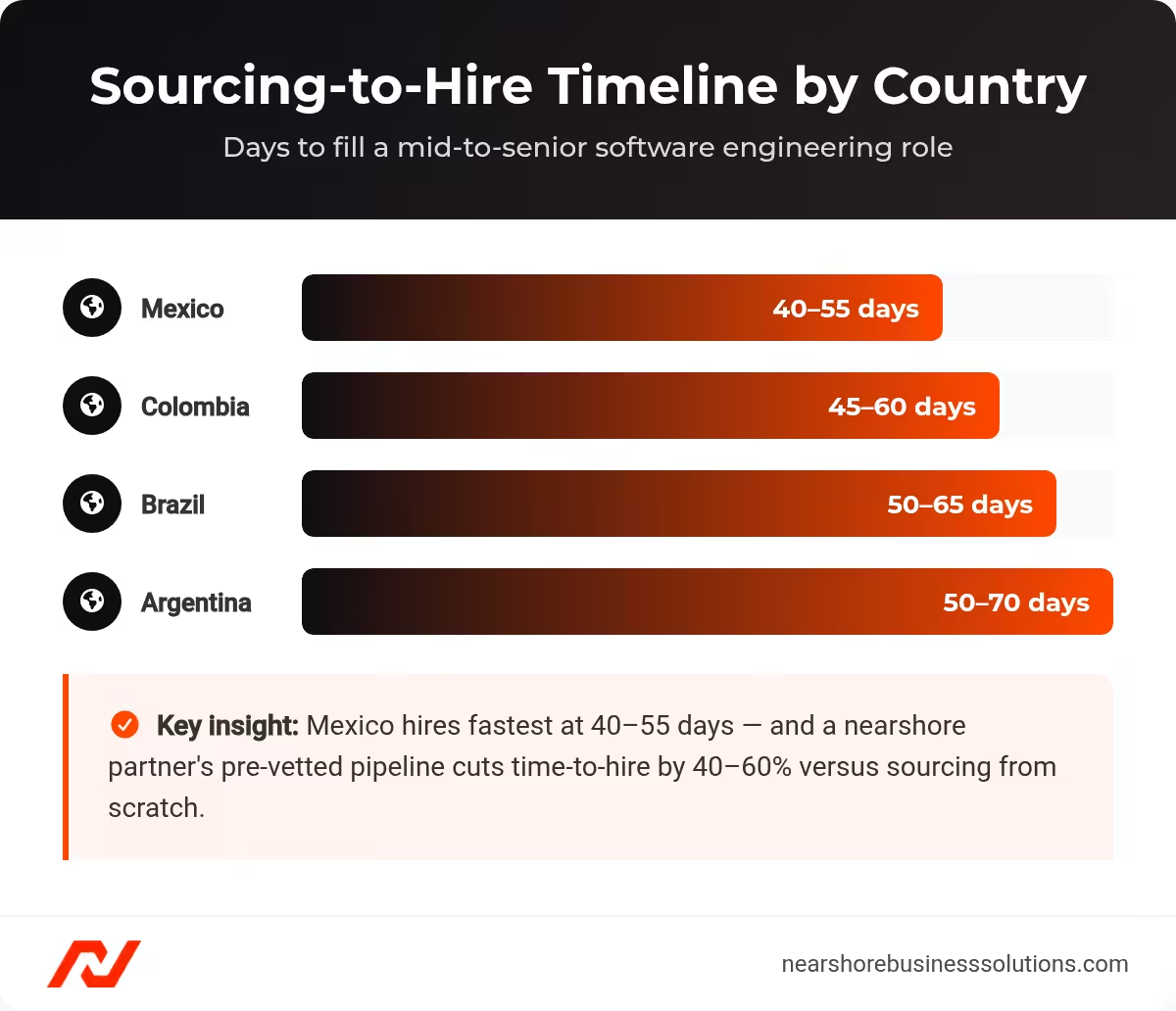
Sourcing-to-hire timelines for software engineers across four Latin American countries.
How Do Structured Interviews Predict Remote Employee Performance?
Unstructured interviews predict job performance at r = .38. Structured interviews predict at r = .51, a 34% improvement that compounds across every hire (Schmidt & Hunter, 1998). That gap widens for remote roles, where interviewers substitute “culture fit” judgments that are really proximity-comfort biases. Google’s Project Oxygen research found that consistent, structured processes with clear rubrics reduced bias and correlated with higher-performing hires.
The framework below adapts Google’s methodology with practices from remote-first companies like GitLab and Automattic:
- Recruiter screen (30 min): Motivation, salary expectations in USD, English fluency check, basic technical fit.
- Hiring manager screen (45 min): Project experience, collaboration style, prior remote operating cadence.
- Async coding challenge (60-90 min): Via HackerRank or Codility. Removes time-zone scheduling friction entirely.
- Live paired programming (60-90 min): Realistic sprint work via CoderPad. This is the most predictive technical stage because it simulates daily remote collaboration.
- Systems design (60 min, senior roles): Via Miro or Excalidraw. Evaluates architectural reasoning and async-friendly communication.
- Values and behavioral interview (45 min): STAR-method questions from a cross-functional interviewer, targeting async communication quality, self-management, and cultural add.
- Offer stage: No new evaluation. The decision was made in the debrief after stage 6.
Each interviewer scores independently before debrief, using a standardized scorecard with five competency dimensions: technical skill, async communication quality, self-management and autonomy, cultural add, and tool and process fluency. Research from the University of Toledo found interviewers form impressions within 10 seconds and spend the rest of the interview confirming that judgment. Independent scoring before discussion eliminates this anchoring bias. Automattic reports that rubric-first evaluation improved interview-to-hire conversion by 25%, with first-year voluntary attrition dropping below 8% versus a 13.2% industry average.
For async assessments, three formats test remote readiness with increasing fidelity. Paid take-home tasks run $50-$150, with 85%+ completion rates versus 50-65% for unpaid tasks (Codility, 2023). Loom video responses evaluate verbal clarity without an interviewer guiding the conversation. Written case analyses mirror the daily reality of remote engineering work. Keep total async time under two hours. Candidate satisfaction drops sharply beyond that mark (published 2023 marketplace research).
Should You Hire a Contractor, Direct Employee, or Use an Employer of Record?
After you select a candidate, the engagement structure determines your legal exposure. This is a business decision with legal consequences.
| Dimension | Independent Contractor | Direct Employee (Local Entity) | Employer of Record |
|---|---|---|---|
| Compliance risk | High if misclassified | Low (you own compliance) | Low (EOR owns compliance) |
| Cost structure | Invoice-based, no benefits | Salary + 35-55% employer burden + entity costs | Salary + employer burden + $499-$650/mo EOR fee |
| Speed to engage | Days | Months (entity setup) | 1-2 weeks |
| IP protection | Requires explicit contract | Belongs to employer by default | Assigned via EOR contract |
| Best for | Defined-scope projects | Large teams in one country (10+) | 1-20 full-time hires per country |
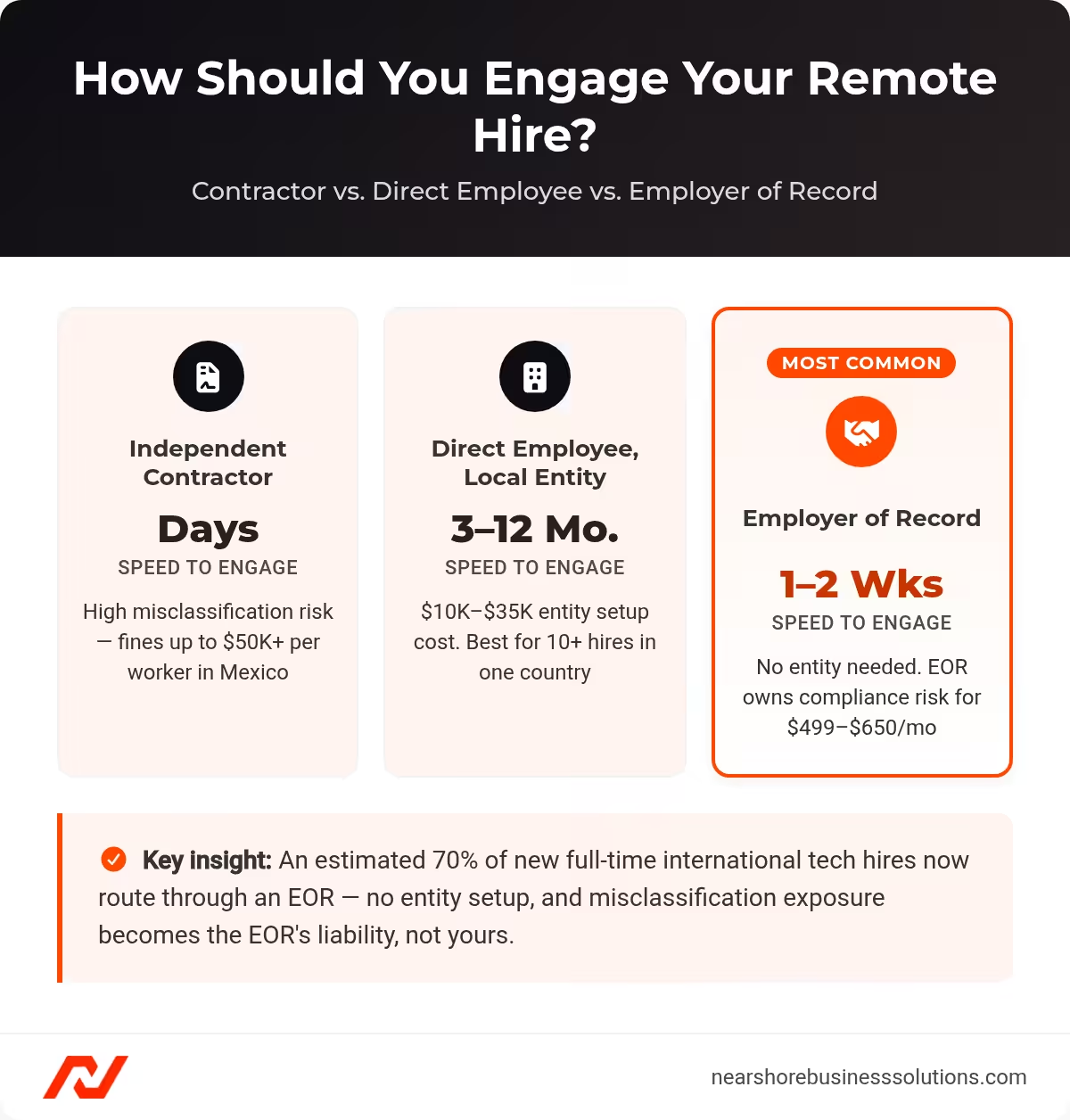
Contractor vs. Employee vs. EOR: engagement speed, cost, and compliance risk compared.
Misclassification stakes are concrete and country-specific. Mexico’s subordination-and-economic-dependence test carries fines up to $50,000 USD per worker plus back pay. Colombia’s subordination test caps lower, up to $12,000 USD per worker, but adds retroactive benefits and legal fees. Argentina and Brazil calculate penalties as 25-100% and up to 40% of unpaid social contributions, respectively (country labor-code penalty provisions, compiled 2024). Labor ministries in Brazil and Argentina increased enforcement audits in 2023-2024, with rulings consistently favoring employee status when control and integration are demonstrated. If the role involves fixed hours, single-client dependency, and company-provided tools, it looks like employment under local law, regardless of what the contract says.
The EOR model has become the default for most US companies hiring full-time internationally. The global EOR market reached $4.43 billion in 2023 and is projected to hit $6.78 billion by 2028 (MarketsandMarkets), with the US-to-LATAM corridor growing fastest. Providers like Deel and Remote maintain their own entities in Brazil, Mexico, Colombia, and Argentina, with onboarding in 1-7 days and fees starting around $599/month. For more on this model, see our guide to Employer of Record in Latin America. Setting up your own local entity takes 3-12 months and costs $10,000-$35,000 depending on jurisdiction (TMF Group, Global Business Complexity Index 2023). It’s justified only once you exceed roughly 20 employees in a single country.
How Do You Onboard Remote Hires So They Stay Past 90 Days?
Organizations with structured onboarding see an 82% improvement in new-hire retention (Brandon Hall Group). Remote employees without explicit milestones default to “prove I’m online” behavior instead of outcome-oriented work.
Pre-boarding checklist (start 2 weeks before Day 1):
- Ship equipment through a global IT logistics provider (Hofy, FirstBase) or coordinate through the EOR.
- Provision all tool access: email, Slack, GitHub, Jira, Notion, VPN, and verify login works.
- Complete all legal paperwork: employment agreement, tax forms, NDA, IP assignment.
- Send a digital welcome packet: org chart, team norms, first-week agenda, onboarding buddy introduction.
- Assign an onboarding buddy in a similar time zone, available for ad-hoc questions during weeks 1-4.
- Schedule Day 1 meetings in advance so the new hire sees a structured calendar on their first morning.
30-60-90 day framework: Days 1-30 focus on learning systems, relationships, and completing a well-defined low-risk first task. Days 31-60 shift to contributing to existing projects with support. Days 61-90 require owning a deliverable independently. For teams using staff augmentation onboarding, this framework integrates with the partner’s existing ramp-up protocols.
What Are the Biggest Mistakes US Companies Make When Hiring Remote Employees?
- Skipping the contractor-vs-employee classification analysis. Misclassification penalties (detailed above) run from $12,000 in Colombia to $50,000+ in Mexico, plus retroactive benefits. Instead: run every international hire through the classification framework before extending an offer.
- Copy-pasting office job descriptions for remote roles. Generic JDs inflate screening volume without improving quality. Instead: embed remote-readiness filters, such as overlap hours, async expectations, and self-management indicators, directly into every posting.
- Relying on unstructured interviews to assess remote fit. Predictive validity of r = .38 drops further when interviewers lack physical-proximity cues. Instead: use a standardized scorecard with remote-specific competency dimensions, scored independently before debrief.
- Treating onboarding as a single-day event. Remote employees without structured milestones churn, and turnover costs run 50-200% of annual salary (SHRM). Instead: implement the pre-boarding checklist and 30-60-90 plan with an assigned buddy and weekly check-ins through Day 90.
- Ignoring state-level and country-level obligations. Even domestic remote hires trigger nexus obligations. International hires add statutory benefits, termination protections, and data-privacy requirements like Brazil’s LGPD. Instead: consult legal counsel or your EOR partner on jurisdiction-specific obligations before extending the offer.
Frequently Asked Questions About Hiring Remote Employees
These are the questions HR leads ask most often once they move past the classification and EOR decision.
How Long Does It Take to Hire a Remote Employee Internationally?
Sourcing-to-hire runs 40-70 days depending on country and role seniority (per 2024 global hiring data), and EOR onboarding adds 1-7 days once you have a signed offer. A nearshore agency partner with an active bench can compress the sourcing phase to as little as 3 days for an initial shortlist.
What Happens If a Remote Hire Doesn’t Work Out?
Most nearshore staffing and EOR partners offer a 90-day replacement guarantee, so a bad match doesn’t cost you a full search over again. Set a 90-day performance checkpoint tied to the onboarding framework above so problems surface before the guarantee window closes.
Do I Need to Provide Equipment for Remote Employees?
Yes, for employees. Ship company-configured hardware through a global IT logistics provider like Hofy or FirstBase, or have your EOR coordinate procurement in-country. Contractors typically use their own equipment unless the contract states otherwise.
How Do I Pay International Contractors and Employees?
Contractors invoice in USD or local currency, and you pay via wire, Wise, or a contractor-payments platform. Employees hired through an EOR are paid in local currency, with the EOR handling payroll tax withholding, social security, and statutory benefits automatically.
What’s the Difference Between Nearshore and Offshore Hiring?
Nearshore hiring, from Latin America for a US company, keeps 0-3 hours of time zone difference, enabling real-time overlap for standups and pair programming. Offshore hiring, from regions like South Asia or Eastern Europe, typically means 8-12 hours of difference and async-only collaboration.
Do I Need a Local Entity to Hire Remote Employees Internationally?
No. An Employer of Record lets you hire full-time employees in a country without incorporating there. A local entity only becomes cost-effective once you exceed roughly 20 employees in a single country.
What English Proficiency Level Should I Require for Latin American Hires?
Most US tech companies require CEFR B2 (upper intermediate) for engineering roles, which corresponds to an EF SET score of 51-60. Argentina posts the region’s strongest general English proficiency, though tech-hub talent in Mexico, Colombia, and Brazil tests well above their national averages.
Ready to Fill Your Next Remote Role?
Nearshore Business Solutions runs remote talent acquisition for US companies: sourcing across Latin America, structured technical and English-proficiency screening, and EOR or contractor routing handled for you. Every placement carries a 90-day replacement guarantee.
Talk to our remote talent acquisition team to build a sourcing-to-onboarding plan for your next remote hire.
Get a free consultation to discuss your hiring needs and receive a custom quote.