
US-LATAM engineering teams need a 4-hour core overlap window and an async-first Slack, Notion, and Loom stack to turn time-zone proximity into real output. LATAM pairings share 4-9 hours of daily workday overlap versus 0-2 for Eastern Europe, but proximity alone does not deliver it.
LATAM pairings deliver 4-9 hours of natural overlap, versus 0-2 hours for Eastern Europe and 0-1 hours for India. Engineers hired through established EOR partners show a 92% twelve-month retention rate, versus roughly 80% in US tech overall (Radford, 2023).
This guide is a practical playbook for VPs of Engineering and CTOs managing distributed teams across Denver, Mexico City, Bogotá, and Buenos Aires. Below, you will find a core overlap window framework, an async-first culture blueprint for Slack, Notion, and Loom, and a 90-day roadmap tied to DORA metrics.
Why Generic Remote Work Tips Fail US-LATAM Engineering Teams
Generic remote-work advice fails US-LATAM teams for one reason: 90% of US tech companies now support some form of remote work (Robert Half, 2024 Salary Guide). Most guidance still assumes one time zone. 38% of those companies operate fully remote. 62% of remote workers say they would leave a co-located role for a remote one (GitLab, 2023). That matters because the engineers you are recruiting from LATAM’s 1.2 million professional software developers (Inter-American Development Bank, 2023) have options. They leave teams that manage them poorly.
LATAM’s time-zone proximity, noted above, is a structural advantage over APAC and Eastern Europe. But overlap alone does not produce results. Without deliberate practices built for cross-Americas collaboration, that proximity decays into the same dysfunction companies see with 12-hour-delta teams.
Why Do 1-3 Time Zone Gaps Still Cause Friction for Near-Shore Teams?
A 1-3 hour time-zone gap causes real friction once you trace it through a sprint cycle. A senior engineer in Austin opens a pull request at 5:02 PM CT. Her reviewer in São Paulo logged off 50 minutes earlier. The PR sits unreviewed for 15-plus hours. The Austin engineer then context-switches back the next morning. That transition costs an average of 23 minutes and 15 seconds of refocus time per interruption (Gloria Mark, UC Irvine).
When synchronous overlap drops below 4 hours, bug resolution time increases by 25%, and teams develop an “us vs. them” mentality (Neeley, Harvard Business Review, 2023). LATAM pairings rarely drop below 4 hours. But many teams never use that overlap strategically. They scatter standups and ad hoc syncs across the full workday instead of compressing collaboration into a protected window.
What Does the 2025-2026 Data Say About LATAM Remote Team Performance?
US companies increased LATAM engineering hiring by 161% in H1 2023 versus H1 2022, making Latin America the fastest-growing hiring region globally (per published global hiring data). Country-level growth: Brazil +192%, Mexico +180%, Colombia +177%, Argentina +165% (per 2024 global hiring platform data). This is not experimental. It is a structural shift in how US companies build engineering capacity.
LATAM engineers hired through reputable EOR partners show the 92% twelve-month retention rate cited above (per 2024 global hiring data), compared to roughly 80% US tech retention (Radford, 2023). Client satisfaction surveys across major nearshore hiring platforms show over 90% of US engineering managers rate their LATAM engineers as meeting or exceeding expectations. The qualifier well-integrated carries the weight. These results come from teams that invested in onboarding, async workflows, and cultural alignment.
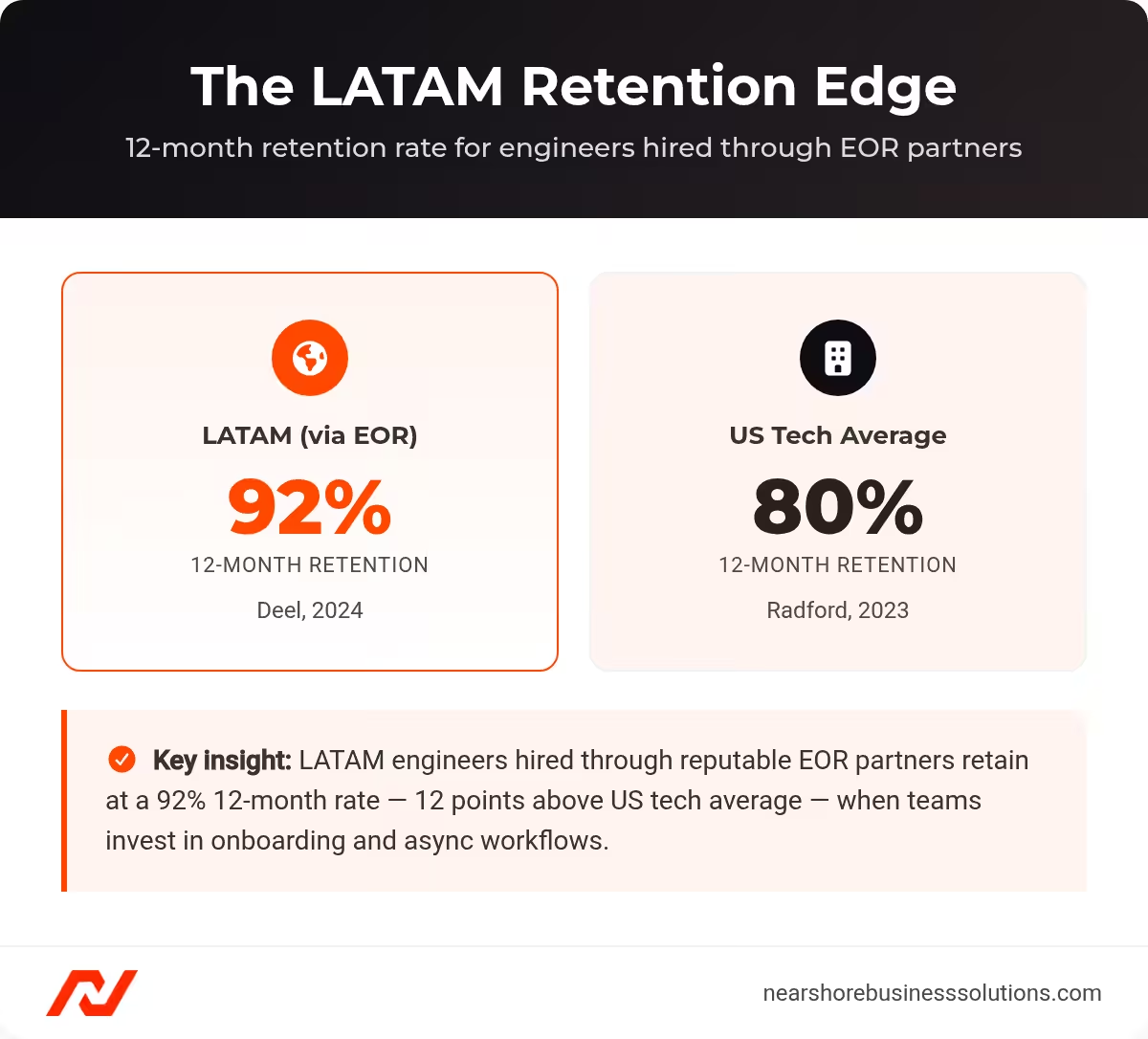
LATAM engineers hired through EOR partners retain at 92%, versus 80% in US tech.
Where Do VP-Level Leaders Hit the Ceiling With LATAM Teams?
Three failure modes account for most underperformance on US-LATAM teams: treating hires like contractors, defaulting to synchronous-everything, and copy-pasting HQ rituals without adapting them.
| Failure Mode | Symptom | Root Cause | Fix |
|---|---|---|---|
| Treating LATAM hires like contractors | Low engagement, high early attrition, exclusion from architecture decisions | Hofstede gap ignored (US Individualism: 91; Colombia: 13; Brazil: 38); no cultural onboarding | See “Onboarding” below |
| Defaulting to synchronous-everything | 2.01 hrs/day lost to performative work (Slack Workforce Lab, 2023) | HQ-centric assumption that presence equals productivity | See “Async-First Culture” below |
| Copy-pasting HQ rituals | Sprint ceremonies clustered in US afternoon, which is LATAM evening; PRs stall at the timezone boundary | No overlap-window audit; retro format assumes real-time candor in high-power-distance cultures | See “Core Overlap Hours” below |
The contractor mindset is the most corrosive of the three. No credible, large-scale study supports the idea that geography determines engineering productivity. Skill, team dynamics, and company processes drive output. That means every failure mode above is fixable through operational design.
How Do You Structure Core Overlap Hours Without Killing Deep Work?
4 hours is the minimum synchronous overlap threshold for distributed teams to stay cohesive (Microsoft Work Trend Index, 2022). Drop below 4, and coordination costs spike. Push above 6, and meeting fatigue compresses focus blocks into fragments too short for real engineering output.
The tightest common US-LATAM pairing, Pacific Time to Buenos Aires, delivers exactly 4 hours of natural overlap. Most pairings exceed it: Pacific Time to Mexico City gets 7 hours, and Eastern Time to Bogotá gets 9. Central Time and Mexico City share an identical time zone, giving a full 9-hour workday overlap. This reveals a counterintuitive problem: most US-LATAM pairings have too much overlap, not too little. That is enough room for a manager to fill every hour with synchronous ceremony.
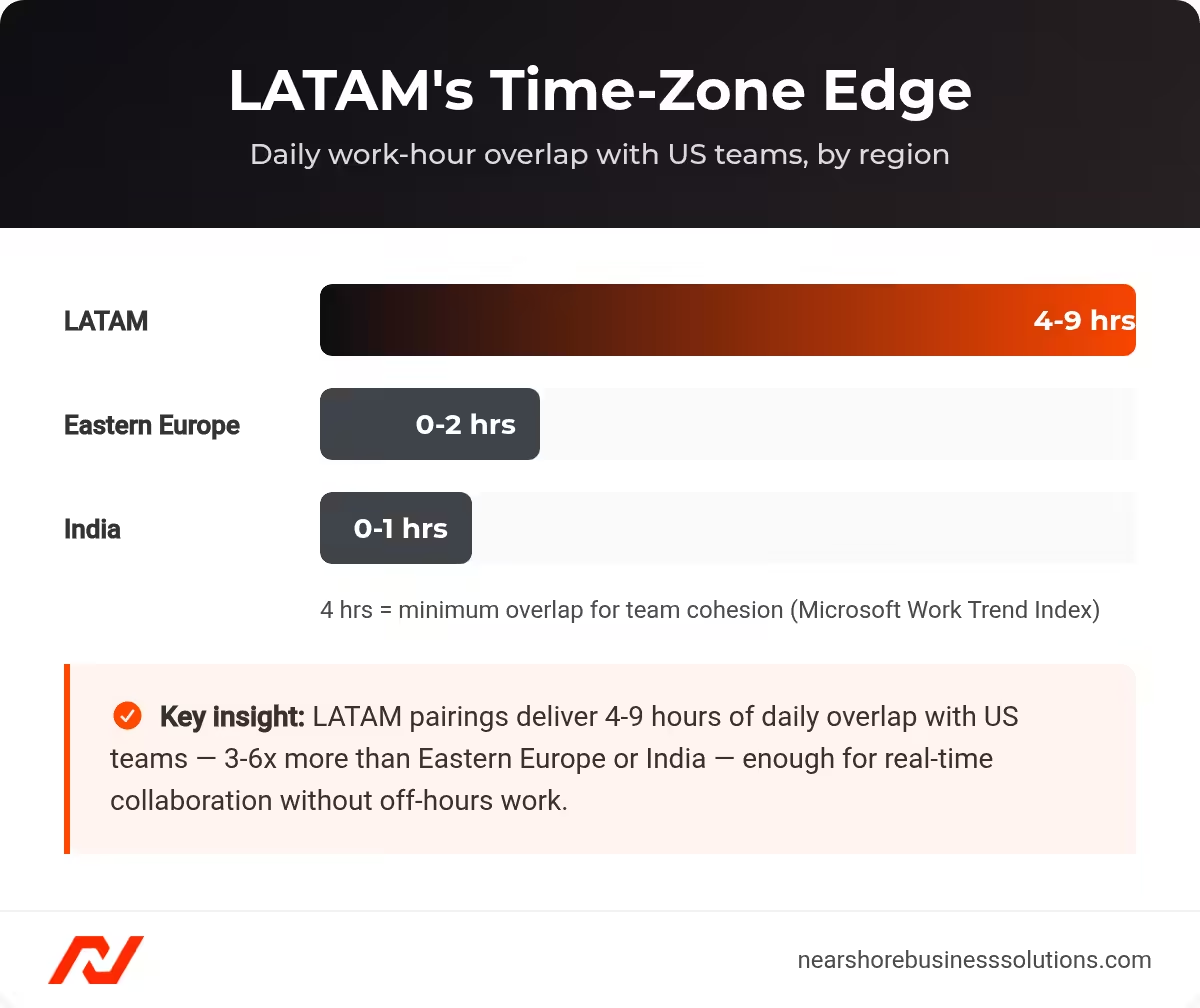
LATAM delivers 4-9 hours of daily overlap with US teams, versus 0-2 elsewhere.
| US Time Zone | LATAM Hub | Overlap |
|---|---|---|
| Pacific (PT) | Buenos Aires (ART) | 4 hours |
| Pacific (PT) | Mexico City (CST) | 7 hours |
| Mountain (MT) | Bogotá (COT) | 7 hours |
| Central (CT) | Mexico City (CST) | 9 hours |
| Eastern (ET) | Bogotá (COT) | 9 hours |
| Eastern (ET) | Buenos Aires (ART) | 8 hours |
The SPACE framework (GitHub, Microsoft Research) identified flow state as a primary driver of both performance and satisfaction. Teams that optimize for time-in-flow see 20-30% reductions in bug rates (GitHub, “The SPACE of Developer Productivity,” 2021). Cal Newport’s deep work framework makes the mechanism explicit: cognitively demanding work needs sustained blocks of 90-plus minutes. A calendar fragmented by three 30-minute syncs does not leave three “free” hours. It leaves six unusable segments.
The fix: compress all synchronous collaboration into a single 4-hour overlap window, and declare every hour outside it a no-meeting zone. For more on protecting individual focus, see our guide on remote work productivity tips.
How Do You Design a 4-Hour Overlap Window That Holds Across Three Cities?
The recommended window is 10:00 AM to 2:00 PM ET. For a Denver, Mexico City, and Buenos Aires team, that maps to 8:00 AM-12:00 PM MT, 9:00 AM-1:00 PM CST, and 11:00 AM-3:00 PM ART. Every configuration falls within normal working hours, and every engineer keeps at least one 3-hour uninterrupted block outside the window.
Three steps turn this into an operating system:
- Audit every recurring meeting. Pull a calendar export for the past 4 weeks. Tag each event as “requires real-time discussion” or “could be async.” In calendar audits across distributed engineering clients, NBS typically sees 40-60% of recurring meetings qualify for async conversion. Replace them with Loom recordings, Notion docs, or structured Slack updates carrying a 4-hour response SLA.
- Force-fit surviving meetings into the 10 AM-2 PM ET band. Standup at 10:15 AM ET, 15 minutes, hard stop. Sprint planning Monday at noon. Retro Friday at 1 PM. If a ceremony does not fit, it is too long, or it should split into an async pre-read plus a 25-minute sync.
- Declare no-meet blocks outside the window, for everyone. The Denver lead cannot schedule a “quick 1:1” at 3:00 PM CST. The Buenos Aires architect does not accept a 4:30 PM ART “optional sync.” Overlap hours belong to the team. Non-overlap hours belong to the individual.
Enforcing the grid. Paul Graham’s “Maker’s Schedule, Manager’s Schedule” essay names the core tension: managers think in 1-hour blocks, while makers need half-day blocks. Configure Clockwise or Reclaim.ai to auto-block focus time outside the overlap window on every engineer’s calendar. Track “fragmented time,” meaning days when focus blocks split into segments under 90 minutes. Internal client data at NBS flags any engineer whose fragmented time exceeds 30% of the week as an organizational design failure, not a personal one. Implement mandatory Slack statuses, a red circle for deep work, a green circle for overlap availability, and a moon for off-hours, to eliminate “green dot anxiety.”
When Should Overlap Hours Flex for Incidents and Launch Weeks?
Overlap hours should flex for two scenarios only: production incidents and release pushes. Both demand controlled, time-boxed flexibility, not a permanent expansion of the window.
Incident response. Use a follow-the-sun on-call rotation that treats LATAM time-zone distribution as a structural advantage. Empower, a fintech with 15 engineers in Colombia, reached 24/7 on-call coverage with minimal handoffs using this model (per a published nearshore platform case study, 2023). Three rules make it work:
- Equal night-hour exposure across all engineers
- Escalation paths that route to whoever is in mid-workday, not the most senior person
- Compensatory time scheduled within the same sprint
Launch week. Extend the window by 1-2 hours for release week, but pre-announce it two weeks in advance. Cap extensions at 5 business days per quarter. If you need more than that, the root cause is thin async documentation or an undertested CI/CD pipeline.
How Do You Build an Async-First Engineering Culture for US-LATAM Teams?
Async-first communication makes written updates the primary mode of work. At GitLab, the handbook-first pioneer, this cuts meeting load about 50% and onboarding time 30% (GitLab Communication Handbook). Synchronous meetings exist only to resolve ambiguity that writing could not. High-performing distributed teams replace daily standups with async updates via Geekbot or Standuply. They reserve one weekly tactical sync, compressing total meeting obligations to roughly 1.5-2 hours per week.
For US-LATAM teams, async-first removes the implicit hierarchy where decisions happen in English, in real time, in rooms LATAM engineers can attend only by giving up personal time. The async stack has three parts: Slack for rapid coordination, Notion for durable documentation, and Loom for visual walkthroughs. For a deeper breakdown, see our guide on remote collaboration tools.
How Do Loom Walkthroughs and Notion RFCs Replace Meetings?
A design review with six engineers costs 6 engineer-hours and produces no searchable record. A 4-minute Loom costs 4 minutes to record and about 13.5 total engineer-minutes to watch at 1.5x speed. Loom’s advantage for US-LATAM teams goes beyond time savings. In relationship-oriented cultures common across LATAM, a Slack message saying “this approach won’t scale” reads as blunt criticism. A Loom preserves tone instead. Text scales information. Video scales rapport.
An anonymous SaaS company, $25M ARR with 10 engineers in Brazil, standardized on Notion and Loom. It realized 55% cost savings per engineer and a $300K annual cut in US contractor spend (per 2024 global hiring data). Stripe’s Developer Coefficient study found engineers lose about 17 hours a week to maintenance work such as bad documentation (Stripe, 2021). New LATAM hires feel that tax harder: they cannot tap a colleague on the shoulder to fill a documentation gap across a time-zone boundary.
Two constraints prevent async bloat. Loom recordings are capped at 5 minutes; longer content splits into a Notion pre-read plus a Loom walkthrough. Notion RFCs are capped at 800 words, with a 48-hour comment window and a published resolution summary at close.
What Slack Hygiene Rules Prevent an Always-On Culture?
Seven organizational rules keep Slack from creating an always-on culture, starting with reserving top-level posts for announcements only.
- Threads only for substantive messages
- Channel prefixes (
#team-,#proj-,#alert-,#social-) enforced at creation - Published SLAs:
#alert-gets a 15-minute response during overlap,#proj-gets 4 hours,#social-has no SLA - No DMs for technical decisions, so the async record exists in a channel
- Status emoji for deep work and off-hours, set automatically on a schedule
- Scheduled send for any message composed outside the recipient’s working hours
- Weekly Slack audit by engineering managers for hygiene and SLA compliance
Rules 5 and 6 normalize boundaries as a system feature. When every engineer, including US-based managers, visibly sets off-hours statuses and schedules messages, the team learns that offline time is expected. This signal sustains the retention advantage described above. LATAM engineers from collectivist cultures will not proactively assert boundaries, but they will quietly disengage when boundaries are violated.
How Do You Make Async Decisions Stick Without Relitigating in Sync Meetings?
You make async decisions stick with a decision-lock protocol: document the call in Notion, open a 48-hour comment window to all engineers, then lock it. The most corrosive pattern on US-LATAM teams is a decision made asynchronously in Notion that gets overturned in a sync meeting only HQ-based people attend.
Reopening a locked decision requires a new RFC with new evidence, not a hallway conversation. Zapier operates on this principle at scale and reports retention above 90%, attributed partly to this documentation-first approach that prevents HQ bias (Zapier Blog).
Track compliance with a standing retro question: were any locked decisions overturned in a sync meeting this sprint? Two consecutive sprints at zero signals the protocol has taken hold. Teams that reach that steady state see a shift: LATAM engineers author more RFCs, not fewer. They trust their written contributions will not be overridden by whoever shows up to a Thursday afternoon call.
What Does a 90-Day Roadmap to US-LATAM Remote Team Best Practices Look Like?
A 90-day roadmap has two phases. Month 1 sets the overlap window and Slack rules. Months 2-3 scale async onboarding and DORA metrics tracking. Nextdoor used this phased approach to cut its average time-to-hire from 90 days to 45 days by using an EOR partner for hiring and compliance (per a published 2023 case study).
What Happens in Month 1: Audit, Overlap Window, and Slack Rules?
- Audit every recurring meeting. Kill or compress anything outside the 10 AM-2 PM ET band.
- Declare the 4-hour core overlap window and publish it to all-hands.
- Ship all seven Slack rules with channel naming, SLAs, and scheduled-send enforcement.
- Deploy Clockwise or Reclaim.ai to auto-protect focus time on every engineering calendar.
- Configure async standups via Geekbot or Standuply.
- Engage an Employer of Record partner to speed up hiring, compliance, and benefits setup.
What Happens in Months 2-3: Async Onboarding, Loom Workflows, and DORA Dashboards?
Layer in a 30-day async onboarding playbook:
- Week 1: tooling access and culture docs
- Week 2: paired tickets with a US-based buddy
- Week 3: a first solo PR
- Week 4: a first async Loom demo
Empower’s buddy system increased engineering velocity by 25% within six months (per a published nearshore platform case study, 2023). Nextdoor’s pod-based integration model achieved 95% LATAM retention over two years (per a published nearshore platform case study, 2023). For more on structuring this phase, see our guide on how to manage a remote team.
Instrument DORA metrics: deployment frequency, lead time, change failure rate, and time to restore, plus PR cycle time as your async health indicator. Heroku paired US architects with 20-plus senior Argentinian engineers and established 4-5 hours of daily overlap. The result: a 40% cut in time-to-market and roughly 50% cost savings (per a published nearshore platform case study, 2023).
The ROI compounds. Hiring five senior LATAM engineers costs roughly $100,000 fully loaded each, versus $210,000 for a comparable US Tier-2 hire. That gap saves about $550,000 a year on salary alone (per 2024 published LATAM salary guides). Add roughly $100,000 in recruiting and setup fees, and Year 1 ROI reaches approximately 450%. Teams that invest in async infrastructure in Q1 see measurable velocity gains by Q3. That gain is not from hiring cheaper engineers. It comes from building the operating system that lets distributed talent perform at full capacity.
Frequently Asked Questions About US-LATAM Remote Work Best Practices
These are the questions VPs of Engineering and CTOs ask most often when building a distributed US-LATAM team.
How Long Does It Take to Set Up Core Overlap Hours for a New US-LATAM Team?
It takes about 30 days. The Month 1 phase above covers auditing meetings, declaring the 4-hour window, and shipping Slack rules, all of which can ship inside a single sprint cycle.
What Is the Difference Between Nearshore and Offshore Remote Engineering Teams?
Nearshore LATAM teams deliver 4-9 hours of daily overlap with US time zones, versus 0-1 hours for India and 0-2 hours for Eastern Europe. That gap is why LATAM pairings support real-time pairing and same-day PR reviews, while offshore pairings depend almost entirely on async handoffs.
Do LATAM Remote Engineers Need to Work US Hours?
No. LATAM engineers only need to be available during the shared 4-hour core overlap window described above. The rest of the day belongs to protected deep work, on their own local schedule.
How Do You Pay LATAM Engineers on a Distributed Team?
Most US companies pay LATAM engineers through an Employer of Record like Deel. The EOR handles local payroll, taxes, and statutory benefits, and typically activates within 2-4 weeks of signing.
Do You Need a Local Legal Entity to Hire LATAM Engineers?
No, you do not need a local entity. An EOR partner employs the engineer on your behalf in their home country, which removes the legal exposure of misclassifying a contractor.
What Tools Should a US-LATAM Remote Team Use for Async Communication?
Use Slack for rapid coordination inside the overlap window, Notion for durable documentation and RFCs, and Loom for video walkthroughs capped at 5 minutes. Together they form the async stack described above.
What Happens if the Core Overlap Window Doesn’t Fit an Engineer’s Time Zone?
You flex it, but only for incidents or launch weeks, following the rules in the section above. A permanent mismatch usually means the wrong hub city was chosen. Re-run the overlap matrix before adjusting individual schedules.
Ready to Build Your US-LATAM Engineering Team?
Nearshore Business Solutions sources and vets developers across Latin America. We screen for technical skills, English fluency, and US work style fit.
Every placement includes a 90-day replacement guarantee, and you receive your first pre-vetted candidates within 3 business days.
Get a free consultation to discuss your hiring needs and receive a custom quote.