Nearshore outsourcing delegates software development and IT work to teams in nearby countries that share your time zone band, cutting senior engineering costs 50 to 60 percent while keeping 6 to 9 hours of daily overlap. For U.S. companies, that means Latin America: a market projected to reach $139.40 billion by 2029 (Statista, 2024).
The global IT outsourcing market reached $617.68 billion in 2023 and is projected to hit $1.14 trillion by 2030 at a 9.2 percent CAGR (Grand View Research, 2024). The nearshore segment grows fastest: 38 percent of businesses increased nearshoring activity over 24 months versus 24 percent for offshoring (Proximo, 2023), and 72 percent of IT leaders plan to maintain or increase nearshore staff through 2026 (2023 nearshore outsourcing industry research).
Nearshore outsourcing is no longer a cost play bolted onto the margins of your roadmap. It is a capability decision that determines how fast you ship, how far your budget stretches, and how resilient your team becomes against a single labor market’s constraints. This guide covers what nearshore outsourcing means in practice, how the engagement lifecycle works from first call to integrated team, why the strategic case has strengthened beyond cost savings, when nearshore beats offshore or onshore hiring, what it really costs, and how to run your first 90 days.
What Does Nearshore Outsourcing Actually Mean in 2026?
Nearshore outsourcing is the practice of delegating business processes, particularly software development and IT services, to teams in a nearby country that shares a border, time zone band, or both with the buyer’s home market. For U.S. companies, “nearshore” means Latin America and Canada. The defining characteristics: 0 to 3 hours of time zone difference, strong cultural affinity with North American work norms, and geographic proximity that keeps flights under five hours from most U.S. hubs. Even with a clear definition, misconceptions persist, which our guide 8 myths about nearshoring in Latin America takes on directly.
The term is relative to the buyer. A U.S. CTO partnering with engineers in Colombia is nearshoring. A German VP Engineering staffing a team in Poland is also nearshoring. The constant is proximity: geographic, temporal, and cultural. For U.S. tech companies in 2026, the relevant corridor runs from Monterrey and Mexico City through Bogotá, Medellín, Buenos Aires, and São Paulo. That market is projected to reach $139.40 billion by 2029, growing at an 8.31 percent CAGR from its $93.35 billion 2024 base (Statista, 2024).
Shared working hours change how teams operate, not just when they meet. A product manager in Austin and a backend engineer in Bogotá share the full 9-to-5 window. Contrast that with Bangalore, which overlaps with U.S. Eastern for roughly 2.5 hours and with Pacific for effectively zero. Cultural alignment compounds the advantage: Latin American engineering culture emphasizes direct communication, collaborative problem-solving, and Agile fluency. USMCA, the U.S.–Mexico–Canada trade agreement, includes dedicated digital trade provisions that prohibit data localization requirements, enforce IP protections aligned with U.S. standards, and eliminate customs duties on digital products.
Most mature nearshore engagements run a hybrid model: an onshore technical lead embedded with the U.S. product team, supported by a nearshore squad of three to six engineers handling core development. This structure preserves strategic control on the U.S. side while concentrating execution capacity in LATAM.
How Does Nearshore Fit on the Spectrum Between Onshore and Offshore?
Three models offer three trade-off profiles. For a deeper analysis, see our Nearshore vs Offshore comparison.
| Dimension | Onshore | Nearshore | Offshore |
|---|---|---|---|
| Time Zone Overlap with US | Full (same zone) | 7–9 hours shared | 0–2.5 hours |
| Typical Cost (senior engineer, annual fully burdened) | $206K–$231K | $80K–$110K (via vendor) | $40K–$70K (via vendor) |
| Communication Friction | Low | Low | High |
| Cultural Alignment with US Teams | High | High | Medium to Low |
| IP Protection & Legal Framework | Strong | Strong (USMCA for Mexico/Canada; WIPO-compliant for Colombia/Argentina) | Variable |
| Talent Pool Depth | Deep but competitive; 1.4M unfilled US tech roles | 1M+ LATAM developers, 15% YoY growth | Very deep; India alone has 5M+ developers |
| Travel Accessibility | Domestic flights | 3–5 hour flights | 15–24 hour travel |
| Best For | Leadership roles, security-sensitive workstreams | Core product engineering, full-squad augmentation | Large-volume QA, maintenance, async workflows |
Which Regions and Talent Corridors Matter Most?
Latin America now hosts over 1 million professional software developers, with 15 percent year-over-year growth (SlashData, Q1 2022). The region produces more than 1.3 million STEM graduates annually (UNESCO, 2022). If you are building a dedicated squad, our nearshore IT staffing service sources across all four primary corridors below.
| Country | Developer Count | Kearney GSLI Rank | Key Strengths | Time Zone vs US Eastern |
|---|---|---|---|---|
| Brazil | 500,000+ | #6 | Largest LATAM pool; “Competitive” technology skills (Coursera 2023) | ET −1 to −2 hrs |
| Mexico | 225,000+ | #8 | USMCA-aligned; Central Time; growing Monterrey/Guadalajara hubs | ET −1 hr |
| Argentina | ~135,000 | #14 | #11 globally in algorithms (HackerRank); high English proficiency (#28 EF EPI) | ET +1 hr |
| Colombia | ~100,000 | #12 | Full ET overlap; fastest-growing U.S. nearshore destination | ET ±0 hrs |
How Does Nearshore Outsourcing Work, From First Call to Integrated Team?
A structured nearshore engagement compresses the entire cycle, scoping through first productive sprint, into 6 to 10 weeks for a full team of 3 to 5 engineers, with the first hire typically starting within 3 to 6 weeks.
- Scoping & Requirements Definition (1–2 weeks). Document roles, tech stack, seniority levels, team size, and engagement model. A strong partner will pressure-test these inputs before sourcing begins.
- Vendor Selection & Shortlisting (1–2 weeks, can overlap). Evaluate 2–3 partners against technical vetting rigor, cultural-fit screening, 12-month retention rate, and pipeline speed.
- Candidate Sourcing & Vetting (5–10 business days). The vendor presents pre-vetted candidates who have cleared technical assessments, English proficiency checks, and reference verification.
- Interviews & Offer (1–2 weeks). Your team runs live technical interviews using the same bar you would apply to a domestic hire. LATAM notice periods average 2–4 weeks.
- Onboarding & Integration (2–4 weeks). Engineers gain access to Slack, Jira, repos, and CI/CD pipelines on day one. First productive output lands within the first or second sprint.
- Scaling & Continuous Delivery (6–10 weeks total). A full squad reaches steady-state sprint velocity by week 8 to 10.
What Are the Main Nearshore Engagement Models?
Four engagement models cover the vast majority of nearshore work, each tuned to a different control and duration profile.
| Model | Best For | Duration | Control | Pricing |
|---|---|---|---|---|
| Staff Augmentation | Filling skill gaps, scaling quickly | Ongoing | High (you manage) | T&M monthly/hourly |
| Dedicated Teams / BOT | Long-term product work, new products | 1–2+ years | Shared | Monthly retainer |
| Project-Based | Well-defined standalone projects | Fixed | Low (vendor manages) | Fixed-price or T&M |
| EOR | Hiring LATAM talent without local entity | Ongoing | High (you manage) | EOR fee + compensation |
Most VP-level buyers start with staff augmentation to validate the model, then graduate to dedicated teams once retention and velocity benchmarks prove out.
How Does Time Zone Overlap Transform Collaboration and Sprint Velocity?
Six to nine hours of daily overlap is not a scheduling convenience. It is a structural advantage that LATAM corridors clear against both U.S. coasts, while Bangalore manages only 0 to 2.5 hours.
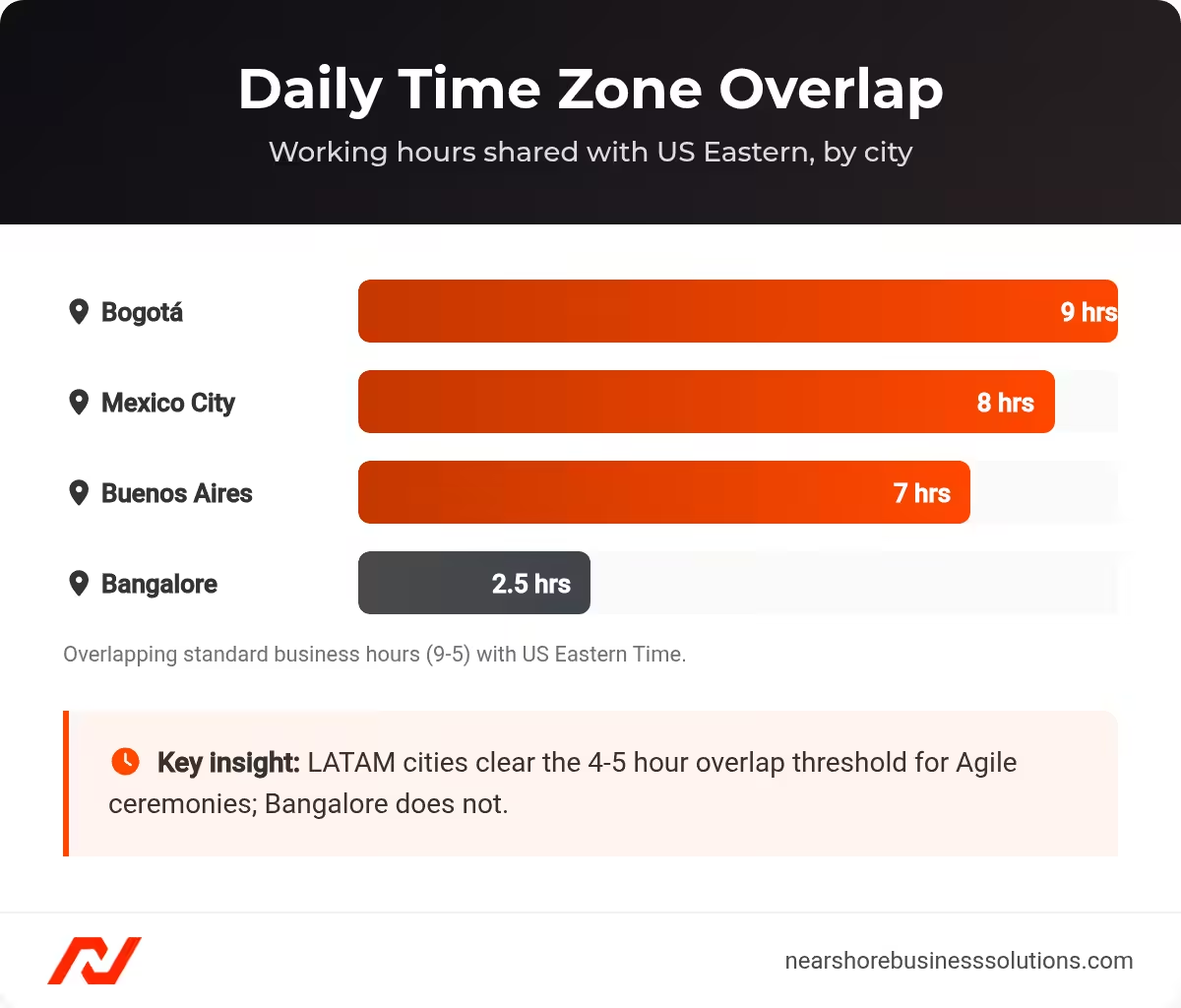
Daily time zone overlap with US Eastern Time across LATAM cities versus Bangalore.
| Your Location | LATAM City | Overlapping Hours |
|---|---|---|
| US Eastern | Bogotá | 9 hours (full day) |
| US Eastern | Mexico City | 8 hours |
| US Eastern | Buenos Aires / São Paulo | 7 hours |
| US Pacific | Mexico City | 7 hours |
| US Pacific | Bogotá | 6 hours |
| US Eastern | Bangalore | 2.5 hours |
| US Pacific | Bangalore | 0–1 hour |
The impact shows up in three places. First, standup cadence: a 9:30 AM ET standup includes every LATAM engineer without anyone joining before breakfast or after dinner. Second, code review turnaround: a PR opened at 2 PM COT gets real-time feedback instead of adding 12 to 16 hours of latency. Third, bursty collaboration: MIT Sloan Management Review found that short periods of rapid, real-time interaction strongly predict high-performing teams (“The New Science of Great Teams,” 2012). Engineering leaders consistently cite a minimum of 4 to 5 hours of daily overlap as the threshold for effective Agile ceremonies, and every primary LATAM corridor clears that bar against both U.S. coasts.
How Does Day-One Onboarding and Integration Work?
High-performing nearshore partners run onboarding with four components. First, access provisioning before the start date (Slack, Jira, GitHub, CI/CD, VPN). Second, embedded participation in the same channels, ceremonies, and boards as domestic team members. Third, tech stack compatibility that eliminates tooling friction; the most common stacks across LATAM (JavaScript, Python, Java, TypeScript, Node.js, React, SQL, AWS) mirror U.S. adoption patterns per Stack Overflow’s 2023 Developer Survey. Fourth, structured first-sprint goals designed to produce a merged PR within the first week. A well-onboarded nearshore engineer becomes indistinguishable from a domestic team member in daily workflow within 30 days.
Why Are Engineering Leaders Shifting Strategy Toward Nearshore in 2026?
Ninety percent of companies rated their outsourcing relationships as successful in a 2023 outsourcing industry report, with productivity and quality, not just cost, cited as the primary metrics. For a deeper treatment of the upside, see our guide to nearshore outsourcing benefits. The strategic case starts with the decision every engineering leader faces quarterly: open headcount that stalls the roadmap versus budget constraints that cap team size. Nearshore resolves both sides simultaneously.
How Does Nearshore Compress Time-to-Productivity From Months to Weeks?
The average U.S. software engineering hire takes 45 to 60 days from requisition to accepted offer (2024 developer-marketplace hiring data). Add notice periods and onboarding ramp, and a single senior hire reaches full productivity in four to five months. LATAM nearshore hiring through a vetted partner compresses that to 21 to 30 days, a 40 to 50 percent reduction (2024 developer-marketplace hiring data).
NextRoll cut its average time-to-hire from over 90 days to 21 days using staff augmentation with senior Ruby on Rails developers in Latin America, with engineers contributing to core product development from their first sprint (published nearshore staffing case study). Zapier scaled from zero to 15-plus nearshore engineers in Colombia within 12 months, maintaining code quality and velocity benchmarks (PSL/Encora Case Study).
The throughput math: a domestic process filling four senior roles in six months delivers roughly 24 engineer-months by year-end. The same four roles filled nearshore in eight weeks deliver approximately 40 engineer-months, a 67 percent increase in productive capacity.
How Do You Measure Nearshore ROI Beyond Cost Savings?
A senior LATAM engineer through a staff augmentation vendor bills at $7,000 to $9,500 per month all-inclusive (reflecting a 35 to 60 percent vendor markup over direct compensation), translating to roughly $45 to $75 per hour fully loaded. The equivalent U.S. engineer costs $150 to $200 per hour when you factor salary, benefits, equity, recruiting fees, and overhead. For a deeper breakdown of engagement pricing, see our nearshore staff augmentation service.
NextRoll’s 55 percent cost savings (published nearshore staffing case study) did not just reduce burn. It funded additional engineering capacity. The budget that covers three domestic senior engineers covers six to seven nearshore engineers at equivalent seniority. But hourly rate comparisons are an input metric. The output metric that matters is cost-per-delivered-story-point. A nearshore senior engineer delivering 18 to 22 story points per sprint at $8,500 per month produces each point at $387 to $472. A domestic engineer delivering the same points at $19,000 per month produces each at $864 to $1,056, more than double the unit cost for identical throughput.
Technical rigor underpins these economics. Argentina ranks 11th globally in algorithms on HackerRank. Brazil scores “Competitive” in technology skills overall in Coursera’s 2023 Global Skills Report, with particular strength in Software Engineering, Cloud Computing, and Data Analysis. South American learners on Coursera show standout performance in these domains, evidence that the region’s engineering pipeline produces practitioners, not just graduates.
How Does Nearshore Reduce Engineering Concentration Risk?
When 100 percent of your engineering capacity sits in the U.S., you are exposed to one labor market’s wage inflation, one country’s attrition dynamics, and one talent pool’s supply constraints. U.S. tech attrition runs 13 to 15 percent annually. Nearshore partners routinely report sub-10 percent attrition for placed engineers, a gap driven by competitive local-market compensation and dedicated career development (2022 nearshore partner retention data).
Four LATAM countries rank in Kearney’s Global Services Location Index top 15, each with distinct economic profiles and labor market conditions. Distributing nearshore capacity across two or three markets hedges against country-specific risks. Engaging two nearshore partners sourcing from different corridors eliminates single-vendor dependency without fragmenting team culture.
When Should You Choose Nearshore Over Offshore or Onshore?
Deloitte’s 2023 Global Shared Services and Outsourcing Survey found that 76 percent of companies selecting an outsourcing model cited “alignment with business objectives” over “lowest cost” as the primary decision driver. The right model matches the specific constraint you are solving. Teams weighing where nearshoring fits their operating model can review our roundup of nearshoring resources for business efficiency, which covers top destinations and implementation best practices.
Which Model Fits Each Engineering Scenario?
Six common scenarios map cleanly to a recommended model, with real-world examples for each.
| Engineering Scenario | Recommended Model | Why | Real-World Example |
|---|---|---|---|
| Scale by 5 engineers in 30 days | Nearshore staff aug | Speed + control + overlap | NextRoll: 90+ → 21 days time-to-hire |
| Build a new product from scratch | Nearshore dedicated team / BOT | Long-term ownership, option to internalize | Cars.com: Dedicated teams in Colombia, 5+ year partnership |
| Establish a regional engineering hub | Nearshore dedicated center | Strategic presence, talent pipeline | Eventbrite: Mendoza, Argentina center grew to 100+ engineers |
| Hire LATAM talent without entity setup | EOR | Direct management, compliance handled | Gusto: Hired across Mexico and LATAM via EOR |
| Standalone tool with fixed scope | Offshore/nearshore project-based | Bounded deliverable, cost-optimized | Best when collaboration intensity is low |
| Embed a senior architect in leadership | Onshore or nearshore (same TZ) | Full overlap, high-bandwidth communication | Nearshore viable from Mexico City/Bogotá (8–9 hr overlap) |
The dedicated-team trajectory plays out clearly in Mexico. Internet Brands started with a six-person software development squad and scaled it past 230 engineers through a long-term nearshore partnership, all within the same Central Time band that keeps a Monterrey or Mexico City team on the U.S. work rhythm. That growth, from a small pilot to a full regional engineering center, is exactly what the dedicated-team and build-operate-transfer models are designed to support: validate fit with a handful of engineers, then expand into a standing capability without rebuilding the relationship from scratch.
What Decision Criteria Actually Matter?
Six factors determine whether nearshore, offshore, or onshore produces the best outcome.
Collaboration intensity. Teams with high time zone overlap report significantly higher cohesion and satisfaction; temporal distance acts as a measurable drag on performance (Journal of Product Innovation Management, 2011). If your work requires daily synchronous touchpoints, nearshore’s 6 to 9 hours of overlap is the minimum viable model.
English proficiency. EF 2023 EPI national averages (Argentina #28, Brazil #70, Colombia #75, Mexico #89) reflect entire adult populations. Nearshore vendors specifically vet for C1/C2 (Advanced/Fluent) English. Always evaluate individual candidates, not country rankings.
Technical skill depth. Coursera’s 2023 Global Skills Report rates Brazil “Competitive” in technology, with South American learners showing particular strength in Software Engineering and Cloud Computing. Argentina ranks #11 globally in algorithms (HackerRank). LATAM talent concentrates in the same domains U.S. product companies hire for: JavaScript, Python, Java, React, Node.js, and cloud platforms.
IP sensitivity. USMCA provides U.S.-aligned IP and digital trade protections for Mexico and Canada. Colombia and Argentina enforce WIPO-compliant regimes. For HIPAA, SOC 2, or GDPR workloads, this legal alignment matters.
Retention and continuity. Sub-10 percent nearshore attrition versus 13 to 15 percent U.S. tech attrition translates directly to lower re-hiring costs and more predictable sprint capacity.
Cost efficiency. The 50 to 60 percent savings versus U.S. fully burdened costs are real, but they are an input. Measure cost-per-delivered-story-point to validate that savings convert to efficiency, not quality degradation.
What Does Nearshore Outsourcing Cost in 2026?
Nearshore outsourcing costs $80,000 to $110,000 per year for a senior engineer through a vendor, 50 to 60 percent below the $206,000 to $231,000 fully burdened cost of the U.S. equivalent (published 2023 nearshore vendor benchmarks). The number that ultimately matters is not the rate card but the hidden line items and the cost-per-delivered-story-point underneath it.
What Are the Rate Ranges by Role, Region, and Seniority?
Senior-level roles (5 to 8 years experience) span roughly $40,000 to $90,000 across LATAM versus $130,000 to $210,000 onshore. All figures below reflect 2024 data sourced from published global hiring and developer-marketplace data, Glassdoor, Levels.fyi, and vendor market analysis.
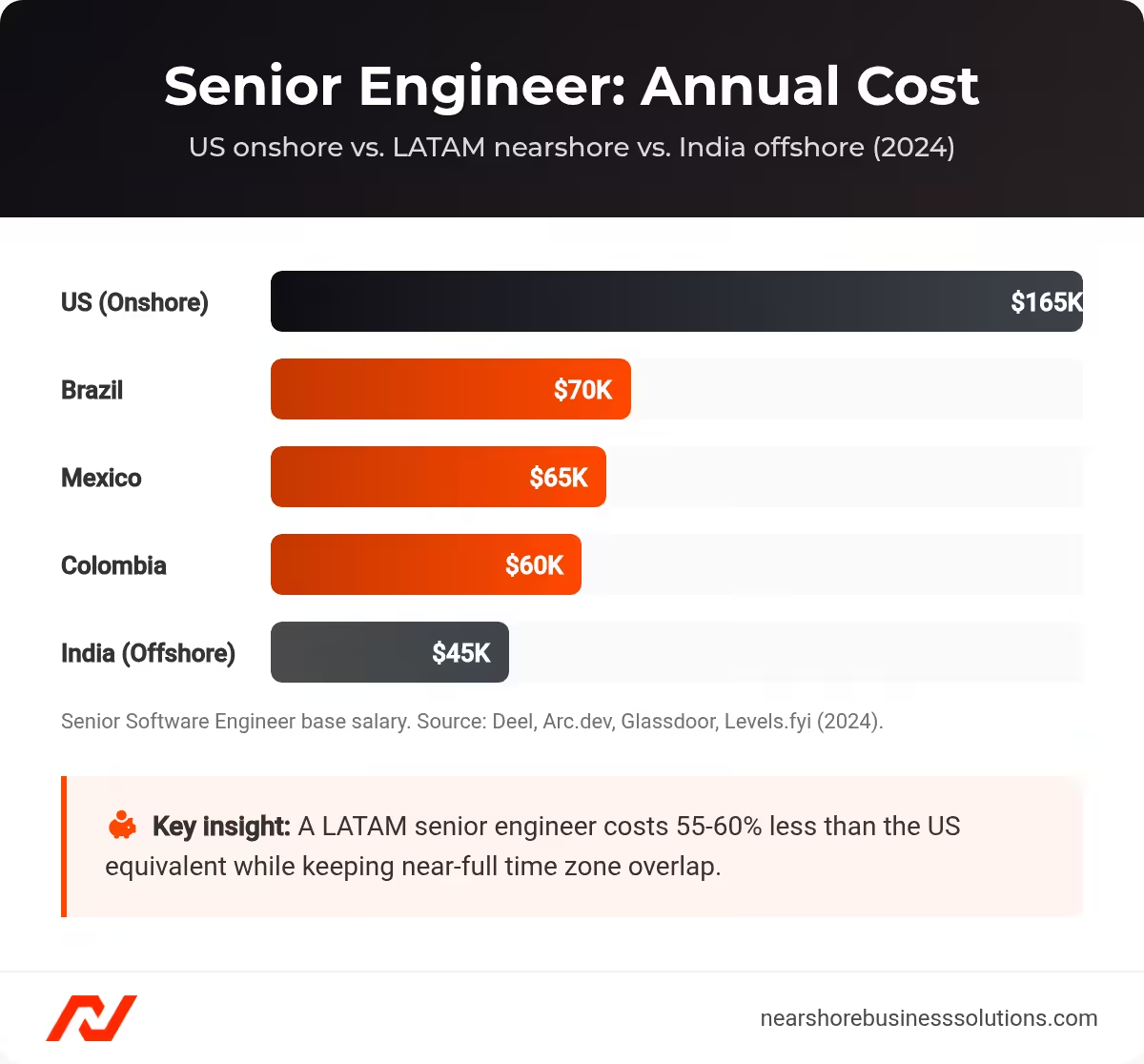
Senior engineer annual cost: US onshore versus LATAM nearshore versus India offshore.
| Role | US (Onshore) | Mexico | Colombia | Argentina | Brazil | India (Offshore) |
|---|---|---|---|---|---|---|
| Senior Software Engineer | $165,000 | $65,000 | $60,000 | $55,000 | $70,000 | $45,000 |
| DevOps / Platform Engineer | $170,000 | $70,000 | $65,000 | $60,000 | $75,000 | $50,000 |
| Engineering Manager | $210,000 | $85,000 | $80,000 | $75,000 | $90,000 | $65,000 |
| QA / SDET Engineer | $130,000 | $50,000 | $45,000 | $40,000 | $55,000 | $35,000 |
| Data Engineer | $160,000 | $68,000 | $62,000 | $58,000 | $72,000 | $48,000 |
| React / Frontend Engineer | $155,000 | $62,000 | $58,000 | $53,000 | $68,000 | $42,000 |
U.S. fully burdened cost runs 1.25x to 1.4x base salary ($206K to $231K for a $165K engineer). LATAM nearshore via vendor: $80K to $110K per year total for a senior engineer. Net savings: 50 to 60 percent versus a direct U.S. hire (published 2023 nearshore vendor benchmarks). Beware bottom-of-market pricing. Rates significantly below these ranges typically signal junior talent marketed as senior.
What Hidden Costs Should You Anticipate?
Four line items sit outside the headline rate card and belong in any realistic total cost of ownership model. Budget for vendor markups (35 to 60 percent over direct compensation, already reflected in $7,000 to $9,500 per month bill rates), ramp-up periods where output runs below steady-state for 2 to 4 weeks, tooling and license costs for additional seats, and travel for in-person kickoffs or quarterly visits.
How Do You Get Started: A VP Engineering’s 90-Day Action Plan
Getting started takes three moves: define measurable success criteria, vet partners against a 10-point checklist, and structure the first 90 days into three 30-day phases. A full squad reaches steady-state velocity by week 8 to 10 when these steps run in sequence.
How Do You Define Scope and Success Criteria First?
Clarify what you are solving for (speed, cost, a specific skill gap) and define measurable success criteria before engaging any vendor. “Three mid-level React engineers onboarded and shipping code within four weeks” is a success criterion. “Explore nearshore” is not.
How Do You Vet Partners on Engineering Culture and Technical Rigor?
A tactical vetting checklist covers ten points, from technical screening through cultural-fit signals.
- Technical assessment process. Ask to see screening methodology and pass rates.
- English proficiency verification. Confirm vetting for C1/C2, not self-reported levels.
- Tech stack alignment. Verify deep experience in your specific stack with portfolio examples.
- Retention data. Ask for attrition rates (benchmark: below 10 percent) and retention mechanisms.
- Client references. Speak with 2 to 3 current clients at similar scale.
- Trial/pilot structure. Best vendors welcome a paid 2 to 4 week pilot before full commitment.
- Onboarding process. Evaluate whether they have a documented playbook or treat integration as ad hoc.
- Security and compliance. Review SOC 2 compliance, NDA frameworks, IP assignment clauses.
- Scaling flexibility. Confirm 30-day notice periods and bench depth.
- Cultural fit signals. Do their engineers ask good questions during initial calls?
How Do You Structure the First 90 Days for Compounding Momentum?
Three 30-day phases move a nearshore squad from first ticket to a data-driven scaling decision.
Days 1–30, Onboarding and First Tickets. Complete integration: shared Slack channels, repo access, Jira boards, team norms. Target: first PR merged, first standup attended, first sprint commitment delivered. Success signal: nearshore engineers are indistinguishable from internal team in daily workflow.
Days 31–60, Increasing Ownership and Velocity Measurement. Nearshore engineers take ownership of features, not just tickets. Begin measuring delivery velocity: story points per sprint, cycle time, PR review turnaround. Full team productivity is typically reached in this window.
Days 61–90, Full Integration and Retrospective. Conduct a formal retrospective on the engagement model. Evaluate whether to scale, shift models, or maintain current state. Success signal: a clear data-driven case for continuation or expansion, the trajectory Cars.com followed when it grew a nearshore partnership into a 5-plus year platform modernization program.
Frequently Asked Questions About Nearshore Outsourcing
How long does it take to hire a nearshore developer?
A vetted nearshore partner presents pre-screened candidates in 5 to 10 business days, with the first hire typically starting within 3 to 6 weeks. That compares to 45 to 60 days just to reach an accepted offer through a domestic process (2024 developer-marketplace hiring data).
What is the difference between nearshore and offshore outsourcing?
Nearshore uses teams in nearby countries with 6 to 9 hours of daily time zone overlap, while offshore uses distant markets like India with only 0 to 2.5 hours of overlap. Nearshore costs more per hour ($45 to $75 versus $30 to $50) but reduces communication friction and code-review latency.
Do I need to set up a local entity to hire in Latin America?
No. An Employer of Record (EOR) model lets you hire and directly manage LATAM engineers without establishing a local entity, while the EOR handles payroll, benefits, and compliance. Staff augmentation through a vendor also requires no entity on your side.
How much can I save with nearshore outsourcing?
U.S. companies typically save 50 to 60 percent versus a fully burdened domestic hire (published 2023 nearshore vendor benchmarks). A senior LATAM engineer runs $80,000 to $110,000 per year all-in through a vendor, versus $206,000 to $231,000 fully burdened for the U.S. equivalent.
What if a nearshore developer does not work out?
Reputable vendors offer paid 2 to 4 week pilots and 30-day notice periods, so you can validate fit before committing long term. Nearshore partners also report sub-10 percent annual attrition, well below the 13 to 15 percent rate for U.S. tech roles (2022 nearshore partner retention data).
Which Latin American countries are best for nearshore engineering?
Brazil (500,000+ developers), Mexico (225,000+), Argentina (~135,000), and Colombia (~100,000) all rank in Kearney’s Global Services Location Index top 15. Colombia offers full U.S. Eastern overlap, Mexico is USMCA-aligned, and Argentina ranks #11 globally in algorithms on HackerRank.
Ready to Build Your Nearshore Engineering Team?
Nearshore Business Solutions sources and vets senior engineers across Mexico, Colombia, Argentina, and Brazil. We screen for technical skills, C1/C2 English fluency, and U.S. work-style fit, then embed them directly into your sprints.
Every placement includes a 90-day replacement guarantee, and you receive your first pre-vetted candidates within 3 business days.
Book a free nearshore staffing consultation to scope your first squad and receive a custom rate quote.
Do you need a nearshoring consultant?
Usually not as a separate engagement. Nearshoring consultants charge advisory fees to help with country selection, cost modeling, and vendor shortlists, which makes sense for large moves like relocating manufacturing. For building a nearshore engineering or back-office team, an established nearshore staffing partner provides the same advisory inputs, salary benchmarks, country comparisons, and compliance guidance as part of the hiring engagement. A practical test: request a scoping call first. If a partner can answer your cost and country questions in that call, you do not need to pay separately for the consulting layer.