
Recruitment in Argentina connects US tech companies with a 115,000-140,000 developer pool trained at UBA and UTN, at salaries 60-70% below US rates (Deel, Arc.dev, Levels.fyi 2024) through AFIP-compliant hiring structures.
Senior engineers cost $55,000-$85,000 a year versus $170,000-$250,000+ in the US (Deel, Arc.dev, Levels.fyi 2024; see table below). Argentina ranks #1 in Latin America for tech skills (Coursera Global Skills Report 2023) and #28 globally for English proficiency (EF EPI 2023), with 7-8 hours of daily overlap with US Eastern Time.
We connect you with vetted engineers from Buenos Aires and Córdoba, screened for technical depth, English fluency, and US work-style fit through our Hire in Argentina service. Below, you will find salary benchmarks, Ley de Contrato de Trabajo compliance requirements, and step-by-step hiring guidance for 2026.
Why Does Argentina Deliver LATAM’s Strongest Talent-to-Cost Ratio in 2026?
Argentina pairs a 1.19 million-account GitHub developer community, up 24% year over year (GitHub Octoverse 2023), with salaries 60-70% below US rates. No other LATAM market currently matches that combination. Argentina also ranks in TopCoder’s Top 15 globally for competitive programming and #36 on HackerRank’s country leaderboard. It outperforms India and the US in specific challenge categories. Stack Overflow’s 2023 Developer Survey placed Argentina at 1.45% of global respondents, a disproportionate share for a country of 46 million people. The sections below break down the graduate pipeline, the cost math, and the time-zone advantage driving that ratio.
How Deep Is Argentina’s Graduate Pipeline From UBA, UTN, and ITBA?
Very deep: 11,000-14,000 engineers, computer scientists, and related technology professionals graduate from Argentine universities every year (UBA, UTN, and UNC institutional data, 2022-2023). That pipeline extends well beyond junior developers. UBA (Universidad de Buenos Aires) ranks #1 in Latin America for employer reputation in the QS World University Rankings 2024. It graduates over 1,500 students annually from its Faculties of Exact and Natural Sciences and Engineering combined. UTN (Universidad Tecnológica Nacional) operates campuses in every major city and produces more than 5,000 engineers per year, concentrated heavily in Information Systems Engineering. ITBA (Instituto Tecnológico de Buenos Aires) runs a smaller, highly selective program whose graduates cluster in fintech and AI roles. In Córdoba, increasingly called the “Silicon Valley of the South,” Universidad Nacional de Córdoba and Instituto Universitario Aeronáutico collectively add 1,200+ tech graduates annually. That local ecosystem is anchored by the Córdoba Technology Cluster’s 600+ member companies (Córdoba Technology Cluster data).
65% of Argentina’s tech professionals hold a university-level degree, completed or in progress, and another 20% hold tertiary credentials (SysArmy Encuesta de Sueldos IT 2023.2). Technology stacks mirror exactly what US product teams run: JavaScript (68%), SQL (59%), Python (41%), TypeScript (39%), Java (33%), and C#/.NET (25%), with React.js and Node.js as the dominant frameworks (SysArmy 2023). Buenos Aires’ own Distrito Tecnológico in the Parque Patricios neighborhood adds further density, anchoring engineering employers including MercadoLibre, Globant, Despegar, and Auth0’s regional offices.
How Does Argentina’s Cost Efficiency Compare to Brazil, Colombia, Mexico, and the US?
Significantly better: hiring a senior engineer in Argentina costs $55,000-$85,000/year. That is roughly half the cost of an equivalent hire in Mexico or Brazil, and less than a third of a US-based engineer at $170,000-$250,000+.
| Role | Argentina | US | Mexico | Colombia | Brazil |
|---|---|---|---|---|---|
| Junior Software Engineer | $18,000-$30,000 | $90,000-$125,000 | $25k-$40k | $20k-$35k | $25k-$40k |
| Mid-Level Software Engineer | $35,000-$55,000 | $125,000-$170,000 | $45k-$65k | $40k-$60k | $45k-$70k |
| Senior Software Engineer | $55,000-$85,000 | $170,000-$250,000+ | $70k-$95k | $60k-$85k | $70k-$100k |
| Senior DevOps Engineer | $70,000-$100,000 | $180,000-$260,000 | $75k-$105k | $70k-$95k | $80k-$110k |
| Engineering Manager | $90,000-$140,000 | $220,000-$350,000+ | $100k-$150k | $90k-$130k | $100k-$160k |
Sources: Deel Global Hiring Report 2024; Arc.dev Global Developer Salary Explorer 2024; Glassdoor; Openqube Tech Salaries Q1 2024; Terminal.io 2024 Tech Salary Guides; Levels.fyi.
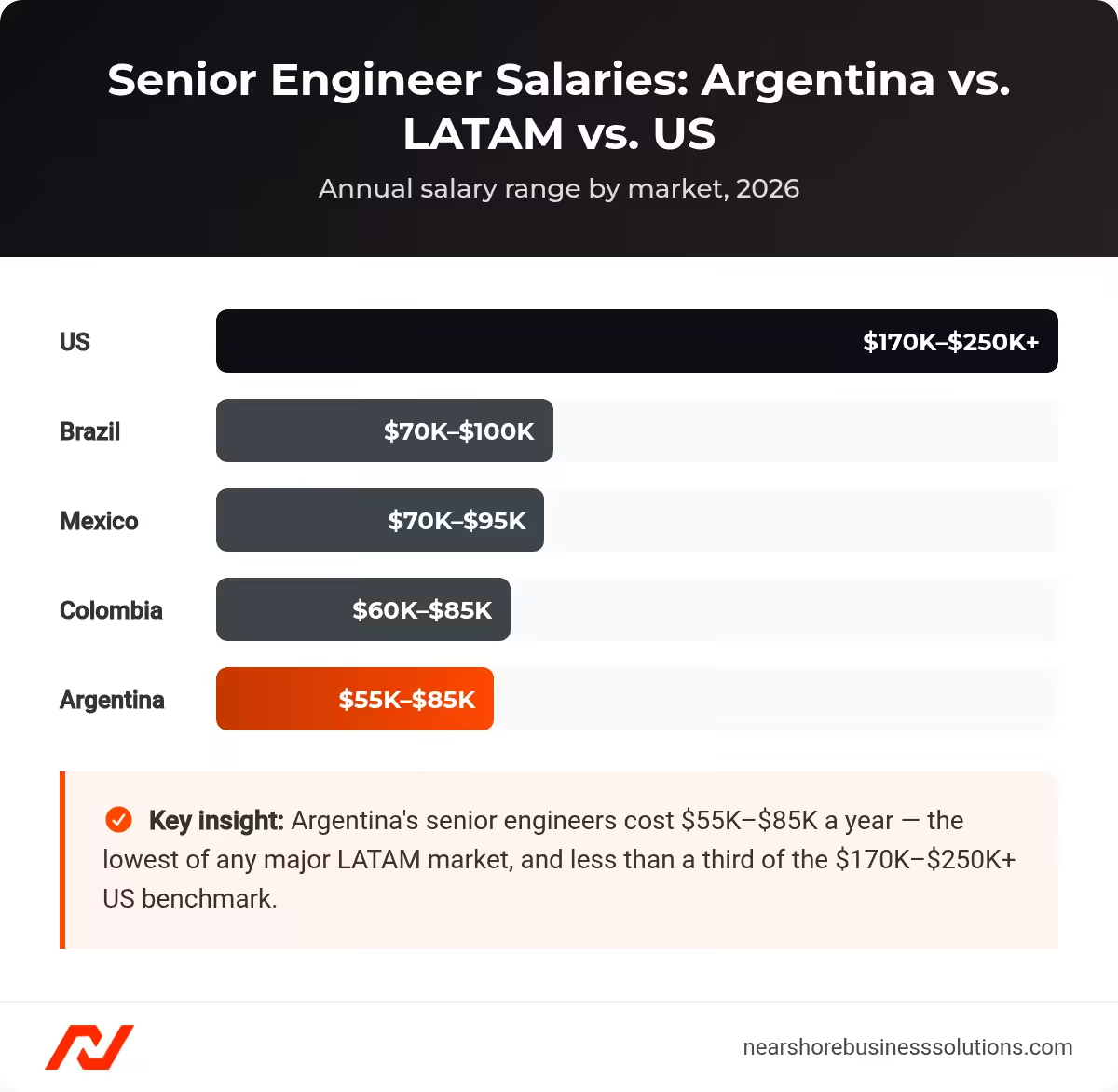
Senior software engineer salary ranges: Argentina versus Colombia, Mexico, Brazil, and the US.
Salaries in Buenos Aires typically run 5-10% higher than Córdoba and other secondary hubs like Rosario and Mendoza, reflecting cost-of-living differences (Glassdoor Argentina salary comparison data, 2024). That gap is narrowing as remote work becomes standard. Argentina’s December 2023 peso devaluation accelerated a trend already favoring US employers: most Argentine tech professionals now expect USD-denominated compensation (Bloomberg Línea, May 2024). Companies that pay in dollars attract top-tier candidates and avoid the retention risk that peso-denominated offers create in a high-inflation economy. NBS’s Hire Software Developers in Argentina service handles sourcing and vetting once you are ready to move from research to active hiring, and our LATAM Developer Salary Guide breaks down compensation by seniority and specialization across the region.
How Do Time-Zone Alignment and Cultural Fit Support US Collaboration?
Argentina delivers 7-8 hours of daily overlap with US Eastern Time and 4-5 hours with Pacific. That is the strongest synchronous window of any major LATAM nearshore market. Argentina runs on ART (UTC-3) year-round with no daylight saving time shifts, so a Buenos Aires engineer’s 10 AM-6 PM workday maps to 9 AM-5 PM EDT. Compare that to Poland (1-4 hours of ET overlap), Ukraine (0-3 hours), or India (0-1.5 hours). GitLab’s 2024 State of Remote Work report identified communication and collaboration as the #1 challenge for distributed teams, and McKinsey’s 2023 research on digital-age talent management found that high-performing agile teams depend on frequent, synchronous interaction. Timezone proximity solves both problems at the lowest cost.
Argentina ranked #28 globally, the highest in Latin America, on the EF English Proficiency Index 2023, earning a “High Proficiency” classification well ahead of Brazil (#48), Colombia (#75), and Mexico (#89). Buenos Aires and Córdoba consistently score in the “Very High Proficiency” band, comparable to several European capitals. Argentine professionals operate with a communication style US teams describe as direct, opinionated, and comfortable with pushback, closer to a San Francisco engineering org than to the high-context, hierarchical styles common in parts of Asia. For a CTO building a nearshore pod that functions as a genuine extension of the US team, that cultural fit reduces management overhead from day one.
What Employment Structures and Legal Pathways Govern Hiring in Argentina?
Three legal pathways exist for US companies hiring Argentine software engineers: a local entity, an Employer of Record (EOR), or independent contractors. AFIP, Argentina’s federal tax authority, governs registration and compliance under all three. Choosing the wrong structure for your stage and headcount is the most expensive mistake a CTO can make when entering the Argentine market.
Should You Set Up a Local Entity or Use an Employer of Record?
For most US companies, an EOR is the faster, lower-risk choice. Local entity setup takes 3-6 months and costs $10,000-$25,000+, while an EOR onboards a hire in as little as 48 hours for $599-$799 per employee per month.
| Factor | Local Entity (S.A.S.) | Employer of Record (EOR) | Independent Contractor (Monotributista) |
|---|---|---|---|
| Setup Time | 3-6 months | Days (as fast as 48 hours) | Immediate |
| Setup Cost | $10,000-$25,000+ | $599-$799/employee/month, or 10-15% of salary | Minimal |
| Compliance Risk | Low, with local counsel | Very low: EOR assumes liability | High: misclassification risk |
| Administrative Burden | High: requires local legal, accounting, HR | Low: EOR handles payroll, taxes, filings | Low for employer, all on contractor |
| Scalability | High (15-20+ employees) | High (1-15 employees ideal) | Limited |
EOR pricing per Deel, Remote, and Oyster provider rates; entity setup and accounting costs per Argentine legal/accounting market data.
Local entity (S.A.S.): Argentina’s S.A.S. structure, introduced under Law 27,349, requires 3-6 months from filing to operational readiness, including drafting bylaws, registering with the IGJ, obtaining a CUIT from AFIP, and opening a corporate bank account. Ongoing monthly costs for local accounting and payroll administration add $2,000-$4,000/month (per Argentine legal/accounting market data). This path makes economic sense only for 15-20+ planned hires. Companies that incorporate locally and register under Argentina’s Knowledge Economy Law (Ley de Economía del Conocimiento, Law 27,506) can qualify for payroll contribution reductions and corporate income tax cuts for registered software and IT service activity, an added incentive for larger, long-term engineering hubs.
Employer of Record (EOR): An EOR, such as Deel, Remote, Oyster, or G-P, acts as the legal employer in Argentina, handling AFIP registration, payroll, social security contributions, aguinaldo, and obra social enrollment. The US company retains day-to-day operational control. For teams of 1-15 engineers, an EOR eliminates the need for local legal infrastructure entirely. For a detailed provider comparison, see the Employer of Record in Argentina guide.
A recruitment agency identifies, screens, and presents candidates. It does not solve the legal employment structure question: the candidate still needs employment through either a local entity or an EOR.
When Does Contractor Engagement Work, and Where Does It Create Misclassification Risk?
Contractor engagement works only for defined, project-based work. Argentina’s Ley de Contrato de Trabajo (LCT, Law 20,744) applies a “primacy of reality” principle. If the substance of a relationship looks like employment, courts treat it as employment regardless of what the contract says. Argentine courts evaluate six factors when determining whether a contractor relationship constitutes disguised employment:
- Exclusivity. The contractor works primarily for one client.
- Fixed schedule. Required attendance at standups or set hours.
- Organizational integration. Company email, org chart presence, performance reviews.
- Company-provided tools. Laptops, software licenses, stipends.
- No substitution rights. The company expects that specific individual.
- Salary-like payments. Monthly fixed amounts rather than milestone-based invoicing.
If three or more factors are present, reclassification risk moves from theoretical to probable. A successful reclassification claim creates retroactive liability: back-dated social security contributions plus interest and penalties that can double the principal, unpaid aguinaldo and vacation for every year of the relationship, full severance under LCT Articles 232, 233, and 245, and penalty multiplications under Laws 24,013 and 25,323. For a senior engineer engaged as a contractor at $7,000/month for three years, reclassification can generate a single-event liability of $150,000-$250,000+ once back contributions, unpaid benefits, penalties, and severance stack together (calculation based on LCT Articles 232, 233, 245 and Laws 24,013, 25,323).
Contractor engagement is legitimate when a defined project has clear deliverables and an end date, the contractor works for multiple concurrent clients, the contractor sets their own hours, payment is milestone-based, and the contractor owns their equipment. For ongoing, full-time engineering roles, the cost of compliance through an EOR or local entity is always lower than the cost of reclassification.
What Does Argentina’s Ley de Contrato de Trabajo Require From Foreign Employers?
Law 20,744, the Ley de Contrato de Trabajo (LCT), spans 277 articles governing every employment relationship on Argentine soil. Its protections cannot be waived by contract. A CTO who treats Argentine employment like US at-will hiring will generate six-figure liabilities within 18 months.
What Leave and Aguinaldo Benefits Must Employers Provide?
Employers must pay aguinaldo, the 13th-month salary: 8.33% of annual base salary, paid in two installments by June 30 and December 18 (LCT, Sueldo Anual Complementario). Each installment equals 50% of the highest monthly gross salary earned during the preceding six-month period, not an average, meaning any raise or bonus spike increases the obligation for the entire period.
Paid vacation scales with seniority:
| Tenure | Paid Vacation |
|---|---|
| Under 5 years | 14 calendar days |
| 5-10 years | 21 calendar days |
| 10-20 years | 28 calendar days |
| Over 20 years | 35 calendar days |
Combined with approximately 19 national holidays per year, a first-year employee receives 33+ paid non-working days annually. Cash substitution for unused vacation is prohibited during active employment (LCT).
Sick leave provisions exceed the US statutory framework significantly. The employer pays the employee’s full salary, not a reduced rate, for the entire protected period: 3 months per year for employees with under 5 years of service, 6 months for those with 5+ years, doubling if the employee has dependents (LCT).
Maternity leave runs 90 calendar days, paid by social security (ANSES), with an additional 3-6 months of unpaid excedencia available upon return. Termination during pregnancy or within 7.5 months post-birth triggers 13-month punitive indemnification under LCT Article 178. Paternity leave is a 2 calendar day statutory minimum, though most tech companies extend it to 10-15 days as a competitive benefit.
What Is the Total Cost of Employment and TCOE Multiplier?
Total employer cost runs 1.40x-1.55x gross salary once every mandatory contribution is included. For a mid-senior developer earning $75,000 USD gross annual salary:
| Cost Component | Annual Cost (USD) |
|---|---|
| Gross Annual Salary | $75,000 |
| Employer Social Security (~25% of gross: pension ~17%, PAMI ~2%, family allowances ~4.5%, ART ~2-4%) | $18,750 |
| Aguinaldo (8.33% of gross) | $6,248 |
| ART Workers’ Comp (~3% of gross) | $2,250 |
| Prepaga Supplement (~$200/month, market-standard) | $2,400 |
| Estimated Total Employer Cost | ~$104,648-$108,248 |
| TCOE Multiplier | ~1.40x-1.45x gross |
Estimate based on AFIP cargas sociales rates and LCT statutory requirements, corroborated by EOR provider data from Deel and Remote.
Adding employer-side contributions on the aguinaldo itself, since it is subject to social security contributions, and common benefits like meal vouchers and connectivity stipends pushes the multiplier to 1.50x-1.55x. A company that budgets only gross salary will understate true cost by 40-55%. The critical comparison: that same role costs roughly $105,000-$116,000 fully loaded in Argentina versus approximately $252,000 for an equivalent $210,000-gross US hire, a 54% savings on a fully loaded basis, or roughly $135,750 per seat per year.
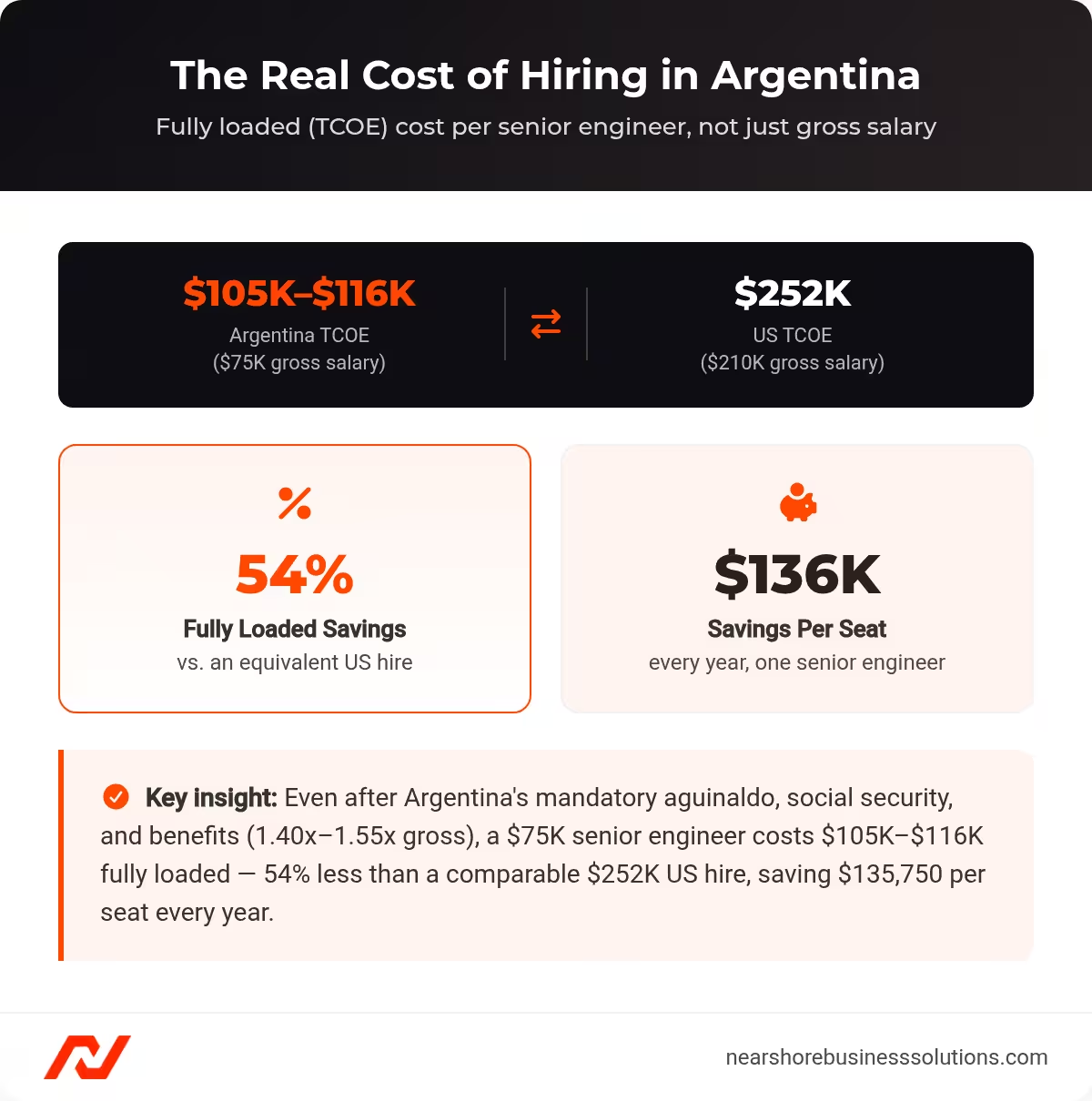
Fully loaded TCOE for a senior engineer: Argentina versus the US, with per-seat savings.
What Does the AFIP Registration Checklist Require?
You may be registering your first hire in Buenos Aires or Córdoba, operating through a local entity, or verifying EOR compliance. These seven steps apply to every formal employment relationship:
- Obtain a CUIT (tax ID) for the legal entity from AFIP. Processing takes 5-15 business days.
- Register as an employer with AFIP’s Registro de Altas y Bajas en Materia de la Seguridad Social.
- File alta temprana for each new employee before their first day. Failure constitutes unregistered employment, triggering penalties under Laws 24,013 and 25,323.
- Contract an ART provider (workplace risk insurance). The policy must be active before the employee’s start date; cost runs approximately 2-4% of gross salary depending on risk classification (typical of providers including Galeno ART and Experta ART).
- Enroll the employee in an obra social (mandatory health insurance). Most tech companies supplement this with a prepaga plan such as OSDE, Swiss Medical, or Galeno.
- Set up Libro de Sueldos Digital (digital payroll book), updated and filed monthly through AFIP.
- File Form 931 monthly, the payroll tax declaration reporting all compensation, employee deductions (~17% of gross), and employer contributions (~23-27% of gross), due by the 7th-11th business day of the following month.
Companies using an EOR should confirm their provider completes all seven steps for every hire. Skipping any one of them creates the same unregistered-employment exposure described in the contractor misclassification section above.
What Questions Do US Companies Most Often Ask About Recruiting in Argentina?
These are the most common questions US technology leaders ask about hiring and compliance in Argentina.
How Long Does It Take to Hire an Engineer in Argentina?
Specialized recruitment agencies typically reduce time-to-fill from 60-90 days to 25-40 days for senior technical roles. Once you have selected a candidate, an EOR completes employment onboarding in as little as 48 hours, while entity-based hiring adds the 3-6 month formation timeline described above.
Do I Need a Local Entity to Hire in Argentina?
No. You can hire compliantly through an Employer of Record without establishing an Argentine entity. A local entity becomes cost-effective only once you plan to employ 15-20+ people long-term.
What Happens If a Contractor Relationship Gets Reclassified?
Reclassification creates retroactive liability covering back-dated social security contributions, unpaid aguinaldo and vacation, full severance, and statutory penalties, a six-figure exposure as detailed above. Use an EOR or local entity for any ongoing, full-time role to eliminate this risk.
How Do I Pay Argentine Engineers?
Payment in USD is standard practice since the December 2023 peso devaluation and functions as a retention benefit. EOR providers handle currency conversion, tax withholding, and social security remittance automatically each pay cycle.
What Mandatory Benefits Am I Required to Provide?
Argentine law requires aguinaldo, tenure-based paid vacation, extended paid sick leave, maternity and paternity leave, ART workplace insurance, and obra social health coverage, as detailed above. These benefits apply identically regardless of role or seniority.
What Is the Difference Between an EOR and a Recruitment Agency?
An EOR is the legal employer of record, handling AFIP registration, payroll, and compliance. A recruitment agency only sources and screens candidates. Most companies need both: an agency or in-house sourcing to find candidates, and an EOR or entity to employ them compliantly.
Is Argentina’s Tech Talent English-Proficient Enough for US Team Integration?
Yes. Argentina ranks #28 globally and #1 in Latin America on the EF English Proficiency Index 2023, with Buenos Aires and Córdoba scoring in the “Very High Proficiency” band. Specify English fluency requirements in job descriptions and confirm with a live technical interview before extending an offer.
How Do You Get Started Building Your Argentine Engineering Team?
Nearshore Business Solutions sources and vets developers from Buenos Aires, Córdoba, and Rosario. We screen for technical skills, English fluency, and US work-style fit. Our acceptance rate is 16%.
Every placement includes a 90-day replacement guarantee. You receive pre-vetted candidates in 2-4 weeks.
Get a free consultation to discuss your Argentina hiring needs and receive a custom quote.