Hiring Ruby on Rails developers in Latin America costs 60-70% less than US rates while delivering 6-8 hours of daily timezone overlap for real-time collaboration.
Latin American Rails developers cost $32,000-$135,000 annually depending on seniority and country. São Paulo, Mexico City, and Buenos Aires host over 10,900 active Rails developers combined. Senior engineers deliver the same Rails 7.2+ stack expertise as US developers at 59.5% lower fully-loaded cost.
This guide covers 2026 salary benchmarks by country, sourcing strategies, technical screening frameworks, and legal compliance requirements across Brazil, Mexico, Argentina, Colombia, Chile, and Costa Rica. We source pre-vetted Rails developers from these hubs with a 16% acceptance rate and 90-day replacement guarantee.
What Does It Mean to Hire Ruby on Rails Developers from Latin America?
Hiring Rails engineers from Latin America means contracting developers in Mexico, Colombia, Brazil, or Argentina who work remotely for US companies during US business hours.
What Are the Advantages of Hiring Ruby on Rails Developers from Latin America?
Hiring Latin American Rails developers delivers 40% faster release cycles due to 6-8 hour daily timezone overlap with US teams.
Timezone alignment enables same-day iteration. Mexico City provides 8 hours EST overlap. Bogotá provides 8 hours EST. Teams run standups at 9am, resolve blockers by lunch, and ship fixes before end of day. Synchronous communication cuts response lag by 75%: nearshore developers respond within 2 hours at 95% rates versus 15-25% offshore. Project success rates jump 20 percentage points: nearshore 80%, offshore 60%.
Cost arbitrage runs 50-60% below US rates. A developer in Colombia earning $3,500/month maintains a lifestyle comparable to a US developer earning $8,000/month.
What Are the Disadvantages of Hiring Ruby on Rails Developers from Latin America?
Latin American hiring creates four core risks that require proactive management.
Talent poaching concentrates in São Paulo and Mexico City, where top 1% Rails developers field 3-5 competing offers monthly. Argentine currency volatility demands USD contracts. 2026 political uncertainty in Brazil (general elections) and Mexico (USMCA revision) requires multi-year planning. Buenos Aires and São Paulo cut EST overlap to 6 hours, limiting afternoon collaboration.
Why Should Companies Hire Ruby on Rails Developers in Latin America?
Companies hire Latin American Rails developers because 7-hour daily overlap combined with 50% cost savings produces better cost-per-collaborative-hour than any offshore alternative.
A nearshore developer at $65/hour with 7 overlap hours delivers more value than an offshore developer at $30/hour with 1 overlap hour. Lima provides 8 hours EST overlap. Mexico City offers full overlap across all US time zones.
For more on hiring remote developers in Latin America, including engagement model comparisons and talent pool data, see our complete LATAM hiring guide.
How Do Time Zone Advantages Benefit Companies Hiring Ruby on Rails Developers?
Time zone alignment transforms daily development workflows. When a US product manager identifies a bug at 10am EST, a Mexico City developer can investigate, propose a fix, and deploy to staging before 5pm. Offshore teams operating 12 hours ahead require 24-48 hour cycles for the same workflow. This reduces mean time to resolution by 60% compared to offshore alternatives.
How Does Cultural Compatibility Affect Collaboration with Latin American Rails Developers?
Cultural alignment drives 98% two-year retention in dedicated team models.
Dedicated team structures outperform staff augmentation for long-term retention. Companies report developers integrate as core team members rather than temporary resources. Remote work culture matches US expectations: async communication, sprint ceremonies, and documentation standards align without cultural friction. US compensation creates strong retention incentives through purchasing power parity.
How Does English Proficiency Among Latin American Developers Facilitate Communication?
English proficiency ranges from moderate to executive-level, with Argentina, Uruguay, and Chile ranking highest on the EF EPI.
Argentina, Uruguay, and Chile deliver “High” EF EPI ratings. Developers from Buenos Aires, Montevideo, and Santiago lead complex technical discussions without language barriers. Graduates from University of Buenos Aires (UBA), ITBA, and Universidad Austral produce strong English fundamentals. Brazil and Mexico rank moderate to high, hub-dependent. Colombia trends moderate but improves rapidly among younger cohorts from Universidad de los Andes and EAFIT.
What Are Ruby on Rails Developer Rates in Latin America in 2026?
Ruby on Rails developer rates in Latin America range from $32,000 annually for junior developers in Argentina to $135,000 for senior engineers in Chile.
How Much Does It Cost to Hire a Ruby on Rails Developer in Latin America?
Senior Ruby on Rails developers in Latin America cost an average of $65/hour in 2026, with year-over-year growth of 6-9%.
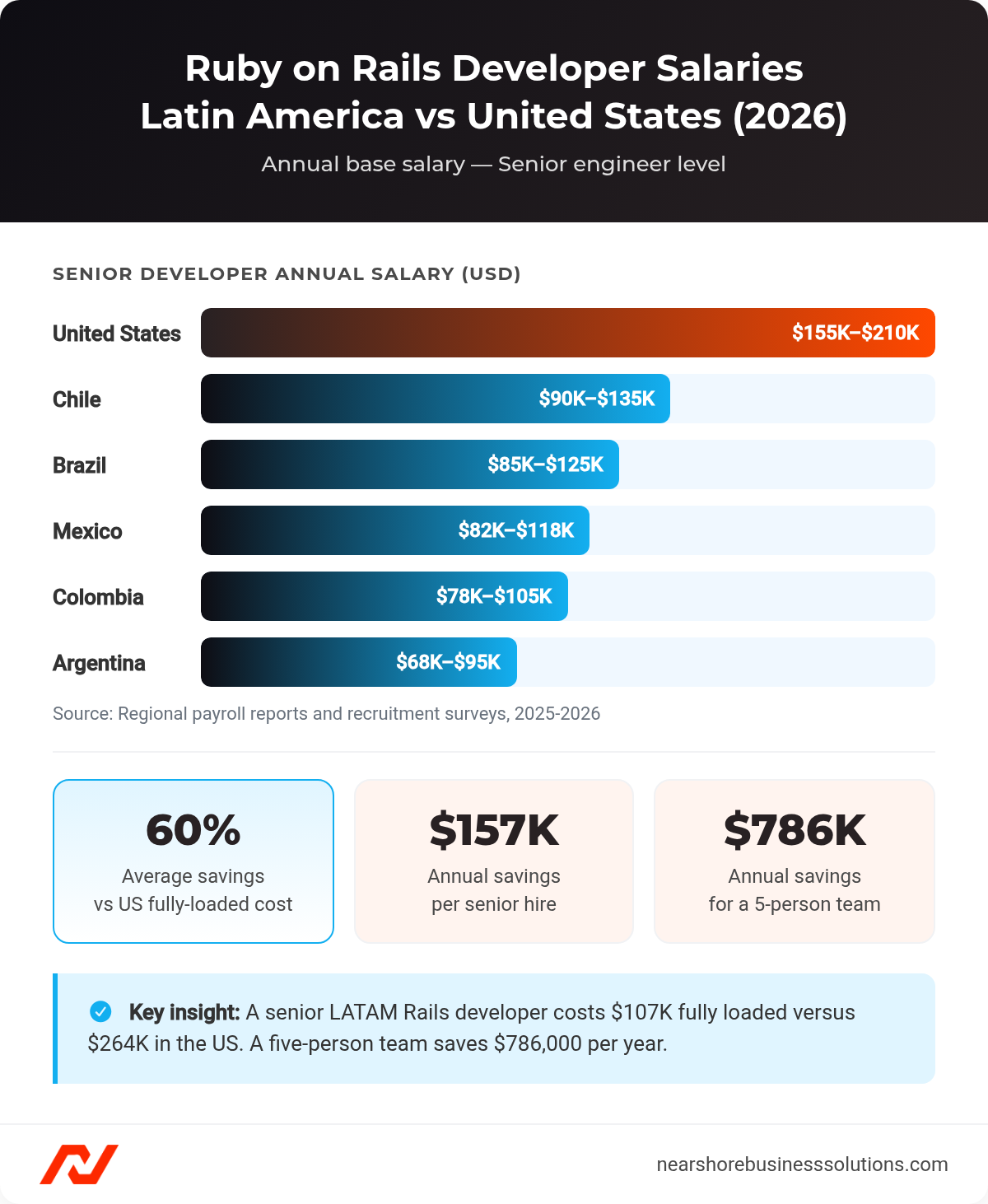
Senior Rails developer annual salaries across five Latin American countries versus US rates in 2026.
| Country | Junior (0-2 Yrs) | Mid-Level (3-5 Yrs) | Senior (5-10+ Yrs) |
|---|---|---|---|
| United States | $92,000-$115,000 | $121,000-$145,000 | $155,000-$210,000 |
| Argentina | $32,000-$48,000 | $48,000-$68,000 | $68,000-$95,000 |
| Brazil | $40,000-$58,000 | $58,000-$85,000 | $85,000-$125,000 |
| Mexico | $38,000-$55,000 | $55,000-$82,000 | $82,000-$118,000 |
| Colombia | $34,000-$52,000 | $52,000-$78,000 | $78,000-$105,000 |
| Chile | $42,000-$62,000 | $62,000-$90,000 | $90,000-$135,000 |
How Do Ruby on Rails Developer Rates in Latin America Compare to US Rates?
Latin American rates deliver 59.5% savings versus fully-loaded US costs. A senior US Rails developer costs $264,250 fully loaded. A senior Latin American developer costs $107,050. A five-person team saves $786,000 annually.
Argentina delivers the deepest discount: 44-61% below US senior averages. Colombia and Mexico cluster at 42-60% and 38-58% savings. Brazil and Chile range 35-55% and 32-52%, reflecting stronger local economies.
| Expense Category | US Senior (NYC/SF) | LATAM Senior (Avg. Hub) | Annual Savings |
|---|---|---|---|
| Base Salary | $175,000 | $65,000 | $110,000 |
| Payroll Taxes | $26,250 | $11,050 | $15,200 |
| Health and Benefits | $18,000 | $8,500 | $9,500 |
| Recruitment Fee | $35,000 | $13,000 | $22,000 |
| Equipment and Support | $5,000 | $3,500 | $1,500 |
| EOR Management Fee | $0 | $6,000 | ($6,000) |
| Total Annual Cost | $264,250 | $107,050 | $157,200 |
How Do Latin American Rails Rates Compare to Eastern Europe?
Latin America matches Eastern Europe on pricing but wins on timezone alignment. Poland, Romania, and Ukraine offer similar $55-75/hour senior rates. A Ukrainian developer at $60/hour working 9am-5pm Kyiv time (2am-10am EST) delivers minimal US overlap. A Colombian developer at $65/hour working 9am-5pm Bogotá time delivers full-day synchronous collaboration.
Which Latin American Countries Have the Best Ruby on Rails Developers?
Latin America hosts over 17,700 active Ruby on Rails developers across seven major tech hubs. São Paulo leads with 4,200+ developers, followed by Mexico City at 3,800+ and Buenos Aires at 2,900+.
What Makes Mexico an Attractive Destination for Ruby on Rails Hiring?
Mexico delivers 3,800+ Rails developers in Mexico City and 1,400+ in Guadalajara, with 130,000+ engineering graduates entering the workforce annually.
Mexico City concentrates e-commerce and logistics expertise with 1,100 GitHub contributors. Guadalajara, “Mexico’s Silicon Valley,” captures 40% of Mexico’s IT growth. Graduates from Tecnológico de Monterrey (ITESM), UNAM, and IPN supply both hubs. The IMMEX program provides tax incentives for US companies establishing regional operations. Infrastructure: 91.99 Mbps median broadband, 60%+ urban 5G.
What Makes Brazil a Competitive Market for Ruby on Rails Talent?
Brazil offers Latin America’s largest Rails talent pool: 4,200+ active developers in São Paulo, with 3,100 GitHub contributors and bootcamps achieving 97% placement rates.
São Paulo specializes in FinTech and enterprise SaaS, driven by Brazil’s PIX instant payment system accounting for 44% of digital commerce volume. Le Wagon and Ironhack feed the pipeline alongside 100,000 annual IT graduates. Mobile infrastructure leads the region at 251.55 Mbps median speed. Brazil’s LGPD requires specific privacy provisions for developers handling personal data.
What Makes Colombia a Growing Hub for Ruby on Rails Development?
Colombia combines growing talent pools with cloud-native specialization and HealthTech investment that grew 37.6% in 2024.
Bogotá hosts 2,100+ Rails developers focused on cloud infrastructure and DevOps. Medellín’s Ruta N innovation district adds 1,500+ developers specializing in mobile integration. Both cities produce developers from Universidad de los Andes, EAFIT, and Universidad Nacional. INNpulsa Colombia and ProColombia support the ecosystem. Formal employment multiplier: 1.35-1.40x base salary.
What Makes Argentina a Leading Destination for Ruby on Rails Developers?
Argentina offers 2,900+ Rails developers in Buenos Aires at the lowest regional cost, with USD-denominated contracts providing inflation protection.
Buenos Aires concentrates 800 GitHub contributors specializing in data science. Argentina’s Knowledge Economy Law provides 15% reduced income tax through 2029. University of Buenos Aires (UBA), ITBA, and Universidad Austral produce 27,000+ tech graduates annually. The Milei government stabilized the macroeconomic framework in 2024-2025. Employment multiplier: 1.65-1.80x base salary. The Distrito Tecnológico in Buenos Aires serves as the primary tech hub.
What Makes Chile a Strong Option for Hiring Ruby on Rails Developers?
Chile delivers 1,800+ Rails developers in Santiago with Latin America’s fastest broadband at 360.89 Mbps and 92% urban 5G coverage.
Santiago’s Rails developers specialize in FinTech and retail systems, with 1,000 GitHub contributors per 1,800 developers indicating strong open-source participation. Salaries sit at the regional high end but still deliver 32-52% savings versus US rates. Infrastructure outperforms many US metro areas. Chile’s High EF EPI rating means Santiago developers lead complex technical discussions and handle stakeholder communication without language barriers.
What Are the Main Steps to Hire Ruby on Rails Developers in Latin America?
Hiring Latin American Rails developers requires four core steps: defining requirements, sourcing from regional talent pools, screening for Rails expertise, and structuring compliant contracts.
How Do You Source Ruby on Rails Developers in Latin America?
Source from 2M+ Latin American tech professionals targeting the seven major Rails hubs using GitHub activity as a quality signal.
Regional job boards concentrate Rails talent: Get on Board (Latin America-wide), GeekHunter (Brazil), Hireline (Mexico), and Torre (Colombia). Ruby communities on Discord and Slack provide referral networks. Nearshore agencies with pre-vetted developer benches reduce time-to-hire from 45 days to 14 days. For backend developer hiring guidance including technical screening frameworks, see our backend developer resource.
How Do You Screen Ruby on Rails Developers for Technical Skills?
Screen for Rails 7.2+ expertise using assessments that test ActiveRecord, caching, background jobs, and security patterns.
Test Rails framework knowledge: ActiveRecord query optimization, RESTful routing, Rails security features (strong parameters, CSRF protection), Sidekiq background processing, and Redis caching strategies. Evaluate code quality through live coding reviewing RSpec test coverage, database optimization, and error handling. Review GitHub portfolios for Rails version currency (7.x, not legacy 5.x), test coverage, and README documentation quality.
How Do You Handle Contracts and Legal Considerations When Hiring in Latin America?
Secure IP rights with Work-for-Hire clauses and use an Employer of Record for compliance. Mexico provides the strongest IP protection, with rights defaulting automatically to the EOR.
Include explicit IP assignment in all contracts governed by US or international arbitration law. Avoid contractor misclassification: Brazil and Argentina labor courts retroactively reclassify misclassified contractors with back-payment penalties. EOR services cost $4,800-8,400 annually per seat and handle payroll, benefits, tax compliance, and legal exposure.
How Do You Onboard Ruby on Rails Developers in Latin America?
Onboard through managed service providers. Standard timeline: Week 1 equipment setup and codebase orientation, Week 2 pair programming and first ticket, Week 3 independent feature work.
Assign an onboarding buddy from your senior Rails developers to reduce ramp-up time by 40%. Provide the same tools as your US team: GitHub access, Slack, Jira or Linear, Datadog or New Relic. Document tribal knowledge including architecture decisions, deployment procedures, and debugging playbooks. Remote developers need written context that US team members absorb through proximity. Create a completion checklist tracking Day 1 (accounts, team calls), Week 1 (first commit merged), and Week 2 (sprint ceremonies attended).
What Technical Skills Should Ruby on Rails Developers in Latin America Have?
What Ruby on Rails Framework Knowledge Should Developers Possess?
Rails developers need Rails 7.2+ with Ruby 3.3+ with YJIT enabled. 85%+ of senior LATAM teams have adopted this stack, which delivers 15-25% production latency improvements through JIT compilation.
API-centric architecture dominates modern Rails. Teams build Rails as a backend for mobile apps and JavaScript frontends. Developers need strong API design skills: RESTful routing, JSON serialization, and versioning strategies. Rails ranks as the third-highest paying technology globally, reflecting the premium for deep framework expertise. It powers 439,000+ websites worldwide.
What Database and Testing Skills Should Rails Developers Have?
PostgreSQL, Redis, and Elasticsearch form the core database stack with 95%+ adoption. RSpec, Capybara, and FactoryBot define the testing standard with 98%+ adoption among senior LATAM teams.
PostgreSQL expertise includes complex queries, JSONB columns, full-text search, and query optimization using EXPLAIN ANALYZE. Redis handles caching and Sidekiq queue management. RSpec developers write unit tests for models, request specs for APIs, and feature specs for user flows. Test coverage expectations: 80%+ for production codebases, verified with SimpleCov.
What Front-End Technologies Should Ruby on Rails Developers Understand?
Hotwire (Turbo and Stimulus) and React or Next.js split frontend approaches, with 90%+ of senior LATAM teams using one or the other.
Use Hotwire for content-heavy apps requiring partial page updates. Use React for dashboard-heavy applications with complex state. For full-stack development roles combining Rails backend expertise with modern frontend capabilities, see our full-stack developer hiring guide.
What Are the Different Hiring Models for Ruby on Rails Developers in Latin America?
Three hiring models serve different needs: staff augmentation for burst capacity, dedicated teams for long-term ownership, and bridge-to-hire for strategic expansion.
Should You Use Staff Augmentation or Dedicated Teams?
Staff augmentation fills burst capacity with 7-14 day time-to-hire and 75-85% retention. Dedicated teams achieve 93-98% retention over 18+ months but require 21-45 days to hire.
Staff augmentation works for product launch sprints, backlog reduction, and temporary needs under 12 months. Dedicated teams own long-term product development with intact squads working exclusively on your product. The bridge-to-hire model provides a 6-12 month evaluation period at 90%+ retention before transitioning to direct employment.
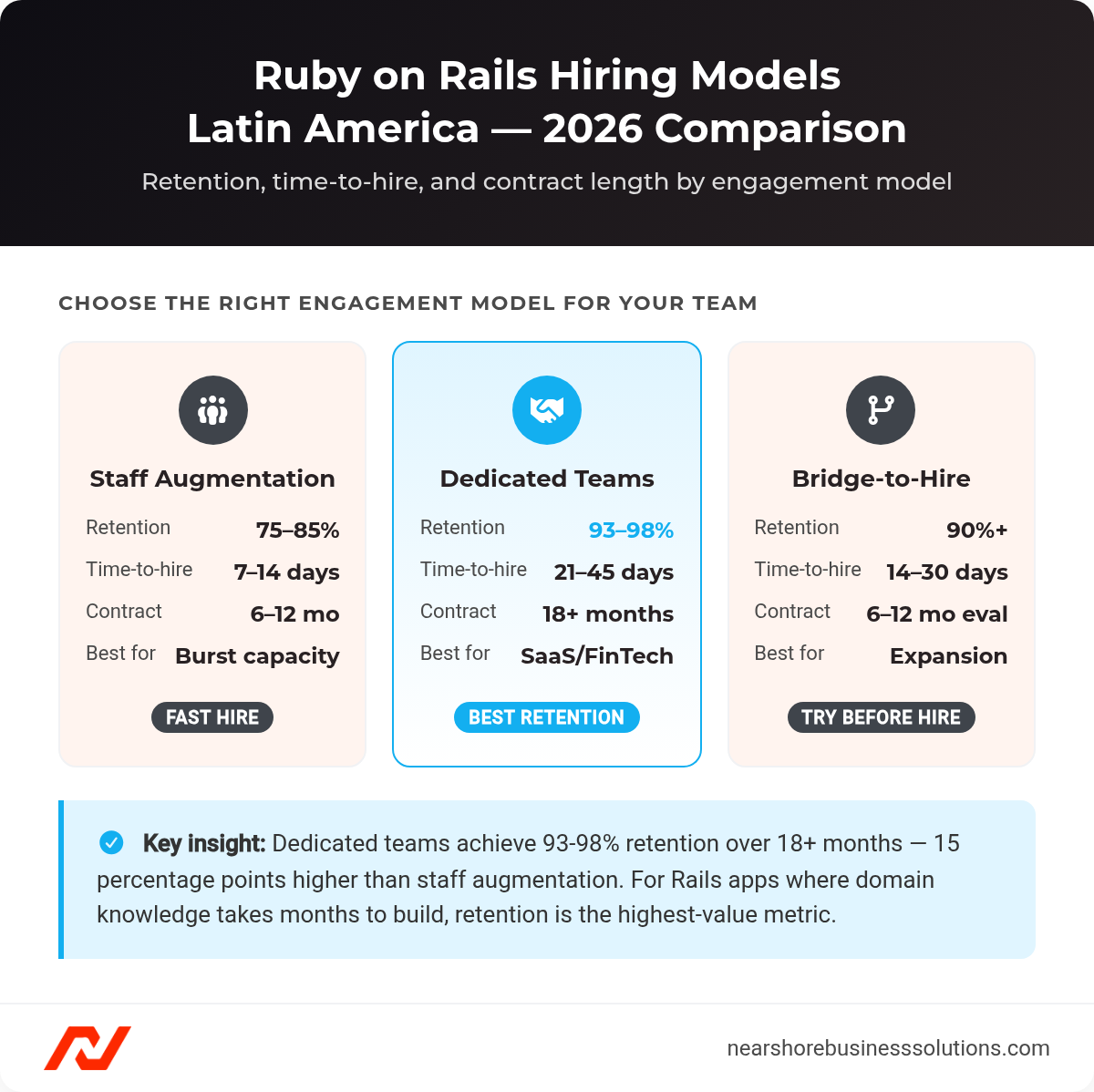
Retention rates and time-to-hire comparison across three Latin American Rails hiring models.
| Feature | Staff Augmentation | Dedicated Teams | Bridge-to-Hire |
|---|---|---|---|
| Primary Goal | Scale specific tasks | Long-term product ownership | Transition to direct hire |
| Typical Contract | 6-12 months | 18+ months | 6-12 month evaluation |
| Retention Rate | 75-85% | 93-98% | 90%+ |
| Time-to-Hire | 7-14 days | 21-45 days | 14-30 days |
How Does Nearshore Compare to Offshore and Onshore Development?
Nearshore delivers same-day collaboration with 6-8 hours of overlap. Offshore runs on 24-hour async cycles. Onshore eliminates timezone friction but costs 60-70% more.
Nearshore teams iterate 40% faster because questions resolve the same day rather than in the 24-hour offline cycle. Project success rates: nearshore 80% versus offshore 60%. Fully loaded US senior developer: $264,250. LATAM senior equivalent: $107,050. The Latin American IT market is projected to reach $110.3 billion by 2030, reflecting the region’s evolution from cost arbitrage to quality engineering.
Frequently Asked Questions About Hiring Ruby on Rails Developers in Latin America
These are the most common questions US CTOs and engineering leaders ask about hiring Ruby on Rails developers in Latin America.
How Long Does It Take to Hire a Ruby on Rails Developer in Latin America?
Staff augmentation takes 7-14 days. Dedicated team models take 21-45 days. The additional time for dedicated teams is offset by 93-98% retention versus 75-85% for staff augmentation. Define your technical requirements and budget before sourcing to minimize time-to-hire.
What If a Developer Does Not Work Out?
Most nearshore agencies include a 60-90 day replacement guarantee. Nearshore Business Solutions provides a 90-day replacement guarantee on all placements. Replacement sourcing typically takes 7-14 days from the same pre-vetted pool.
How Do I Pay Latin American Rails Developers?
Use wire transfer, Wise, or Payoneer for monthly payments. Wise charges 0.5-1% in fees versus $25-45 for wire transfers. Avoid PayPal due to high fees and limited Latin American coverage. USD-denominated contracts protect developers from local currency volatility, especially in Argentina. Pay on fixed dates (1st or 15th) to reduce turnover risk.
Do I Need a Local Legal Entity to Hire in Latin America?
No. Hire through an Employer of Record without establishing a local entity. EOR services cost $4,800-8,400 annually per seat and handle payroll, benefits, tax compliance, and legal exposure. A local entity makes sense only when hiring 10 or more developers in one country long-term.
What Compliance Requirements Apply When Hiring Latin American Rails Developers?
Brazil’s LGPD requires privacy provisions for developers handling personal data. Colombia’s Law 1581 governs data protection. Argentina aligned its IP protection framework with international standards in November 2025. Include explicit Work-for-Hire and IP assignment clauses in all contracts. Use EOR services to avoid contractor misclassification, which can trigger retroactive penalties.
How Do I Retain Ruby on Rails Developers Long-Term?
Structure total compensation at the 75th percentile for the country with USD-denominated contracts and 8-12% annual raises. A developer earning $65,000 in Colombia maintains a lifestyle comparable to a US developer earning $140,000+. Add private health insurance, $100-200/month co-working stipend, and a $1,500-2,500 annual learning budget for conferences and courses like RailsConf and GoRails.
What Is the Best Latin American Country for Ruby on Rails Developers?
São Paulo offers the largest talent pool (4,200+ developers) with deep FinTech specialization. Mexico City provides the best timezone overlap across all US zones. Buenos Aires delivers the lowest cost with strong English proficiency. Colombia offers the best value in cloud-native and DevOps Rails work. Choose based on your primary need: pool size, timezone, cost, or specialization.
Ready to Build Your Latin American Rails Engineering Team?
Nearshore Business Solutions sources and vets Ruby on Rails developers from São Paulo, Mexico City, Buenos Aires, Bogotá, Santiago, and San José. We screen for technical skills, English fluency, and US work style fit. Our acceptance rate is 16%.
Every placement includes a 90-day replacement guarantee. You receive pre-vetted candidates in 2-4 weeks.
Get a free consultation to discuss your Rails hiring needs and receive a custom quote.