
Using an Employer of Record in Chile lets US companies hire compliant employees in under two weeks. Chile has 61,000 software engineers, costs 55-68% less than US rates, and offers near-perfect East Coast timezone overlap.
Chilean developers at Pontificia Universidad Católica (UC), Universidad de Chile, and USM cost $18,000-$70,000 annually versus $85,000-$195,000 for US equivalents. Santiago hosts over 4,000 tech companies and operates in GMT-4, giving full overlap with US East Coast business hours.
We connect US companies with EOR providers that hold direct Chilean legal entities. Below, you’ll find employment contract rules, payroll rates, severance calculations, and the 2025 pension reform changes you need to budget for.
What Is an Employer of Record in Chile?
An Employer of Record in Chile is a third-party entity that legally employs workers on behalf of a foreign company. The EOR holds the employment contract, runs payroll, withholds taxes, and manages statutory benefits. The US client company directs the worker’s day-to-day tasks.
How Does an EOR Work in Chile?
The EOR registers as the legal employer with Chile’s Dirección del Trabajo, signs a compliant employment contract in Spanish, and handles all obligations under the Código del Trabajo. The US company pays one consolidated invoice covering gross salary, statutory contributions, and service fees. Onboarding takes 5-10 business days from offer acceptance to contract signature.
What Is the Difference Between an EOR and a PEO in Chile?
An EOR is the legal employer of record. A PEO requires co-employment, meaning you must already be incorporated in Chile. Use an EOR if you have no Chilean entity and no plans to establish one soon.
| Feature | EOR | PEO |
|---|---|---|
| Legal employer | EOR entity | Client company (co-employment) |
| Client entity required in Chile | No | Yes |
| Compliance liability | EOR-held | Shared |
| Speed to hire | Days | Weeks to months |
| Best for | Market entry, distributed teams | Companies with existing local entity |
Why Do US Companies Use an EOR to Hire in Chile?
An EOR eliminates the need to incorporate locally, which takes 3-6 months and creates ongoing tax and legal obligations in Chile. You can have a compliant Santiago-based employee working within two weeks.
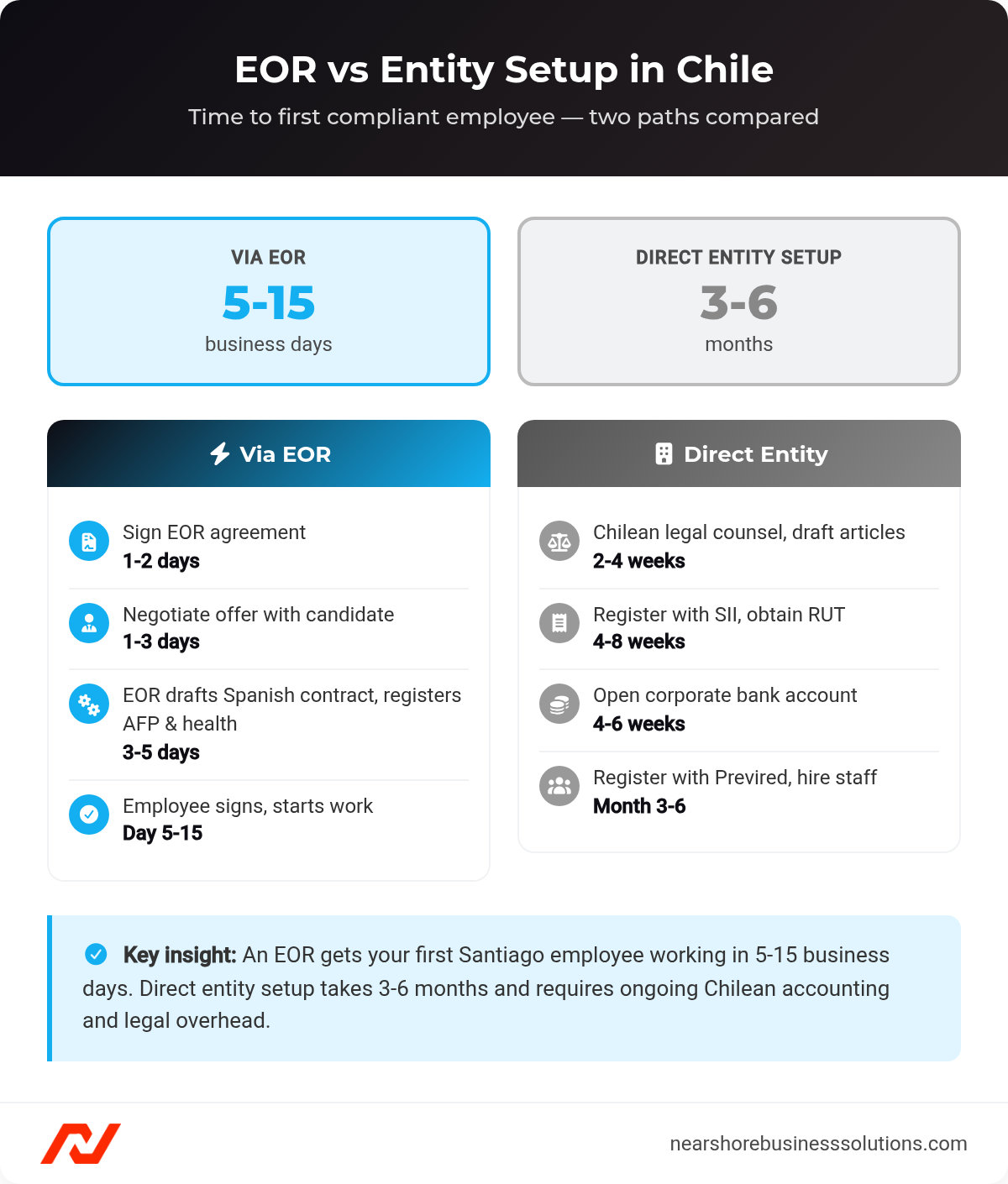
Time to hire a compliant Chilean employee via EOR versus direct entity incorporation.
Chile’s labor framework favors the employee. The principio pro-operario (worker-favoring principle) means courts rule in the worker’s favor when contract language is ambiguous. Misclassifying a worker as a contractor when the relationship shows subordinación y dependencia exposes you to retroactive AFP contributions, fines up to 60 UTM (~USD $4,500 per worker), and criminal liability for the company’s legal representative.
What Are the Main Risks of Hiring in Chile Without an EOR?
Four compliance risks apply when you hire Chilean workers without an EOR:
- Misclassification fines: The Dirección del Trabajo audits contractor relationships. Reclassification triggers retroactive AFP and health contributions from day one, plus fines of up to 60 UTM (~USD $4,500) per worker.
- Permanent establishment risk: Paying Chilean workers directly without a local entity may trigger a taxable PE under Chilean law, exposing your US company to Chile’s 27% corporate income tax.
- Termination liability: Without proper employment infrastructure, wrongful termination claims generate indemnización payments outside your budget.
- Payroll tax exposure: Chile requires monthly filings with the SII, AFP administrators, and health funds. Non-compliance generates interest at 1.5% per month plus penalties.
Is It Legal for a US Company to Hire Chilean Employees Directly?
Yes, but it requires establishing a legal presence in Chile: a branch or subsidiary, SII registration, and a Chilean RUT (tax ID). Without that structure, paying a Chilean worker as a “contractor” when the work shows subordination is illegal under the Labor Code. An EOR removes this entire compliance burden.
What Does Chilean Labor Law Require for Employment Contracts?
Chilean law requires written employment contracts within 15 days of start date (5 days for fixed-term contracts). Verbal agreements are enforceable but create a legal presumption in the employee’s favor in disputes.
For a deeper look at hiring across the region, see our complete guide to hiring software developers in Latin America.
What Must Be Included in a Chilean Employment Contract?
The Código del Trabajo (Art. 10) requires these clauses:
- Full legal name and RUT of both parties
- Start date and work location
- Job title and description of duties
- Agreed salary and payment frequency
- Daily and weekly work schedule (jornada laboral)
- Contract term (indefinite or fixed)
- Any agreed benefits beyond the legal minimum
- Remote work provisions (required since Law 21.220, 2020)
Contracts must be in Spanish. Any foreign-language version has no legal standing in Chilean courts.
What Is the Standard Probation Period in Chile?
Chile has no statutory probation period. Workers have full labor law protections from day one, including severance entitlements after one year of service. Trial period clauses carry no legal weight for severance calculations.
What Types of Employment Contracts Are Permitted in Chile?
Three contract types exist under Chilean law:
| Contract Type | Duration | Key Limitation |
|---|---|---|
| Indefinite (indefinido) | Open-ended | Most common; standard for tech roles |
| Fixed-term (plazo fijo) | Up to 1 year (renewable once to 2 years) | Becomes indefinite if renewed beyond limit |
| Project-based (por obra o faena) | Duration of specific project | Scope must be clearly defined |
Fixed-term contracts used to avoid severance are a common compliance failure. Courts routinely reclassify them as indefinite.
What Is the 40-Hour Work Week Change for 2024-2028?
Chile is transitioning from 45 hours to 40 hours per week. The schedule:
- April 2024: Reduced to 44 hours per week
- April 2026: Reduced to 42 hours per week
- April 2028: Full 40-hour week implemented
Overtime is capped at 2 hours per day with a 50% surcharge. The Dirección del Trabajo has narrowed the “Article 22” exemption (unlimited hours for senior management) to exclude standard software engineering roles.
What Employee Benefits Are Mandatory in Chile?
Every Chilean employee receives a statutory floor of benefits that includes 15 business days of paid leave, parental leave, a legal gratification payment, and full social security enrollment. EORs must provide these minimums regardless of what the US client offers internally.
How Many Vacation Days Are Employees Entitled to in Chile?
Employees with one or more years of continuous service earn 15 business days of paid annual leave (feriado legal). Workers in Regions XI (Aysén), XII (Magallanes), and the Province of Palena receive 20 business days. Unused leave must be compensated at termination.
What Parental Leave Rights Apply in Chile?
Chile’s parental leave is among the most generous in Latin America. Most costs fall on the social insurance system, not the employer.
| Leave Type | Duration | Who Covers Payment |
|---|---|---|
| Prenatal leave | 6 weeks before birth | FONASA/Isapre |
| Postnatal leave | 12 weeks after birth | FONASA/Isapre |
| Extended postnatal leave | 12 additional weeks | FONASA/Isapre |
| Paternity leave | 5 days paid | Employer |
| Child illness leave (under age 2) | As needed | FONASA/Isapre (subsidy) |
What Is the Legal Gratification Obligation in Chile?
Chilean law requires companies to share 30% of annual profits with workers. For SaaS and startup entities, Article 50 provides the common alternative: a guaranteed bonus of 25% of annual salary, capped at 4.75 times the monthly minimum wage.
As of January 2026, that works out to an annual gratification cap of CLP 2,560,250 (monthly minimum wage of CLP 539,000 x 4.75). EORs build this into your total employment cost automatically.
How Does Social Security and Payroll Taxation Work in Chile?
Chile’s employer contribution burden is lower than most of Latin America. Brazil adds roughly 70% above salary. Argentina adds roughly 50%. Chile adds 3.5-6% above gross salary for employers, plus a new 1% pension contribution that started August 2025.
What Are the Payroll Contribution Rates in Chile?
The August 2025 pension reform added a mandatory employer AFP contribution. Build this into long-term workforce cost models.
| Contribution | Employee Rate (2025) | Employer Rate (2025) |
|---|---|---|
| AFP pension | 10.00% | 1.00% (started Aug 2025) |
| Health (FONASA/Isapre) | 7.00% | 0.00% |
| Disability/Survival (SIS) | 0.00% | 1.78% |
| Unemployment insurance (AFC) | 0.60% | 2.40% |
| Work accident (ATEP) | 0.00% | 0.90%-4.30% |
| SANNA program | 0.00% | 0.03% |
The pension reform rate increases to 7% employer contribution over the next nine years. Plan for this cost trajectory before signing multi-year contracts.
How Does the AFP Pension System Affect Payroll?
Chile’s AFP (Administradora de Fondos de Pensiones) system is mandatory for all employees. Seven AFP funds operate; workers choose their own. The EOR registers the employee with their chosen AFP, remits contributions monthly, and handles fund transfers if the worker switches.
What Is the Difference Between FONASA and ISAPRE Health Insurance?
Every Chilean worker contributes 7% of gross salary to health insurance. They choose between two systems:
- FONASA: Public health fund. Lower supplemental cost, simpler administration.
- ISAPRE: Private health insurers. Plans typically cost more than 7%, with the worker covering the difference.
The employer has no direct health contribution obligation beyond ensuring the 7% deduction is withheld and remitted. Many competitive packages include an Isapre subsidy, which EORs can structure as a non-taxable benefit.
How Does an EOR Manage Employment Compliance in Chile?
An EOR handles the full employment lifecycle in Santiago and across Chile from contract drafting through termination. The US company never touches Chilean regulatory infrastructure directly.
How Does the EOR Onboard a New Employee?
The EOR drafts and countersigns a compliant Spanish-language contract, registers the employee with their chosen AFP and health fund, enrolls them in the mutual de seguridad (work accident insurance), and creates the payroll record in the SII system. Timeline is 5-10 business days from offer acceptance, assuming the employee already holds a Chilean RUT.
How Does the EOR Run Monthly Payroll in Chile?
Monthly payroll in Chile involves five steps:
- Calculate gross salary per the contract
- Deduct AFP (10%), health (7%), and unemployment insurance (0.6%)
- Apply impuesto único de segunda categoría (income tax, progressive 0-40%)
- Remit net salary to the employee’s Chilean bank account
- Pay employer unemployment insurance (2.4%) and work accident premium
All filings are due by the 12th of the following month. Delays trigger automatic interest.
How Does the EOR Submit Social Security Filings?
The EOR submits monthly planillas (contribution reports) to each AFP, FONASA/Isapre, and the mutual de seguridad through PREVIRED. This is Chile’s centralized social security payment portal. It consolidates most mandatory remittances and generates proof-of-payment certificates the worker may need for mortgage applications.
How Does the EOR Handle Ongoing HR Administration?
Beyond payroll, the EOR tracks vacation accrual and approvals, manages sick leave documentation and subsidy applications, handles salary adjustments (Chile adjusts minimum wage annually on July 1), issues payslips (liquidaciones de sueldo) required by law, and maintains the employee’s file per Dirección del Trabajo record-keeping rules.
What Are the Termination and Severance Rules in Chile?
Chile’s termination framework is employee-protective. A wrongful dismissal costs one month’s notice pay plus one month per year of service. Understand the rules before making any hiring decision.
What Is the Required Notice Period for Termination in Chile?
Employers must give 30 days’ written notice (aviso previo) before terminating an indefinite contract, or pay one month’s salary in lieu. Written notice goes to the employee and a copy files with the Dirección del Trabajo inspector within 3 days.
How Is Severance Pay Calculated Under Chilean Law?
For workers with more than one year of continuous service, severance (indemnización por años de servicio) equals one month’s last salary per year of service, capped at 11 months.
Example: A Santiago developer earning CLP 2,000,000/month (~USD 2,100) with 5 years of service receives: 5 months x CLP 2,000,000 = CLP 10,000,000 (~USD 10,500) in severance, plus one month in lieu of notice. Severance does not apply during the first year of employment.
What Are Valid Grounds for Termination Without Severance?
Chilean law (Art. 160) allows dismissal without severance for specific serious causes:
- Misconduct (falta de probidad)
- Sexual harassment
- Intentional property damage
- Abandonment of work (unjustified absences for 2+ consecutive days or 3+ in a month)
- Acts that seriously harm the employer’s reputation
- Criminal offense against the employer
These grounds must be documented rigorously. Courts scrutinize Art. 160 dismissals closely. Reversal triggers full severance plus a 20-80% surcharge (recargo legal). For business-reason terminations under Art. 161, severance is mandatory.
How Does an EOR Handle Terminations in Chile?
The EOR drafts the carta de despido specifying the legal grounds, calculates the final settlement (finiquito), files the termination notice with the Dirección del Trabajo, and executes the finiquito signing before a notary or union delegate. Final pay including accrued vacation, proportional benefits, and severance must be settled within 5 business days of the last working day. The EOR indemnifies the US company against compliance errors in this process.
How Much Does an EOR Service in Chile Cost?
Total employment cost runs 115-125% of agreed gross salary, plus the EOR service fee. Chilean employer contributions are lower than Brazil or Argentina, making it one of the more cost-efficient nearshoring destinations in Latin America.
For a broader look at hiring models, see our guide to hiring developers in Chile.
What Pricing Models Do EOR Providers Use in Chile?
Three pricing models are common:
| Model | Typical Rate | Best for |
|---|---|---|
| Flat monthly fee per employee | USD $299-$699/month | Predictable budgeting, 1-10 employees |
| Percentage of gross salary | 8-15% of gross | Higher-salary roles |
| Hybrid (flat + % above threshold) | Varies | Mid-market providers |
Flat-fee models are easier to budget. Percentage models become expensive for senior engineers earning USD $5,000-8,000/month.
What Total Employer Costs Should US Companies Budget Per Employee?
| Cost Component | Rate |
|---|---|
| Gross salary | 100% (baseline) |
| AFP employer contribution | +1.00% (rising to 7% over 9 years) |
| Disability/Survival (SIS) | +1.78% |
| Unemployment insurance (employer) | +2.40% |
| Work accident insurance | +0.90-4.30% |
| SANNA program | +0.03% |
| EOR service fee | +$400-$700/month or 8-15% |
| Total all-in | ~115-130% of gross + EOR fee |
Legal gratification (25% of annual salary capped at 4.75x minimum wage) is typically built into the monthly cost structure by EOR providers.
What Do Chilean Software Engineers Earn Compared to US Rates?
Chilean developers in Santiago cost 55-75% less than US equivalents. Senior roles offer the most savings in absolute dollar terms.
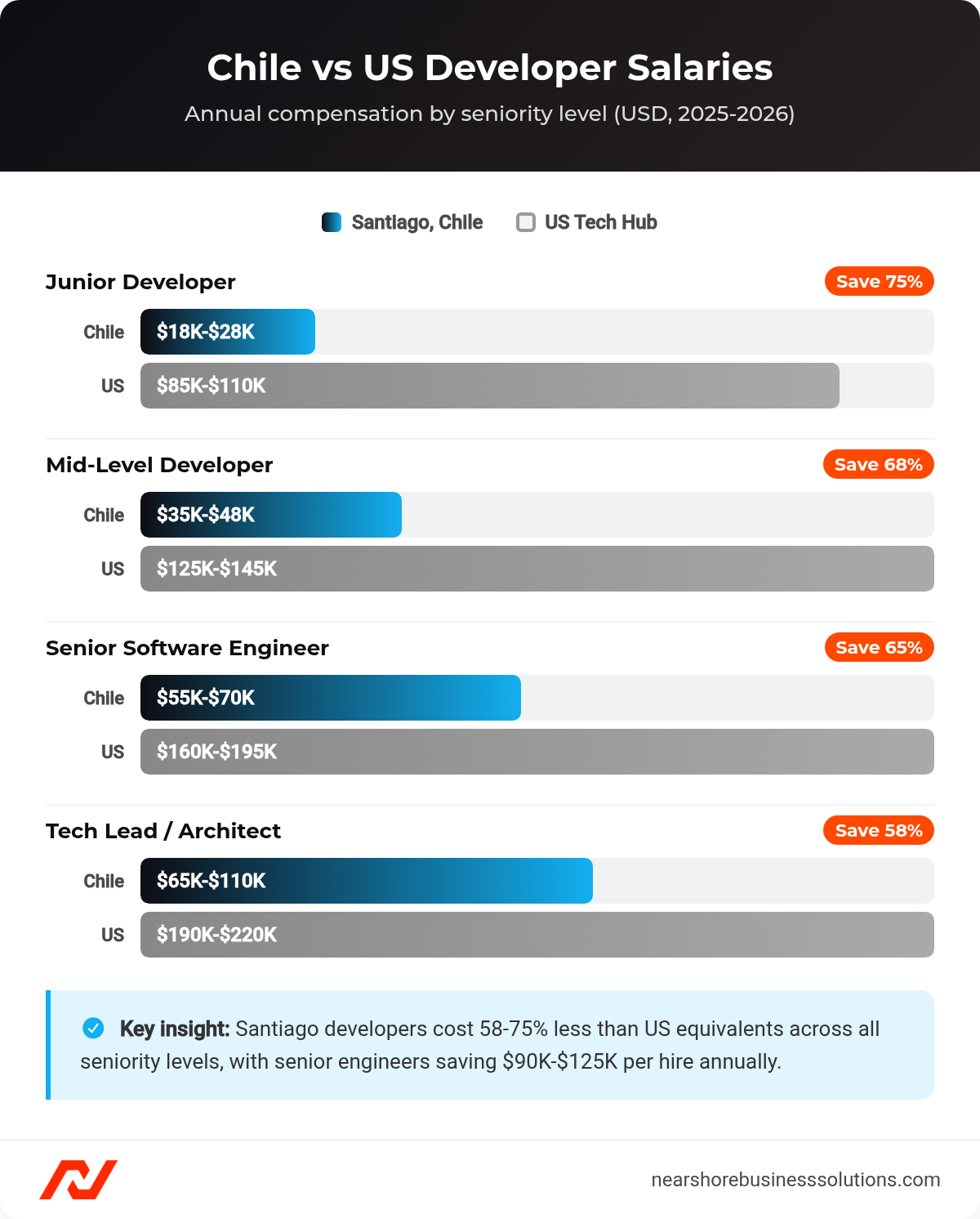
Annual developer salaries in Santiago versus US tech hubs by seniority level.
| Role | Santiago Annual Salary | US Tech Hub Average | Savings |
|---|---|---|---|
| Junior developer | $18,000-$28,000 | $85,000-$110,000 | 75% |
| Mid-level developer | $35,000-$48,000 | $125,000-$145,000 | 68% |
| Senior software engineer | $55,000-$70,000 | $160,000-$195,000 | 65% |
| Tech lead/architect | $65,000-$110,000 | $190,000-$220,000 | 58% |
How Do US Companies Choose the Right EOR for Chile?
The right EOR has a direct legal entity in Chile, not a partner network. Global platforms offer integrations and scale. Chile-focused boutique providers offer deeper Dirección del Trabajo relationships and faster issue resolution.
For backend engineering roles specifically, see our backend developer hiring guide.
What Questions Should You Ask an EOR Provider Before Hiring in Chile?
Six questions to ask every EOR provider:
- Do you have a legal entity registered in Chile? Not a partner network. A direct Chilean entity.
- Who signs the employment contract? It must be the EOR’s Chilean entity, not a local third-party.
- How do you handle Dirección del Trabajo audits? They should have a documented process.
- What is your SLA for payroll errors? Anything beyond 48 hours is unacceptable.
- How do you handle Art. 160 terminations? They should offer legal indemnification coverage.
- Are you compliant with Chile’s Data Protection Law (Law 21.719)? Effective December 2026, this GDPR-aligned law creates fines up to USD $1.4M.
What Red Flags Indicate a Non-Compliant EOR in Chile?
Six warning signs to watch for:
- Uses a third-party employer or “shell” entity instead of its own Chilean subsidiary
- Cannot produce its Chilean RUT and PREVIRED enrollment documentation on request
- Offers “contractor” arrangements as a cheaper alternative to employment
- Vague about who signs the carta de despido or finalizes the finiquito
- No Chilean legal counsel on staff or retainer
- Pricing below 110% of gross salary (insufficient to cover AFP, health, and work accident contributions)
Frequently Asked Questions About Using an EOR in Chile
These are the most common questions US companies ask about the EOR model in Chile.
Can a US Company Use an EOR in Chile to Hire Remote Workers?
Yes. This is the most common use case. Chilean Law 21.220 (2020) governs teletrabajo (remote work). Remote arrangements must be in the employment contract, including equipment provision, connectivity cost coverage (the employer must cover “a reasonable portion”), and the employee’s right to disconnect outside working hours.
Does Using an EOR in Chile Create a Permanent Establishment for US Tax Purposes?
Generally, no. Because the EOR is the legal employer, the US company has no registered business activity, contracts, or signing authority in Chile. However, if your Chilean worker concludes contracts on behalf of the US company or acts as a “dependent agent” under the US-Chile tax treaty (entered into force 2024-2025), PE risk returns. Consult a cross-border tax advisor for your situation.
How Long Does It Take to Hire an Employee in Chile Through an EOR?
It takes 5-15 business days from offer acceptance to first working day, assuming the employee has a Chilean RUT. Foreign nationals without a Chilean RUT add 2-4 weeks. This compares to 3-6 months to incorporate your own entity in Santiago.
Can an EOR in Chile Hire Foreign Nationals?
Yes. The 85% national worker rule (Art. 19, Código del Trabajo) applies only if you have 25 or more employees in Chile. Below 25 employees, no nationality quota applies. EORs handle work permit coordination for foreign hires, though visa approval timelines of 30-90 days are outside their control.
Do I Need to Provide Equipment to My Chilean Employee?
Yes, under Law 21.220, the employer must provide the equipment needed for remote work. The employer must also cover a reasonable portion of connectivity costs. EORs specify these obligations in the employment contract and can help structure equipment allowances.
What Happens if I Need to Terminate a Chilean Employee Early?
If the worker has less than one year of service, no severance applies. For workers with more than one year, severance is one month’s last salary per year of service, capped at 11 months. A 30-day notice period or one month’s pay in lieu is also required. For Art. 160 cause-based terminations, document everything before acting.
Does Chile’s New Data Protection Law Affect My EOR Arrangement?
Yes. Law 21.719 is fully effective by December 2026. It creates a new regulator (Agencia de Protección de Datos Personales) with fines up to USD $1.4M. It applies to US SaaS companies processing data of Chilean subjects. Compliant EOR providers include data handling provisions in their contracts aligned with this law.
Is Using an Employer of Record the Right Move for Your US Company in Chile?
For most US companies hiring 1-20 Chilean employees in Santiago, an EOR is the correct default. You get full labor law compliance, zero entity setup cost, and a clear monthly cost structure. You avoid the 3-6 month incorporation delay and ongoing Chilean accounting overhead.
Use an EOR if:
- You’re hiring fewer than 20 employees and have no existing Chilean entity
- You need to hire within weeks, not months
- You want compliance liability handled by a specialist, not your US legal team
- You’re testing the Chilean market before committing to a permanent presence
Consider a direct entity instead if:
- You plan to hire 30+ employees long-term (entity costs amortize at scale)
- You’re bidding on Chilean government contracts requiring local incorporation
- You need full operational control over HR processes and systems
Chile is a strong nearshoring destination. Santiago’s “Chilecon Valley” ecosystem, powered by Start-Up Chile government programs, has built a talent pool of 100,000+ IT professionals. Chilean engineers trained at Pontificia Universidad Católica (UC), Universidad de Chile, and Federico Santa María (USM) score an average 593 on the EF English Proficiency Index, the highest in Latin America’s IT sector. An EOR removes the one remaining barrier: getting compliant employment infrastructure in place fast enough to act on the opportunity.
Ready to Hire Your First Chilean Employee?
Nearshore Business Solutions connects US companies with vetted engineers from Santiago’s tech ecosystem. We screen for technical skills, English fluency, and US work style fit. Our acceptance rate is 16%.
Every placement includes a 90-day replacement guarantee. You receive pre-vetted candidates in 2-4 weeks.
Get a free consultation to discuss your hiring needs and receive a custom quote.