Agile team structure organizes software teams into autonomous, cross-functional squads that own end-to-end delivery. High-performing squads save 60-65% on engineer costs by combining LATAM nearshore talent with structured agile practices.
Agile squads deliver faster than siloed teams. Distributed teams using structured planning deliver 35% more story points than those running unmodified co-located techniques. Latin American engineers report engagement scores of 8.2/10 versus 5.8/10 for domestic US engineers.
Nearshore Business Solutions places pre-vetted engineers from Buenos Aires, Bogotá, Guadalajara, and São Paulo into agile squads. Below you’ll find role definitions, framework comparisons, scaling tactics, and guidance for building high-performing distributed teams.
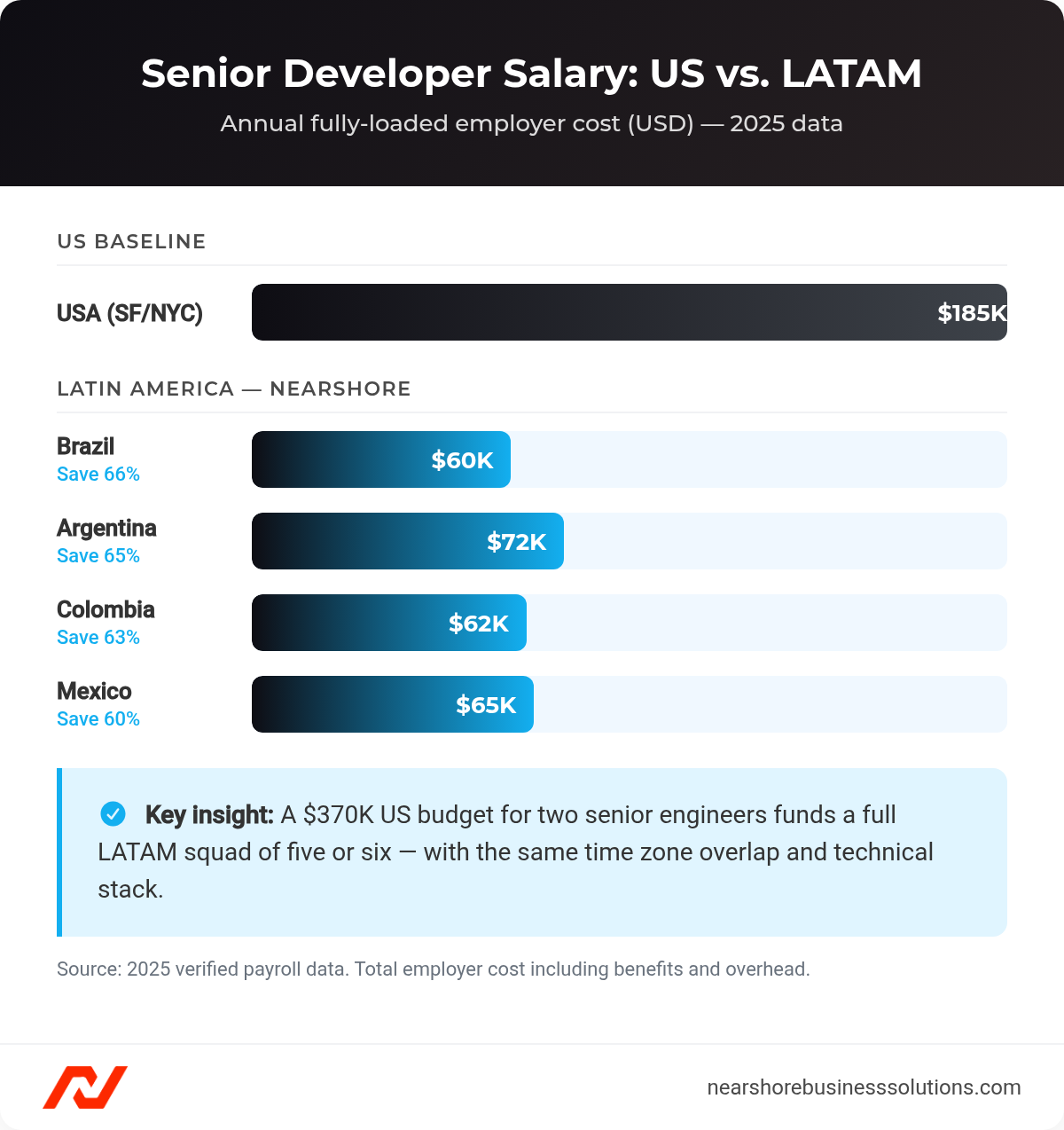
Senior developer fully-loaded costs by region, with LATAM saving 60–66% versus US tech hubs.
What Are the Key Roles in an Agile Team?
Six roles define a functioning agile squad: Product Owner, Scrum Master (or Tech Lead), Frontend Engineer, Backend Engineer, QA, and DevOps. Each owns a specific layer of delivery accountability. For AI-integrated products, MLOps is a seventh non-negotiable role.
What Does a Product Owner Do in an Agile Team?
The PO owns the “What” and “Why.” They translate stakeholder vision into a prioritized, executable backlog. Effectiveness is measured against the Definition of Done: every sprint must produce a releasable increment of value.
In distributed or nearshore configurations, the PO carries extra weight. A team in Bogotá or Buenos Aires must pursue the same North Star as leadership in San Francisco. Misalignment here compounds sprint over sprint.
What Are the Responsibilities of a Scrum Master?
The Scrum Master owns the “How.” They facilitate ceremonies, coach the team, and shield it from external noise. Key operational lever: managing WIP limits (Work in Progress) to prevent context-switching and burnout.
The modern SaaS trend is clear: non-technical Scrum Masters are being replaced by Tech Leads. A Scrum Master can run a retrospective. They cannot unblock an architectural bottleneck stalling a sprint. For velocity-focused startups, that distinction is decisive.
What Does the Development Team Do in Agile?
Development team roles cover the full delivery stack, from UI to infrastructure:
| Role | Skill Profile | Primary Accountability |
|---|---|---|
| Frontend Engineer | T-shaped: React/Vue depth, broad stack | UI delivery, component quality |
| Backend Engineer | T-shaped: Python/Node/Go depth | API, data logic, service integrity |
| QA Engineer | “Shift left” quality coaching | Acceptance criteria, CI/CD regression suites |
| DevOps Engineer | Automation-first mindset | Build/release pipelines, MTTR, microservices migration |
| MLOps Engineer | Data pipelines, GPU management | Model accuracy, drift detection |
QA has evolved beyond end-of-process testing. Modern QA engineers co-author acceptance criteria with the PO before a single line of code is written. DevOps prevents technical debt through automation. MLOps is now a non-negotiable role for HealthTech and EdTech teams embedding AI features.
What Is the Role of an Agile Coach?
The Agile Coach operates outside the squad. They work at the organizational level to embed agile practices across teams, resolve systemic impediments, and upskill Scrum Masters and Tech Leads. In scaling environments, the coach is the connective tissue between framework theory and ground-level execution.
What Is a Stakeholder’s Role in an Agile Team?
Stakeholders (investors, C-suite, enterprise customers) do not attend standups. They interface through the Product Owner. The PO translates market signals into backlog priorities. The PO is the firewall keeping stakeholder noise from destabilizing sprint focus.
How Is an Agile Team Structured?
The foundational unit is a cross-functional squad: a small, self-contained team that takes a feature from concept to production without external dependencies. Squad size ranges from 5-12 people depending on the framework.
What Is a Cross-Functional Agile Team?
Cross-functional squads embed all required disciplines under one mission. Popularized by the Spotify model and now standard across the SaaS landscape, composition adapts to context:
- HealthTech: HIPAA compliance engineers embedded in-squad
- FinTech: Security and data integrity specialists alongside core engineers
- AI-native startups: MLOps embedded from day one
The principle is consistent: no waiting on another team for a capability your squad needs daily. You can learn more about hiring full-stack developers in Latin America to staff these cross-functional roles.
What Is a Self-Organizing Team in Agile?
Self-organizing teams make their own execution decisions. They decide how to break down work, who tackles what, and how to handle blockers. The Tech Lead serves as the on-site anchor. They maintain code quality and architectural consistency without micromanaging task assignment. This is critical in nearshore configurations where headquarters cannot provide real-time oversight.
What Is the Ideal Size of an Agile Team?
Team size varies by framework:
| Framework | Team Size | Cycle Length |
|---|---|---|
| Scrum | 5–9 people | 2–4 weeks |
| Spotify Model | 6–12 per squad | Variable |
| Shape Up | 2–3 people | 6 weeks + 2-week cooldown |
| SAFe (ART level) | 50–125 people | 8–12 weeks |
A Spotify Tribe (multiple squads on a related product area) caps at under 100 people. Beyond that, coordination costs outweigh the benefits of scale.
How Are Agile Team Members Organized by Skill Set?
Agile teams are organized around T-shaped skill profiles. Each member has deep expertise in one discipline combined with enough breadth to collaborate across adjacent functions. As products scale in complexity, squads add domain specialists to match their technical context.
MLOps Engineers represent the emerging mandatory addition for AI-integrated products. They manage data pipelines, GPU cluster allocation, and monitoring for model drift. Teams skipping this role accumulate silent technical debt in their AI layer.
What Are the Responsibilities of Each Agile Team Member?
Each role has a primary KPI set. Accountability is explicit, not diffuse. Four roles carry the most direct impact on velocity.
What Are the Day-to-Day Responsibilities of the Product Owner?
Primary KPI: Product Value Delivered / Backlog Health
- Refine and prioritize the backlog based on business value
- Write and acceptance-test user stories
- Make real-time trade-off calls during the sprint
- Align stakeholders without disrupting team focus
The PO is not a backlog administrator. When the PO operates as one, teams lose the strategic “Why.” Sprint output becomes technically correct but business-irrelevant.
What Are the Day-to-Day Responsibilities of the Scrum Master?
Primary KPIs: Team Velocity / Sprint Predictability
- Run standups, retrospectives, sprint planning
- Remove blockers before they compound
- Enforce WIP limits
- Shield the team from scope creep and external interruption
What Are the Individual KPIs for Each Development Team Role?
Development team KPIs by role:
| Role | Primary KPIs |
|---|---|
| Tech Lead | Technical Debt Ratio / Deployment Frequency |
| QA Engineer | Defect Leakage / Automation Coverage |
| DevOps | Mean Time to Recovery (MTTR) / Cycle Time |
| MLOps | Model Accuracy / Drift Detection Rate |
Who Is Accountable for Delivery in an Agile Team?
In squads of 5–9, the Tech Lead is the de facto delivery accountability owner. Technical debt and slow development cycles are the primary velocity killers at scale-up stage. Only the Tech Lead has the authority and context to address both simultaneously.
What Are the Main Agile Frameworks and How Do They Shape Team Structure?
Framework selection is a structural decision, not a process preference. Each produces a fundamentally different team topology. Five frameworks dominate the growth-stage SaaS landscape.
How Does Scrum Define Team Structure and Roles?
Scrum is best for standard SaaS growth contexts with teams of 5–9 and 2–4 week sprints. Scrum enforces hard role boundaries between PO, Scrum Master, and Development Team. Sprint progress is tracked on a burn-down chart.
Its rigid role definition is its strength and its limitation. It works at squad-level but requires augmentation (SAFe, LeSS) when organizations scale beyond a single team.
How Does Kanban Structure a Team Differently from Scrum?
Kanban removes the sprint boundary. Work flows continuously, pulled by team capacity rather than pushed by a planning cycle. Teams are organized around a value stream rather than a fixed scope.
Kanban suits operations, support, and maintenance workstreams where priorities shift faster than a 2-week sprint allows. It deprioritizes role formality in favor of flow metrics: lead time, cycle time, and throughput.
How Does SAFe Organize Teams?
SAFe is best for $50M–$100M ARR organizations and regulated sectors like HealthTech and FinTech. It supports teams of 50–125 per Agile Release Train (ART) across 8–12 week Program Increments. SAFe aligns all participants (developers, POs, architects, business owners) to a single mission.
The governance overhead is real, but so is the coordination benefit across multiple time zones and large-scale initiatives.
How Does LeSS Structure Multiple Agile Teams?
LeSS extends single-team Scrum to multiple teams working on one product. It uses one Product Owner, one backlog, and one sprint review. LeSS avoids the governance weight of SAFe.
It is attractive for companies that have outgrown a single squad but want to preserve Scrum’s simplicity. The trade-off: it requires organizational discipline that SAFe’s structure enforces by default.
How Does the Spotify Model Approach Agile Team Structure?
The Spotify model is best for high-autonomy cultures and nearshore or distributed teams. Teams of 6–12 per squad operate within Squads, Tribes, Chapters, and Guilds. Chapters connect specialists horizontally across squads. Guilds extend this concept organization-wide as voluntary communities.
The Spotify model is effective for nearshore teams. It prioritizes cultural alignment and trust over rigid hierarchy. A squad in Mexico City can operate with the same autonomy as US-based counterparts. Our backend developer hiring guide covers how to staff these squads with LATAM engineers.
How Do You Scale Agile Team Structure Across a Large Organization?
Scaling introduces one problem that single-squad teams never face: inter-team dependencies. Every framework is, at its core, a solution to that problem. Three structural layers manage this at scale.
What Is a Squad, Tribe, Chapter, and Guild in Scaled Agile?
The Spotify scaling units:
| Unit | Scope | Size | Purpose |
|---|---|---|---|
| Squad | Product feature area | 6–12 | End-to-end delivery |
| Tribe | Related product domain | Less than 100 | Alignment across squads |
| Chapter | Functional discipline (horizontal) | Varies | Standards, best practices |
| Guild | Interest community (org-wide) | Varies | Knowledge sharing, no reporting lines |
How Do You Coordinate Dependencies Between Multiple Agile Teams?
As organizations grow from one squad to a tribe, inter-team dependency management becomes the primary scaling challenge. Four structural options:
- SAFe Program Boards for large, predictable dependencies
- Spotify Guilds/Chapters for standards alignment without governance overhead
- Explicit API contracts and shared backlogs for technical dependencies
- Synchronous overlap windows for distributed teams requiring real-time coordination
What Is a Release Train in SAFe and How Does It Work?
An Agile Release Train (ART) locks all participants (engineers, POs, architects, business owners) onto a synchronized 8–12 week cadence (Program Increment). Everyone plans together, ships together, and reviews together.
The benefit for multi-timezone organizations: SAFe’s structure replaces the informal coordination that only works when everyone is in the same office.
How Do You Maintain Alignment Across Scaled Agile Teams?
Alignment at scale requires replacing informal coordination with explicit structural mechanisms. SAFe uses Program Increment planning to synchronize all teams on a shared roadmap. LeSS uses a single shared backlog. Shape Up uses a “pitch” model where senior leadership shapes projects into high-level briefs before handing them to autonomous 2–3 person teams.
In Shape Up, teams use Hill Charts to self-report progress. “Uphill” represents discovery and decision-making. “Downhill” represents pure execution. This eliminates micro-management. The 6-week cycle followed by a 2-week cooldown removes the sprint treadmill entirely.
What Are the Most Common Challenges When Scaling Agile Team Structure?
63% of failed sprints in distributed teams are attributed to communication gaps. Four mitigations address this directly:
- Defined synchronous overlap windows (minimum 3 hours/day)
- Documentation-first requirements before any meeting
- Explicit dependency mapping at planning sessions
- Single source of truth for backlog state (Jira, Linear, GitHub)
How Do You Build a High-Performing Agile Team?
High-performing agile teams share three traits: clear role accountability, high engagement, and structured onboarding that compresses time-to-productivity. Latin American engineers report engagement scores of 8.2/10 versus 5.8/10 for domestic US engineers.
What Qualities Define a High-Performing Agile Team?
High-performing teams enforce three structural habits: hard WIP limits to prevent context-switching, a Definition of Done applied to every increment without exception, and retrospectives that produce committed action items (not just observations).
Engagement is a measurable velocity multiplier. Lower attrition and higher sustained throughput follow directly from higher engagement. Team composition decisions, including geography, have measurable performance consequences.
How Do You Onboard New Members Into an Agile Team?
AI tooling has compressed onboarding timelines from 2–4 months to 2–6 weeks. The structural recommendation: start with a 3–6 month pilot project ($10,000–$30,000 investment) to validate cultural fit and communication workflows before scaling the engagement.
Companies like Superhuman and Nasdaq report nearshore engineers achieving peak performance within months. The key: giving them full access to leadership context and company vision from day one.
How Do You Handle Role Conflicts Within an Agile Team?
The most common structural conflict: dedicated Scrum Master versus empowered Tech Lead. The resolution is trending clear in modern SaaS startups. Tech Leads win.
When a sprint is blocked by an architectural decision, only the Tech Lead can unblock it. The Scrum Master facilitates the conversation. The Tech Lead resolves it. For nearshore squads of 5–9, the Tech Lead is the single most important hire.
How Do You Measure Agile Team Performance?
Agile team performance is measured through three metric categories:
- Output metrics: velocity, deployment frequency
- Quality metrics: defect leakage, MTTR
- Predictability metrics: sprint completion rate, cycle time
The data confirms that structural decisions drive the numbers. Distributed teams using structured planning deliver 35% more story points than co-located teams using unmodified techniques. Teams that deliberately select their toolchain report 27% higher satisfaction and 40% improvement in sprint predictability within two quarters.
What Are the Most Common Agile Team Structure Mistakes?
Three structural failure modes appear repeatedly across growth-stage companies. Each one directly reduces velocity and team output.
What Happens When Agile Roles Are Poorly Defined?
When the Product Owner becomes a backlog administrator, the team loses strategic direction. Sprint output becomes technically correct but business-irrelevant. The symptom: completed tickets, missed outcomes.
The fix is structural. The PO must have the authority and context to make real-time prioritization calls, not just groom a list.
Why Do Siloed Teams Undermine Agile Team Structure?
Two data points illustrate the cost of silos in distributed contexts:
- 24-hour feedback cycles emerge when teams are separated by large time zone gaps. A developer in Asia waits a full day for a Product Owner clarification.
- Annual developer attrition in offshore India exceeds 40%. This creates a retraining cycle that destroys institutional knowledge and suppresses velocity.
Siloed team design amplifies both problems. Cross-functional squads with overlapping time zones solve both. Annual developer attrition in Latin America sits under 15%, making LATAM squads a significantly more stable option. Our full-stack developer hiring guide covers how to find these engineers.
How Does Micromanagement Conflict With Agile Principles?
Shape Up was explicitly designed to eliminate ticket-backlog micromanagement. Its “pitch” model and Hill Charts are structural tools that make micro-management operationally unnecessary. Agile at every framework level assumes team autonomy. When managers override that assumption, the framework’s velocity benefits disappear.
How Does Agile Team Structure Work in Different Contexts?
Agile applies across software development, marketing, and product management. The core mechanics adapt to context while the cross-functional principle remains constant.
How Is Agile Team Structure Applied in Software Development?
In the $5M–$100M ARR SaaS context, product complexity drives specialization. Generalist squads work at early stage. As the product scales, squads need embedded domain experts: HIPAA compliance engineers for HealthTech, security and data integrity specialists for FinTech, and MLOps engineers managing model pipelines for AI-native products. The squad structure adapts. The cross-functional principle does not.
How Is Agile Team Structure Applied in Marketing?
Marketing agile teams (often called “growth squads”) apply sprint cadences to campaign development, content production, and conversion optimization. Roles shift: the PO becomes the Growth Lead. Developers are replaced by designers, copywriters, and analysts. The same core mechanics apply: backlog prioritization, sprint cycles, retrospectives, and WIP limits.
How Is Agile Team Structure Applied in Product Management?
Product management is inseparable from the PO function in agile. The PO’s market readiness judgment (determining whether customers adopt self-service purchasing or require sales-assisted demos) directly shapes backlog priority. This is product strategy executed at the sprint level, not delegated to a separate planning function.
Can Remote or Distributed Teams Adopt an Agile Team Structure?
Yes, with deliberate structural modifications. Most LATAM countries share 6–8 hours of overlap with the US business day. Three hours of daily synchronous time is the proven “sweet spot” for distributed squad alignment.
All requirements, architectural decisions, and bug reports should be fully documented in Jira, Linear, or GitHub before any meeting. This replaces hallway conversations that co-located teams rely on. Distributed agile succeeds when the structure compensates for the absence of proximity. It fails when it simply replicates co-located processes asynchronously.
Frequently Asked Questions About Agile Team Structure
These are the most common questions engineering leaders ask about agile team structure.
How Long Does It Take to Build an Agile Team?
You can have a pre-vetted nearshore squad ready in 2–4 weeks through a staffing partner. AI tooling has also compressed new member onboarding from 2–4 months to 2–6 weeks. Starting with a pilot project of 3–6 months validates fit before you scale.
What Happens If an Agile Team Member Doesn’t Work Out?
Address role conflicts early through retrospectives. If an engineer is not a fit, a 90-day replacement guarantee from your staffing partner covers the transition at no additional cost. Structural role clarity prevents most conflicts before they escalate.
Do Nearshore Agile Teams Need Special Tooling?
Nearshore teams need documentation-first tooling: Jira or Linear for backlog management, GitHub for code, and Loom or Notion for async communication. The key is a single source of truth for backlog state accessible to all team members regardless of time zone.
How Do You Pay LATAM Developers on an Agile Team?
Most US companies pay LATAM developers through an Employer of Record (EOR) or staff augmentation partner. This handles local contracts, payroll, and compliance in each country. Direct payment is also possible but requires understanding local labor law in Argentina, Mexico, Colombia, and Brazil.
What Is the Difference Between Nearshore and Offshore Agile Teams?
Nearshore teams (LATAM) share 6–8 hours of daily overlap with US teams. Offshore teams (India, Eastern Europe) produce 24-hour feedback cycles. Nearshore also delivers lower attrition: under 15% annually for LATAM versus over 40% for offshore India. The cost difference between the two is now marginal. The productivity and retention advantage is not.
Do I Need a Local Entity to Hire LATAM Agile Team Members?
No. Most companies use a staff augmentation partner or EOR. This lets you hire in Argentina, Colombia, Mexico, and Brazil without incorporating locally. Setup typically takes 3–7 days through an EOR versus 30–90 days for a local entity.
What Is the Best Agile Framework for a Distributed Team?
The Spotify model is the best fit for distributed nearshore teams. It prioritizes autonomy and cultural alignment over rigid hierarchy. Scrum works well for single squads of 5–9 people. SAFe is appropriate for organizations with 50+ engineers across multiple teams in regulated sectors.
Ready to Build Your Agile Engineering Team?
Nearshore Business Solutions sources and vets developers from Buenos Aires, Bogotá, Guadalajara, Monterrey, and São Paulo.
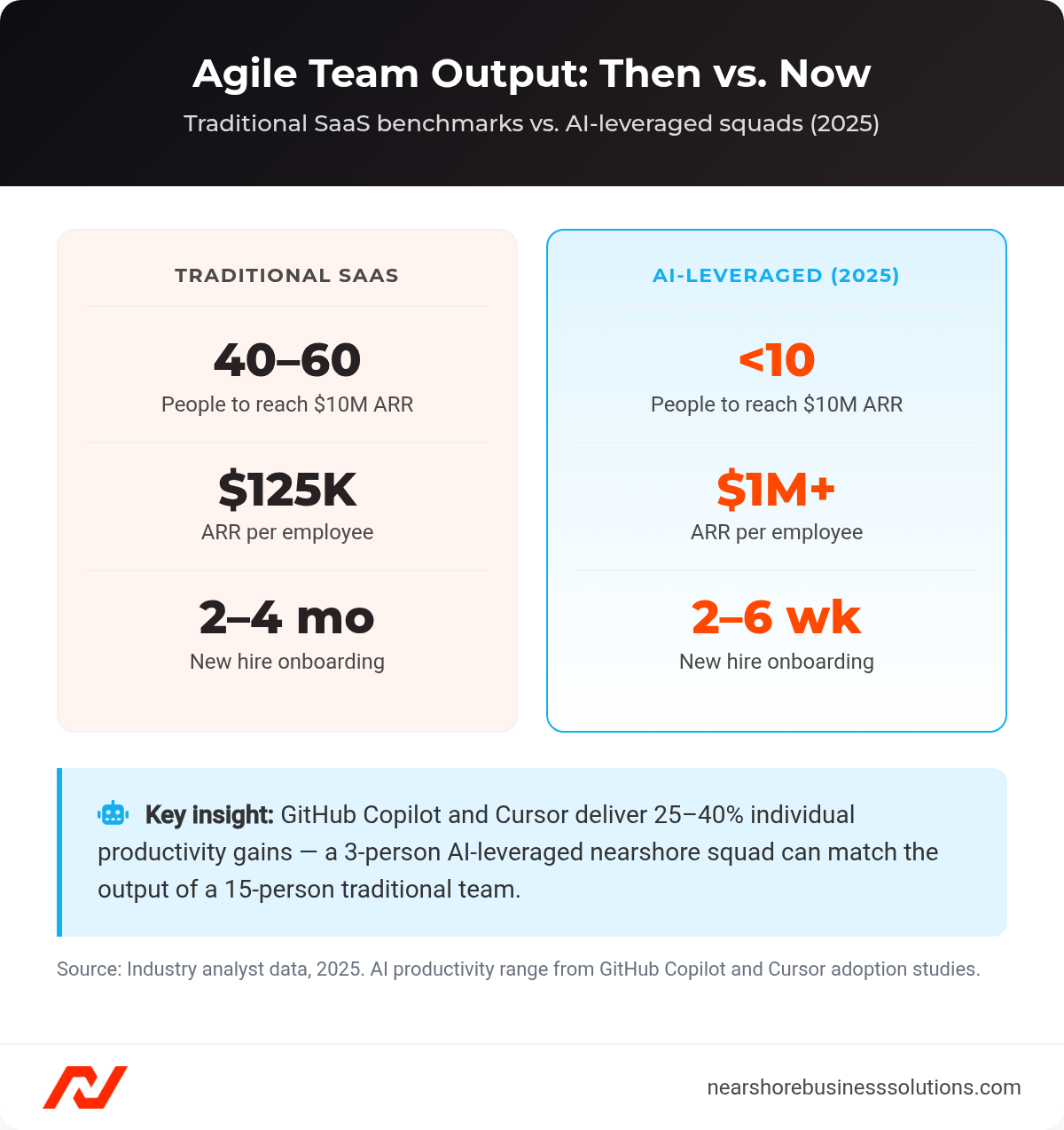
AI-leveraged agile squads reach $10M ARR with under 10 people versus 40–60 in traditional SaaS models.
We screen for technical skills, English fluency, and US work style fit. Our acceptance rate is 16%.
Every placement includes a 90-day replacement guarantee. You receive pre-vetted candidates in 2–4 weeks.
Get a free consultation to discuss your hiring needs and receive a custom quote.