
The Bureau of Labor Statistics projects a US shortage of 1.2 million software developers by 2026. LATAM answers it with roughly 1.2 million professional developers, growing 8 to 10% annually, who overlap 6 to 8 hours daily with US teams. This eight-step playbook connects hiring, onboarding, and retention into one engine that cuts employment costs 40 to 60% and fills senior roles in under 35 days.
Why Do Remote Hiring Steps Fail Before They Even Start?
Most remote hiring failures trace back to a single root cause: engineering leaders copy their on-site process, add a Zoom link, and expect equivalent outcomes. They don’t re-scope roles for async execution, define overlap-hour mandates, or audit whether their ATS can process an international candidate. The result is a hiring funnel optimized for a reality that no longer exists.
A single failed senior engineering hire costs $277,500 to $370,000 once you factor in lost productivity, recruitment spend, and ramp-up time, according to SHRM cost-of-turnover modeling applied to senior engineering salaries. Multiply by the 13.2% annual turnover rate across US tech reported by LinkedIn, or the 20 to 25% rate common at high-growth startups, and the financial exposure becomes existential.
The core failure mode is a job description designed for in-office collaboration applied without modification to a distributed role. Every remote req needs three structural rewrites before it goes live: deliverables replace presence-based expectations, async communication norms replace synchronous defaults, and overlap-hour mandates replace the unstated assumption that everyone works the same 9-to-5.
Nextdoor learned this the expensive way. Their US-only hiring process stretched time-to-hire past three months. When they shifted to a LATAM-focused strategy via Terminal, with role scoping rebuilt for distributed execution, time-to-hire dropped to four to six weeks. A bloated process doesn’t just cost you time. It costs you the best candidates, who accept offers from competitors that move faster. A structured remote talent acquisition process closes that speed gap.
How Much Does Time-Zone Alignment Actually Change Engineering Outcomes?
One hour of offset versus twelve hours of offset produces fundamentally different engineering outcomes. Sprint velocity degrades as synchronous overlap shrinks. Pair programming becomes impractical below 4 hours of overlap. Incident response turns a 30-minute P1 resolution into a 12-hour relay when the on-call engineer can’t reach the system owner in real time.
For any company on Eastern or Central Time, every major LATAM hub delivers a minimum of 6 to 8 hours of daily overlap. That covers standups, sprint ceremonies, pair programming, and incident response without forcing anyone into unsustainable off-hours schedules. The salary delta between LATAM and Southeast Asia narrows to $15K to $30K for senior roles, but LATAM delivers 4 to 7 more hours of daily overlap, half the turnover, and faster hiring timelines.
| Dimension | LATAM (Avg) | Eastern Europe | Southeast Asia / India |
|---|---|---|---|
| Time-zone overlap with US (ET/CT) | 6–8 hours | 1–3 hours | 0–1.5 hours |
| Time-to-hire (senior) | 21–35 days | 50+ days (post-2022) | 45 days |
| Annual turnover | 8–12% | 10–15% (volatile) | 20–30% |
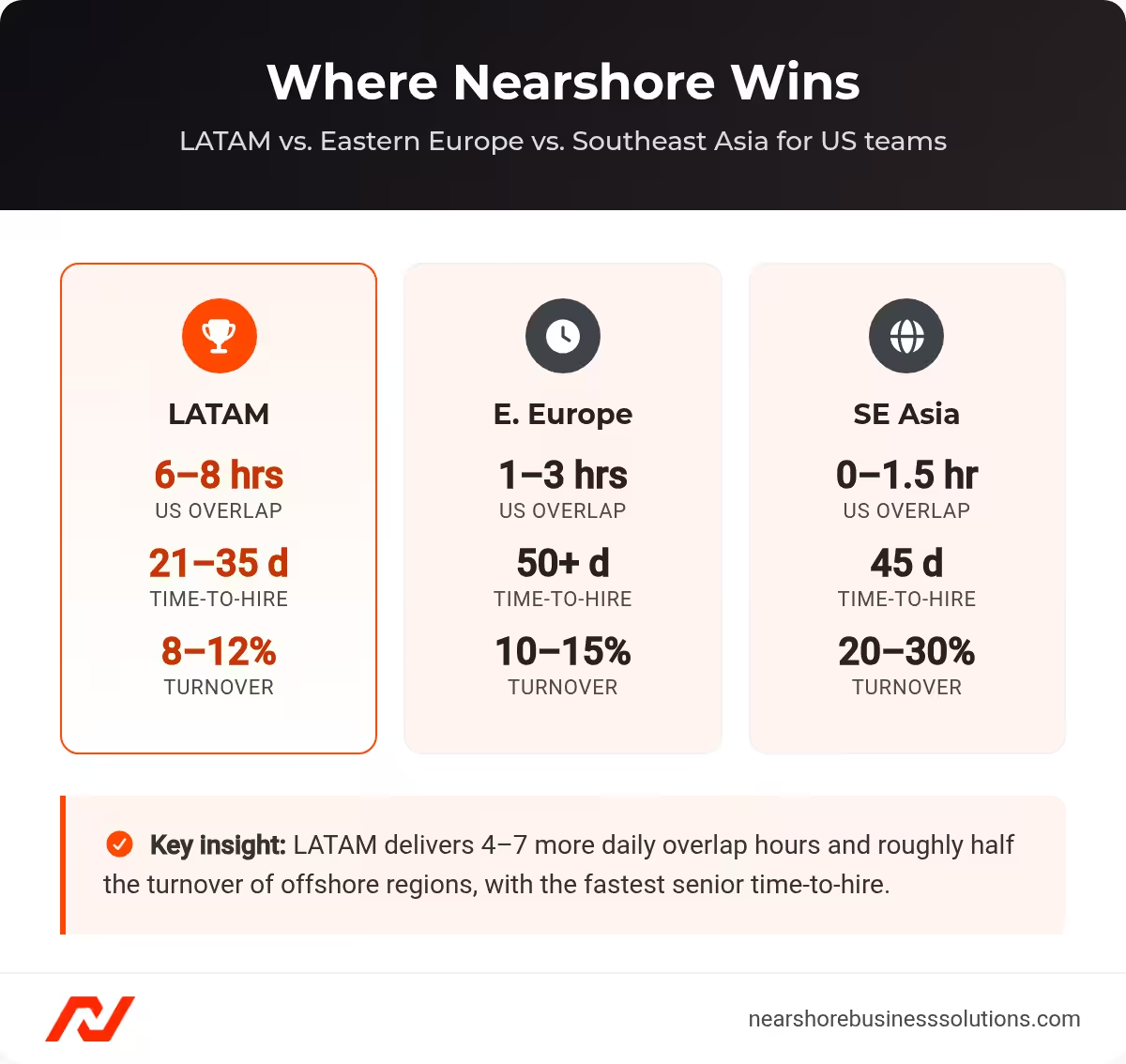
Nearshore LATAM versus offshore regions on overlap hours, time-to-hire, and turnover.
What Belongs on a Remote-Readiness Scorecard Before You Open the Req?
45% of remote employees report feeling “more disconnected” from their company than they would in an office (Owl Labs, 2023). That disconnection starts when the req opens without the infrastructure to support a distributed hire. Answer every question below before opening any remote req. A “no” on any item signals a gap that will surface as a failed hire or early attrition:
- Is the role scoped with async-compatible deliverables?
- Are required collaboration and overlap hours defined explicitly?
- Is the ATS configured for international candidates (English proficiency screen, time-zone confirmation, multi-currency offers)?
- Does the team have a documented remote communication charter?
- Is the legal and compliance pathway determined (EOR vs. contractor vs. entity)?
- Is budget approved inclusive of EOR fees ($400 to $699 per month per employee, per 2024 Deel and Remote.com published pricing)?
- Is an onboarding buddy identified in an overlapping time zone?
How Do You Hire Remote Talent From LATAM With Confidence? (Steps 1–3)
Resolve the legal vehicle question before you design the process. Contractor agreements carry serious misclassification risk under both IRS guidelines and local labor codes. Local entity setup exceeds $50,000 and consumes 6 to 12 months. The Employer of Record (EOR) is the dominant model: the EOR acts as the legal employer in the host country, handling payroll, benefits, taxes, and compliance while you retain day-to-day management. Lock in an employer of record in Latin America before you open the req.
Step 1: Define Every Role for Distributed Execution, Not Office Muscle Memory
Top LATAM engineers screen out companies whose job descriptions signal operational immaturity about remote work. For the end-to-end sequence from defining the role to onboarding, see our walkthrough on how to hire remote employees from Latin America. Stack Overflow’s 2023 Developer Survey found that 42% of developers who rejected a job opportunity cited unclear role expectations as a primary reason, a number that rises for remote roles.
Take a standard on-site responsibility, “Collaborate closely with the product team to ship features on time,” and rewrite it: “Own end-to-end delivery of 2 to 3 features per sprint. Post async standup updates in Linear by 10:30 AM CT daily. Available for synchronous pairing during the 10 AM to 2 PM CT overlap window.”
Every distributed JD needs three elements on-site JDs omit: measurable async deliverables, explicit overlap-hour mandates, and ATS-stage requirements for international candidates (English proficiency at B2/C1, tech stack verification, time-zone compatibility).
Step 2: Source Where LATAM’s Best Engineers Actually Spend Their Time
960,000-plus software developers work across four countries: Brazil (about 500,000), Mexico (about 225,000), Argentina (about 135,000), and Colombia (about 100,000). LinkedIn captures the most visible segment but misses senior engineers embedded in local companies and open-source contributors who network through community channels.
A blended sourcing approach outperforms single-channel strategies. Specialized platforms (Terminal, Revelo, Turing) compress top-of-funnel by 60 to 70%, per their published recruiter benchmarks. Region-native job boards like Getonbrd (500K-plus registered tech professionals) and Torre reach high-intent candidates. University partnerships with institutions like USP and Unicamp (Brazil), UBA (Argentina), and Universidad de los Andes (Colombia) build pipeline one to two quarters ahead of need. GitHub contributor searches tap senior specialists who don’t use traditional channels: Brazil ranks 5th globally in open-source contributions. A managed recruitment in Latin America partner runs all of these channels in parallel.
Care.com partnered with Andela to source engineers from Brazil and Argentina, filling critical senior roles in under four weeks and accessing a talent pool they had zero visibility into through existing US-centric channels.
Step 3: Design a Structured Interview Loop That Predicts Remote Success
Structured interviews predict job performance with 34% greater validity than unstructured interviews (Schmidt & Hunter, Psychological Bulletin, 1998). Google’s Project Oxygen confirmed this: structured behavioral interviews combined with work sample tests were the most reliable predictor of engineering success. The failure mode for cross-cultural hiring is specific. Unstructured interviews reward verbal fluency and cultural mirroring, not engineering competence.
Build your loop as four stages:
- Initial Screen (20 min, sync): Recruiter-led video call evaluating English proficiency (B2/C1), time-zone fit, and motivation alignment.
- Async Take-Home Challenge (3–4 hrs): Practical coding challenge scoped to the role’s tech stack. Evaluate code quality, problem-solving, documentation habits, and test coverage.
- Live Pair-Programming (60 min, sync): Collaborative coding via VS Code Live Share or Tuple. Evaluate real-time problem decomposition, communication under pressure, and debugging approach.
- Collaboration Simulation + Behavioral (45–60 min, sync): Write a Slack message explaining a technical blocker to a non-technical PM, record a 3-minute Loom of a design decision, and provide written PR feedback, followed by structured behavioral questions on async conflict resolution.
The collaboration simulation is the highest-signal stage for remote hires. It tests the exact skills the engineer will use every day, in the exact formats they’ll use them.
What Does It Actually Take to Onboard Remote Employees Who Ramp in Half the Time?
Organizations with strong onboarding improve new hire retention by 82% and productivity by over 70% (Brandon Hall Group). Yet most engineering leaders treat onboarding as a logistics exercise. Employees who report great onboarding are 2.6 times more likely to be extremely satisfied with their workplace (Gallup), and 69% stay for at least three years (SHRM Foundation). Onboarding is the highest-impact retention lever available, above compensation adjustments, title changes, or perks.
Step 4: Adapt the 30-60-90 Day Framework for Nearshore Engineers
An anonymized FinTech ($50M ARR) hired eight senior full-stack engineers from Brazil. After 18 months it reported 100% retention of the initial cohort, and the nearshore team’s sprint velocity exceeded the domestic average by 15%. That happened because structured onboarding exploited LATAM’s time-zone advantage for real-time mentorship.
| Phase | Key Activities | Owner | Success Metrics |
|---|---|---|---|
| Days 1–30 | Pre-configured laptop delivery, system access, daily buddy check-ins, codebase walkthroughs, first small coding task, intro to product roadmap | Manager, Buddy, People Ops | First commit merged, all systems accessed, buddy cadence established |
| Days 31–60 | Own a medium-sized feature, present demo at team meeting, contribute to code reviews, receive specific feedback on technical work and communication | Manager, New Hire | Feature shipped, active in code reviews, 60-day check-in completed |
| Days 61–90 | Lead a significant project, identify codebase improvements, set 6–12 month goals | Manager, New Hire | Solo feature shipped, performance goals documented, buddy transitions to peer |
Step 5: Pair Cultural and Technical Onboarding With a Cross-Border Buddy System
Despite cultural proximity, LATAM engineers need intentional onboarding to US team norms. Hofstede data reveals real gaps. Power Distance scores (Mexico 81, Brazil 69 vs. US 40) mean new hires may be less likely to push back or ask questions of managers. High Uncertainty Avoidance (Mexico 82, Brazil 76 vs. US 46) means clear documentation matters more. Onboarding must explicitly address these norm gaps.
The buddy system is the delivery mechanism for both cultural and technical integration. Pair new LATAM hires with someone who shares at least 4 overlap hours. The buddy is not a manager or mentor. They are a “context translator” who answers questions the new hire doesn’t know to ask. Cadence: daily check-ins week 1, three times per week weeks 2 to 4, weekly through month 3, then transition to a standard peer relationship. Equip buddies with async tools: Loom for pre-recorded architecture walkthroughs, dedicated Slack channels (#new-hires, #dev-questions), and scheduled virtual coffee chats for informal relationship-building.
How Do You Build Remote Talent Retention Into Every Sprint?
Retention is an engineering-systems problem, not an HR problem. Research across Buffer, GitLab, and Owl Labs (2023–2024) reveals the top five drivers: challenging work, compensation, career growth, flexibility, and team belonging. Compensation is #2, not #1. Belonging, growth, and meaningful work outweigh pay.
Step 6: Benchmark Compensation That Respects LATAM Markets Without Exploiting Them
Pay in USD and benchmark annually against the 75th percentile of the local market. Grant stock options or RSUs on the same schedule as US employees, a major differentiator. A senior backend engineer in Mexico costs $90K to $101K fully loaded via EOR versus $240K to $259K in the US, a 55 to 65% savings that funds competitive local compensation without a race to the bottom.
| Role | US (Avg) | Mexico | Colombia | Argentina | Brazil |
|---|---|---|---|---|---|
| Senior Backend | $185,000 | $75,000 | $70,000 | $65,000 | $80,000 |
| Senior Full-Stack | $190,000 | $80,000 | $75,000 | $70,000 | $85,000 |
| Senior DevOps | $195,000 | $85,000 | $80,000 | $75,000 | $90,000 |
| Senior Data Engineer | $200,000 | $90,000 | $85,000 | $80,000 | $95,000 |
US total loaded cost: 1.3x–1.4x base. LATAM via EOR: 1.2x–1.35x base. Sources: Terminal, Arc.dev, Glassdoor, Levels.fyi (2024).
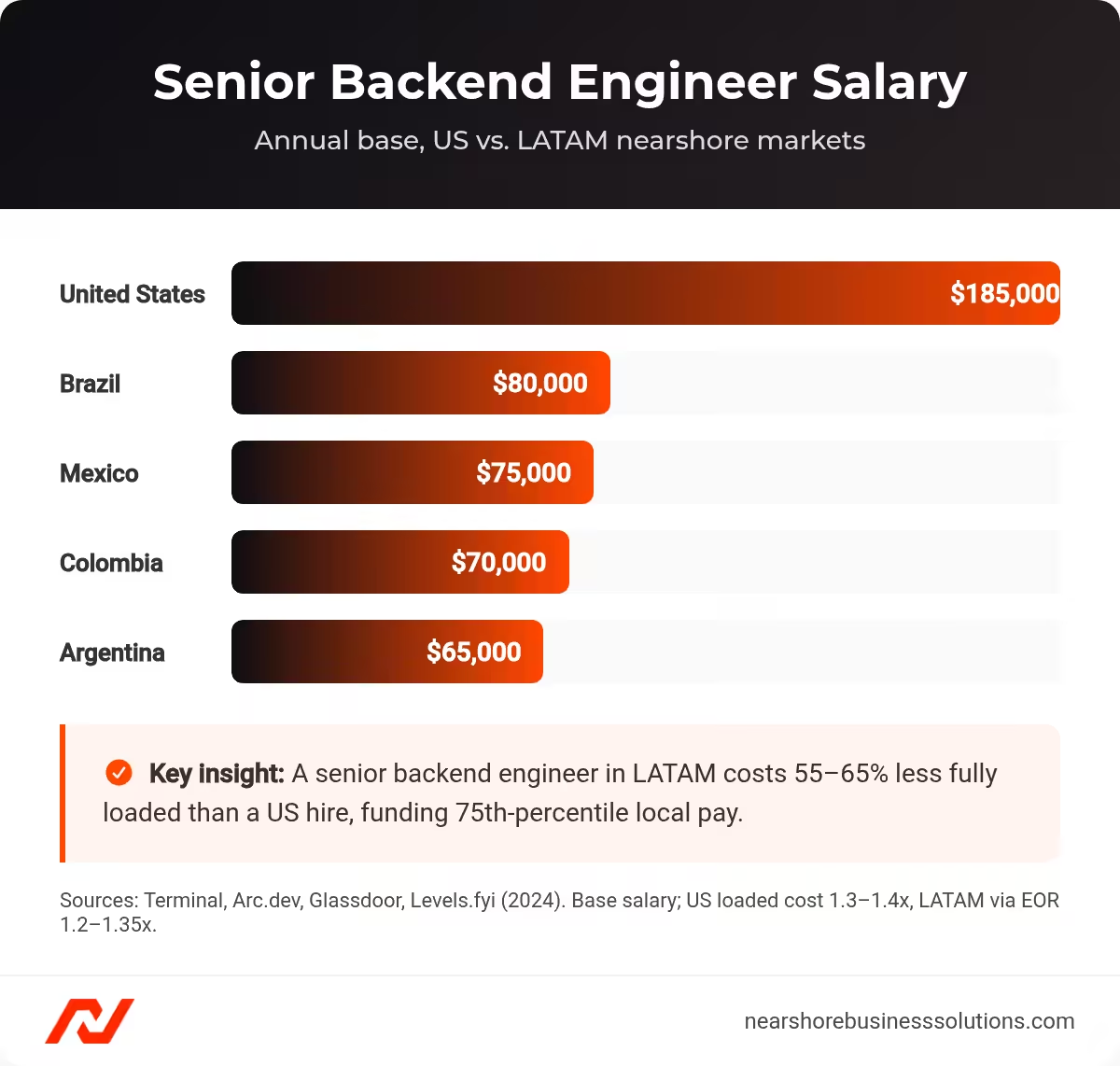
Senior backend engineer base salaries across the US and four LATAM markets.
Step 7: Build Career Ladders, Not Career Ceilings
The #1 reason senior LATAM engineers leave is that they hit an invisible ceiling. Create and document a technical career ladder (Engineer I → II → Senior → Staff → Principal) that is globally consistent. Include skip-level 1:1s, conference sponsorships, and internal mobility as concrete retention levers. Zapier built its entire engineering organization on a remote-first model with globally consistent career paths and famously high retention. As CEO Wade Foster stated: “We want the best person for the job, regardless of their address.”
Step 8: Build Async Rituals That Make Remote Engineers Feel Like Insiders, Not Contractors
Belonging is the retention lever most remote programs neglect, and the one LATAM engineers cite most when they stay. Build it into every sprint: async standups with personal check-ins, recorded all-hands where remote engineers present alongside HQ staff, Slack channels for non-work interests, and quarterly virtual offsites. Great manager and team culture, the feeling of psychological safety, ranks among the top five retention drivers. Engineers who feel like insiders contribute like insiders. Engineers who feel like contractors update their resumes.
Frequently Asked Questions
How long does it take to hire a LATAM engineer?
Time-to-hire for senior LATAM engineers runs 21 to 35 days, versus 50-plus days for Eastern Europe and 45 days for offshore. A managed nearshore process with pre-vetted candidates can deliver a shortlist in days rather than weeks.
What if a remote engineer doesn’t work out?
Structured onboarding and a 90-day buddy system catch fit problems early, inside the first 30 to 60 days. Pairing this with an EOR model means you can offboard cleanly and compliantly under local labor law without carrying entity risk.
Do I need a local entity to hire in Latin America?
No. An Employer of Record lets you hire compliantly without entity setup, which otherwise exceeds $50,000 and takes 6 to 12 months. The EOR is the legal employer in-country, handling payroll, benefits, and taxes while you manage the work.
How do I pay LATAM engineers?
Pay in USD and benchmark annually against the 75th percentile of the local market. EOR fees run $400 to $699 per month per employee on top of salary, and a senior backend engineer in Mexico still costs 55 to 65% less fully loaded than a US equivalent.
What’s the difference between nearshore and offshore?
Nearshore LATAM delivers 6 to 8 hours of daily US time-zone overlap versus 0 to 1.5 hours for offshore Asia. That overlap enables real-time standups, pair programming, and incident response, and it correlates with 8 to 12% turnover versus 20 to 30% offshore.
Ready to Build Your LATAM Engineering Team?
Nearshore Business Solutions sources, vets, and onboards senior engineers across Brazil, Mexico, Colombia, and Argentina. We screen for technical skills, English fluency, and US work-style fit, then handle EOR compliance so your team goes live in weeks, not quarters.
The eight steps form a single system. A JD scoped for distributed execution attracts the right candidates. A structured interview loop selects for remote competence. A 90-day onboarding framework with a cross-border buddy accelerates ramp. Competitive compensation, visible career ladders, and intentional belonging rituals keep engineers engaged past the one-year mark.
Book a LATAM hiring consultation to get a custom sourcing plan and salary benchmark for your roles.