
Nearshore software development services cut senior developer costs 50-60% versus US rates, per a 2024 global software outsourcing salary and rates guide. You get dedicated engineering teams in Mexico, Colombia, Argentina, and Brazil working your time zone, within a 1-4 hour difference.
LATAM senior developers cost $65,000-$88,000 per year versus $165,000 in the US. Staff augmentation fills roles in 1-3 weeks versus 6-8 weeks for domestic hires. The nearshore outsourcing segment grows at 10.5% CAGR through 2030, outpacing offshore (8.9%) and onshore (6.2%), per Deloitte’s 2023 Global Outsourcing Survey.
We connect you with vetted engineers from tech hubs in Bogota, Guadalajara, Buenos Aires, Medellin, and Sao Paulo. Each engineer is screened for technical skills, English fluency, and US work style fit. This guide covers the full capability catalog, engagement models, pricing, and how to choose the right provider.
Why Are CTOs Shifting Engineering Budgets to Nearshore Development?
CTOs are switching because US senior developer costs now average $247,500 per year. That figure includes the $165,000 base salary, 30% benefits load, 20% recruiting fee, and the actuarial cost of an 18-month tenure followed by a $40,000+ replacement cycle. A nearshore staff augmentation engagement delivers an equivalent senior developer for an estimated $105,000 per year.
Three forces made this shift structural. First, post-pandemic remote work proved co-location is optional. Collaboration tooling matured. The “butts in seats” objection disappeared. Second, US domestic talent pools contracted while salary expectations inflated. Cloud Architects now command $190,000+ in base salary. The average US tech hire takes 6-8 weeks to close. Third, offshore engagements in India and Southeast Asia produced widespread risk fatigue from 10-12 hour time zone gaps that drag on sprint velocity, incident response, and team cohesion.
According to Deloitte’s 2023 Global Outsourcing Survey, 45% of IT leaders cited nearshoring as a key part of their 2024-2025 strategy, up from 32% in 2021. A growing number of Fortune 100 companies already use some form of LATAM technology services, including Walmart, Google, Citibank, and Johnson & Johnson.
What Do Offshore Time Zone Gaps Actually Cost?
Offshore time zone gaps cost an estimated 15-25% in productivity, per Gallup’s State of the Global Workplace research on async collaboration friction. A pull request submitted at 5 PM in Bangalore sits unreviewed until 8 AM Pacific. A blocker raised during India’s morning standup doesn’t reach the US team until their afternoon. That delay compounds across a squad of eight engineers over a six-month engagement and shrinks the headline 70% salary savings considerably.
| Cost Factor | Offshore Impact | Nearshore Impact |
|---|---|---|
| Time Zone and Velocity | 9.5-12.5 hr gap; estimated 15-25% productivity loss (Gallup) | 4-8 hours of real-time overlap; same-day PR reviews |
| Rework Rates | Async requirement clarification increases wrong-feature builds | Real-time clarification reduces rework by an estimated 5-10% |
| Communication Overhead | Language and cultural gaps require heavier documentation | High English proficiency and Western cultural affinity |
| Travel Costs | SF to Bangalore: 20+ hours, $1,500-$2,500 per trip | Miami to Medellin: 3.5 hours, $300-$500 per trip |
| Management Attention | Requires dedicated bridge management and cultural translation | Teams operate as direct extensions of the US squad |
Cars.com validated these dynamics at scale. Partnering with Gorilla Logic in Costa Rica, the company reported significant development velocity gains. The nearshore squad joined every sprint ceremony in real time, reviewed pull requests within hours instead of overnight, and participated in live incident response alongside US-based SREs.
How Does Nearshore Fit Into a CTO’s Build, Buy, or Partner Decision?
Nearshore fits the “partner” decision when you need senior capacity fast and want to stay below $110,000 per engineer. A nearshore staff augmentation engagement delivers a senior developer for $105,000 annually, a 58% reduction versus the $247,500 first-year cost of a US hire.
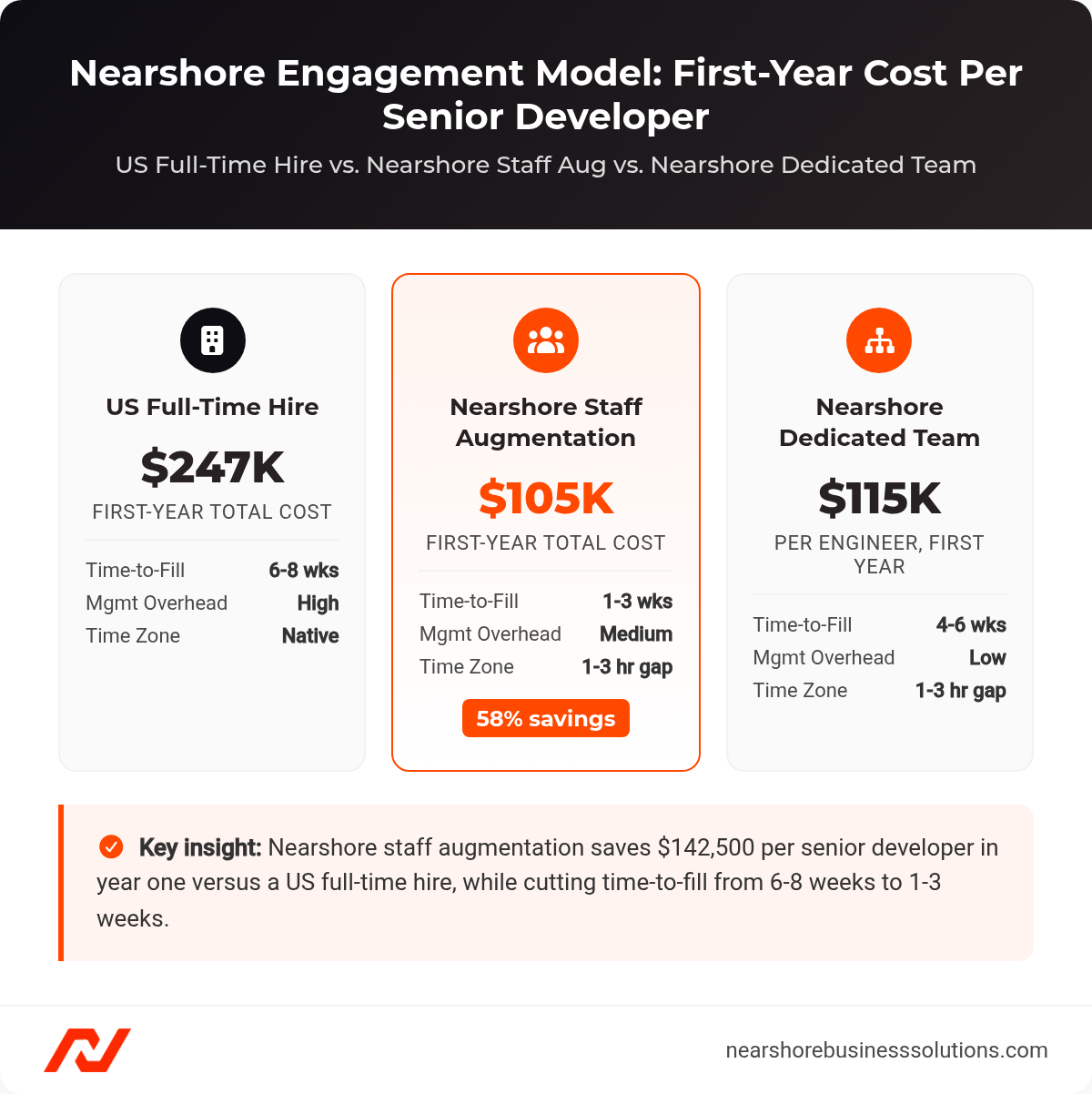
Nearshore staff augmentation saves $142,500 per engineer in year one versus a US full-time hire.
| Dimension | Full-Time US Hire | Nearshore Staff Aug | Nearshore Dedicated Team | Offshore (India) |
|---|---|---|---|---|
| Total First-Year Cost (Sr. Dev) | $247,500 | $105,000 (58% savings) | $115,000 (54% savings) | $75,000 (70% savings) |
| Time-to-Fill | 6-8 weeks | 1-3 weeks | 2-4 weeks | 2-4 weeks |
| Cultural and Time Zone Alignment | Native | High (1-3 hr gap) | High | Low (10-12 hr gap) |
| Management Overhead | High | Medium | Low (provider-managed) | Very High |
Three decision rules: default to nearshore staff augmentation when you need senior capacity fast at under $110,000. Choose a dedicated team when spinning up a new product line that needs its own roadmap and PM layer. Reserve full-time US hires for roles requiring deep institutional context, such as staff engineering, principal architecture, and engineering management positions.
What Can a Nearshore Software Development Company Actually Build?
Modern nearshore firms operate as full-lifecycle engineering partners, not staff shops. The best providers maintain practice leads across custom development, QA automation, DevOps, cloud architecture, and managed operations. Each practice has defined engagement models, toolchain certifications, and outcome-based SLAs.
For a detailed breakdown of nearshore IT capabilities and how they map to US enterprise requirements, see our Nearshore IT Solutions guide.
What Does Custom Software Development Include?
Custom software development starts with a 2-4 week discovery phase. A senior architect and product strategist decompose requirements into an architectural blueprint, identify technical risks, define acceptance criteria, and produce a prioritized backlog before a single line of production code ships.
MVP development represents the most common entry point. A well-defined MVP runs $50,000-$100,000 under a fixed-price contract and ships in 3-4 months. Post-launch, the engagement model shifts to Time and Materials, giving both the engineering team and the CTO flexibility to reprioritize sprint-over-sprint as user data reshapes the roadmap. Average project duration for a net-new product: 6-9 months. Top-tier LATAM providers like Wizeline in Guadalajara and Encora in Mexico City report on-time, on-budget delivery rates exceeding 90%, per their published client case studies.
Code review and technical audit engagements provide immediate diagnostic value for CTOs inheriting legacy systems or evaluating acquisition targets. A senior architect reviews your codebase for quality, security vulnerabilities, scalability constraints, and maintainability debt. The engagement runs on a fixed fee of $10,000-$25,000 and delivers a prioritized remediation roadmap ranked by risk severity.
How Do Nearshore QA and Test Automation Teams Work?
Nearshore QA teams can meaningfully reduce production bug density and increase test coverage within six months of engagement. The shift-left distinction is structural: SDETs join sprint planning, write test cases alongside story acceptance criteria, and build automation in parallel with feature development. For a deeper playbook on making that shift durable, see our guide to shift-left QA best practices.
The capability spectrum covers manual testing, test automation using Selenium, Cypress, and Playwright, performance and load testing with JMeter and Gatling, security testing via OWASP ZAP, and structured daily code reviews targeting a high first-submission pass rate.
The cost advantage is decisive. A US-based SDET commands $130,000 in base salary. A nearshore equivalent in Bogota or Buenos Aires ranges from $50,000 to $62,000, a 50-62% savings per published 2024 nearshore salary benchmarks, without removing the engineer from your daily standup or sprint retrospectives.
What DevOps and Cloud Engineering Capabilities Are Available?
Nearshore DevOps engineers in Mexico average $85,000, Colombia $80,000, Argentina $75,000, and Brazil $88,000, averaging 53% savings versus a US DevOps engineer at $175,000, per published 2024 nearshore salary benchmarks. Brazil and Mexico lead in certified professionals across AWS, Azure, and GCP.
The capability set spans infrastructure-as-code using Terraform, Pulumi, and Ansible; CI/CD pipeline design with Jenkins, GitLab CI, GitHub Actions, and ArgoCD; cloud migration; Kubernetes orchestration; and monitoring using Prometheus, Grafana, and Datadog. Nearshore DevOps engineers integrate directly into US CI/CD pipelines. This enables real-time build monitoring across the entire US business day without overnight handoffs.
What SLA Commitments Can You Get From Managed Operations?
Nearshore managed operations teams deliver contractual SLA commitments across three tiers. A team in Bogota, Guadalajara, or Sao Paulo covers 8 AM-6 PM Eastern natively. Extending to 24/5 requires only a modest shift rotation across two LATAM time zones.
| SLA Component | Bronze | Silver | Gold |
|---|---|---|---|
| Coverage Hours | US business hours (M-F) | Extended (7 AM-10 PM ET) | 24/5 plus weekend on-call |
| Critical Issue Response | 60 minutes | 30 minutes | 15 minutes |
| Uptime Guarantee | 99.5% | 99.9% | 99.95% |
| Engineer Attrition SLA | — | Less than 8% annually | Less than 5% annually |
| Sprint Velocity Consistency | — | Plus or minus 15% sprint-over-sprint | Plus or minus 10% sprint-over-sprint |
How Do Nearshore Software Services Scale to Match Your Engineering Roadmap?
Three engagement models exist. Each optimizes for a different variable: speed, autonomy, or scope certainty. Choosing the wrong one costs more than the talent itself. For a comparison of staff augmentation versus other nearshore models, see our Staff Augmentation vs. Nearshoring guide.
How Does Nearshore Staff Augmentation Work?
Staff augmentation delivers three pre-vetted senior candidates within 72 hours. Your manager interviews them using the same rubric applied to domestic hires. The selected engineer appears in your Jira board, your GitHub org, and your Monday standup within days. The provider handles payroll, benefits, local compliance, and career development. You handle technical direction. For a detailed look at how this model works in practice, see our Staff Augmentation service page.
Time-to-start compresses the hiring cycle by 60-80%: one to three weeks from request to onboarding versus six to eight weeks domestically. Veeva Systems validated the retention economics directly. After augmenting core product teams with specialized engineers in Argentina, the company sustained a 97% retention rate across a two-year engagement.
Gusto demonstrated the scaling economics. Partnering with a nearshore hiring platform in Mexico, Gusto accessed an engineering talent pool outside the hyper-competitive Bay Area market and achieved an estimated 50% reduction in fully loaded per-engineer costs.
For details on how NBS sources and vets talent, see our Nearshore IT Staffing guide.
When Does a Dedicated Nearshore Team Make Sense?
A dedicated team makes sense when you need a cross-functional pod that owns its own roadmap, not just individual contributors embedded in your team. The provider assembles three to five developers, one QA engineer, and a part-time PM and Scrum Master. The pod reaches operational readiness in four to six weeks.
| Dimension | Staff Augmentation | Dedicated Team |
|---|---|---|
| Control Model | Client manages directly | Provider manages daily operations; client sets strategy |
| Management Overhead | Medium | Low |
| Team Composition | 1-3 individuals | Cross-functional pod (5-7) |
| Best-For Scenario | Backlog surges, skill-gap fills | New product lines, platform modernization |
| Ramp-Up Time | 1-3 weeks | 4-6 weeks |
Zapier scaled its engineering organization by over 50 nearshore engineers structured as dedicated pods. The result was an estimated 30% acceleration in product roadmap delivery with high-quality hires onboarded three times faster than comparable US cycles. ServiceTitan assembled a dedicated team in Colombia that launched a new product line six months ahead of the internal schedule, saving an estimated $1.2 million in first-year operational costs versus a California-based build. For SaaS founders mapping this to their own stage, our nearshore development playbook for SaaS startups lays out the hiring sequence from seed through Series B.
What Is Project-Based Fixed-Scope Delivery?
Project-based delivery transfers delivery risk from the client to the provider via fixed-price, milestone-gated contracts. Payments release at milestone completion. This risk transfer comes at a cost: scope rigidity. Every requirement change triggers a change-order process that adds one to three weeks of overhead per modification.
Three scenarios justify fixed-scope delivery: compliance-driven builds such as SOC 2 remediation and HIPAA pipelines where scope is externally defined; one-time system builds like customer portals and data migrations with clear completion criteria; and MVPs for validation where fixed scope bounds the investment and forces discipline. Toast demonstrated fixed-scope economics by working with Improving in Mexico to complete a project-based integration build 35% under budget.
What Does Nearshore Software Development Cost?
Nearshore senior developers cost 54-58% less than US equivalents on a total first-year basis. The table below shows role-by-role benchmarks across the primary LATAM markets, per published provider surveys.
| Role | United States | Mexico | Colombia | Argentina | Brazil |
|---|---|---|---|---|---|
| Sr. Full-Stack Dev | $165,000 | $75,000 | $70,000 | $65,000 | $78,000 |
| DevOps Engineer | $175,000 | $85,000 | $80,000 | $75,000 | $88,000 |
| QA / SDET | $130,000 | $60,000 | $55,000 | $50,000 | $62,000 |
| Engineering Manager | $220,000 | $110,000 | $100,000 | $95,000 | $115,000 |
| Cloud Architect | $190,000 | $95,000 | $90,000 | $85,000 | $100,000 |
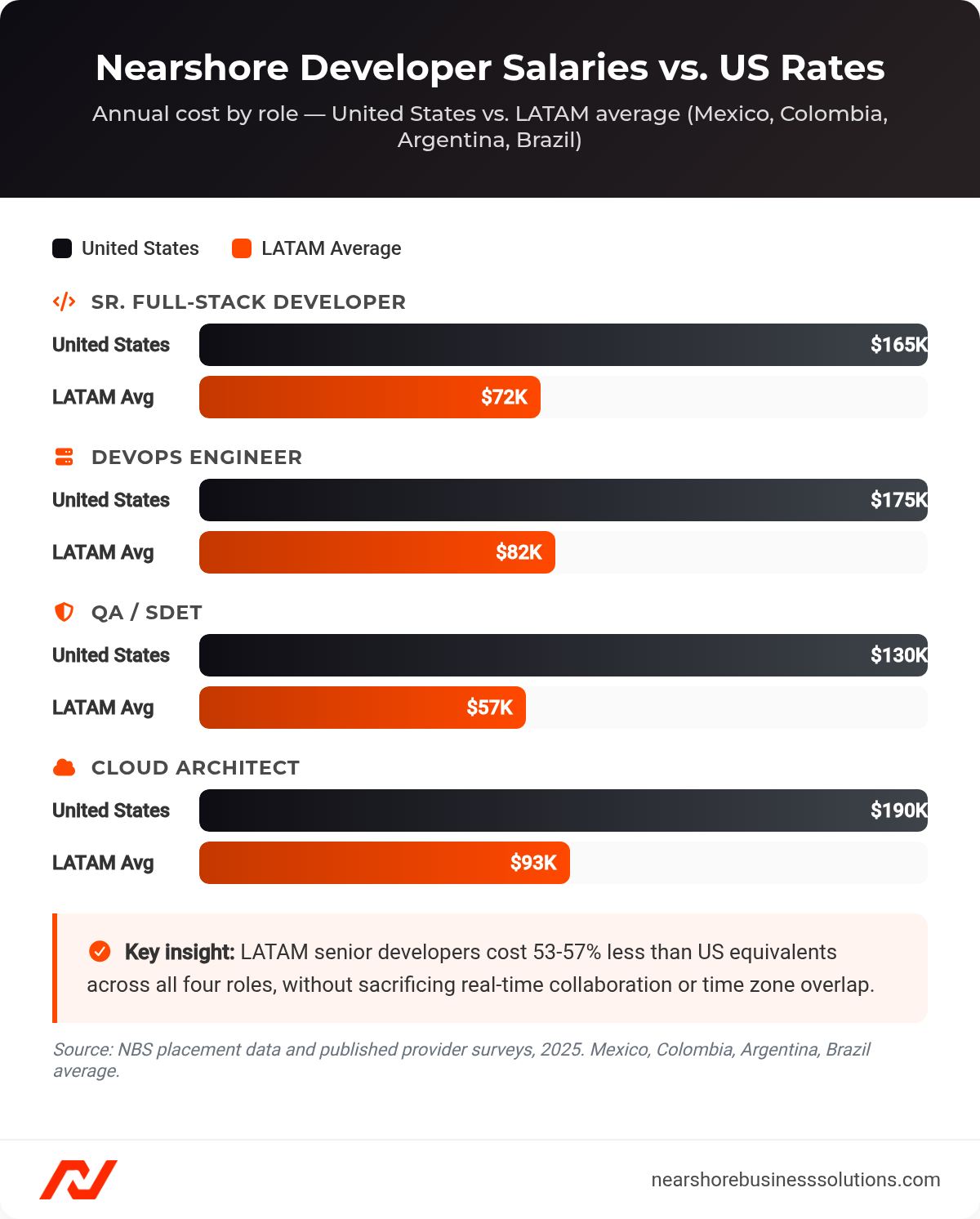
LATAM senior developers cost 53-57% less than US equivalents across all four engineering roles.
Time and Materials contracts, the most common model for agile projects, benchmark at $60-$85/hour for senior LATAM developers. Fixed-price contracts suit bounded scopes like MVPs. Retainers cover ongoing managed operations priced by systems covered and SLA tier. For a detailed pricing breakdown by engagement model, see our Nearshore Development Pricing Models guide.
What Is the Total First-Year ROI on a Five-Person Team?
A five-person US in-house team costs approximately $1,237,500 in year one (five engineers at the $247,500 fully loaded cost). A nearshore dedicated team costs approximately $575,000 (five engineers at $115,000), a savings of roughly $662,500. Eventbrite validated this at scale, achieving a 40% reduction in development costs for nearshore-handled projects and 25% faster time-to-market for new mobile ticketing features through its nearshore engineering partnership in Argentina and Colombia.
The hidden cost multipliers for offshore erode its headline 70% savings: 15-25% productivity loss from time zone misalignment (per Gallup research), an estimated 5-10% higher rework rates, and very high management overhead narrow the effective advantage significantly when compared to nearshore’s 54-58% savings delivered without those penalties.
What Are the Most Frequently Asked Questions About Nearshore Software Development Services?
These are the most common questions CTOs and VPs of Engineering ask before engaging a nearshore software development provider.
How Long Does It Take to Start with a Nearshore Team?
Staff augmentation delivers candidates within 72 hours and onboards your first engineer in 1-3 weeks. Dedicated team assembly takes 4-6 weeks to reach operational readiness. Both timelines assume a complete job description and a single-stage interview process on your side.
What Happens If a Nearshore Developer Doesn’t Work Out?
NBS includes a 90-day replacement guarantee on every placement. If a developer leaves or doesn’t meet expectations within 90 days, we replace them at no additional cost. Replacement cycles average 1-2 weeks because the replacement candidate is sourced from the same pre-vetted pool.
Who Owns the IP on Code Written by Nearshore Engineers?
IP ownership transfers to you under standard work-for-hire clauses. Each engineer signs an individual NDA before starting. Your provider’s master services agreement reinforces this at the company level. This applies to all countries where NBS operates.
How Do I Pay Nearshore Developers?
You pay NBS a monthly retainer or hourly rate, depending on your engagement model. NBS handles payroll, benefits, local labor compliance, and tax obligations for each developer in their home country. You receive a single consolidated invoice in USD.
What Is the Difference Between Nearshore and Offshore?
Nearshore means hiring in countries within 1-4 time zones of your US headquarters, typically Mexico, Colombia, Argentina, Brazil, and Costa Rica. Offshore means hiring in countries 8-12 hours away, typically India, the Philippines, or Eastern Europe. The 15-25% productivity loss from offshore time zone misalignment narrows the effective cost advantage from 70% to closer to 40-50% when fully accounted for.
Do I Need a Local Legal Entity to Hire Nearshore?
No. NBS operates as the employer of record in each country, which means you access senior talent in Bogota, Guadalajara, Buenos Aires, and Sao Paulo without setting up a local entity. Local entity setup takes 3-6 months and adds significant legal and compliance overhead.
How Do You Screen Nearshore Engineers?
Our vetting process screens for three things: technical skills, English fluency, and US work style fit. We run live coding exercises under time pressure, not multiple choice tests. We verify references from US-based companies.
How Do You Get Started Scaling Your Engineering Team with Nearshore Talent?
Nearshore Business Solutions sources and vets senior developers across Mexico, Colombia, Argentina, and Brazil. We handle sourcing, compliance, and career development. You handle technical direction. Every placement includes a 90-day replacement guarantee.
See how our talent acquisition process works and receive a custom quote for your team requirements.