
Nearshore outsourcing in Latin America saves US tech companies 40-60% on engineering costs while delivering same-timezone collaboration with developers in Mexico, Colombia, Argentina, Brazil, Chile, and Uruguay.
LATAM engineers cost $30-85/hour versus $75-220/hour in the US. Time zone overlap reaches 6-9 hours daily with every major US region. Attrition runs 10-15% annually versus 20-25% in India, saving over $250K per 10-person team across two years.
Below you will find data-backed benchmarks on all 12 nearshore outsourcing benefits. We source developers from Guadalajara, Medellin, Buenos Aires, Bogota, Sao Paulo, and Montevideo. Each candidate is vetted for technical skills, English fluency, and US work-style fit.
Why Are US Engineering Teams Replacing Offshore with LATAM Nearshore?
42% of enterprises plan to increase nearshore usage in 2026 versus just 28% for offshore, according to Everest Group’s Q3 2023 Global Sourcing survey. Three structural drivers are accelerating this shift.
First, 68% of engineering leaders cite time zone alignment as a primary factor in improving sprint velocity, per HFS Research’s 2023 survey of 350 G2000 enterprise leaders. Second, 55% point to cultural proximity and communication quality. Third, 47% are diversifying talent locations to reduce dependence on India and Eastern Europe.
Published global hiring data showed 161% growth in US companies hiring across Latin America in the first half of 2022. LinkedIn Economic Graph data showed a 40% year-over-year jump in US job postings targeting LATAM software developers from 2022 to 2023.
What Does the $587.5 Billion IT Outsourcing Market Shift Mean for Your Team?
The global IT outsourcing market will reach $587.5 billion by 2027, according to Grand View Research. The fastest-growing segment is nearshore, not offshore. Statista projects Latin America’s IT services market alone will hit $85.6 billion as US engineering leaders abandon 12-hour async gaps for real-time collaboration.
For a VP Engineering at a $5M-$100M ARR company, this shift has a concrete implication. Teams that switch from India to LATAM nearshore typically recover the onboarding cost within 6-9 months through reduced attrition, faster code review cycles, and lower management overhead. Early-stage teams feel these gains fastest, as our breakdown of the benefits of hiring Latin American remote workers lays out. Those gains are part of a broader set of advantages of nearshore outsourcing for US companies spanning cost, talent access, and time-zone alignment.
How Does Time Zone Overlap Multiply Sprint Velocity?
LATAM tech hubs deliver 6-9 hours of daily overlap with every major US time zone. No offshore region matches this. MIT Sloan found that teams with at least four hours of daily overlap report 32% higher project success rates than teams operating asynchronously.
| US Time Zone | Mexico City (UTC-6) | Bogota (UTC-5) | Lima (UTC-5) | Sao Paulo (UTC-3) | Buenos Aires (UTC-3) |
|---|---|---|---|---|---|
| Pacific (PT) | 7 hrs | 6 hrs | 6 hrs | 4 hrs | 4 hrs |
| Central (CT) | 9 hrs (full) | 8 hrs | 8 hrs | 6 hrs | 6 hrs |
| Eastern (ET) | 8 hrs | 9 hrs (full) | 9 hrs (full) | 7 hrs | 7 hrs |
For deeper comparisons across Southern Cone markets, see our analysis of Chile vs Peru vs Uruguay nearshore hiring.
What Does the Data Show About PR Cycle Times and Code Review?
Same-day code review is the core productivity advantage. GitHub’s 2023 Octoverse report found that high-performing organizations merge pull requests in under six hours. PRs unreviewed for 24 hours are 2x more likely to require additional revision rounds.
An offshore team in India operating on a 13.5-hour gap delivers 65-75% of planned story points per sprint. PRs pushed at end-of-day reach US leads 12 hours later. Each review cycle averages 2.3 round-trips over 3-4 calendar days.
A nearshore team in Colombia on a 3-hour gap delivers 90-95% of planned story points. Building that kind of Colombian team usually begins with local sourcing, covered in our guide to recruitment agencies in Colombia. PRs are reviewed within 1-2 hours, averaging 1.2 round-trips. Most merge the same day.
An anonymized FinTech client increased sprint velocity by 15% after transitioning to Colombia and Mexico teams, per a 2023 nearshore platform case study. Zapier built significant engineering pods in Latin America and achieved an estimated 40% reduction in talent costs while increasing development velocity.
How Does Real-Time Incident Response Reduce MTTR?
PagerDuty’s 2023 State of Digital Operations report found that organizations with on-call rotations across compatible time zones resolve P1 incidents 29% faster. For a company processing $50K per hour in transactions, the difference between a 45-minute and 4-hour resolution is $162,500 in direct revenue exposure per incident.
Offshore teams on 10-12 hour gaps cannot support real-time incident response during US business hours without requiring engineers to work nights. LATAM teams in Guadalajara or Montevideo are online during standard US working hours.
Why Does Eastern Europe Still Create Async Bottlenecks?
Warsaw sits at UTC+1: a 9-hour gap with US Pacific. For Pacific-based teams, overlap is near zero during standard hours. Eastern teams get roughly 3 hours.
A 2024 Clockwise report found that engineering teams with fewer than four hours of overlap spent 37% more time in formal meetings to compensate for lost informal communication.
Eastern Europe also carries compliance costs LATAM avoids. EU member states (Poland, Romania) trigger GDPR obligations. 60% of US companies contracting with EU-based providers incurred unbudgeted compliance costs averaging $47,000 per engagement in year one, per IAPP-EY 2023.
Why Does Cultural Alignment Give LATAM Nearshore an Edge?
US engineering managers gave LATAM teams an average NPS of +55 for communication and collaboration, versus +20 for offshore teams in Asia, according to a 2023 survey presented at the Nearshore Americas Executive Summit. That 35-point gap signals a structurally different working relationship.
How Does Power Distance Affect Agile Team Performance?
Hofstede’s Power Distance Index exposes the structural problem with offshore agile teams. India scores 77 and the Philippines 94. LATAM tech teams operate at 38-55 within tech cohorts.
High power distance cultures inhibit agile through three dysfunction patterns. Blocker concealment: engineers attempt solving blockers independently rather than escalating. Agreement bias in grooming: ambiguous tickets are accepted without challenge, producing implementation divergence. Retrospective silence: surface-level observations replace root-cause analysis.
Google’s Project Aristotle identified psychological safety as the single strongest predictor of team effectiveness. High power distance cultures structurally suppress this dynamic.
LATAM engineers typically reach full productivity within 4-6 weeks, compared to 8-12 weeks for offshore engineers. The difference comes from fewer communication barriers and real-time collaboration during onboarding.
How Do English Fluency Levels Compare Across LATAM Developer Cohorts?
National EF English Proficiency scores for Mexico and Colombia aggregate the entire adult population. Software engineers in Guadalajara or Medellin completed CS curricula from English-language textbooks, contribute to open-source projects in English, and interview in English for US-facing roles. Developer cohorts score 15-25 percentile points above national averages.
A 2022 study in the Journal of Applied Linguistics found that listener comprehension speed drops 12-18% when processing unfamiliar accent patterns. In a high-stakes incident response call, that drag causes repeated clarifications and decisions made on incomplete understanding.
What Product Advantages Come from US Market Proximity?
LATAM developers building products for US end users understand the consumer context: UX expectations, compliance landscape, and purchasing behavior. Shared Western business norms, similar media consumption, and compatible work-life values create immediate rapport.
This proximity effect compounds over time. Teams that retain members accumulate domain expertise and product intuition simultaneously. Higher-quality output arrives with each successive sprint.
What Are the Real Cost Savings of Nearshore Outsourcing vs. Offshore and Onshore?
Nearshore is not the cheapest per hour. It delivers the lowest cost per shipped feature. Typical savings versus US domestic rates: 50-65% for junior roles, 40-60% for mid-level, and 45-55% for senior engineers, according to published nearshore and developer-marketplace rate benchmarks.
What Are the 2025-2026 Rate Benchmarks by Location?
LATAM senior engineers cost $45-85/hour versus $110-220/hour in the US, saving $65-135 per billable hour.
| Location | Mid-Level (3-7 yrs) | Senior (8+ yrs) |
|---|---|---|
| US – Bay Area | $100-$150/hr | $150-$220/hr |
| US – National Avg | $75-$110/hr | $110-$160/hr |
| Mexico | $40-$60/hr | $55-$80/hr |
| Colombia | $35-$55/hr | $50-$75/hr |
| Argentina | $30-$50/hr | $45-$70/hr |
| Brazil | $45-$65/hr | $60-$85/hr |
| India | $25-$45/hr | $40-$65/hr |
| Philippines | $20-$35/hr | $35-$55/hr |
| Poland | $50-$70/hr | $65-$90/hr |
Source: aggregated 2024 developer-marketplace and nearshore rate benchmarks.
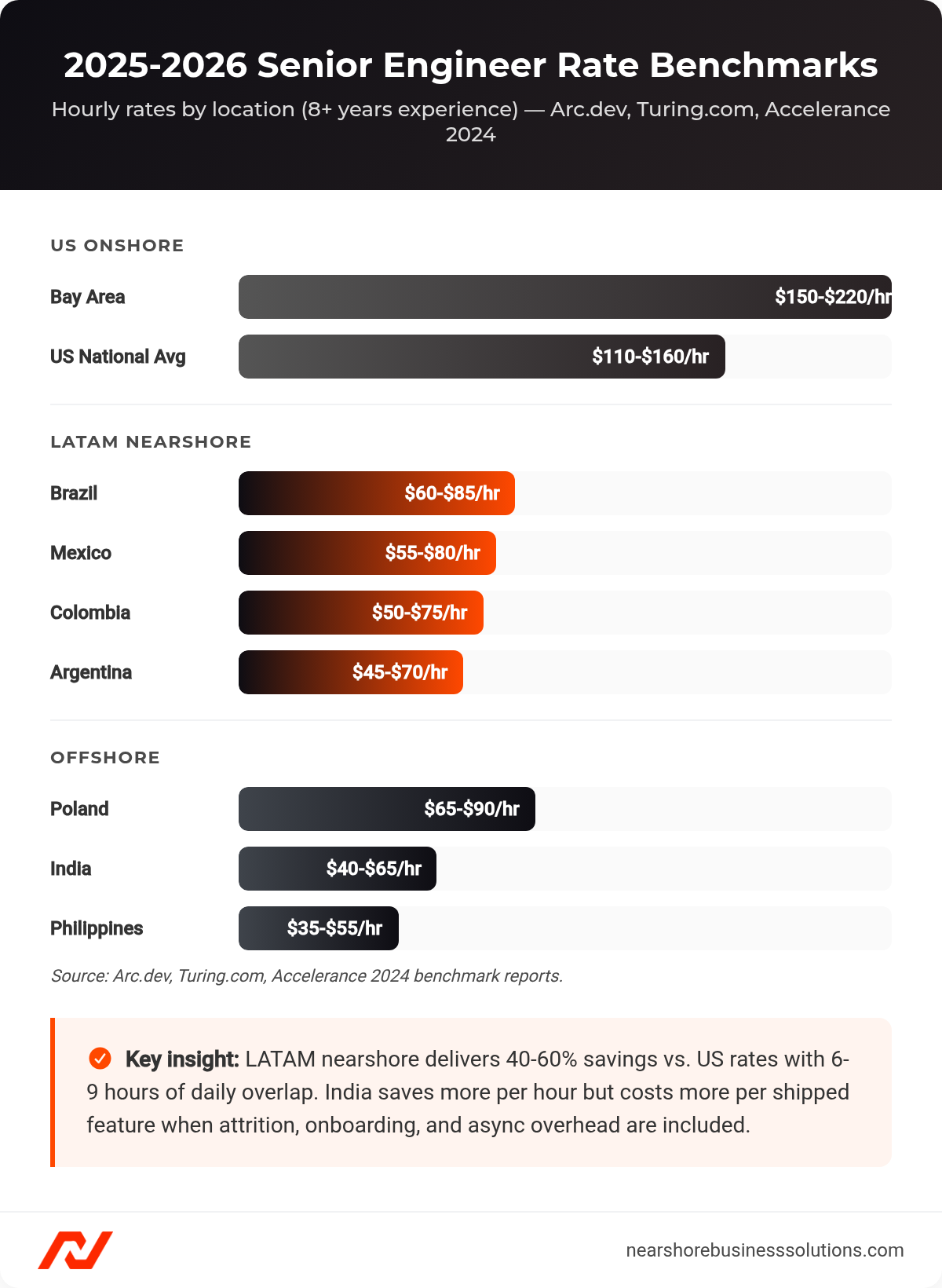
Senior engineer hourly rate benchmarks by location, 2025-2026, source: aggregated developer-marketplace and nearshore rate benchmarks.
Average time to hire a senior engineer in the US: 60-90 days. In major LATAM hubs: 30-45 days, per a 2023 state of global hiring report.
Why Does the Cheapest Hourly Rate Produce the Highest Total Cost?
Fully loaded annual costs reveal the real economics. India’s apparent 65% savings disappear when you add attrition replacement, onboarding ramp time, and async coordination overhead.
- US-Based FTE (Bay Area): $252,000 (Salary $180K + Benefits 25% + Recruiting/Overhead 15%)
- LATAM Nearshore (via EOR/Partner): $122,700 (Salary $85K + Benefits 30% + EOR Fee $7.2K + Equipment $5K) – 51% savings
- India Offshore (via Partner): $89,000 (Salary $65K + Benefits 20% + Partner Fee $6K + Equipment $5K) – 65% savings on paper
The India figure excludes $250K+ in excess attrition replacement costs over two years, 8-12 week onboarding ramps versus 4-6 weeks, and management overhead from async coordination. An anonymized FinTech (Series C, $50M ARR) hired 15 senior engineers in Colombia and Mexico, achieving $1.2M in annual payroll savings, per a published nearshore platform case study.
For a complete breakdown of nearshore software development costs and service models, including engagement structure comparisons, see our LATAM hiring guide.
How Does Attrition Erase Offshore Savings?
Annual attrition in India’s IT services sector runs 20-25%, per NASSCOM industry benchmarks. LATAM nearshore providers report 10-15%, according to Everest Group’s 2023 talent sourcing analysis.
| Region | Annual Attrition | Projected Turnover (2-Year, 10-Person Team) | Est. Replacement Cost |
|---|---|---|---|
| LATAM Nearshore | 10-15% | 2-3 engineers replaced | $250K-$375K |
| India Offshore | 20-25% | 4-5 engineers replaced | $500K-$625K |
| Philippines Offshore | 18-22% | 3.5-4.5 engineers replaced | $437K-$562K |
Replacement cost per senior engineer: $100K-$150K including recruiting, onboarding, ramp-up productivity loss, and knowledge transfer overhead. Source: Everest Group, 2023.
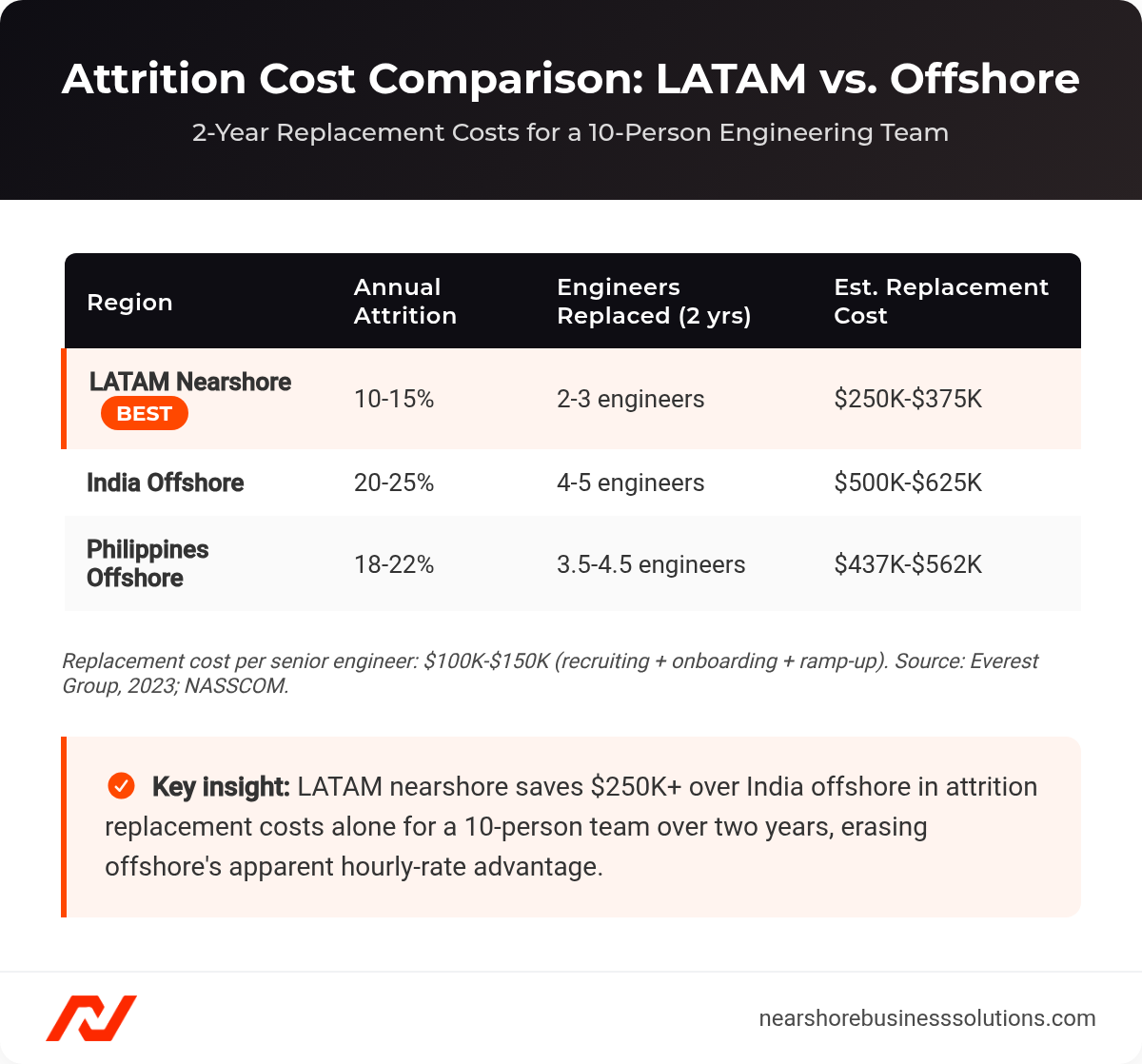
2-year attrition replacement costs for a 10-person engineering team by region.
The $250K differential eats most or all of the hourly rate savings offshore promised at contract signing. US mid-market companies competing for Indian talent go up against Google, Microsoft, Infosys, and every Fortune 500 outsourcing buyer. That same company, working through a nearshore partner in Medellin or Guadalajara, becomes an employer of choice.
What Legal Protections Does USMCA Provide for Nearshore IP?
USMCA provides some of the strongest IP protections in the world for software: explicit copyright coverage for digital works, criminal procedures for trade secret theft, and clear enforcement mechanisms in Mexican courts. These protections are significantly stronger than those available under WTO rules governing relations with India and the Philippines.
For nearshore IT staffing and staff augmentation engagements, three legal structures dominate. Employer of Record (EOR) through providers like Deel or Remote offers lowest-risk compliance. Direct Contractor arrangements provide maximum flexibility with misclassification risk. Own Entity Setup works for teams of 20 or more engineers requiring maximum control.
What Is the Technical Depth of LATAM’s 1.2M-Developer Ecosystem?
LATAM’s total software developer population reaches approximately 1.2 million in 2024. Brazil contributes roughly 500,000, Mexico 225,000, Argentina 135,000, and Colombia 100,000, according to Evans Data Corporation and GitHub’s State of the Octoverse. An estimated 25-30% have 8 or more years of experience. Tapping that senior pool is the subject of our complete guide to nearshore staff for software development, which covers sourcing, cost, and retention end to end.
Which Universities Produce LATAM’s Strongest Engineering Talent?
Latin America produces over 1.5 million STEM graduates annually. Top universities include Universidade de Sao Paulo and Pontificia Universidade Catolica in Brazil, UNAM and Tecnologico de Monterrey (ITESM) in Mexico, Universidad de Buenos Aires (UBA) and ITBA in Argentina, and Universidad de los Andes and EAFIT in Colombia.
Bootcamps like Henry, Laboratoria, and Platzi produce job-ready talent with modern stacks. The ecosystem includes engineers who built products at MercadoLibre, Rappi, Nubank, and Globant – companies operating at US-caliber scale and complexity.
What Technical Roles Are Growing Fastest in LATAM?
DevOps, SRE, and ML Engineering roles are growing fastest in Sao Paulo, Mexico City, and Medellin. Major tech presence includes Oracle and Wizeline in Mexico, Globant and Rappi in Colombia, Mercado Libre and Google in Argentina, and Nubank and Microsoft in Brazil.
Stack proficiency aligns directly to US engineering organizations: React, Python, Node, AWS, and platform engineering. This reduces ramp-up time and ensures skill compatibility from day one.
SOC 2 and ISO 27001 certifications are increasingly common across LATAM delivery centers. Companies operating under Brazil’s LGPD or Colombia’s Law 1581 data protection frameworks already meet many of the compliance requirements US healthcare and fintech clients impose.
Frequently Asked Questions About Nearshore Outsourcing Benefits
These are the most common questions US engineering leaders ask before their first LATAM nearshore engagement.
What Is the Difference Between Nearshore and Offshore Outsourcing?
Nearshore outsourcing places developers in countries 1-3 time zones from your headquarters, primarily across Latin America. Offshore places work 10-12 time zones away, typically in India or the Philippines. Nearshore delivers 6-9 hours of daily overlap versus 0-2 hours for offshore, enabling real-time code review and same-day incident response.
How Long Does It Take to Hire a LATAM Developer?
Hiring through a nearshore staffing partner takes under 2 weeks from kickoff to first day, with first vetted candidates within 3 business days. Direct hiring in LATAM hub cities like Guadalajara, Medellin, or Buenos Aires takes 30-45 days on average, per a 2023 state of global hiring report. Compare this to 60-90 days for senior US hires.
What If a Developer Does Not Work Out?
Nearshore Business Solutions includes a 90-day replacement guarantee on every placement. If a developer does not meet performance expectations within the first 90 days, we replace them at no additional cost. This guarantee eliminates the primary risk of direct offshore hiring.
How Do I Pay Nearshore Developers?
Payment runs through three main structures. Employer of Record (EOR) services like Deel or Remote handle local payroll, benefits, and compliance in 5-7 business days of setup. Direct contractor arrangements pay in USD via wire or platforms like Wise. Own entity setup applies to teams of 20 or more engineers.
Do I Need to Provide Equipment for LATAM Developers?
Equipment policies vary by engagement model. Staff augmentation typically means the provider supplies or reimburses equipment. EOR arrangements often include equipment stipends. Direct contractors generally provide their own equipment. Clarify equipment ownership upfront in your contract to avoid compliance issues.
Is Nearshore Outsourcing Secure for Sensitive Data?
LATAM delivery centers increasingly hold SOC 2 Type I/II and ISO 27001 certifications. Brazil’s LGPD and Colombia’s Law 1581 impose data protection requirements comparable to GDPR in scope. USMCA provides stronger IP enforcement mechanisms than WTO rules, which govern most offshore relationships with India and the Philippines.
What Is the Onboarding Timeline for a Nearshore Developer?
LATAM engineers typically reach full productivity within 4-6 weeks. Offshore engineers average 8-12 weeks, according to published nearshore case study data. The difference comes from real-time collaboration, compatible work hours, and lower communication friction during onboarding.
Ready to Build Your LATAM Nearshore Engineering Team?
Nearshore Business Solutions sources and vets developers from Guadalajara, Medellin, Bogota, Buenos Aires, and Sao Paulo. We screen for technical skills, English fluency, and US work-style fit.
Every placement includes a 90-day replacement guarantee. You receive the first pre-vetted candidates within 3 business days.
Get a free consultation to discuss your hiring needs and receive a custom LATAM engineering cost benchmark.