
A staffing agency in Mexico gives US companies access to 1.1 million IT professionals across Guadalajara, Monterrey, and CDMX at 46 to 70% lower cost than domestic hires, all within CST/MST time-zone overlap.
Mexico’s tech workforce grew 45% since 2020, concentrated in Guadalajara, Monterrey, and CDMX. Senior developers there cost $65,000 to $100,000, versus $160,000 to $220,000 in the US (published 2024 Mexico tech-salary reports). Full time-zone overlap across CST, MST, and CDT means real-time collaboration with US engineering teams.
This guide breaks down what a Mexico recruitment agency actually costs and how REPSE and IMSS compliance checks protect you from joint employer liability. You’ll also see how to choose between direct hire and staff augmentation. Every fee range and benchmark below is sourced, so you can walk into a vendor call with real numbers instead of guesses.
Why Are US Companies Choosing a Staffing Agency in Mexico Over DIY Hiring?
US companies choose a Mexico recruitment agency because DIY hiring costs more and moves slower once you account for legal setup and compliance risk. Mexico’s IT talent pool has reached 1.1 million professionals, up 45% from roughly 750,000 in 2020 (Coursera Global Skills Report 2023; published 2023 nearshoring market reports). Over 700,000 are professional software developers, and Mexican universities add 130,000-plus engineering and technology graduates every year (QS World University Rankings 2024; ANUIES). Against a $160,000 to $220,000 US salary band, that talent pool delivers 46 to 70% cost savings depending on role and seniority.
The operational case is just as strong. Mexico’s labor code has no concept of at-will employment. Terminating a worker without legally justified cause triggers mandatory severance of three months’ salary plus a seniority premium and all accrued benefits. Fully loaded employment costs, covering IMSS, INFONAVIT, SAR, Aguinaldo, vacation premium, profit-sharing (PTU), and state payroll tax, run 35 to 45% above base salary (Deloitte, “Doing Business in Mexico 2024”). A Mexico recruitment agency absorbs that complexity entirely, cutting time-to-hire from 10-plus weeks to under four.
The market reflects the demand. Mexico’s staffing and recruitment market is valued at $5.83 billion USD in 2024, projected to reach $7.13 billion at a 4.10% CAGR by 2029 (Mordor Intelligence, 2024). The IT staffing segment outpaced the broader market with 15 to 20% growth in 2023 to 2024 alone (AMECH and Staffing Industry Analysts, 2024). Between 65 and 75% of revenue for specialized IT staffing firms comes from foreign clients, with US companies accounting for over 90% of that foreign segment (regional IT staffing market analysis, 2023).
Which Mexican Cities Have the Deepest Tech Talent Pools?
Guadalajara, Monterrey, and CDMX hold the deepest pools, each with a distinct industry specialty that should guide where you source a given role.
| City | Key Industries | Talent Pool Size | Avg. Sr. Dev Salary (USD) | US National Avg. | Cost Savings |
|---|---|---|---|---|---|
| Guadalajara | IT, Software, Hardware, Embedded Systems | 125,000+ tech professionals | $65K-$90K | $160K-$220K | 55-60% |
| Monterrey | Fintech, Advanced Manufacturing, Enterprise Software | 95,000 tech professionals | $65K-$90K | $160K-$220K | 55-60% |
| CDMX | Fintech, E-commerce, Broad Professional Services | 200,000+ developers | $70K-$100K | $160K-$220K | 55-60% |
(Source: Endeavor Mexico “Mexico’s Tech Ecosystem” Report, 2023; CBRE “Mexico Tech Hubs” Report, 2023; American Chamber of Commerce of Mexico, 2024)
Guadalajara earned its “Mexico’s Silicon Valley” reputation through anchors like the government-backed Guadalajara Creative Digital City district, home to Intel, IBM, Oracle, and HP alongside a growing startup scene. That legacy makes it the strongest hub for embedded systems and hardware-adjacent software roles. Monterrey’s proximity to the Texas border and industrial base make it the top choice for fintech and enterprise software engineering. CDMX offers the broadest developer pool and the highest salary ceiling, useful when you need to scale a team fast.
Emerging hubs are gaining traction too. Querétaro has 200-plus tech companies and runs roughly 15 to 25% cheaper than CDMX. Mérida focuses on cybersecurity and IT services with strong government incentives and costs roughly 30 to 40% less. Aguascalientes, backed by automotive investment from manufacturers like Nissan, runs roughly 25 to 35% below CDMX. (Hub profiles: CBRE, “Mexico Tech Hubs” Report, 2023; cost-of-living deltas: NBS estimates relative to CDMX.)
Five universities anchor this pipeline (QS World University Rankings 2024; ANUIES):
- Tecnológico de Monterrey (ITESM): ranked among the top engineering schools in Latin America
- Universidad Nacional Autónoma de México (UNAM): the largest university in Latin America
- Instituto Politécnico Nacional (IPN): the top public engineering institution
- Universidad de Guadalajara (UdeG): feeds the Guadalajara tech ecosystem directly
- Instituto Tecnológico Autónomo de México (ITAM): known for rigorous, smaller cohorts
Why Does In-House Recruiting in Mexico Break Down Without Local Legal Infrastructure?
In-house recruiting breaks down because direct hiring requires a Mexican legal entity, typically an S.A. de C.V., registered with multiple government agencies before you can put a single engineer on payroll. That setup typically runs $2,000 to $8,000 in legal, notary, and accounting fees, according to published Mexico market-entry guides, though full operational readiness (banking, tax registration, payroll activation) can take three to five months. It also creates ongoing filing obligations with SAT, IMSS, and INFONAVIT. Companies exploring a lighter alternative sometimes consider an Employer of Record, which bypasses entity formation but carries its own cost and control trade-offs.
The at-will employment gap is the most dangerous blind spot for US leaders used to two-week notice periods. A single mis-hire at a $90,000 base salary can produce a $30,000-plus separation cost before legal fees, since unjustified termination automatically triggers the severance formula described above. Model entity setup, ongoing compliance overhead, and fully loaded employment costs together, and DIY hiring frequently costs more than partnering with a compliant agency. It also takes two to three times longer to produce a signed candidate. Mexico’s USMCA trade framework and IMMEX manufacturing incentives help hardware and logistics operations, but they don’t remove this staffing bottleneck for software teams.
What Services Does a Mexico Recruitment Agency Provide, and What Do They Cost?
A Mexico recruitment agency provides three distinct service models: direct hire, staff augmentation, and managed RPO, each with its own fee structure and compliance burden. Over 2,500 formal staffing firms operate in Mexico, but only approximately 1,200 to 1,500 are dedicated professional staffing, recruitment, or EOR firms (STPS public registry analysis, 2024). That distinction matters because HR leaders who conflate a generalist agency with a specialized recruitment firm often misprice engagements before the first candidate reaches a hiring manager’s calendar.
What Is Direct Hire Staffing in Mexico, and What Does It Cost?
Direct hire staffing costs a one-time fee of 20 to 30% of the candidate’s first-year salary, with 25% as the market midpoint for senior tech roles. The agency sources, screens, and presents candidates. The engineer then joins the client’s payroll directly, which delivers the strongest long-term retention and IP protection of any model.
| Component | Detail |
|---|---|
| Fee Structure | One-time fee: 20-30% of first-year salary; 25% is the market midpoint for senior tech roles |
| Guarantee Period | 90 days replacement guarantee at no additional cost |
| What’s Included | Sourcing, screening, technical assessment, interview coordination, salary benchmarking |
| Entity Requirement | Requires a Mexican legal entity or an Employer of Record in Mexico |
| Time-to-Hire | 6-10 weeks (assumes entity already established) |
This model fits senior engineering leadership, roles requiring deep product-domain knowledge, and positions where IP sensitivity demands a direct employment relationship. It fits poorly for rapid team scaling or project-based work where headcount may shrink within 12 months, since severance exposure makes that economically risky. For a senior full-stack engineer at an $85,000 base salary, expect a placement fee near $21,250 at the 25% midpoint. Amortized over 24 months of retention, that’s an effective monthly recruitment cost under $900.
What Does Staff Augmentation Cost, and How Does the Markup Work?
Staff augmentation bills a fixed monthly rate of 1.5x to 1.8x the engineer’s base salary, an all-inclusive figure covering statutory costs and agency margin. The staffing agency remains the legal employer while the client directs daily work, sprint assignments, and technical priorities. This model eliminates the need for a Mexican entity, removes direct severance liability, and lets headcount flex with project demand. Contracts typically require 30 days’ written notice to remove a resource and must include explicit IP assignment and indemnification clauses, since non-compete clauses are largely unenforceable under Mexican labor law.
| Statutory Component | % of Base Salary | What It Covers |
|---|---|---|
| IMSS (Social Security) | ~15-20% (capped) | Health, disability, retirement: employer portion |
| INFONAVIT (Housing Fund) | 5% | National housing fund |
| SAR (Retirement Fund) | 2% | Private retirement account |
| Aguinaldo (Christmas Bonus) | ~4.11% | Mandatory annual bonus, minimum 15 days’ salary |
| Vacation & Prima Vacacional | ~4.1% (Year 1) | 12 days minimum plus 25% premium |
| PTU (Profit Sharing) | Varies | 10% of agency’s taxable profit, capped at 3 months’ salary per employee |
| State Payroll Tax | ~2-3% | Varies by state |
| Total Statutory Burden | ~35-45% | Added above base salary before agency margin |
| Agency Gross Margin | 25-45% over fully loaded cost | Recruitment, account management, compliance, overhead |
(Source: Deloitte, “Doing Business in Mexico 2024”; Mexican Federal Labor Law, Articles 76-87)
The math produces a clear multiplier. A $6,000 monthly base becomes $8,100 to $8,700 fully loaded, then $10,125 to $12,615 at margin. That yields an all-in bill rate of 1.5x to 1.8x base salary. An agency quoting below 20% markup is likely underreporting statutory obligations or misclassifying employees as contractors. That practice triggers fines of $4,400 to $266,000 MXN per worker under Mexico’s 2021 outsourcing reform.
RPO vs. Contingency vs. Retained Search: Which Fits Your Hiring Volume?
Your hiring volume determines the right engagement model: contingency for one-off roles, retained for senior or confidential searches, and RPO once you’re hiring five or more engineers per quarter.
| Engagement Type | Best For | Fee Structure | Timeline |
|---|---|---|---|
| Contingency | Individual contributor roles, 1-2 hires | 20-30% of salary, paid on hire | 4-8 weeks |
| Retained | VP/Director-level, niche specializations | 25-35% in three installments | 6-12 weeks |
| RPO | 5+ hires per quarter, ongoing needs | Monthly fee ($3K-$8K) plus reduced per-hire (15-20%) | Ongoing |
Contingency dominates the market by volume because most US companies start with one or two nearshore hires to validate the model. RPO becomes cost-effective once volume sustains five or more hires per quarter. Below that threshold, the management fee erodes the savings versus contingency pricing.
What Hidden Costs Inflate Your Total Staffing Spend in Mexico?
Three cost categories sit outside the quoted rate and surface as budget surprises if you don’t ask about them upfront: Aguinaldo timing, PTU provisioning, and currency risk.
Aguinaldo hits in December regardless of hire date, since Mexican Federal Labor Law (Article 87) mandates a minimum Christmas bonus of 15 days’ salary, prorated by months worked. At a $7,500 monthly salary, an engineer hired in January accrues nearly $3,750 due that December. Confirm the agency amortizes it into the monthly bill rate instead of invoicing it as a lump sum.
PTU exposure persists despite post-reform caps. The 2021 labor reform capped individual PTU payouts at three months’ salary, but the underlying 10% taxable-profit obligation remains the agency’s liability. Ask the agency to show how PTU is provisioned, typically 3 to 5% of base salary built into the monthly rate.
Currency fluctuation erodes or inflates real costs by an estimated 8 to 15% annually if contracts are peso-denominated. The peso weakened from roughly 17.1 per dollar in January 2024 to about 20.8 by early 2025, a swing of over 20%, based on Banco de México spot-rate data. Denominate contracts in USD so the agency, not your budget, absorbs the conversion risk.
What Should You Look for When Evaluating a Mexico Recruitment Firm?
Evaluating a Mexico recruitment firm comes down to six criteria: REPSE certification, IMSS compliance, talent pipeline depth, fill-rate benchmarks, fee transparency, and bilingual account management. The 2021 REPSE reform dissolved or absorbed over 100,000 subcontracting companies and transferred roughly 3 million workers to their true employers’ payrolls (STPS registry analysis, 2024). That reform dramatically consolidated and formalized the market. Compliance comes first on this list because a non-compliant agency exposes you to joint employer liability, a financial risk that dwarfs any savings the engagement was designed to produce.
What Is REPSE Certification, and Why Is It the Compliance Baseline?
REPSE, short for Registro de Prestadoras de Servicios Especializados, is a mandatory federal registry that every staffing agency operating in Mexico must hold. Registration requires tax compliance certificates from SAT, IMSS, and INFONAVIT, must define the precise specialized service the agency provides, and must be renewed every three years. Verification is public and free at repse.stps.gob.mx.
Consequences for engaging a non-REPSE agency are severe:
- Fines: $11,000 to $275,000 USD per worker at 2024 UMA values. The STPS applies fines per worker, not per contract, so a 10-person engagement with a non-compliant agency can generate $110,000 to $2.75 million in exposure.
- Tax non-deductibility: 30% ISR plus 16% VAT equals a 46% surcharge on every dollar already spent with the agency.
- Joint employer liability: Full back-liability for unpaid wages, benefits, IMSS contributions, and severance, with no cap.
- Criminal charges: Possible for willful tax evasion through fraudulent outsourcing schemes.
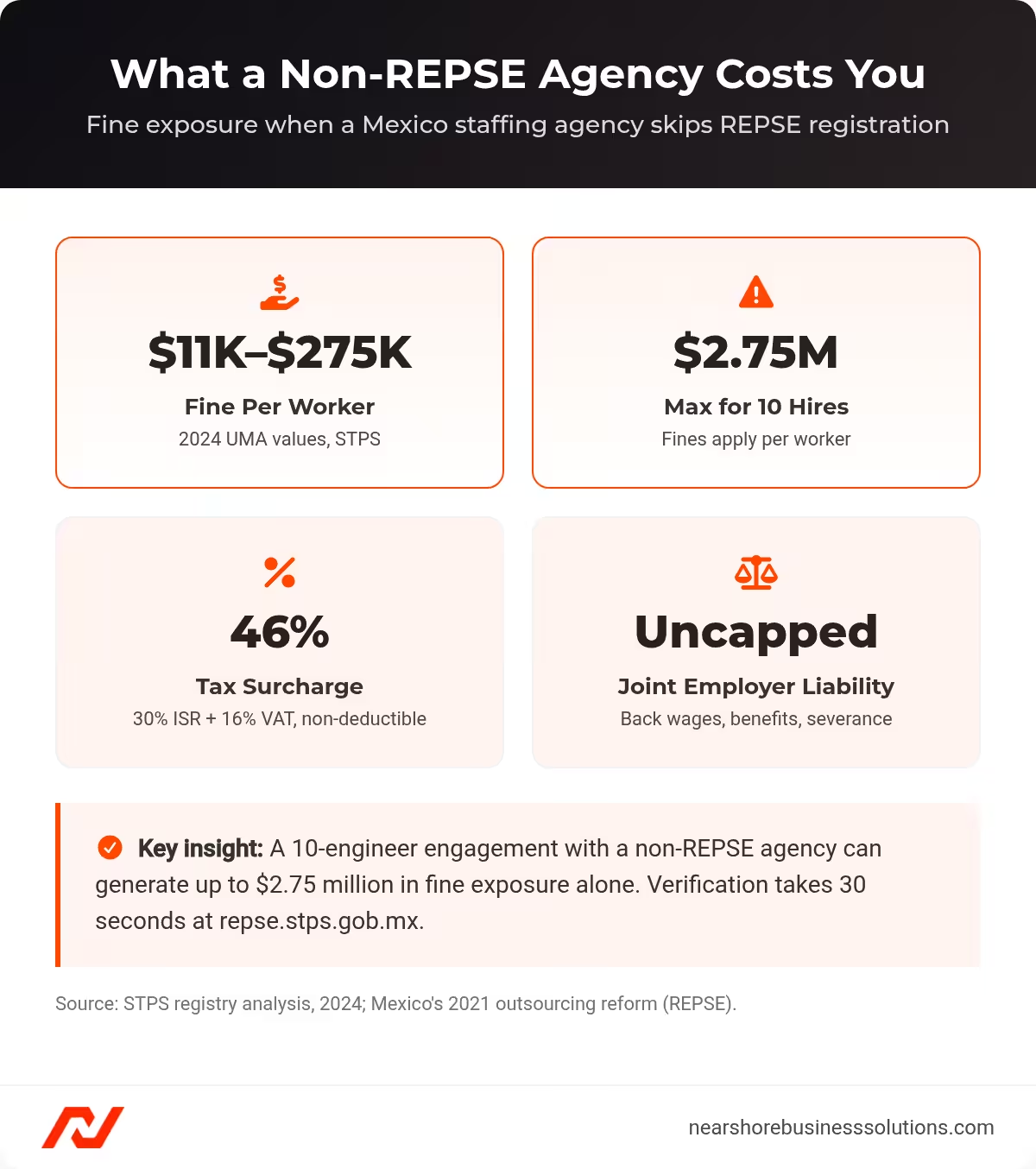
Fine exposure and liability risk when a Mexico staffing agency skips REPSE registration.
A legitimate Mexico recruitment firm raises REPSE proactively, in the first discovery call and again in the master services agreement. An agency that hesitates to share its registration number is a red flag.
How Do You Verify an Agency’s IMSS Compliance?
You verify IMSS compliance by requesting quarterly filings and pay-stub proof, since under-registration is the most common compliance shortcut in the industry. Some agencies report a lower salary to IMSS than the worker actually earns to cut their own contribution. That under-reporting reduces the worker’s healthcare coverage and retirement balance, and neither side notices until an audit hits. The IMSS statute of limitations for contribution recovery is five years, so liability from a non-compliant agency can persist long after the engagement ends.
A compliant agency produces, on request:
- Quarterly ICSOE and SISUB filings
- Certificates of good standing (Opinión de Cumplimiento) from SAT, IMSS, and INFONAVIT
- Redacted pay stubs at comparable salary levels
- Explicit indemnification clauses in the MSA covering all employer-side liabilities
An agency that calls these requests “unusual” is either non-compliant or managing compliance so loosely that the distinction doesn’t matter.
What Fill-Rate and Time-to-Hire Benchmarks Should You Expect?
You should expect a 7 to 10 business day time-to-shortlist and a 3:1 to 4:1 candidate pass-through rate from a specialized Mexico recruitment agency. Many US engineering leaders who report dissatisfaction with nearshore hires trace the failure to inadequate technical screening at the agency level, not candidate quality. Specialized IT staffing firms fill roles 35 to 40% faster than generalist teams (SIA Workforce Solutions Buyer Survey, 2024).
| Metric | Benchmark |
|---|---|
| Time-to-shortlist | 7-10 business days |
| Staff augmentation time-to-hire | 2-6 weeks |
| Direct hire time-to-hire | 6-10 weeks |
| Candidate pass-through rate | 3:1 to 4:1 (higher ratios indicate weak screening) |
A composite case study drawn from published Guadalajara-based staff augmentation engagements (regional nearshore provider case data, 2023) illustrates the upside. A San Francisco-based Series C fintech achieved a 28-day average time-to-hire for 22 senior Java and Kotlin engineers. Fully loaded cost ran about $95,000 per engineer versus $250,000-plus for a Bay Area equivalent, an estimated $3.4 million in annual savings with 91% retention after 18 months. Ask any agency you’re evaluating for their own fill-rate and retention data, then compare it against these benchmarks.
Direct Hire vs. Staff Augmentation: Which Model Fits Your Growth Stage?
Staff augmentation fits early scaling and speed-critical hiring, while direct hire fits companies making 5 or more permanent leadership hires with an entity already in place. US companies hiring in Mexico increasingly start with augmentation to de-risk the decision before committing to direct payroll.
| Factor | Direct Hire | Staff Augmentation |
|---|---|---|
| Speed | 6-10 weeks (entity required) | 2-6 weeks |
| Cost | 20-30% one-time fee + 35-45% ongoing burden | 1.5x-1.8x monthly salary (all-inclusive) |
| Flexibility | Low: severance obligations | High: 30-day notice |
| Compliance Ownership | Client | Agency |
| Best For | 5+ permanent hires, leadership roles | Project-based, scaling, speed-critical |
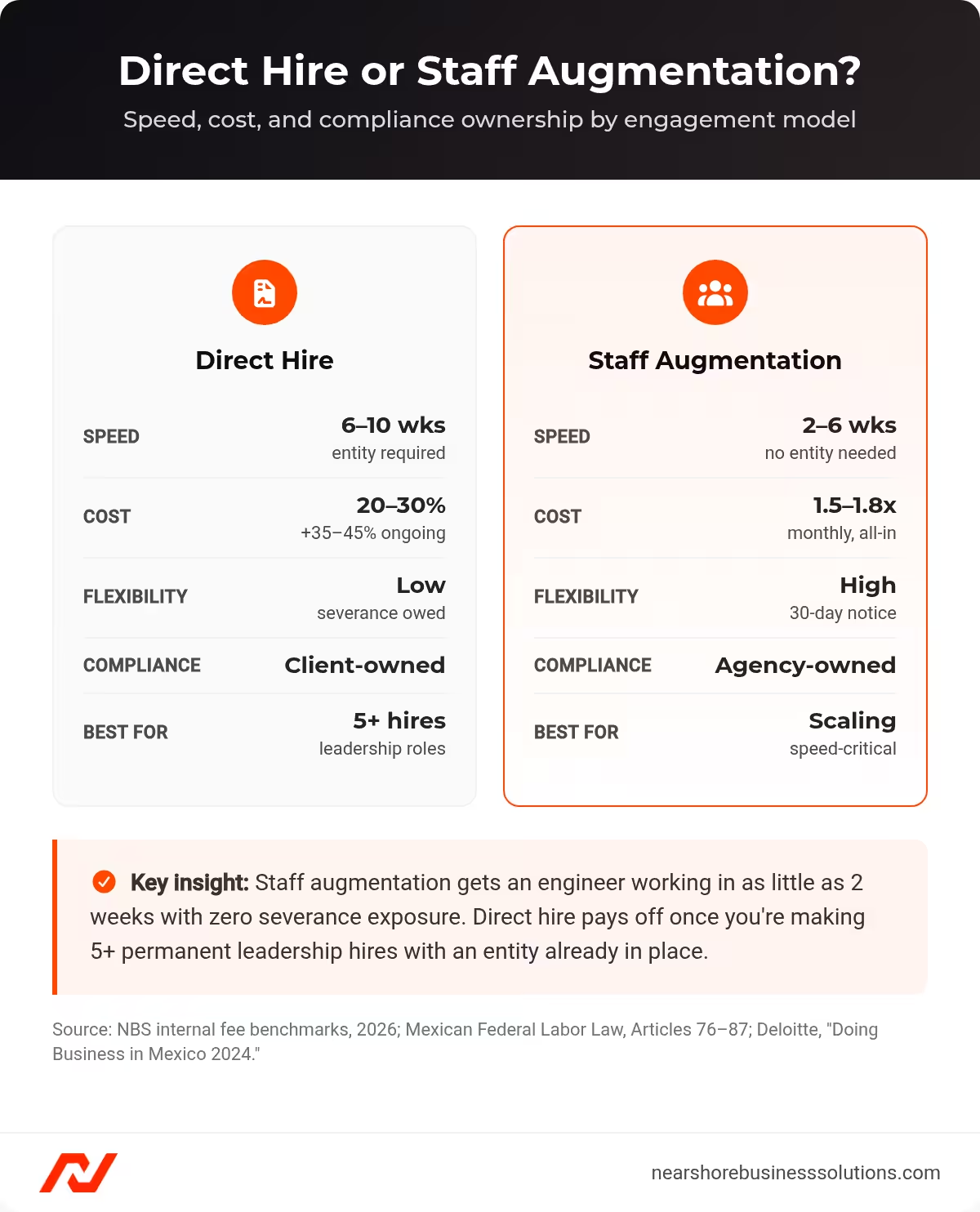
Speed, cost, flexibility, and compliance ownership compared across direct hire and staff augmentation models.
What Is the Hybrid Path, and How Do You Convert Top Performers to Direct Hire?
The hybrid path lets you start with staff augmentation and convert your best engineers to direct hire once you’ve validated fit, typically over six to twelve months. The sequence runs in five steps:
- Start with staff augmentation. Engage 1 to 5 engineers while the agency handles all compliance. Timeline: 2 to 6 weeks.
- Evaluate over 6 to 12 months. Assess cultural fit and technical output using the same KPIs as your US team.
- Establish a Mexican entity, or use an EOR as a bridge. Employer-of-Record fees for Mexico typically run $400 to $800 per employee per month, according to published EOR platform pricing, usually 5 to 15% of total employment cost, with the percentage shrinking as base salary rises since most providers charge a flat monthly fee rather than a percentage of payroll.
- Negotiate conversion terms with the staffing agency.
- Transfer top performers to direct payroll and assume full compliance responsibility.
Why Do Operations Leaders Choose Nearshore Business Solutions as Their Mexico Staffing Partner?
Operations leaders choose Nearshore Business Solutions because NBS is REPSE-registered, IMSS-compliant, and staffed with account managers based in Guadalajara, Monterrey, and CDMX. Every evaluation criterion outlined above, compliance documentation, transparent cost breakdowns, specialized technical screening, and bilingual account management, is available on request from your first discovery call.
Is NBS REPSE-Registered and IMSS-Compliant for US-Mexico Cross-Border Hiring?
Yes. NBS operates as a REPSE-registered, IMSS-compliant staffing agency with operational presence across Guadalajara, Monterrey, and CDMX. Our compliance officer hands your legal or finance team the REPSE certificate, quarterly ICSOE and SISUB filings, and Opinión de Cumplimiento documents from SAT, IMSS, and INFONAVIT. You get all of it before you sign anything.
Does NBS Provide Transparent Fee Structures With Full Cost Breakdowns?
Yes. NBS provides line-item cost decomposition on every engagement: base salary, each statutory component, and agency margin separated clearly, not bundled into an opaque all-in rate. Contracts are denominated in USD so peso volatility never hits your budget. Aguinaldo and PTU are amortized into monthly billing instead of surprising you as a lump sum, and IP assignment clauses are standard in every MSA.
Frequently Asked Questions About Staffing Agencies in Mexico
These are the questions Operations Directors and HR Leads ask most before signing with a Mexico recruitment agency.
How long does it take to hire through a staffing agency in Mexico?
Staff augmentation typically delivers a hired engineer in 2 to 6 weeks. Direct hire takes 6 to 10 weeks, assuming your Mexican entity is already established. Add three to five months if entity formation runs in parallel.
What happens if a placed developer doesn’t work out?
Reputable direct hire agencies offer a 90-day replacement guarantee at no added cost. For staff augmentation, a 30-day written notice clause lets you swap or remove a resource without severance liability, since the agency remains the legal employer.
Do I need a Mexican legal entity to hire through a staffing agency?
No, not for staff augmentation or direct hire through an Employer of Record. You only need an entity for direct hire without an EOR. Setting up a Mexican legal entity (S.A. de C.V.) typically runs $2,000 to $8,000 in legal, notary, and accounting fees, according to published Mexico market-entry guides, though full operational readiness (banking, tax registration, payroll activation) can take three to five months.
How do I pay developers hired through a Mexico staffing agency?
You pay the agency a single monthly invoice in USD. The agency handles payroll, IMSS, INFONAVIT, Aguinaldo, and PTU on the back end, so you never issue payments directly to the worker.
What’s the difference between REPSE certification and IMSS compliance?
REPSE confirms the agency’s legal right to operate as a specialized-services provider. IMSS compliance confirms the agency actually pays the statutory contributions it owes on every worker. An agency can hold valid REPSE registration and still under-report salaries to IMSS, so verify both separately.
Is staff augmentation or direct hire cheaper for a 2-year engagement?
Staff augmentation usually costs less upfront and carries no severance exposure. Direct hire’s one-time 20-30% fee can be cheaper over a multi-year horizon once amortized, since it avoids the ongoing 1.5x-1.8x monthly markup. Model both against your expected tenure before deciding.
Why do some staffing agency quotes look cheaper than others?
Compliance costs (registration, quarterly filings, compliance staff) are already baked into a certified agency’s margin. A quote that looks unusually low relative to the 1.5x-1.8x staff augmentation benchmark above often means those compliance costs were skipped, not saved.
Ready to Build Your Mexico Engineering Team With a REPSE-Compliant Staffing Partner?
Nearshore Business Solutions sources and vets talent from Guadalajara, Monterrey, and Mexico City. Every direct hire placement includes a 90-day replacement guarantee, and staff augmentation resources are available in 2 to 6 weeks.
Start hiring in Mexico with NBS to get a REPSE-compliance cost breakdown and a custom quote for your role.
Prefer to talk it through first? Get a free consultation with our team.