
Ecuador mandates 11 national paid holidays in 2026, and a 2016 reform under Código del Trabajo Artículo 65 moves six of them onto a Monday or Friday when the calendar date falls midweek or on a weekend, though only one of the six actually shifts in 2026. Quito and Guayaquil employees get a 12th paid day for their city’s founding holiday. For US employers hiring in Ecuador, payroll runs on the observed date, not the calendar date, and missing that gap triggers a 100% wage surcharge.
| Holiday Name | Calendar Date | Day of Week | Observed Date | Paid/Mandatory Status | Shift Rule |
|---|---|---|---|---|---|
| Año Nuevo (New Year’s Day) | Jan 1 | Thursday | Jan 1 | National, mandatory paid | Exempt by statute |
| Carnaval (Day 1) | Feb 16 | Monday | Feb 16 | National, mandatory paid | Weekday fixed |
| Carnaval (Day 2) | Feb 17 | Tuesday | Feb 17 | National, mandatory paid | Exempt by statute |
| Viernes Santo (Good Friday) | Apr 3 | Friday | Apr 3 | National, mandatory paid | Weekday fixed |
| Día del Trabajo (Labor Day) | May 1 | Friday | May 1 | National, mandatory paid | Movable |
| Batalla de Pichincha | May 24 | Sunday | Mon, May 25 | National, mandatory paid | Movable |
| Fundación de Guayaquil | Jul 25 | Saturday | Fri, Jul 24 | Local, Guayaquil canton only | Movable |
| Primer Grito de Independencia | Aug 10 | Monday | Aug 10 | National, mandatory paid | Movable |
| Independencia de Guayaquil | Oct 9 | Friday | Oct 9 | National, mandatory paid | Movable |
| Día de los Difuntos | Nov 2 | Monday | Nov 2 | National, mandatory paid | Movable |
| Independencia de Cuenca | Nov 3 | Tuesday | Nov 3 | National, mandatory paid | Movable (collision exception) |
| Fundación de Quito | Dec 6 | Sunday | Mon, Dec 7 | Local, Quito canton only | Movable |
| Navidad (Christmas Day) | Dec 25 | Friday | Dec 25 | National, mandatory paid | Exempt by statute |
Fundación de Quito and Fundación de Guayaquil are alternative local holidays, not additive: an employee is entitled to whichever city they work in, bringing the per-employee total to 12 mandatory paid days in Quito or Guayaquil and 11 elsewhere in Ecuador.
Which of Ecuador’s 2026 Holidays Actually Move to a Different Day?
Eleven national public holidays apply to every employer operating under the Código del Trabajo, with no exceptions for foreign-incorporated companies or remote arrangements. In 2026, only one of them, Batalla de Pichincha, actually changes its observed date. Four of the other five movable holidays already fall on a Monday or Friday, so the shift rule produces no change. The fifth, Independencia de Cuenca, falls on a Tuesday and keeps its calendar date under the consecutive-holiday rule the 2016 reform added, because the Monday it would otherwise move to is already Día de los Difuntos.
What Should Employers Know About Ecuador’s Q1 and Q2 2026 Holidays?
Beyond the dates in the table above, several of the January-May holidays carry planning notes worth flagging. Año Nuevo is exempt by statute, so it holds its calendar date; because New Year’s Day 2026 lands on a Thursday, expect a possible puente decree converting Friday, January 2, into a bridge day. Carnaval’s dates are set by the Easter calculation, which places Easter Sunday on April 5, 2026; Carnival Tuesday is one of the three days Art. 65 exempts by name, and Carnival Monday is already a Monday. Viernes Santo is Easter-dependent and always falls on a Friday, so it holds its calendar date. Día del Trabajo is movable but lands on a Friday in 2026, generating a three-day weekend without any shift. Batalla de Pichincha, which moves to observed Monday, May 25, commemorates the 1822 battle on the slopes of the Pichincha volcano that secured Quito’s independence; any employee who works May 25 without a prior written agreement triggers the 100% overtime surcharge mandated by Art. 55 of the Código del Trabajo.
What Should Employers Know About Ecuador’s Q3 and Q4 2026 Holidays?
Several of the remaining 2026 holidays carry their own planning notes. Primer Grito de Independencia marks the 1809 proclamation of independence in Quito, one of the earliest such movements in Latin America; it is movable by classification but already falls on a Monday in 2026, so no shift applies. Independencia de Guayaquil is a national holiday observed by every employee in Ecuador, not just those in Guayaquil; for Guayaquil-based teams, this date also opens Fiestas Octubrinas, civic celebrations extending through approximately October 12, though only October 9 carries statutory holiday status for private-sector employers. Día de los Difuntos is a culturally significant observance, and many employees travel to family gravesites in rural provinces. Independencia de Cuenca would shift to the preceding Monday under the standard Tuesday rule, but November 2 is already Día de los Difuntos, and the 2016 reform legislates that collision directly. Its Disposición General Primera, letra a), states that holidays landing on consecutive Monday and Tuesday are not moved: “Si los días feriados coinciden con los días lunes y martes, los días de descanso obligatorio no se trasladarán.” Both days therefore stay on their calendar dates and employees receive Monday and Tuesday as mandatory paid non-working days: a four-day block running from Saturday, October 31, through Tuesday, November 3. Navidad is exempt by statute and falls on a Friday in 2026, creating a clean three-day weekend.
How Does Ecuador’s 2016 Holiday Reform Decide Which Days Employees Get Off?
Ecuador’s labor code guarantees 11 nationally mandated paid holidays, and a 2016 reform introduced deterministic rules that move six of them onto a Monday or Friday to create a long weekend. The reform is codified in the Ley Orgánica Reformatoria a la Ley Orgánica del Servicio Público y al Código del Trabajo, known as the “Ley de Feriados,” published in Registro Oficial Suplemento No. 906 on December 20, 2016. For payroll purposes, the observed date, not the calendar date, is what triggers the surcharge and rest-day obligations under Artículo 65.
Which Ecuador Holidays Are Fixed and Which Ones Move?
Artículo 65 names three of Ecuador’s 11 national holidays as exceptions to the shift rule: “Se exceptúan de esta disposición los días 1 de enero, 25 de diciembre y martes de carnaval.” Two more never trigger a shift, because the Easter calculation fixes them to a weekday that the rule leaves alone. The remaining six follow the deterministic shift rule set by the 2016 reform.
Three holidays are exempt by name in the statute:
- January 1 – New Year’s Day
- Carnival Tuesday
- December 25 – Christmas Day
Two more never trigger a shift, because their weekday is fixed:
- Carnival Monday – always a Monday
- Good Friday – always a Friday
The other six national holidays follow this movable logic:
| Day the Holiday Falls On | Observed Date Shift |
|---|---|
| Monday | No shift, already adjacent to the weekend |
| Tuesday | Moves to the preceding Monday |
| Wednesday | Moves to the following Friday |
| Thursday | Moves to the following Friday |
| Friday | No shift, already adjacent to the weekend |
| Saturday | Moves to the preceding Friday |
| Sunday | Moves to the following Monday |
No managerial discretion is involved. The shift is automatic under Art. 65 of the Código del Trabajo as amended by the 2016 reform, and no significant legislative amendment has altered these rules since 2016.
The Presidency retains authority to declare puentes (bridge holidays) by executive decree, converting a working day sandwiched between a holiday and a weekend into a non-working day. Disposición General Quinta of the 2016 reform grants that power and leaves the make-up terms to the decree itself, so whether employees recover the hours depends on what each decree says.
> **Worked Example: Batalla de Pichincha 2026** > – **Calendar date:** May 24, 2026 (Sunday) > – **Rule:** Sunday holidays move to the following Monday > – **Observed date:** **Monday, May 25, 2026** > – **Legal basis:** Código del Trabajo, Art. 65; Ley Orgánica Reformatoria (Registro Oficial 906)Why Do Generic Calendar Apps Get Ecuador Holidays 2026 Wrong?
Generic calendar tools display the calendar date of a holiday, not the observed date, and that gap triggers the 100% surcharge under Art. 55 of the Código del Trabajo when a company schedules work on the wrong day. In 2026, three dates shift: Batalla de Pichincha (May 24 to May 25), Fundación de Quito (December 6 to December 7), and Fundación de Guayaquil (July 25 to July 24).
The problem compounds for companies with employees in Quito or Guayaquil. Each city adds one local foundation-day holiday, bringing the per-employee total to 12 mandatory paid days off.
What Happens When Employees Work on Ecuador Holidays and How Is the 100% Surcharge Calculated?
The Código del Trabajo, Artículo 55, Numeral 4, mandates that any work performed on a mandatory rest day triggers a 100% surcharge on top of the regular daily wage, for a total cost of 200% of normal daily compensation. Three characteristics distinguish this surcharge. It activates on hour one, not hour nine: no threshold is required, so two hours on a holiday earns two hours at 200%. It is legally non-waivable: Artículo 4 of the same code reads “Los derechos del trabajador son irrenunciables. Será nula toda estipulación en contrario,” so a contract clause trading the surcharge away is void from the moment it is signed. It applies identically to remote employees: Artículos 55 and 65 are written by day, not by workplace, and the unnumbered telework article that the Ley Orgánica de Apoyo Humanitario (Suplemento del Registro Oficial 229, June 22, 2020) added after Artículo 16 states that teleworkers “gozarán de todos los derechos individuales y colectivos, así como beneficios sociales contenidos en este Código.”
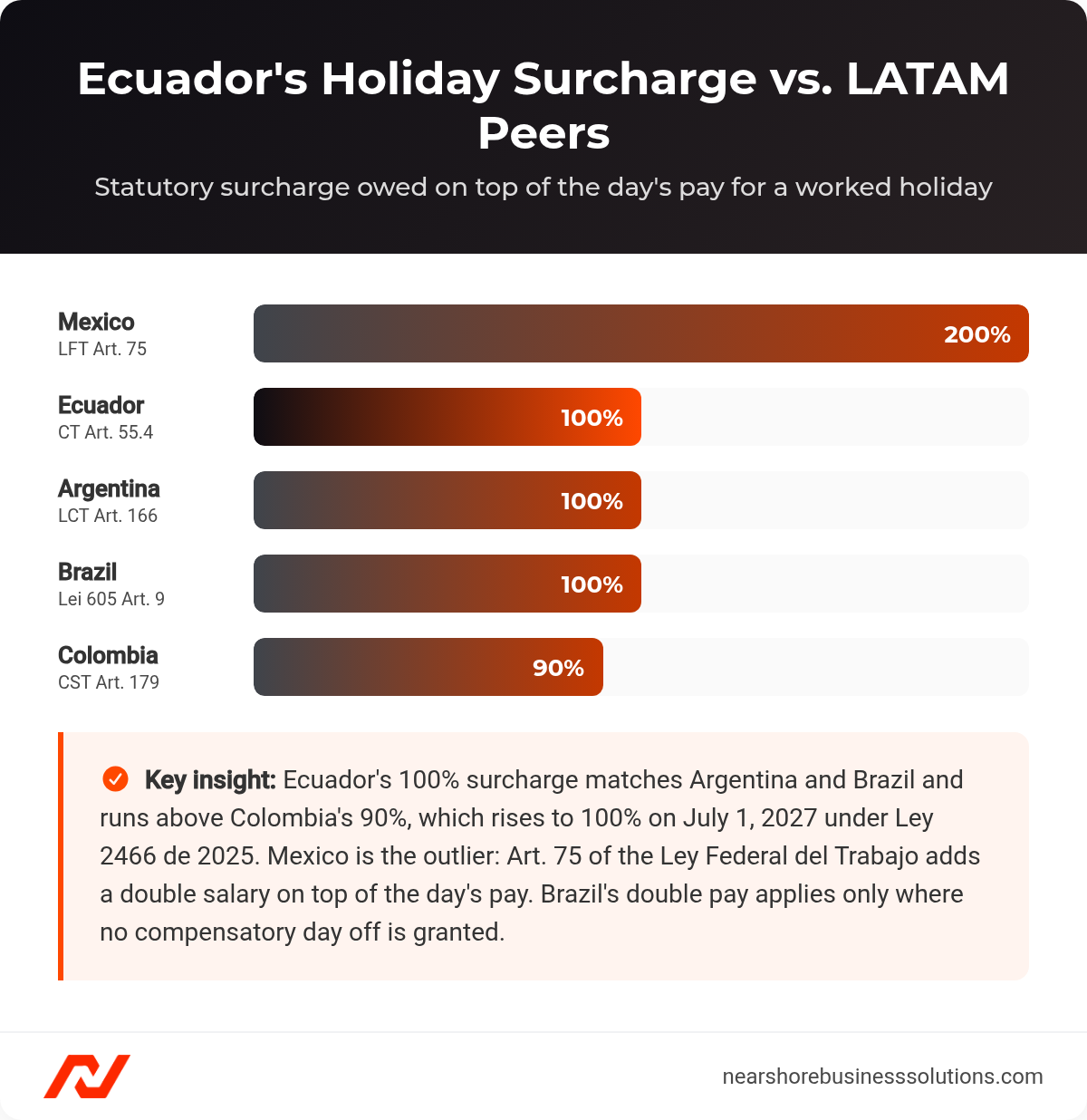
Ecuador’s 100% surcharge matches Argentina (LCT Art. 166) and Brazil (Lei 605 Art. 9), runs above Colombia’s 90% (CST Art. 179, as amended by Ley 2466 de 2025), and sits below Mexico’s 200% (LFT Art. 75), part of the patchwork of public holidays across Latin America that employers have to track country by country.
How Do You Calculate Ecuador’s Mandatory Holiday Pay Surcharge?
The formula is a four-step calculation that starts with the monthly salary and ends with the fully loaded hourly rate for holiday overtime.
- Calculate the daily rate. Monthly gross salary divided by 30 equals the daily rate.
- Apply the holiday surcharge. Daily rate times 2 equals the total compensation owed for the worked holiday.
- Determine the base hourly rate. Daily rate divided by 8 equals the base hourly rate.
- If overtime hours accrue on the same holiday, stack the surcharges. For each overtime hour: base hourly rate, plus 100% holiday surcharge, plus overtime surcharge (50% daytime or 100% nighttime).
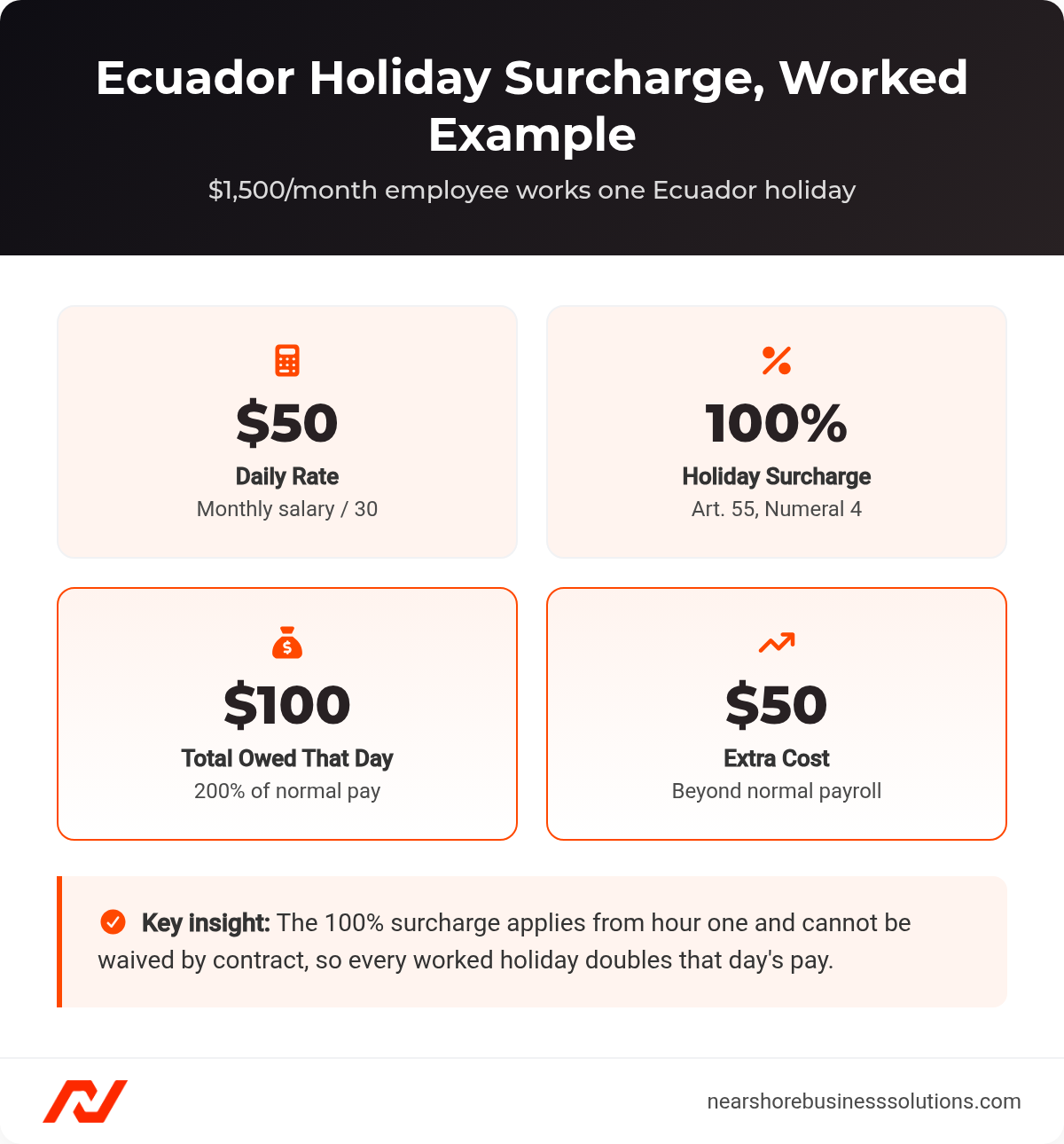
A $1,500/month employee working one holiday costs the employer $50 extra.
What Penalties Apply When Employers Skip Ecuador Holiday Pay?
Any employee can file a denuncia laboral directly with the Ministry, triggering an inspection during which the employer must produce payroll records proving the surcharge was paid. Ignorance of the observed date is not a valid defense, since the movable-holiday rules are published law. Where the code fixes no special sanction, Artículo 628 sets the fine, and Artículo 7 of Mandato Constituyente No. 8 (Suplemento del Registro Oficial 330, May 6, 2008) reset the amounts: the Director Regional del Trabajo imposes a minimum of three and a maximum of twenty unified basic salaries, while labor judges and inspectors impose up to three. Artículo 628 requires the amount to track the circumstances, the gravity of the infraction, and the offender’s ability to pay, and Artículo 632 raises it on a repeat offense. Unpaid surcharges stay claimable for three years from the end of the employment relationship under Artículo 635. For US companies without in-country HR, this is where an employer of record or compliance partner converts regulatory exposure into a managed service.
Which Local Holidays Apply Only to Quito or Guayaquil Employees?
Each city carries one additional local holiday, raising the per-employee total to 12 mandatory paid days off. The obligation runs through the same statute as the national days. Artículo 65 provides that the days named in the corresponding special laws are also days of obligatory rest “para las respectivas circunscripciones territoriales,” and the same article applies the shift rule to them: “Igual criterio se aplicará para los días feriados de carácter local.” The obligation therefore carries identical legal weight to a national holiday: the same 100% surcharge, the same non-waivable status, and the same inspection exposure.
Who Qualifies for the Fundación de Quito Holiday on December 6?
Fundación de Quito commemorates the 1534 Spanish founding of the city. Its mandatory status comes from the national Código del Trabajo, through the Artículo 65 clause that extends obligatory rest days to individual territorial circumscriptions. The local element is the scope: the day is a rest day for the canton of Quito and it carries no obligation anywhere else in Ecuador.
Calendar date: December 6, 2026 (Sunday). Observed date: Monday, December 7, 2026 (Sunday moves to the following Monday).
The holiday applies only to individuals whose place of work is within the Metropolitan District of Quito. A company headquartered in Guayaquil, or in Delaware, with an engineer working remotely from Quito must grant December 7 as a paid day off to that specific individual. A Quito-headquartered company with a Guayaquil-based engineer owes no observance.
How Is Fundación de Guayaquil Different From Independencia de Guayaquil?
Fundación de Guayaquil marks the city’s founding on July 25, 1538. It rests on the same Artículo 65 clause as the Quito holiday, scoped to the canton of Guayaquil, and it is separate from the national October 9 holiday.
Calendar date: July 25, 2026 (Saturday). Observed date: Friday, July 24, 2026, because a local holiday falling on a Saturday moves to the preceding Friday under the same shift rule.
Independencia de Guayaquil (October 9) is a national holiday that every employee observes. Fundación de Guayaquil (July 25) is local. Confusing the two leads to either denying October 9 to non-Guayaquil employees or granting July 25 to employees outside Guayaquil unnecessarily.
How Should Distributed Ecuador Teams Manage Multi-City Holiday Calendars?
A three-step process keeps payroll accurate across Quito, Guayaquil, and every other Ecuadorian city where a company employs staff. First, segregate holiday calendars by canton at hire: tag each employee’s record with the correct municipality and load the corresponding local holiday into their payroll profile. Second, reconcile observed dates against payroll each January: feed the output into the payroll system’s holiday-code table so surcharges auto-calculate. Third, put the two dates that differ from the national calendar in front of engineering managers before they plan a sprint: Monday, December 7 for anyone working in Quito, and Friday, July 24 for anyone working in Guayaquil.
An employer of record operating across multiple Ecuadorian cities automates all three steps: canton-level tagging at onboarding, annual observed-date reconciliation, and per-employee holiday calendars surfaced to client teams.
| Metric | Quito Employee | Guayaquil Employee | US Employee |
|---|---|---|---|
| Total Mandatory Holidays | 12 | 12 | 11 (federal) |
| Weekend Days | 104 | 104 | 104 |
| Vacation Days | 15 | 15 | 15 (assumed) |
| Net Productive Days | 234 | 234 | 235 |
Frequently Asked Questions About Ecuador Holidays 2026
Does the 100% holiday surcharge apply to salaried employees, or only hourly workers?
It applies to both. The Código del Trabajo, Artículo 55, calculates the surcharge from the monthly salary divided into a daily and hourly rate, so salaried employees receive the same 100% surcharge as hourly workers for any holiday hours worked.
Can an employee agree in writing to skip the holiday surcharge?
No. Artículo 4 of the Código del Trabajo makes workers’ rights non-waivable and voids any stipulation to the contrary, so a signed waiver has no legal effect.
Do remote employees working from home on a holiday still trigger the surcharge?
Yes. The rest-day and surcharge articles are written by day, not by workplace, and the telework article the Ley Orgánica de Apoyo Humanitario added after Artículo 16 of the Código del Trabajo gives teleworkers every individual and collective right and social benefit the code contains.
What happens if a national holiday and a local holiday fall in the same week?
Both apply independently. National and local obligations do not offset one another, so an employee owed both takes both days.
Is the December 6 Fundación de Quito holiday paid for employees who live in Quito but work for a Guayaquil-headquartered company?
Yes. The obligation attaches to the employee’s place of work, not the company’s headquarters, so a Guayaquil-based employer with a Quito-based remote engineer must grant December 7, 2026, as a paid day off for that employee.
How many total paid non-working days does an Ecuador-based employee get in 2026?
A Quito or Guayaquil employee gets 12 mandatory holidays plus 104 weekend days and an assumed 15 vacation days, for 234 net productive days in the year. An employee outside those two cities gets 11 mandatory holidays and 235 net productive days.
Ready to Simplify Ecuador Holiday Compliance for Your Team?
Tracking 11 national holidays, two local calendars, and a non-waivable 100% surcharge is a recurring payroll risk for any US company without in-country HR in Ecuador.
Get an Ecuador payroll compliance review to confirm your 2026 holiday calendar and surcharge calculations before Q1.