Costa Rica sets twelve statutory holidays for 2026, nine of them mandatory-pay days under Código de Trabajo Artículo 148. Employers who require work on one of those nine owe double the ordinary wage. This guide gives the full 2026 date list, the two-tier pay rules, and the cross-border planning calendar US HR teams need.
| Date | Day | Holiday | Pay Category | Notes |
|---|---|---|---|---|
| Jan 1 | Thu | New Year’s Day | Obligatory | Direct M-F impact. Friday Jan 2 is the obvious bridge-day request. |
| Apr 2 | Thu | Holy Thursday | Obligatory | Opens the Semana Santa cluster |
| Apr 3 | Fri | Good Friday | Obligatory | Completes the Semana Santa block: four consecutive days off without PTO spend |
| Apr 11 | Sat | Juan Santamaría Day | Obligatory | No M-F impact. Commemorates the national hero killed April 11, 1856, at the Second Battle of Rivas. Uniquely Costa Rican, and often missed by foreign employers. |
| May 1 | Fri | Labor Day | Obligatory | Creates automatic long weekend |
| Jul 25 | Sat | Annexation of Guanacaste | Obligatory | No M-F impact. Celebrates voluntary annexation of 1824. Art. 148 fixes this date permanently: it is never moved to another weekday. |
| Aug 2 | Sun | Our Lady of the Angels Day | Non-Obligatory | No M-F impact. Draws one of the country’s largest annual pilgrimages to Cartago; expect late-July PTO requests. |
| Aug 15 | Sat | Mother’s Day | Obligatory | No M-F impact. Costa Rica observes Mother’s Day on August 15, not the US second-Sunday-in-May date. |
| Aug 31 | Mon | Día de la Persona Negra y la Cultura Afrocostarricense | Non-Obligatory | Direct M-F impact. Falls on a Monday by calendar in 2026, so it makes a three-day weekend on its own. Added to Art. 148 by Ley 10050. |
| Sep 15 | Tue | Independence Day | Obligatory | Expect puente PTO requests for Monday Sep 14 |
| Dec 1 | Tue | Army Abolition Day | Non-Obligatory | Expect puente requests for Monday Nov 30. Added to Art. 148 by Ley 9803. |
| Dec 25 | Fri | Christmas Day | Obligatory | Creates automatic long weekend |
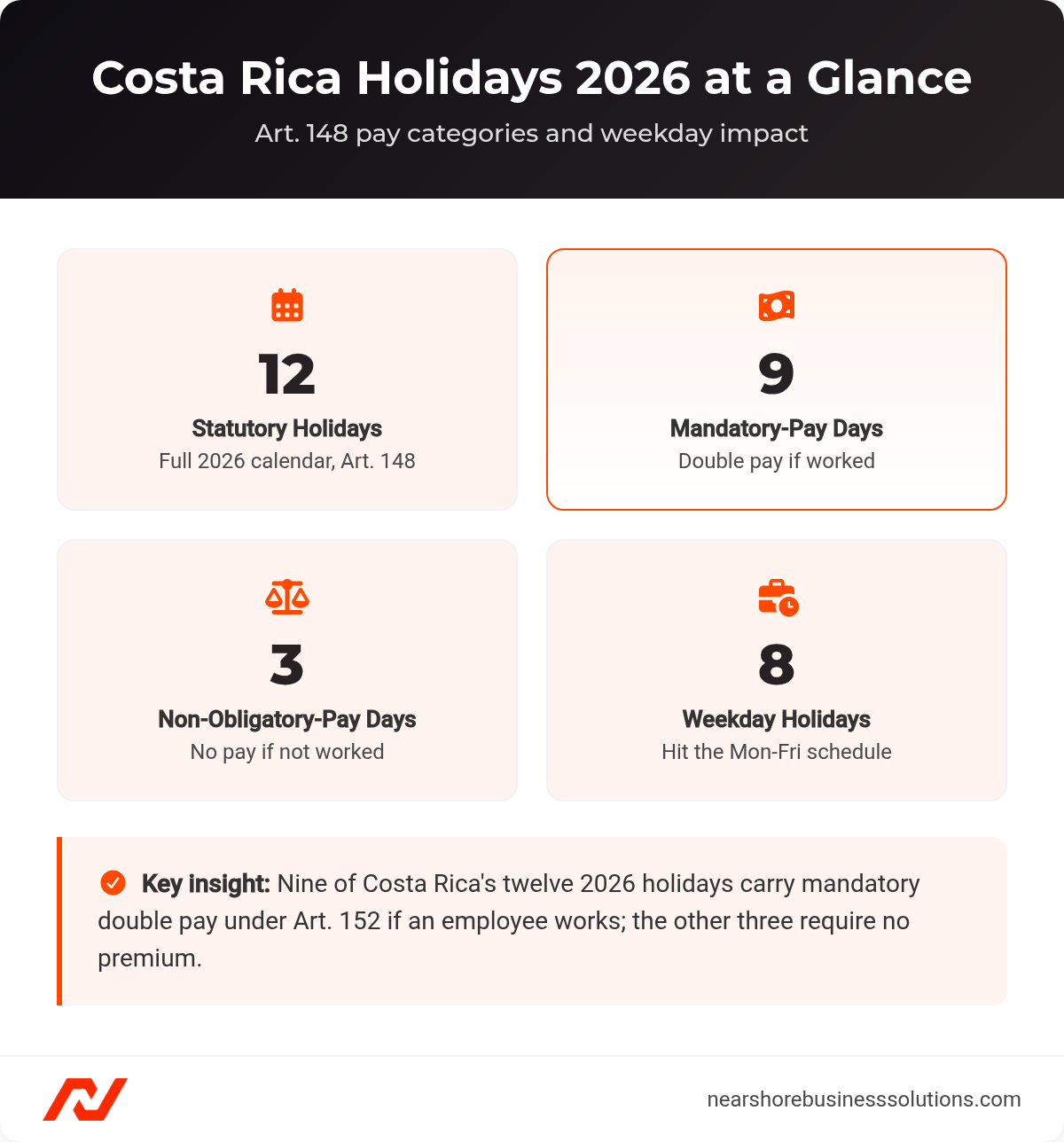
Costa Rica sets 12 statutory holidays for 2026 under Art. 148: nine mandatory-pay and three non-obligatory-pay.
Costa Rica Holidays 2026: Weekday Impact and Working-Day Calculation
The dates and pay categories above match the MTSS circular for the year, CARTA-MTSS-DAJ-AER-1076-2025 of 4 December 2025, “Aplicación de feriados del año 2026.” Four of the twelve statutory holidays fall on weekends in 2026, leaving eight weekday dates that directly disrupt Monday-through-Friday schedules.
Effective working-day calculation for 2026: 365 calendar days minus 104 weekend days leaves 261 weekdays. Subtract the eight holidays that land Monday through Friday and 253 scheduled working days remain before any vacation is taken. Vacation comes off that figure separately, and Art. 153 sets the floor at two weeks for every fifty weeks of continuous service. Run the same two-step calculation on your US baseline before comparing the two, because a gross number on one side and a net number on the other will reverse the real gap.
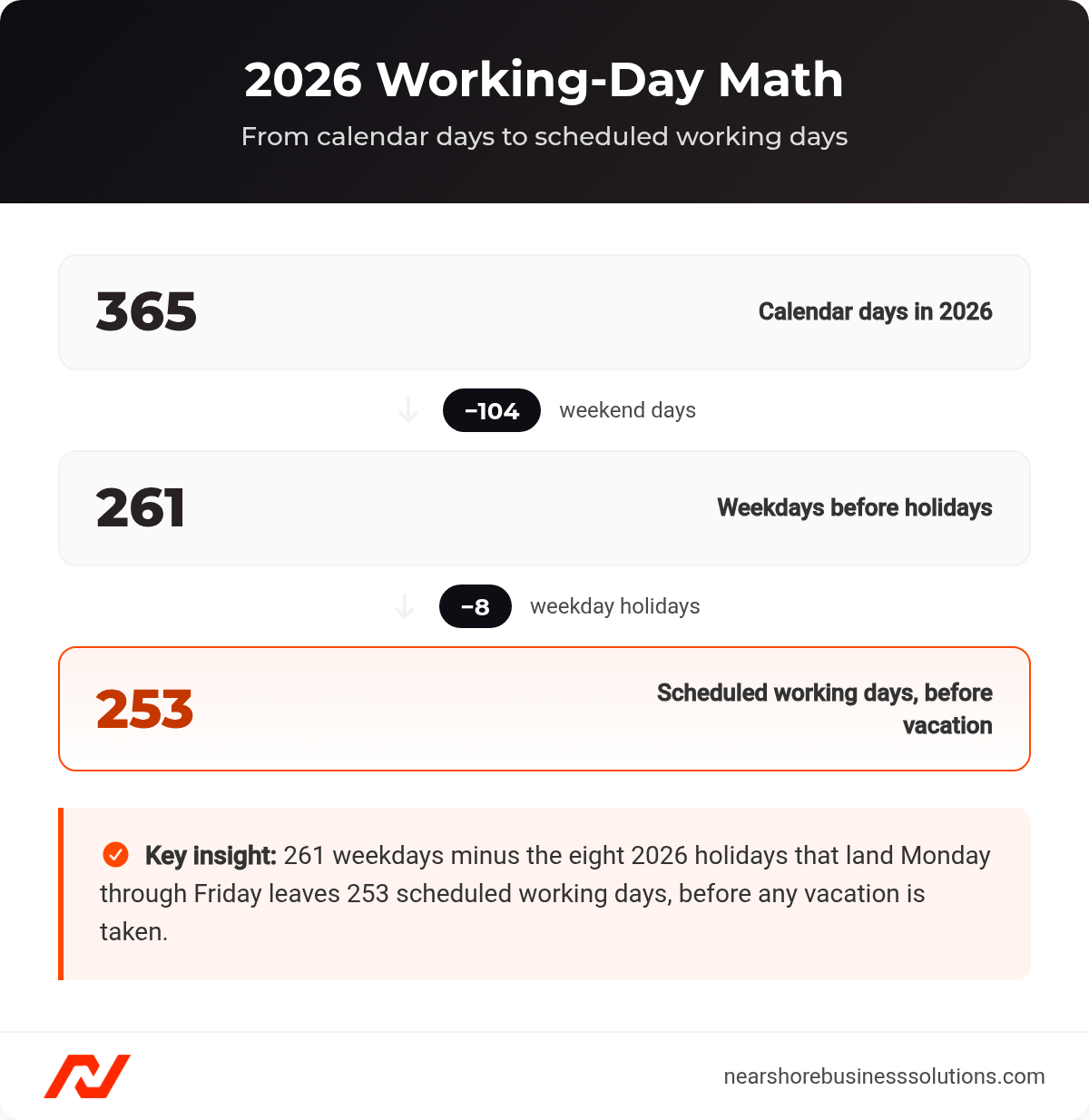
365 calendar days minus weekends and the eight weekday holidays leaves 253 scheduled working days in 2026.
Which 2026 Holidays Fall on Weekends and Why That Matters
None of the four weekend-dated holidays above shifts to a Monday in 2026. The transitorio that once allowed Monday transfers named specific dates in the years 2020 through 2024 and named nothing beyond them. If your EOR or payroll provider shows any 2026 holiday moving to a Monday, they are working from expired rules. Escalate immediately.
What Costa Rica National Holidays Mean for Your Payroll: The Art. 148 Framework
Código de Trabajo Artículo 148 is the single statutory source that defines every national holiday in Costa Rica and dictates how you must pay for each one. The article splits holidays into two legal categories (feriados de pago obligatorio, mandatory-pay holidays, and feriados de pago no obligatorio, non-obligatory-pay holidays), with materially different payroll obligations attached to each. US labor law has no equivalent distinction. Federal holidays in the United States carry zero statutory pay requirements for private employers, and premium pay is purely a matter of company policy. That gap makes Art. 148 a common compliance blind spot for US-based HR teams managing Costa Rican headcount.
The first paragraph of Art. 148, as amended by Ley 10050 of 25 October 2021, reads: “Se considerarán días feriados y, por lo tanto, de pago obligatorio los siguientes: el 1° de enero, el 11 de abril, el Jueves y Viernes Santos, el 1° de mayo, el 25 de julio, el 15 de agosto, el 15 de setiembre y el 25 de diciembre. Los días 2 y 31 de agosto y el 1° de diciembre también se considerarán días feriados, pero su pago no será obligatorio.” That is nine mandatory-pay days and three non-obligatory-pay days, twelve in total. October 12 appears in the same article and is excluded from that list. The second paragraph, as reformed by Ley 10438 of 1 February 2024, reads: “Con el fin de inculcar y preservar los valores patrióticos, las actividades cívicas y educativas del 25 de julio y del 12 de octubre serán conmemoraciones obligatorias en el ámbito nacional, en todas las escuelas y los colegios el propio día de la celebración. Este último, el 12 de octubre, no regirá como día feriado.” The date is a mandatory civic and school commemoration nationwide, and it carries no holiday pay obligation.
Feriados de Pago Obligatorio: When Work Stoppage and Full Pay Are Non-Negotiable
Nine holidays carry the strongest legal protection: January 1, April 11, Holy Thursday, Good Friday, May 1, July 25, August 15, September 15, and December 25. On each of these days, the employer must pay the employee’s full daily wage whether the business operates or not. Artículo 149 goes further and prohibits the work itself: “Queda absolutamente prohibido a los patronos ocupar a sus trabajadores durante los días feriados; y el que lo hiciere sufrirá la multa de ley y deberá indemnizarlos en la forma que determina el párrafo segundo del artículo 152.” Artículos 150 and 151 carve out the exceptions, which cover hotels, restaurants, pharmacies, cinemas, fuel stations and public entertainment, plus work that cannot be postponed and work the employee agrees to voluntarily. The second paragraph of Art. 152 sets the indemnity at “el doble del salario que ordinariamente les pague.” Double pay, which means the regular day’s pay plus one additional day’s pay. It is not triple pay.
> **Payroll Example:** A salaried engineer earns a daily rate of $200. If they do not work on the holiday, they receive $200 (no deduction permitted). If they work, they receive $200 (regular salary) + $200 (Art. 152 premium) = **$400 total**.The Ministerio de Trabajo conducts audits and responds to employee complaints. On the $200 daily rate above, one missed premium across a 20-person team is $4,000 for a single holiday, and the calendar carries nine mandatory-pay days.
Feriados de Pago No Obligatorio: What “Non-Obligatory” Actually Means for Employers
“Non-obligatory pay” does not mean “optional holiday.” Three days, August 2 (Virgen de los Ángeles), August 31 (Día de la Persona Negra y la Cultura Afrocostarricense), and December 1 (Army Abolition Day), still qualify as feriados. The MTSS requires employers to grant the day off if the employee requests it. What differs is the payroll treatment: if the employee does not work, the employer has no obligation to pay. If the employee works, a normal single day’s wage applies with no premium. Most multinational tech employers in Costa Rica treat all three as paid holidays to stay competitive for senior engineering talent.
Which Costa Rica Holidays Move to Monday and Which Stay Fixed?
None move in 2026. The Monday-transfer scheme ran out by its own terms at the end of 2024, and outdated calendars still circulate. The legislative history matters because the law numbers get quoted incorrectly:
- Ley 9875 (16 July 2020) added a transitorio to Artículo 148. Its own title states the purpose and the window: “para trasladar los feriados a los lunes, con el fin de promover la visita interna y el turismo durante los años 2020 al 2024.” The transitorio worked date by date and year by year, and it named no year after 2024.
- Ley 10050 (25 October 2021, published in La Gaceta No. 225 on 22 November 2021) declared August 31 the official date of the Día de la Persona Negra y la Cultura Afrocostarricense, rewrote the first paragraph of Art. 148 to add August 31 as a non-obligatory-pay holiday, and amended the transitorio. Its version of the transitorio moved August 31 of 2021, 2022 and 2023 to the following Sunday, and it ended with April 11, July 25 and August 15 of 2024 moving to the following Monday.
- Ley 10396 (20 November 2023, published in La Gaceta No. 236 on 20 December 2023) amended the same transitorio once more and removed the August 15, 2024 transfer, while leaving the April 11 and July 25, 2024 transfers in place. It created no new transfer scheme and extended nothing past 2024.
- Ley 10438 (1 February 2024, published in La Gaceta No. 53 on 20 March 2024) amended the second paragraph of Art. 148 so that “Se celebrará el 25 de julio siempre en la fecha respectiva y su celebración o feriado no será trasladado a otro día de la semana diferente del correspondiente.” The same law rewrote the sixth paragraph of the transitorio to read “Por último, el disfrute del feriado correspondiente al 11 de abril de 2024 se trasladará al lunes inmediato siguiente,” which leaves April 11, 2024 as the last transfer the text contains.
December 1 entered Art. 148 separately, through Ley 9803 of 19 May 2020, “Celebración nacional del 1° de diciembre como Día de la Abolición del Ejército y día feriado de pago no obligatorio.” No Monday-transfer law created it.
Audit step: Pull your 2026 Costa Rican holiday calendar from your payroll system. Check that it carries twelve dates, not eleven, because August 31 is the one most often missing. If any holiday appears on a Monday that is not its calendar date, the provider is still running the expired 2020-2024 transitorio, or is conflating Costa Rican rules with Colombia’s still-active Ley Emiliani.
How to Handle “Bridge Day” Culture
With Monday transfers gone, the informal puente (bridge day) drives concentrated PTO requests. Three 2026 dates sit one working day away from a weekend. New Year’s Day falls on Thursday, January 1, which puts the request on Friday, January 2. Independence Day falls on Tuesday, September 15, which puts it on Monday, September 14. Army Abolition Day falls on Tuesday, December 1, which puts it on Monday, November 30. August 31 needs no bridge at all, because it is already a Monday. The Código de Trabajo does not require employers to grant bridge days, and denying them carries retention risk. Block January 2, September 14 and November 30 in your capacity model now, and publish the policy before the requests arrive.
How Do Public Holidays Affect Employment Contracts, Benefits, and Termination Calculations?
Holiday pay compounds through every layer of the employer cost structure. Costa Rican employers carry two cost layers above base salary. The first is mandatory payroll contributions: CCSS health and pension, the Fondo de Capitalización Laboral, and levies to Banco Popular, IMAS, INA and INS. The second is accrual-based obligations: the aguinaldo, vacation accrual under Art. 153, and cesantía. Rates in both layers are revised periodically, so price a Costa Rican hire against the CCSS contribution tables in force for the payroll year you are budgeting.
The critical interaction: holiday-work premiums feed into the aguinaldo base and the salary average used for termination severance. An engineer who works all nine obligatory holidays at double pay inflates their salary base, which cascades into aguinaldo payouts and potential separation liability.
An Employer of Record absorbs this calculation, along with the annual CCSS rate-table updates, so US teams never budget off stale numbers.
Holiday Pay Rules During Probation, Sick Leave, and Vacation
The Código de Trabajo settles less here than most policy templates assume, and the gaps are worth knowing before you write them into a contract.
What the statute does establish: Art. 147 makes every day of the year a working day except holidays and weekly rest days. Art. 148 fixes the pay treatment of each holiday and sets holiday pay at the salario ordinario. Art. 149 prohibits working staff on a holiday and routes the penalty through Art. 152. Art. 153 sets the vacation minimum at two weeks per fifty weeks of continuous service and states that justified illness does not break the continuity that vacation accrual depends on.
What the statute does not settle in its own text: whether a holiday falling inside a vacation period consumes a vacation day, how holiday pay interacts with a period of certified sick leave, and whether any waiting period applies during probation. Confirm all three against Costa Rican counsel or an MTSS consulta laboral before they go into an employment contract or an HRIS rule. Do not carry a rule across from another Latin American jurisdiction on the assumption that Costa Rica matches it.
Integrating Costa Rica Holidays into a Multi-Country PTO Policy
Costa Rica’s statutory framework imposes structural constraints that break any attempt to apply a single US-style PTO policy across LATAM jurisdictions, and payroll teams building that comparison should start from the full breakdown of public holidays in Latin America. Three rules for compliant multi-country calendars:
- Separate statutory holidays from discretionary PTO in every contract and HRIS record. Obligatory-pay holidays cannot be deducted from vacation balances or pooled into flexible PTO.
- Document your policy on non-obligatory holidays before onboarding. The competitive norm is to grant August 2, August 31 and December 1 as paid. If you choose otherwise, state it explicitly.
- Map both countries’ calendars onto a single timeline. US Independence Day (July 4) is not a Costa Rican holiday. Costa Rican Independence Day (September 15) is not a US holiday. Only New Year’s Day and Christmas overlap. If your team spans other LATAM markets, run the same merge exercise for Mexico, Colombia, and Argentina.
Frequently Asked Questions
How many paid holidays does Costa Rica have in 2026?
Costa Rica sets twelve statutory holidays for 2026 under Código de Trabajo Artículo 148: nine mandatory-pay days and three non-obligatory-pay days. Four of the twelve fall on weekends in 2026, so eight land on a weekday and disrupt the Monday-through-Friday schedule.
What is the double-pay rule for Costa Rica’s mandatory holidays?
On the nine mandatory-pay holidays, Artículo 149 prohibits the work and Artículo 152 sets the indemnity at double the ordinary wage: the regular day’s pay plus one additional day’s pay. A salaried employee who earns $200 a day and works a mandatory holiday is owed $400 total. It is not triple pay.
Is December 1 a mandatory-pay holiday in Costa Rica?
No. December 1, Army Abolition Day, is one of the three non-obligatory-pay holidays, added to Art. 148 by Ley 9803. The MTSS requires the employer to grant the day off if the employee requests it, but if the employee does not work the employer has no obligation to pay, and if the employee does work a normal single day’s wage applies with no premium.
How many working days does Costa Rica have in 2026 after holidays?
365 calendar days minus 104 weekend days leaves 261 weekdays. Subtract the eight statutory holidays that land Monday through Friday in 2026 and 253 scheduled working days remain, before any vacation is taken.
Do Costa Rica holidays move to Monday in 2026?
No. The Monday-transfer transitorio that Ley 9875 added to Art. 148 covered only the years 2020 through 2024, and Ley 10438 closed it out with April 11, 2024 as its last transfer. Every 2026 holiday lands on its fixed calendar date under the MTSS circular for the year, CARTA-MTSS-DAJ-AER-1076-2025.
Do I need a Costa Rican legal entity to run compliant holiday payroll?
Not necessarily. An Employer of Record can classify each holiday under Art. 148, calculate the double-pay premium correctly, and keep CCSS contribution tables current on your behalf.
How Should US Teams Plan Around Costa Rica Holidays 2026?
Costa Rica operates on Central Standard Time (UTC-6) year-round with no daylight saving adjustment, providing 6-8 hours of daily overlap with US time zones, far more than India’s 0-1 hours or Eastern Europe’s 1-3 hours.
Two clusters shape the year. Semana Santa puts Holy Thursday and Good Friday on April 2 and April 3, two consecutive weekdays that join the weekend into four days off; Juan Santamaría Day follows on Saturday, April 11, with no Monday-to-Friday impact of its own. The August cluster puts three holidays in one month: August 2 (Sunday), August 15 (Saturday) and August 31 (Monday). Only August 31 costs a working day. Plan August around the PTO requests that collect near the two weekend dates, and around the single Monday closure at the end of the month.
Build a Compliant Costa Rica Hiring Strategy
Costa Rica scores 516 on the 2025 EF English Proficiency Index, which places it 55th of the 123 countries and regions ranked, 10th of the 20 Latin American markets EF covers, and inside EF’s “Moderate” band. The score sits above EF’s global average of 488 and is down 18 points from the 2024 edition, so treat English screening as a per-candidate exercise. Set that alongside 253 scheduled working days in 2026 and a time zone that never shifts, and the calendar inputs for a Costa Rican engineering team are fixed a year ahead.
For a complete framework on structuring compliant employment relationships, see our guide on how to hire in Costa Rica.
Get a compliant Costa Rica holiday and payroll calendar built for your team. NBS structures Employer of Record and payroll compliance for Costa Rican hires, including Art. 148 holiday classification and double-pay calculation, and delivers first vetted candidates in 3 business days with 94% retention at 90 days. Talk to a Costa Rica hiring specialist.