
An Employer of Record in Peru lets US companies hire local engineers in 3-5 days, saving 60-68% versus US tech hub salaries.
Peru’s 170,000+ tech professionals work at UTC-5 year-round, giving New York teams 7-8 hours of daily overlap. Senior engineers cost $59,000-$87,000 annually versus $166,000+ in the US. EOR fees run $499-$599 per employee per month.
Our network includes engineers from Lima’s San Isidro and Miraflores districts, vetted for technical skills, English fluency, and US work style fit. Below, you’ll find Peru’s mandatory benefits, payroll mechanics, EOR costs, provider comparisons, and red flags to watch when reviewing contracts.
What Is an Employer of Record, and How Does It Work in Peru?
An Employer of Record is a third-party company that legally employs workers on behalf of a foreign business. The EOR handles local payroll, statutory benefits, tax filings, and compliance. Your company retains full operational control: directing work, setting priorities, and managing day-to-day tasks.
Peru’s labor law is worker-protective and administratively complex. An EOR absorbs all legal liability, so your company accesses Peruvian talent without navigating SUNAFIL regulations, SUNAT filings, or mandatory benefit calculations directly.
What Is the Difference Between an EOR and a PEO in Peru?
An EOR becomes the legal employer. A PEO co-employs workers alongside your company, which requires you to have a registered legal entity in Peru first.
For US companies without a local entity, an EOR is the only viable path. The Latin American PEO/EOR market was valued at $7.96 billion in 2024. The dominant growth is in full-service EOR, driven by demand for platforms that combine legal employment, local payroll, and multi-currency benefits in a single solution.
How Is an EOR Different from Setting Up a Legal Entity in Peru?
The EOR model is faster, cheaper, and carries no upfront capital risk compared to a direct entity.
| Metric | EOR | Direct Entity |
|---|---|---|
| Time to first hire | 3-5 business days | 3-6 months |
| Upfront setup cost | $0-$5,000 | $50,000-$250,000 |
| Legal liability | Held by EOR | Held by US parent |
| Compliance management | EOR platform | Local HR, legal, accounting |
| Minimum headcount | 1 | 5-10 for ROI |
| Admin burden | Near zero | High (monthly SUNAT/PLAME filings) |
For companies hiring fewer than 10 people in Peru, the EOR math is straightforward. Direct entity setup makes sense only when headcount and permanence justify the capital expenditure.
Why Are US Companies Choosing an Employer of Record in Peru?
Three factors drive the decision: talent quality, time zone fit, and cost. Peru’s tech workforce exceeds 170,000 professionals. Lima sits at UTC-5 year-round, giving New York-based teams 7-8 hours of daily overlap and San Francisco teams 4-5 hours. Senior engineers cost $59,000-$87,000 annually versus $166,000+ for a US-equivalent Software Engineer.
The EOR model turns a 3-6 month entity setup into a 3-5 day hire. For growth-stage companies competing for product velocity, that gap is decisive.
For a detailed comparison of Latin American talent markets, see our guide to hiring software developers in Latin America.
What Are the Risks of Hiring in Peru Without a Local Entity?
Misclassification is the primary risk. Peru’s labor authority, SUNAFIL, applies the “Primacy of Reality” principle. If someone functions as an employee (fixed schedule, company equipment, direct supervision), they are legally an employee regardless of how the contract reads.
Reclassification triggers back-payment of all missing statutory benefits plus fines up to $70,000 per violation. The global EOR market is projected to reach $18.2 billion by 2030 precisely because this compliance risk has made direct-to-contractor hiring untenable for venture-backed companies.
How Quickly Can a US Company Start Hiring in Peru Through an EOR?
Through an EOR, your first Peruvian hire can be active on payroll in 3-5 business days.
Peru’s tech sector is growing fast. Demand for tech roles rose 60% year-over-year by 2025, with the IT services market projected to exceed $1.2 billion by 2028. The talent competition is real. An EOR’s speed advantage isn’t just operational: it’s a recruiting edge.
What Does Peru’s Labor Law Require of Employers?
Peru’s labor framework is employee-protective. Indefinite employment is the default, termination requires cause, and benefits are mandated by statute. US companies accustomed to at-will employment need to understand these rules before making a hire.
What Are the Standard Working Hours and Overtime Rules in Peru?
The standard workweek is 48 hours (8 hours per day, 6 days). Overtime is voluntary and compensated at a premium. The first two hours of daily overtime are paid at 25% above the regular hourly rate. Each additional hour is paid at 35%. Night shift work (10 PM-6 AM) carries a minimum 35% wage premium above the minimum wage.
What Are the Termination and Severance Rules US Companies Must Know?
Termination in Peru requires documented just cause: either conduct-based or capacity-based. Without it, the company owes mandatory indemnity:
- Indefinite-term contract: 1.5x monthly salary per year of service, capped at 12 months’ total pay
- Fixed-term contract: 1.5x monthly salary for each remaining month of the contract
An EOR manages all exit procedures, including SUNAFIL filings and local legal exposure. Without one, the US parent navigates this directly.
What Is the Probationary Period for New Hires in Peru?
The standard probation period is 3 months. During this window, termination carries no severance obligation.
For managerial or highly specialized roles, probation can extend to 6 or 12 months. The extension must be explicitly justified and documented in the employment contract. A well-structured EOR contract handles this by default.
Is Remote Work Legally Recognized Under Peru’s Labor Law?
Yes, remote work is legally recognized. Peru enacted Law 31572, which formally recognizes telework and home-based work arrangements. Employers must provide or reimburse costs for equipment and internet connectivity when employees use personal resources for work. Remote workers retain the same labor rights as on-site employees: same benefits, same protections, same termination rules.
What Employee Benefits Are Mandatory in Peru?
Peru mandates five categories of statutory benefits. Every employee on a local payroll receives all of them. An EOR calculates, administers, and pays each one on your behalf.
What Is CTS (Compensacion por Tiempo de Servicios) and How Is It Calculated?
CTS is a mandatory severance savings fund deposited directly into a bank account chosen by the employee.
- Amount: Approximately one monthly salary per year of service
- Payment schedule: Two installments paid in May and November
- Employees can access portions of this fund during employment under specific legal conditions
What Are the Gratificaciones (Annual Bonuses) Required by Law?
Two mandatory bonuses per year are required, each equal to one full month’s gross salary:
- July: National Holidays (Fiestas Patrias)
- December: Christmas
These are non-discretionary. Every employee receives them regardless of performance.
What Vacation and Public Holiday Entitlements Apply in Peru?
- Annual leave: 30 calendar days after 12 months of service
- Minimum time off: 15 days must be taken as actual leave
- Sellback option: The remaining 15 days can be paid out as cash with a written agreement
Peru observes 13 public holidays annually. Employees who work on a public holiday are entitled to additional compensation.
What Is Peru’s Mandatory Profit-Sharing Requirement?
Companies with more than 20 employees that generate taxable income must distribute a share of pre-tax profits. For technology and services companies, the rate is 5% of pre-tax profits.
This amount is distributed proportionally based on days worked and individual salary. It applies to the prior fiscal year and is typically paid in March or April.
What Are the Social Security and Health Insurance Obligations in Peru?
Employers contribute 9% of each employee’s gross monthly salary to EsSalud, Peru’s national health insurance system. This covers the employee and eligible dependents.
Employees contribute to either the public pension system (ONP, 13% of salary) or a private pension fund (AFP, approximately 10-12% depending on the fund). These are employee-side deductions: the employer withholds and remits them.
How Does Payroll Work in Peru for US Employers?
Peruvian payroll runs monthly. All compensation must be paid in Peruvian Soles (PEN). An EOR converts your USD funding and handles local disbursement, tax withholding, and statutory filings.
What Are the Employer Payroll Tax Contributions in Peru?
Peru’s employer cost multiplier runs 1.25x-1.35x. That figure includes EsSalud (9%), CTS deposits, and mandatory bonuses.
| Country | Employer Cost Multiplier |
|---|---|
| Peru | 1.25x-1.35x |
| Mexico | 1.3x-1.4x |
| Colombia | 1.3x-1.5x |
| Brazil | 1.7x-2.0x |
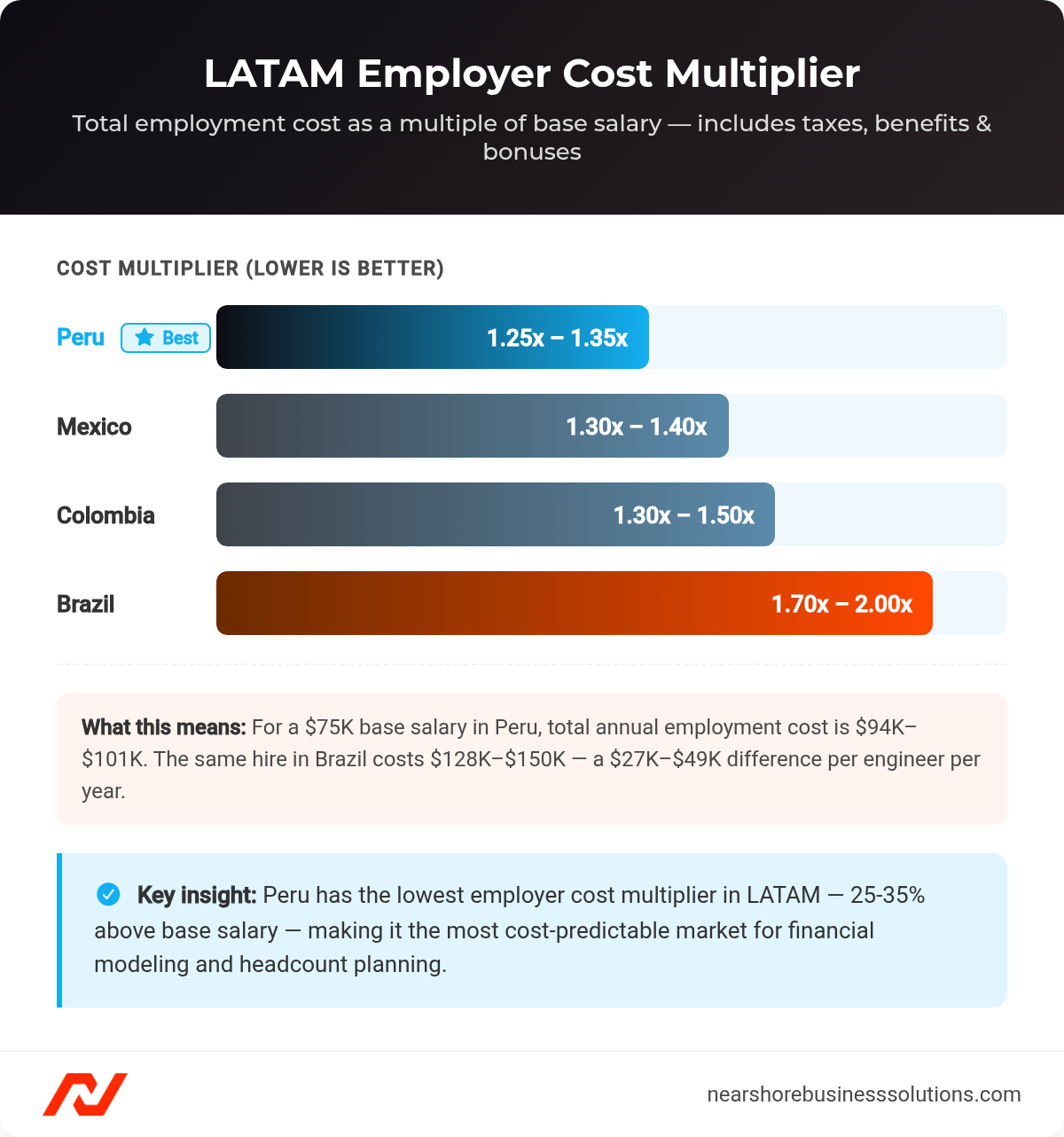
Employer cost multiplier comparison for Peru, Mexico, Colombia, and Brazil.
Peru’s multiplier is the most favorable in the region. For financial modeling, budget 1.3x base salary as a conservative estimate of true employment cost.
What Is the Pay Cycle and Currency Requirement for Peru Payroll?
Payroll runs on a monthly cycle. Salary must be paid in Peruvian Soles (PEN). The EOR converts your USD funding at prevailing exchange rates and handles all local disbursements.
Payroll must be accompanied by a payslip (boleta de pago) delivered to each employee. Employers are required to maintain payroll records (Planilla Electronica / PLAME) filed monthly with SUNAT, Peru’s tax authority.
What Is the Minimum Wage in Peru?
Peru’s national minimum wage (Remuneracion Minima Vital / RMV) is S/ 1,025 per month (approximately $270 USD). Tech workers hired through EOR arrangements earn multiples of this figure. Junior engineers start at $23,000-$35,000 annually. The minimum wage sets the legal floor for all employment contracts.
How Much Does It Cost to Hire an Employee in Peru Through an Employer of Record?
The total cost has two components: the employee’s compensation package (salary plus statutory benefits) and the EOR service fee. For a mid-level software engineer, expect a total monthly outlay of $5,000-$7,500 inclusive of EOR fees.
What Are the Typical EOR Service Fees for Peru?
| Provider | Monthly Fee (Per Employee) | Key Differentiator |
|---|---|---|
| Remote | $599 (annual) | Native Peru entity; IP Guard protection |
| Deel | $599 | 120+ currencies; fast self-serve onboarding |
| Rippling | $499-$599 | Unified HR, IT, and payroll; device management |
| Papaya Global | $599-$770 | Proprietary payment infrastructure; payroll analytics |
| Local Providers | Custom | Deeper in-country legal expertise; flexible benefits |
What Additional Employment Costs Should US Companies Budget For?
Beyond base salary, budget for the following mandatory additions:
- EsSalud: 9% of gross monthly salary
- CTS: One additional monthly salary per year (paid in May and November)
- Gratificaciones: Two additional monthly salaries per year (July and December)
- Profit-sharing: 5% of pre-tax profits for companies with 20+ employees
Effective annual compensation cost equals base salary times approximately 1.3, plus the EOR fee.
How Does the Total Employment Cost in Peru Compare to the US?
US companies save 60-68% on comparable engineering talent versus US tech hub equivalents.
| Role | Peru Senior (Annual) | US Equivalent (Annual) |
|---|---|---|
| Software Engineer | $59,000-$87,000 | $166,000+ |
| DevOps Engineer | $65,000-$85,000 | $148,190+ |
| Data Engineer | $60,000-$80,000 | $150,000+ |
| QA Engineer | $48,000-$65,000 | $114,360+ |
| AI/ML Specialist | $80,000-$110,000 | $177,238+ |
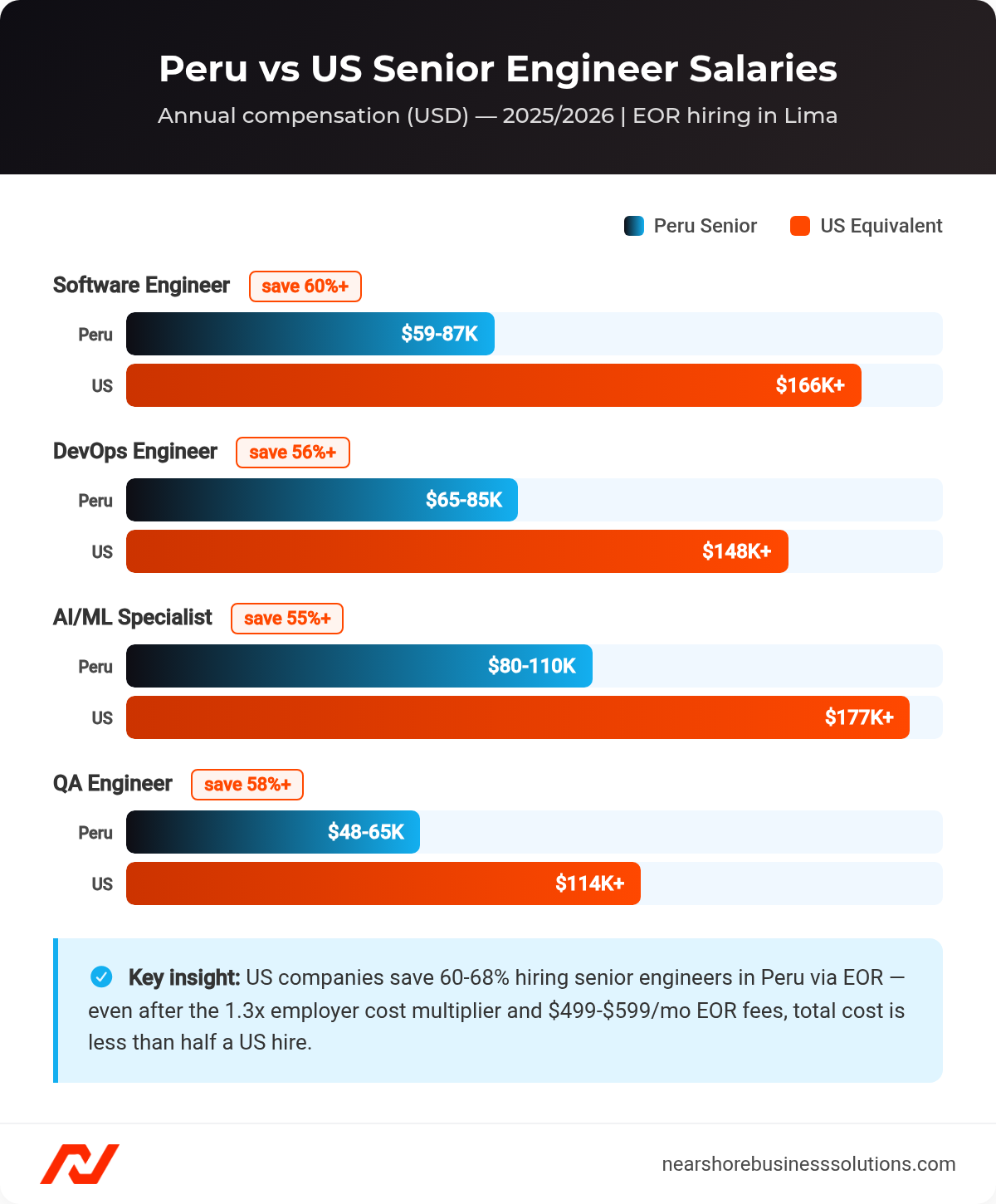
Annual senior engineer salary comparison across four roles — Peru versus US equivalents.
Even after applying the 1.3x employer cost multiplier and EOR fees, the total cost of a senior Peruvian engineer is less than half a US equivalent.
How Do You Choose the Right Employer of Record for Peru?
Prioritize providers with a native legal entity in Peru, not a third-party partner model. Native entities mean the EOR directly employs your workers under their own Peruvian legal structure. This reduces compliance gaps and response time when issues arise.
For a broader overview of staff augmentation models, see our staff augmentation guide.
What Should US Companies Look for in an EOR Contract for Peru?
Three clauses matter most:
- Work-for-hire language: All IP generated by the employee must be explicitly assigned to the US client. Peru’s Copyright Law (Legislative Decree 822) protects software automatically, but the EOR contract must reinforce ownership transfer.
- INDECOPI registration support: The EOR should help register software assets with Peru’s IP authority (INDECOPI) to establish official proof of ownership.
- Data privacy compliance: Peru’s Law 29733 (updated via Supreme Decree 016-2024-JUS) mirrors GDPR. It requires ISO/IEC 27001-aligned security measures, ARCO rights for data subjects, and breach notification to the ANPD. Confirm the EOR’s data handling is compliant.
What Questions Should You Ask an EOR Provider Before Signing?
Before signing with any EOR, ask five direct questions:
- Do you own your legal entity in Peru, or do you use a local partner?
- How do you handle SUNAFIL audits and employee disputes?
- Does your platform manage IT provisioning and device management?
- What is your SLA for onboarding a new hire?
- How do you calculate and remit CTS and gratificaciones?
Rippling is the standout choice for CTOs who want to manage laptops, software access, and payroll from a single platform. Remote’s native Peru entity makes it the strongest option for companies prioritizing compliance certainty.
What Are the Red Flags to Watch Out for in an EOR Agreement?
Four red flags signal a weak EOR contract:
- No native entity disclosure: If the provider can’t confirm they own their Peruvian entity, they rely on a third-party, adding a layer of compliance risk.
- Vague IP assignment language: Generic work-for-hire clauses that don’t specify Peruvian law jurisdiction are insufficient.
- No data processing agreement: Given Peru’s Law 29733 alignment with GDPR, any EOR handling employee data must provide a formal DPA.
- Flat-rate termination handling: Severance in Peru is calculated precisely. Providers that offer flat-rate or estimated severance figures are cutting corners.
How Does the Onboarding Process Work When Hiring Through an Employer of Record in Peru?
An EOR handles all local paperwork. Your team handles the job offer and role definition. The split is clean and fast: 3-5 business days from signed offer to active payroll.
What Documents Are Required to Hire an Employee in Peru?
The EOR collects and processes the following on your behalf:
- National ID (DNI) or passport
- Tax identification number (RUC, if applicable)
- Signed employment contract (in Spanish, as required by Peruvian law)
- Bank account details for salary disbursement
- AFP or ONP pension fund selection
- Health insurance enrollment confirmation (EsSalud)
Employment contracts in Peru must be in Spanish. Bilingual versions are acceptable, but Spanish governs in any legal dispute.
How Long Does Onboarding a Worker in Peru Through an EOR Typically Take?
It takes 3-5 business days from signed offer to active payroll enrollment.
Lima’s commercial districts in San Isidro and Miraflores offer 200+ Mbps fiber connections across major co-working spaces. Peru’s ICT market is growing at 12.98% CAGR, and infrastructure in these districts is mature enough to support immediate productivity for remote engineers.
What Are the Alternatives to an Employer of Record in Peru?
Two alternatives exist: establish a direct legal entity or hire independent contractors. Both carry significant drawbacks for growth-stage companies.
Should US Companies Set Up Their Own Legal Entity in Peru Instead?
Only commit to a direct entity if you’re hiring 10+ long-term employees and can wait 3-6 months. Direct entity setup costs $50,000-$250,000 upfront and requires ongoing monthly SUNAT/PLAME filings, local HR, legal counsel, and accounting infrastructure.
The market trend is clear. The Latin American EOR market is growing from $7.96 billion (2024) to a projected $22.3 billion by 2033 at 12.17% CAGR. Growth-stage companies are not building local entities: they’re delegating that complexity to EOR platforms.
What Are the Risks of Hiring Independent Contractors in Peru?
The risks are high. SUNAFIL’s “Primacy of Reality” doctrine means contractor classification is determined by how the relationship actually functions, not how the contract reads. Any contractor who follows a fixed schedule, uses company-issued equipment, or reports to a direct supervisor will be reclassified as an employee.
Reclassification triggers back-payment of all statutory benefits plus fines up to $70,000 per violation. For a company that has had three contractors for two years, the liability exposure can exceed $200,000 before legal fees.
What Are Peruvian Tech Companies That Prove the Market’s Depth?
Peru’s tech scene has produced companies capable of core product development, not just support work. This matters when you’re evaluating whether Peruvian engineers can carry production responsibilities.
In FinTech, Culqi (a digital payments platform acquired by Credicorp Capital) and Kambista (a digital currency exchange) demonstrate that Lima engineers can build secure, high-transaction financial systems. Leasy recently raised $28 million to expand its engineering team in Lima, signaling strong investor confidence in the local talent pool.
In HealthTech, Doctocliq uses AI-powered diagnostic systems across nine languages, delivering the kind of complex AI work that growth-stage US companies increasingly need. In EdTech, platforms like Crehana have scaled to serve 200,000+ learners across Latin America from engineering teams based in Lima.
The government has invested $100 million in institutions like UTEC (University of Engineering and Technology) and is building 11 Science and Technology Parks focused on AI, cybersecurity, and cloud computing. Arequipa is emerging as a secondary hub with 38,000 developers at slightly lower price points than Lima.
Frequently Asked Questions: Employer of Record in Peru
These are the most common questions US tech leaders ask about using an EOR to hire in Peru.
Can a US Company Hire a Peruvian Employee Directly Without an EOR?
Technically yes, but only through a registered local entity. Without a Peruvian legal entity, a US company cannot appear on a local payroll, remit to SUNAT, or contribute to EsSalud. Attempting to do so through direct bank transfers and contractor agreements puts the company squarely in SUNAFIL’s misclassification crosshairs.
Does Peru Have Different Labor Rules for Foreign-Owned Companies?
No. Under the US-Peru Trade Promotion Agreement (PTPA), US companies receive the same legal treatment as local entities. The same labor laws, the same IP protections under Legislative Decree 822, and the same enforcement mechanisms apply. Foreign ownership does not create a separate compliance tier.
What Happens If an Employer of Record Violates Peru’s Labor Laws?
Under the EOR model, legal liability sits with the EOR, not the US parent company. If the EOR miscalculates CTS, misfiles payroll, or mishandles a termination, they are responsible for the resulting penalties and back-payments. This liability transfer is a core value proposition of the model. Vet your EOR’s compliance track record before signing.
Is an EOR in Peru a Good Fit for Long-Term Hiring or Just Short-Term?
Long-term. Peru’s talent pipeline is built for sustained growth. There are 36,939 STEM graduates entering the workforce annually. The government has invested $100 million in UTEC and is building 11 new Science and Technology Parks. Demand for tech roles rose 60% year-over-year by 2025. Companies like Leasy, Culqi, and Doctocliq have all scaled engineering teams in Lima for core product work.
Do I Need to Provide Equipment to Peruvian Employees?
You’re not required to, but Peru’s Law 31572 requires employers to provide or reimburse equipment and internet costs when employees use personal resources for work. Most EOR arrangements include equipment procurement options. Rippling handles this through integrated IT and device management, making remote laptop provisioning straightforward from the same platform used for payroll.
How Does Peru’s English Proficiency Compare to Other LATAM Countries?
Peru outperforms several major nearshoring markets. Peru ranks in the mid-50s globally on the EF English Proficiency Index, ahead of Brazil (75th), Colombia (76th), and Mexico (104th). Lima scores 542 on the EF EPI, placing it in the High-Moderate band. Within the engineering community, technical English is typically stronger due to English-language documentation and global certifications (AWS, Azure, Google Cloud).
What Is the Time Zone Overlap Between Peru and US Tech Centers?
Peru operates on UTC-5 year-round with no Daylight Saving Time. New York gets 7-8 hours of daily overlap with a Lima-based team. Austin gets 6-7 hours. San Francisco and Seattle get 4-5 hours. This overlap enables daily stand-ups, real-time code reviews, and emergency troubleshooting within the standard US business day.
Is an Employer of Record the Right Move for Your Peru Expansion?
For most growth-stage US tech companies, yes.
Peru combines several factors that are hard to replicate elsewhere in Latin America:
- English proficiency: Lima scores 542 on the EF EPI, in the High-Moderate band, ahead of Brazil, Colombia, and Mexico
- Time zone: UTC-5 year-round, no Daylight Saving Time, with 7-8 hours of daily overlap for New York teams
- Cost: 60-68% savings versus US tech hub equivalents, with the lowest employer cost multiplier in the region (1.25x-1.35x)
- Talent depth: 170,000+ tech professionals, with Lima’s San Isidro and Miraflores districts holding the highest concentration of senior, English-fluent engineers
- Pipeline: 36,939 STEM graduates annually from institutions like UTEC, with 11 Science and Technology Parks under development
- Compliance certainty: The EOR model handles SUNAFIL exposure, statutory benefits, IP assignment, and data privacy compliance under Law 29733
The EOR model is not a workaround. For companies between $5M and $100M ARR, it is the structurally correct way to scale engineering in Peru. It’s legally sound, operationally fast, and built for the compliance requirements that matter to investors and acquirers.
If you’re evaluating providers, prioritize those with native Peru entities, integrated IT management, and explicit IP assignment language in their master service agreements. The difference between a well-structured EOR contract and a generic one shows up exactly when you need it most: during a termination, an audit, or an acquisition due diligence.
For a country-specific hiring overview, see our Peru hiring guide.
Ready to Build Your Peru Engineering Team?
Nearshore Business Solutions sources and vets developers from Lima’s San Isidro and Miraflores districts and Arequipa. We screen for technical skills, English fluency, and US work style fit.
Every placement includes a 90-day replacement guarantee. You receive the first pre-vetted candidates within 3 business days.
Get a free consultation to discuss your hiring needs and receive a custom quote.