
IT staffing in Latin America cuts developer costs 50-65% while accessing 2 million+ engineers across Mexico, Argentina, Colombia, and Brazil.
LATAM developers cost $43,000-$82,000 annually versus $142,000-$175,000 for US equivalents. Major tech hubs in Monterrey, Guadalajara, Medellín, and Buenos Aires offer 70-90% time zone overlap with US business hours. New teams reach 85-95% efficiency within six months.
Nearshore Business Solutions sources from top universities: Tecnologico de Monterrey (ITESM) and UNAM in Mexico, Universidad de los Andes in Colombia, and UBA and ITBA in Argentina. Below, you’ll find salary benchmarks, hiring models, legal requirements, and a step-by-step guide to integrating a nearshore team.
What Is Nearshore IT Staffing?
IT staffing places developers in adjacent time zones on your team. You hire engineers in Mexico, Argentina, or Colombia at 40-60% of US costs who work your hours and ship to your repos.
How Does Nearshore IT Staffing Work?
Three models cover nearshore hiring: direct contractor, Agent of Record (AOR), or Employer of Record (EOR).
Direct contractor onboards in days. You contract individuals directly. Risk: misclassification penalties if local law deems them employees.
AOR provides contractors with compliance paperwork handled by a third party. You still face classification risk.
EOR is the legal employer. It owns the entity, payroll, benefits, and compliance risk. You direct the work. Onboarding takes 1-2 weeks. This is the standard model for US companies without a local legal entity.
EOR costs 15-20% more than direct contracting but eliminates misclassification exposure.
What Factors Affect Nearshore IT Staffing Success?
New teams start at 60-70% efficiency, reaching 85-95% within six months. Projects complete 40% faster than offshore due to time zone overlap. Real-time communication resolves blockers the same day instead of across 12-hour gaps.
Three accelerators drive faster ramp-up: system documentation, a senior engineer handling onboarding, and direct Slack access from day one.
What Is an Extended Tech Team?
An extended tech team integrates external developers into your core product lifecycle. They work on your roadmap, attend planning sessions, and own features. They do not execute isolated maintenance tasks.
How Does an Extended Tech Team Differ from Traditional Outsourcing?
Traditional outsourcing hands off defined projects. Extended teams collaborate on architecture decisions, share tribal knowledge, and contribute to your codebase daily. Developers join sprint planning and technical design sessions, not just ticket execution.
Why Do Companies Build Extended Tech Teams?
Two pressures drive this: a domestic talent shortage and offshore friction. US hiring timelines stretch to 4-6 months for senior roles. Far-shore models in Asia-Pacific and Eastern Europe create async delays that break Agile workflows.
What Are the Benefits of Nearshore IT Staffing?
Staff augmentation through Latin America delivers measurable ROI across three dimensions: time zone alignment, cost savings, and cultural compatibility.
How Does Time Zone Alignment Improve Collaboration?
Major LATAM tech hubs share 70-90% overlap with US hours. India and the Philippines operate on 10-13 hour gaps. LATAM enables same-day standups, pair programming, and sprint reviews.
| City | Eastern | Central | Pacific |
|---|---|---|---|
| Mexico City | 8 hours | 9 hours | 7 hours |
| Bogota | 9 hours | 8 hours | 6 hours |
| Santiago | 8 hours | 7 hours | 5 hours |
| Buenos Aires | 7 hours | 6 hours | 4 hours |
What Cost Savings Does Nearshore IT Staffing Provide?
You save 50-65% on gross salary versus US hires. Statutory benefits add 20-35% to base salary (Aguinaldo, Prima Vacacional, social security, housing funds).
| Role | US Salary | LATAM Salary |
|---|---|---|
| Frontend Engineer | $142,000 | $43,200-$58,000 |
| Backend Engineer | $151,000 | $48,000-$64,000 |
| Full-Stack Developer | $158,000 | $51,600-$72,000 |
| DevOps Engineer | $165,000 | $55,000-$80,000 |
| AI/ML Specialist | $175,000 | $66,300-$82,200 |
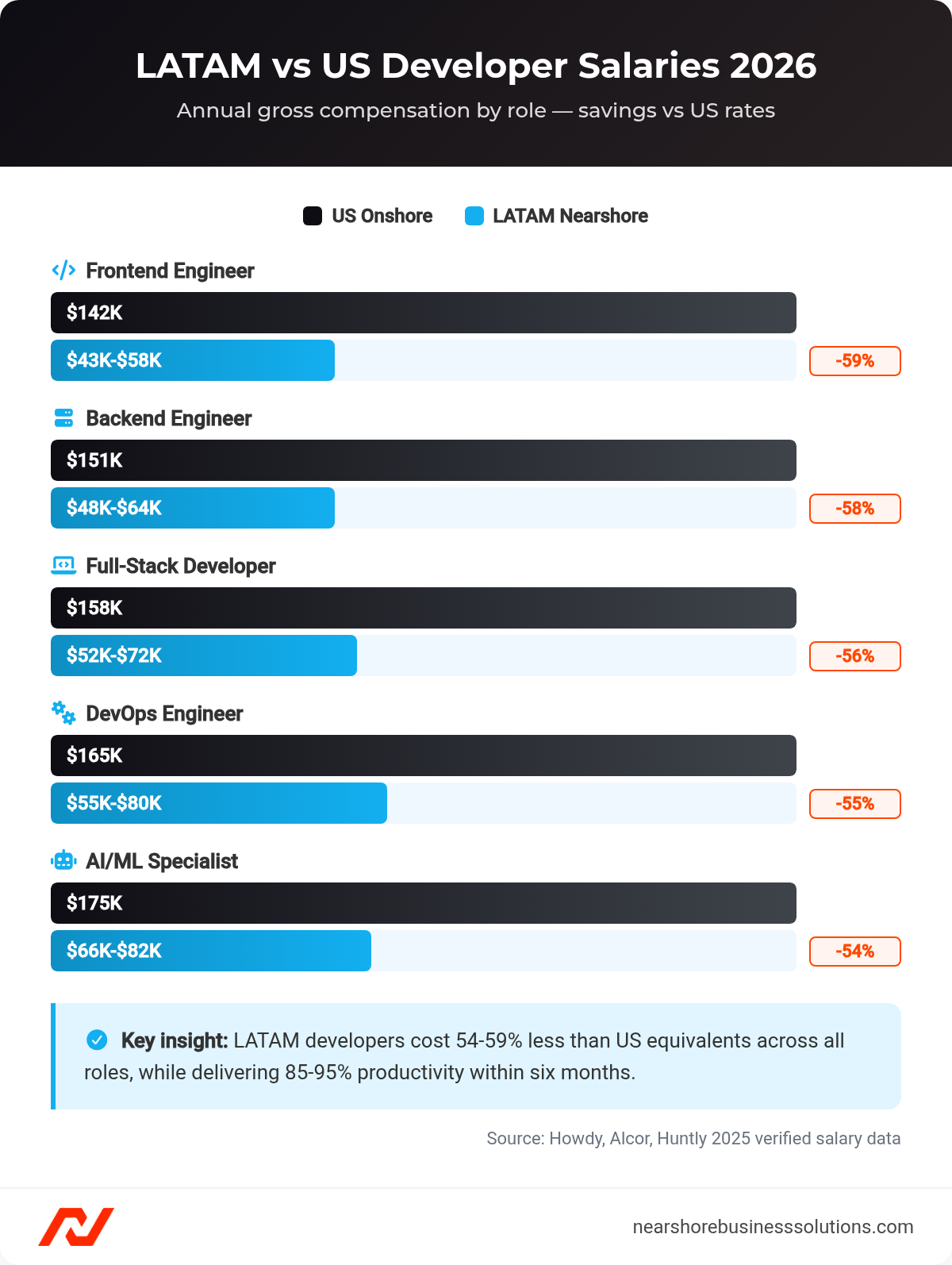
LATAM developers cost 54-59% less than US equivalents across all engineering roles.
A senior DevOps engineer in Mexico costs roughly $85,000 fully loaded. The US equivalent in a high-cost city runs over $210,000.
How Does Cultural Compatibility Affect Performance?
LATAM work culture mirrors US norms on proactive communication and ownership. Argentina ranks second in LATAM for English proficiency among developers. Applications for North American tech roles increased 370% over four years: working with US companies carries real career prestige.
What Communication Advantages Come with Nearshore Teams?
Nearshore response time runs 1-2 hours versus 8-12 hours for offshore. Management overhead stays at 5-10% versus 15-25% for far-shore. Synchronous communication cuts coordination costs on your senior engineers.
What Are the Disadvantages of Nearshore IT Staffing?
How Does Nearshore Pricing Compare to Offshore Alternatives?
Nearshore costs 30-50% more per developer than offshore base rates. Recruitment fees run 15-20% of salary versus 10-15% for offshore. Security and VPN setup costs $100-200 per month versus $200-400 for offshore.
What Talent Pool Limitations Exist in Nearshore Regions?
High regional demand creates churn. Maintain 20% bench strength to cover attrition without delivery gaps. Demand shifted from entry-level generalists to senior specialists in AI, cloud, and cybersecurity. Finding specialized roles takes 4-8 weeks versus 2-4 weeks for full-stack generalists.
What Is the Difference Between Nearshore, Offshore, and Onshore Staffing?
Nearshore delivers 60-70% cost reduction with minimal efficiency trade-off versus US onshore rates. Offshore teams plateau at 80% efficiency due to async bottlenecks.
| Metric | Nearshore | Offshore | Onshore |
|---|---|---|---|
| Initial productivity | 70% | 55% | 90% |
| 6-month efficiency | 95% | 80% | 100% |
| Response time | 1-2 hours | 8-12 hours | Under 1 hour |
| Management overhead | 5-10% | 15-25% | 0% (internal) |
Communication friction and time zone delays add 15-20% to offshore base costs, which erodes the rate advantage.
Which Staffing Model Offers the Best Cost-to-Value Ratio?
Nearshore ROI beats offshore when you factor in hidden costs. A $65/hour Mexico City senior developer who ships clean code in two sprints outperforms a $30/hour offshore developer whose output requires rework. Time zone alignment eliminates the 15-20% offshore coordination tax.
Why Is Latin America a Top Choice for Nearshore Tech Talent?
Latin America has 2 million+ developers and produces 220,000 STEM graduates annually from 430+ universities, including Tecnologico de Monterrey, UNAM, and Universidad de los Andes.
| Country | Developers | Annual STEM Grads | English Ranking | Specialization |
|---|---|---|---|---|
| Mexico | 800,000 | 124,000 | #20 LATAM | AI/ML, Cloud, IoT |
| Brazil | 540,000 | 46,000 | #17 LATAM | Java, .NET, Fintech |
| Colombia | 165,000 | 15,000 | #18 LATAM | FoodTech, SaaS |
| Argentina | 150,000 | 13,000 | #2 LATAM | Data Science, Cloud |
| Chile | 66,000 | 25,000 | #8 LATAM | AI, Data Analytics |
What Tech Skills Are Available in Latin America?
React, Node.js, Python, and Go dominate the regional stack. Mexico and Brazil hold 95% of regional AI patents. By end of 2025, the region shifted toward high-level expertise in generative AI, cloud-native environments, and digital product design.
Core competencies: React, Node.js, Python, Go, AWS/GCP/Azure, Kubernetes, Terraform.
Regional specialization:
- Mexico and Brazil lead in AI/ML talent
- Argentina, anchored by UBA and ITBA graduates, dominates data science
- Colombia excels in SaaS and cloud infrastructure, supported by INNpulsa Colombia programs
How Do You Build Your Extended Tech Team with IT Staffing?
How Do You Define Your Technical Requirements?
Start with stack and seniority. Modern stacks to prioritize: React, Node.js, Python, and Go. Demand shifted toward senior specialists in AI, cloud, and cybersecurity. Generalist roles fill in 2-4 weeks; specialized roles take 4-8 weeks.
How Do You Select a Nearshore IT Staffing Provider?
Four criteria separate reliable providers from risky ones. Look for SOC2 Type 2 and ISO 27001 certifications, presence in primary tech hubs (Monterrey, Guadalajara, Medellín, Buenos Aires), on-the-ground compliance expertise for each country, and retention data above 85% monthly.
Ask potential partners: How do you handle misclassification risk? What is your IP assignment process? What is your developer retention rate and time to replacement?
What Vetting Process Ensures Quality Nearshore Talent?
Monthly retention runs 85-92% for top LATAM nearshore providers, compared to 70-80% for Asia-Pacific offshore. Defect detection reaches 90-95%, aided by real-time requirement clarification. Data from 200+ distributed projects confirms nearshore teams reach high-performance levels faster than offshore.
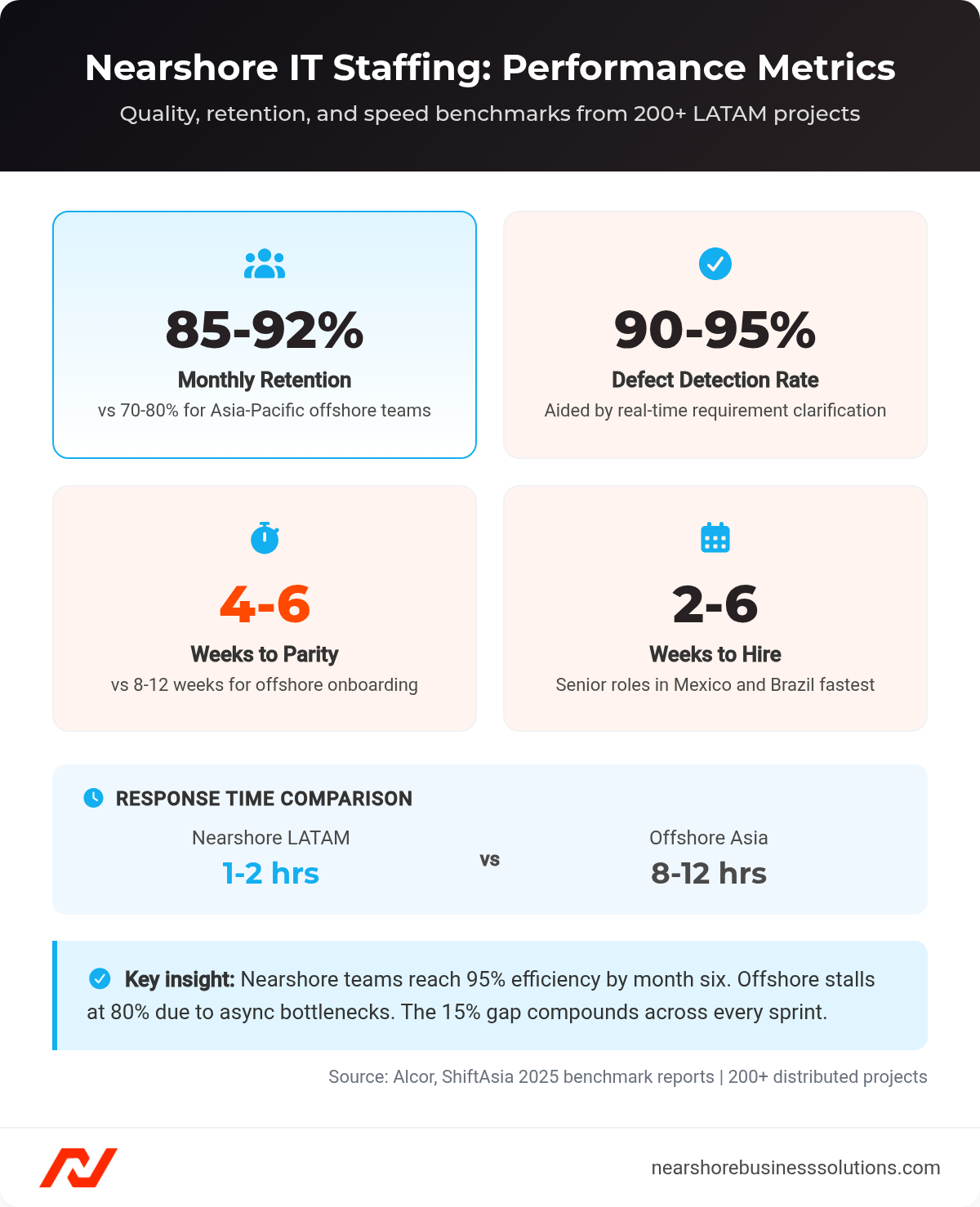
LATAM nearshore teams reach 95% efficiency by month six, with 85-92% monthly retention.
Verify these benchmarks with potential providers before signing. Request retention data by quarter, time-to-productivity metrics by seniority level, and case studies showing ramp time and defect rates. Check LinkedIn for employee tenure and client testimonials. Long-standing partnerships signal operational stability. Request client references in your sector, not just generic testimonials.
How Do You Onboard Nearshore Team Members Effectively?
Nearshore developers reach parity with US-based engineers in 4-6 weeks. Offshore takes 8-12 weeks due to async onboarding drag. Senior developers reach parity 50% faster than mid-level.
Time to hire a senior role: 2-6 weeks. Mexico and Brazil are the fastest markets. Three onboarding practices accelerate ramp-up: assign a senior in-house engineer as a dedicated point of contact for the first 30 days, provide full system documentation before week one, and grant direct Slack access to relevant channels from day one. Avoid routing all communication through a project manager: direct access to engineering channels reduces context loss and speeds knowledge transfer.
What Is IT Staff Augmentation in Nearshore Models?
How Does IT Staff Augmentation Differ from Dedicated Teams?
Staff augmentation adds individual developers to your existing team. They report to your engineering managers and work on your backlog. You get direct control over sprint planning, code reviews, and architecture decisions.
Dedicated teams operate as a managed unit. The vendor handles team composition, task allocation, and delivery management. Use this model when you want turnkey delivery without daily management overhead.
When Should You Choose Staff Augmentation Over Project Outsourcing?
Choose staff augmentation when you need control over architecture decisions, code reviews, and sprint planning. Choose project outsourcing when scope is defined and you want turnkey delivery.
EOR provides maximum compliance coverage. The contractor model carries misclassification risk.
How Do You Manage a Nearshore Extended Tech Team?
What Communication Practices Ensure Nearshore Success?
Agile cadence requires real-time overlap for collaborative tasks. Schedule standups, sprint planning, and retros during shared hours. Use async for status updates and deep-work documentation.
Synchronous communication during shared hours resolves ambiguity that would otherwise create multi-day delays in offshore models.
How Do You Handle Performance Management with Remote Teams?
Apply the same performance framework as local hires. Set clear OKRs, run biweekly 1:1s, and tie feedback to code quality metrics and delivery velocity. Track pull requests, test coverage, and story completion rates. Remote location does not change accountability standards.
How Do You Maintain Team Cohesion Across Locations?
Invest in purpose and upskilling. Teams without growth paths face a retention crisis. Quarterly in-person gatherings improve trust for distributed teams. Rotate on-call responsibilities equally: do not silo nearshore engineers into support-only roles. Include nearshore developers in technical design decisions from day one.
Core metrics to track: monthly retention (85-92%), defect detection (90-95%), ramp-up to parity (4-6 weeks), sprint velocity, code review turnaround, and incident response time.
What Does Nearshore IT Staffing Cost?
LATAM staffing revenue hit $11.1 billion in 2024, projected to reach $14+ billion by 2027. US mid-market adoption reached 48% in 2025, up from 12% in 2020.
What Are Mexico IT Staffing Rates?
| Role | Annual Salary (Fully Loaded) |
|---|---|
| Frontend Engineer | $52,000 |
| Backend Engineer | $60,000 |
| Full-Stack Developer | $65,000 |
| DevOps Engineer | $78,000 |
| AI/ML Specialist | $82,200 |
Hiring in Mexico offers the largest developer pool in LATAM at 800,000+ specialists, with graduates from ITESM, UNAM, and IPN filling tech hubs in Guadalajara (Mexico’s Silicon Valley) and Monterrey.
How Does the ROI Compare to Onshore Hiring?
A 5-engineer team for 12 months produces an ROI of 122%. Onshore costs $59,165/month at $142,000/year average. Nearshore costs $25,000/month at $60,000/year average. Overhead adds $1,500/month. Productivity adjustment for the first six months (85% efficiency) adds $2,250/month average.
ROI = [(Onshore cost – Nearshore cost) x Team size x Duration – (Overhead + Productivity adjustment)] / (Nearshore cost x Team size x Duration) x 100
For LATAM developer hiring options, the math improves further when you account for faster ramp-up compared to offshore models.
What Pricing Models Do Nearshore Providers Offer?
Two models dominate. The contractor model charges a flat hourly fee. You invoice for hours worked. The EOR model charges base salary plus statutory benefits (20-35%) plus a service fee (15-20%). EOR total cost runs 35-55% above base salary. Contractor rates appear lower but carry misclassification risk.
What Legal Considerations Apply to Nearshore IT Staffing?
How Do Contracts Work with Nearshore Teams?
Under the EOR model, the provider handles tax compliance and misclassification risk. You sign a service agreement with the EOR, not individual developers. Under the contractor model, you contract directly with developers. Misclassification penalties fall on you.
Mexico’s 2021 subcontracting reform and Colombia’s evolving regulatory environment require on-the-ground expertise. Top EORs provide SOC2 Type 2 reports and ISO 27001 certifications as a baseline.
What Intellectual Property Protections Should Be in Place?
Three-party IP assignment is required under the EOR model. The developer assigns IP to the EOR, and the EOR assigns IP to you. Both transfers must be explicit and documented. Failure to ensure a clean transfer chain causes valuation drops during acquisitions.
Brazil requires specific IP agreements to ensure code belongs exclusively to the foreign entity. Work with local counsel.
How Do Employment Laws Differ Across Nearshore Regions?
Each country has distinct statutory benefits: Aguinaldo in Mexico, the 13th salary in Brazil. EOR absorbs this complexity. The contractor model leaves it to you.
HealthTech integration into US-regulated sectors requires HIPAA adherence and SOC2 compliance. Verify your EOR supports Business Associate Agreements (BAAs). GDPR compliance is a joint responsibility when US companies determine the purpose of data processing.
Is Nearshore IT Staffing Effective for Long-Term Projects?
How Does Retention Work in Nearshore Models?
Monthly retention runs 85-92%. Developers view US company experience as career acceleration: resume value, exposure to advanced tooling, and higher future earning potential. Long-term projects benefit from reduced knowledge loss and compounding efficiency gains beyond the 6-month ramp period. Teams that hit the 12-month mark typically operate at full parity with in-house engineers on delivery velocity and code quality metrics.
Can Nearshore Teams Integrate with Company Culture?
Yes. Companies that build integrated, bilingual, cross-functional teams gain a decisive competitive advantage. Cultural integration requires deliberate effort: include nearshore developers in all-hands meetings, celebrate regional holidays, rotate team leads between locations, and create equal advancement paths.
Teams with strong cultural integration report higher retention and faster knowledge transfer.
What Mistakes Should You Avoid with Nearshore IT Staffing?
What Are the Five Common Failure Modes?
Five pitfalls account for most nearshore failures. Recognizing them before you engage a provider saves months of costly recovery time and significant legal exposure.
Misclassification triggers heavy fines and back-taxes. Use an EOR or establish a local legal entity.
IP ambiguity reduces valuation during M&A due to unclear assignment chains. Use explicit three-party IP clauses.
Retention crisis creates knowledge loss and project delays when developers are treated as disposable capacity. Invest in long-term purpose and upskilling.
Economic volatility destabilizes payroll when contracts are denominated in local currency. Denominate contracts and salaries in USD.
Communication gap creates misaligned expectations when requirements are underdocumented. Invest in “evangelization”: document why decisions were made, not just what was built.
How Do You Prevent Communication Breakdowns?
Prioritize soft skills during hiring. Technical competence without communication ability creates bottlenecks. Establish synchronous touchpoints for ambiguity resolution. Do not rely on ticket descriptions alone. Context prevents misalignment and reduces the need for rework.
Frequently Asked Questions
How long does it take to hire nearshore developers?
It takes 2-6 weeks to hire a senior nearshore developer, depending on the country and specialization. Mexico and Brazil are the fastest markets. Specialized roles in AI, cloud, and cybersecurity take 4-8 weeks.
What happens if a developer does not work out?
Top nearshore providers offer 90-day replacement guarantees. The EOR model simplifies offboarding: the EOR handles termination compliance, not you.
Do I need to provide equipment for nearshore developers?
Most EOR arrangements include device provisioning and VPN security tooling. Confirm your provider’s standard equipment policy before signing. Security setup costs $100-200/month for nearshore versus $200-400/month for offshore.
How do I pay nearshore developers?
Under the EOR model, you pay the EOR a monthly fee that covers salary, statutory benefits, and the service charge. You do not pay developers directly. Denominate contracts in USD to avoid currency volatility.
What is the difference between nearshore and offshore?
Nearshore places developers in adjacent time zones (1-3 hours from US). Offshore places developers 10-13 hours away. Nearshore enables same-day standups and pair programming. Offshore creates async delays that add 15-20% to project coordination costs.
Do I need a local entity to hire nearshore developers?
No. An EOR acts as the legal employer in the country. You direct the work without setting up a local entity. This eliminates the 6-12 month process of incorporating a local business.
Is nearshore staffing right for early-stage startups?
Post-Series A companies benefit most: established roadmap, proven product, scaling headcount. Early-stage startups under $5M often need co-located teams for rapid pivots. Mid-market companies ($5M-$100M revenue) are the primary adopters.
Ready to Build Your Latin America IT Staffing Team?
Nearshore Business Solutions sources and vets developers from Monterrey, Guadalajara, Medellín, Buenos Aires, and Bogota. We screen for technical skills, English fluency, and US work style fit. Our acceptance rate is 16%.
Every placement includes a 90-day replacement guarantee. You receive pre-vetted candidates in 2-4 weeks.
Get a free consultation to discuss your hiring needs and receive a custom quote.