
Chile gives US tech companies access to LATAM’s highest senior developer density, 4th-ranked global broadband infrastructure, and base salaries 70% below US coastal rates.
Chilean developers cost $47,400-$61,000 annually at the senior level. Time zone overlap delivers 6-8 shared hours with New York and San Francisco daily. PUC, Universidad de Chile, and UTFSM produce engineers with 5-6 year degrees equivalent to US master’s-level preparation.
We connect US teams with vetted developers from Santiago, Valparaíso, and Concepción. Below you’ll find salary benchmarks, a step-by-step hiring process, legal compliance requirements, and guidance on the EOR model that eliminates entity establishment.
Why Should You Hire Software Developers in Chile?
Chile offers three advantages that distinguish it from other LATAM markets: the highest senior developer density in the region (45%), OECD-level legal frameworks, and time zone alignment that enables real-time collaboration across all US time zones.
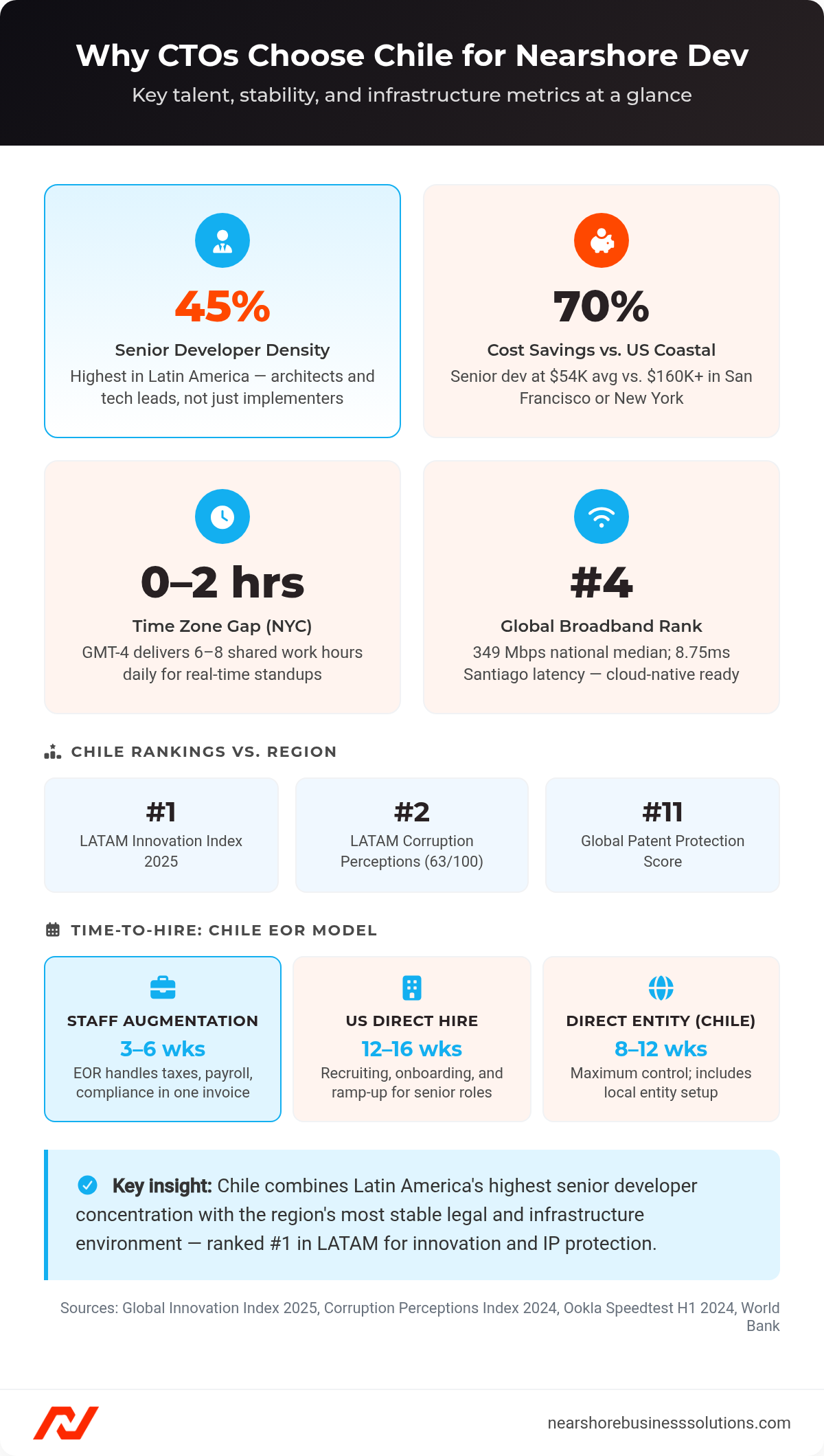
Chile hiring advantage metrics: senior talent density, cost savings, timezone alignment, and infrastructure rankings.
What Are the Advantages of Chile Tech Talent?
Chile’s developer workforce is 45% senior-level, the highest concentration in Latin America. Chilean developers score 98% in statistical programming and 97% in computer programming on global assessments. That ranking places them 4th in Latin American technology prowess overall. Time zone alignment delivers 6-8 shared work hours daily: GMT-4 creates a 0-2 hour difference with New York and 3-5 hours with San Francisco. Teams can run synchronous stand-ups, pair programming sessions, and incident response calls without scheduling workarounds.
For comparison, see our guide to hiring software developers in Latin America for a full LATAM overview.
What Are the Challenges of Hiring Developers in Chile?
Chile faces a 6,000-professional annual IT talent deficit, which creates a competitive recruiting environment. Senior developers in Santiago receive 2-3 recruiter contacts weekly. Specialized domains like cybersecurity and advanced data science show shortages closer to 28,000 professionals. Currency volatility adds a compensation layer: the CLP fluctuated 12.33% against USD in 2023-2024. USD-indexed salary structures (calculated in USD, paid in CLP at mid-market rate) resolve this for most companies.
What Is the Quality of Software Developers in Chile?
Chilean engineering programs span 5-6 years and award the “Civil Engineer” (Ingeniero Civil) professional title. Pontificia Universidad Católica de Chile (PUC), Universidad de Chile, and Universidad Técnica Federico Santa María (UTFSM) lead technical education nationally. This degree structure builds deep foundations in mathematics, physics, and systems architecture. Graduates architect solutions rather than just implement features.
What Technical Skills Do Chilean Developers Typically Have?
Agile and DevOps practices are near-universal among senior Chilean talent. AWS and Microsoft certifications are common across the workforce. Kubernetes and containerization are standard for senior backend engineers in Santiago. Healthcare tech capabilities include strong HL7 and FHIR interoperability expertise. DevSecOps adoption increased significantly following Chile’s 2025 cybersecurity law. Strong .NET/C# concentration exists in corporate and Microsoft-environment shops.
What Programming Languages Are Most Common Among Chilean Developers?
JavaScript leads with 10,900 specialists and 18% annual growth. Python follows with 6,200 specialists and is the primary language for AI and machine learning applications. The table below shows the full breakdown.
| Language/Framework | Specialists | Context |
|---|---|---|
| JavaScript | 10,900 | 18% annual growth, web/mobile foundation |
| Python | 6,200 | Primary for AI/ML applications |
| React | 4,700 | Leading frontend framework |
| Java | 4,000 | Banking and enterprise standard |
| TypeScript | 3,800 | Preferred by senior developers |
| Node.js/Express | 3,800 | Microservices core |
| PHP | 3,400 | E-commerce and legacy web systems |
How Strong Is English Proficiency Among Chilean Tech Talent?
IT professionals in Chile average 593 on standardized English tests, placing them at B2/C1 CEFR level. Chile ranks 8th in Latin America for English proficiency overall. Santiago’s tech cohort significantly outpaces the national average. Developers with C1/C2 fluency can lead client-facing sprint reviews and technical discovery calls. These developers command a 15-20% salary premium, which remains well below US-equivalent rates.
How Do Chile Developer Costs Compare to Other Hiring Options?
Senior developers in Chile cost $47,400-$61,000 annually versus $160,000+ in US coastal markets. That difference represents a 70% reduction in base salary. Fully-loaded costs run 20-30% above base when accounting for employer contributions and operational overhead.
What Are the Salary Ranges for Developers in Chile?
Senior software developers in Chile cost $47,400-$61,000 annually. The table below compares Chile rates against other LATAM markets and the US.
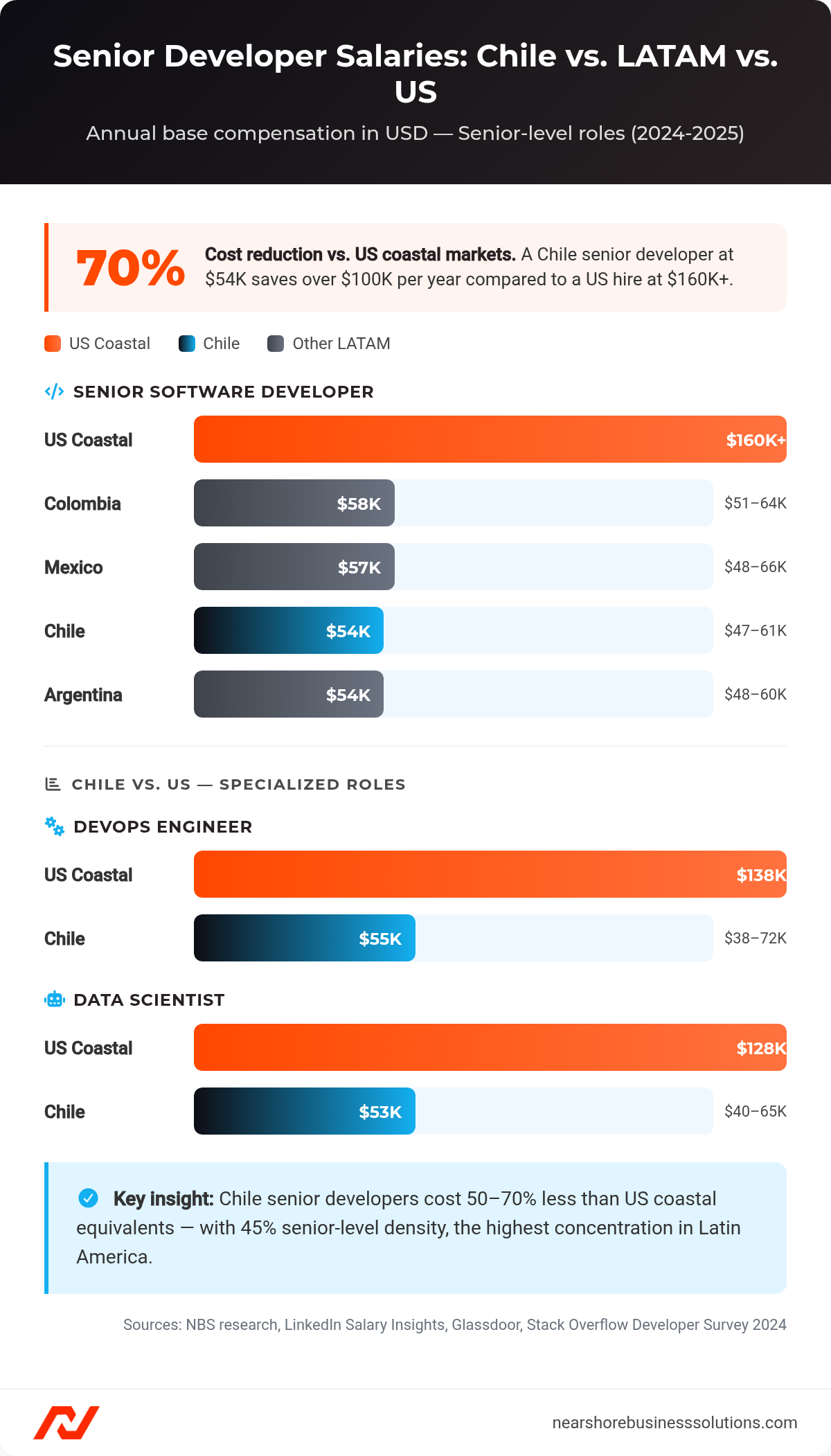
Senior developer salaries across LATAM and the US, showing Chile’s 50–70% cost advantage over US coastal markets.
| Role | US (Coastal) | Chile | Mexico | Colombia | Argentina |
|---|---|---|---|---|---|
| Senior Software Dev | $160,000+ | $47,400-$61,000 | $48,000-$66,000 | $51,600-$63,600 | $48,000-$60,000 |
| DevOps Engineer | $138,000 | $38,000-$72,000 | $50,000-$65,000 | $45,000-$60,000 | $42,000-$60,000 |
| Data Scientist | $128,000 | $40,000-$65,000 | $45,000-$62,000 | $40,000-$58,000 | $38,000-$55,000 |
| Tech Lead | $185,000+ | $60,480-$151,200 | $100,000-$130,000 | $85,000-$110,000 | $90,000-$115,000 |
What Additional Costs Should You Budget For?
A $50,000 base developer costs $60,000-$65,000 fully loaded. The table below breaks down mandatory employer contributions.
| Cost Category | Rate/Amount | Notes |
|---|---|---|
| Unemployment Insurance | 2.4% (employer) | For indefinite-term contracts |
| Disability/Survival (SIS) | 1.5% (employer) | Capped at monthly UF limit |
| Accident Insurance | 0.95%-3.4% | Depends on risk category |
| Health/Pension | 17% (employee) | Deducted from gross; employer manages remittance |
| 13th Month Pay | ~8.3% (customary) | Pro-rated monthly or paid as annual bonus |
| Paid Vacation | 15 working days | Mandatory after 12 months |
| Hardware/Setup | $2,000-$3,000 | Laptop, VPN, remote-office stipend |
| EOR/Payroll Fees | $200-$500/month | Third-party management platform |
How Does Chile Compare to Other LATAM Countries for Hiring?
Chile distinguishes itself from other LATAM markets on stability, infrastructure, and talent density rather than raw pool size. The 61,000-66,000 ICT professionals in Chile are fewer than Mexico’s 800,000, but 45% are senior-level versus Mexico’s broader junior distribution.
How Does Chile’s Political and Economic Stability Compare?
Chile scores 63/100 on the Corruption Perceptions Index (32nd globally, 2nd in LATAM). The Political Stability Index is 0.12 positive versus a world average of -0.07. GDP per capita exceeds $30,000, the highest in South America. The Global Innovation Index 2025 places Chile 51st globally and 1st in Latin America. World Bank ranks Chile 59/190 for Ease of Doing Business. These metrics make Chile the lowest-risk LATAM market for US companies establishing development teams.
How Does Chile’s Infrastructure Compare to Other LATAM Countries?
Chile ranks 4th globally for fixed broadband speed. Santiago delivers 257.02 Mbps download, 174.50 Mbps upload, and 8.75ms latency. Valparaíso posts 287.68 Mbps download at 11.63ms latency. Concepción delivers 279.02 Mbps download at 21.64ms. Multiple Pacific and Atlantic subsea cable landing points provide redundancy. This infrastructure eliminates technical barriers for real-time cloud-native development.
How Does Chile’s Time Zone Compare?
Chile operates GMT-4 (GMT-3 during austral summer), delivering 0-2 hour differences with New York and 3-5 hours with San Francisco. This creates 6-8 shared work hours for synchronous collaboration. Eastern Europe shows 6-9 hour gaps; Asia shows 12-15 hour inversions. Chile is the best time zone fit in LATAM for US East Coast teams.
What Is the Hiring Process for Software Developers in Chile?
The typical timeline for hiring a senior Chilean developer runs 3-6 weeks through a staffing agency or EOR, or 8-12 weeks for direct hire. Six steps cover the full process from requirements through onboarding.
How Do You Define Requirements and Source Candidates?
Target the 45% senior developer cohort directly. Primary tech hubs are Santiago, Valparaíso, and Concepción. Santiago’s “Sanhattan” districts (Las Condes, Providencia) concentrate the largest tech companies in Chile. Valparaíso hosts academic research concentration from PUC and UTFSM campuses. Concepción has an active startup cluster. The 6,000-professional annual deficit makes passive candidate sourcing critical. Source through LinkedIn, local boards like Laborum and Trabajando.com, and GitHub community engagement.
Which Hiring Model Should You Choose?
Three models are available, each with different cost, speed, and control trade-offs.
Employee Model (via local entity): Maximum control and long-term loyalty. Includes severance obligation of one month’s pay per year of service. Requires local entity setup, which adds cost for teams under 20 developers.
Staff Augmentation/EOR: Three to six weeks to hire. Consolidates local taxes, labor nuances, and benefits into a single monthly invoice. IP assignment stays under US law. Best for teams of 5-20 developers.
USD Contractor Model: Senior developers function as independent contractors receiving USD payments to hedge currency volatility. Cost-effective but requires careful classification management under 2024 labor frameworks.
How Do You Assess Technical Skills for Chilean Developers?
Expect candidates with 5-6 year engineering degrees from PUC, Universidad de Chile, or UTFSM. Near-universal Agile and DevOps practices among senior talent mean assessments should focus on architectural thinking and system design. Basic coding tests underestimate this cohort. Use live system design exercises instead. Developers with AWS and Microsoft certifications are common for backend and cloud roles.
What Legal and Compliance Steps Are Required?
Chile’s phased 40-hour workweek reduces weekly hours from 44 (2024) to 42 (2026) to 40 (2028). Right to Disconnection (Law 21,220) mandates 12-hour uninterrupted rest periods. This complicates on-call rotations for DevOps and SRE roles. Use “follow-the-sun” models across time zones to maintain coverage. Misclassifying employees as contractors triggers significant penalties under updated 2024 frameworks.
What Legal and Tax Considerations Apply When Hiring in Chile?
Chilean labor law is highly protective of workers. Two recent changes require attention before structuring any engagement.
What Are Chile’s Labor Laws for Remote and Contract Workers?
The Right to Disconnection (Law 21,220) mandates 12 uninterrupted rest hours during which employers cannot contact employees. The 40-hour workweek phase-in runs through 2028. Strict labor protections require proper classification. Misclassifying employees as contractors triggers significant penalties. The EOR model avoids these risks by handling classification and compliance on your behalf.
How Do You Handle Taxes and R&D Credits in Chile?
Law 20,241 (R&D Law) provides a 35% direct tax credit on eligible R&D expenditures. The remaining 65% is deductible as a business expense. The effective benefit can cover up to 52.55% of total R&D investment costs. The yearly ceiling is approximately $1.2 million (15,000 UTM) per company. The law extends through 2035. Up to 50% of R&D activity can occur outside Chile.
Do You Need a Local Entity to Hire in Chile?
You do not need a local entity to start hiring in Chile. The Productivity Law exempts “export services” (software engineering for use abroad) from the 19% VAT and Additional Withholding Tax (WHT). This reduces operational costs by 19% versus domestically consumed services. EOR models are economically viable for teams of 1-20 developers before entity establishment becomes cost-effective.
What Is Chile’s Tech Ecosystem Like?
Chile is Latin America’s second-largest startup ecosystem behind Brazil. The country hosts 303 active startups with 122 focused on software and data. It recorded $1.1 billion in VC investment across 112 transactions in 2024. Forty-two percent of 2024 VC dollars went to Seed and Series A rounds, indicating a healthy early-stage pipeline in cleantech and AI. CORFO (Production Development Corporation) manages R&D grants and tax credits for companies establishing development centers in Chile. The Chile Digital 2035 program targets $1.87 billion in IT outsourcing demand and drives curriculum modernization at PUC, Universidad de Chile, and UTFSM.
Which Major Tech Companies Operate in Chile?
Amazon has earmarked $4 billion for a new Chile cloud region launching late 2026 with three availability zones. Google has invested $850 million in regional data center capacity. Microsoft inaugurated its Chile Cloud Region in June 2025. Oracle operates multiple cloud regions supporting the Chilean banking and telecom sectors. These hyperscaler investments create a tier of “prestige” employers that set compensation benchmarks for senior talent.
What Chilean Tech Companies Validate the Talent Quality?
Cornershop was acquired by Uber for $3 billion. The Santiago team functions as a core innovation hub for Uber’s global grocery and delivery platform. NotCo is an AI-driven food-tech unicorn using machine learning to disrupt global consumer goods. Betterfly is an insurtech unicorn and Latin America’s first B-Corp unicorn. Caja Los Andes digitized 2.6 million documents using Google Cloud, reducing its IT security risk index from 8.8 to 2.6. These exits and deployments confirm senior-level capability, not just maintenance work.
For details on working directly with our Chile network, see our Chile developer hiring service page.
How Do Cultural Factors Affect Working with Chilean Developers?
Chilean developers align well with US work styles on punctuality, directness, and professional communication. Santiago’s office vacancy rate hit 8.8% in Q4 2024 as tech companies adopted permanent remote and hybrid models.
What Is the Work Culture Like in Chile?
Strong work-life balance culture aligns directly with the Right to Disconnection law. Tech companies concentrate in Santiago’s “Sanhattan” districts (Las Condes, Providencia) when office presence is required. Valparaíso boutique coworking spaces (CIEN, Paralelo) attract mobile and frontend developers at lower cost. WeWork operates 100+ desk configurations in Santiago with business-class printing and secure networks. Regus/Spaces operates 18+ locations across Santiago and Valparaíso.
How Do Chilean Developers Approach Collaboration?
Chilean developers handle synchronous stand-ups, pair programming, and emergency incident response within shared work hours. Developers with C1/C2 fluency lead client-facing sprint reviews and technical discovery calls. Santiago’s 8.75ms latency supports real-time collaboration tools without performance issues. Professional communication style is direct but maintains formality in initial interactions. This matches the expectation of US CTOs and VPs of Engineering at growth-stage companies.
What Are the Biggest Challenges When Hiring in Chile?
Three challenges affect every hiring effort in Chile: competition from hyperscalers, talent scarcity, and currency-driven retention pressure.
How Do You Compete for Senior Chile Tech Talent?
AWS and Google presence creates prestige-tier employers that set compensation benchmarks. Senior developers receive 2-3 recruiter contacts weekly due to the 6,000-professional annual deficit. Companies must differentiate on technical challenges, remote flexibility, and professional development opportunities. Salary alone is not sufficient in this market.
How Do You Retain Chilean Developers Long-Term?
USD-indexed salaries (calculated in USD, paid in CLP at mid-market rate) hedge currency risk for both parties. Professional development stipends covering AWS and Azure certifications ($300-$1,000 per certification) improve retention. English training programs ($200-$400/month per developer) build career paths for client-facing roles. Clear progression paths to senior architect and principal roles matter more than incremental salary increases for this cohort.
Frequently Asked Questions About Hiring Software Developers in Chile
These are the most common questions US tech leaders ask when evaluating Chile as a nearshore destination.
How Long Does It Take to Hire a Developer in Chile?
Through a staffing agency or EOR model, typical time-to-hire is 3-6 weeks for senior roles. Direct hire through job boards and internal sourcing takes 8-12 weeks due to the competitive market. Agency sourcing is recommended for first hires in Chile.
Do You Need to Provide Equipment to Chilean Developers?
Most companies provide a laptop and VPN setup. Initial hardware costs run $2,000-$3,000 per developer. This covers laptop, secure VPN client, and a remote-office stipend. Some EOR providers include equipment logistics in their service.
How Do You Pay Chilean Developers?
The two most common structures are: (1) USD-indexed salary paid via EOR in local CLP at mid-market rate, and (2) direct USD payment to a registered contractor. USD-indexed is preferred for employee-relationship engagements. It protects the developer’s purchasing power and gives the company predictable USD budgeting.
What Happens If a Developer Does Not Work Out?
Most nearshore agencies provide a 90-day replacement guarantee. If a placed developer does not meet expectations within that window, the agency sources a replacement at no additional placement fee. This reduces hiring risk for first-time Chile engagements.
Do You Need a Local Entity to Hire Chilean Developers?
No. An Employer of Record (EOR) handles payroll, taxes, and compliance in Chile on your behalf. EOR fees run $200-$500/month per developer. Entity establishment only becomes cost-effective at 20+ full-time employees.
What Is the Difference Between Nearshore and Offshore for Chile?
Nearshore means hiring in a country with similar time zones to the US. Chile is nearshore: 0-2 hour difference from New York, 3-5 hours from San Francisco. Offshore typically refers to Asia, which runs 12-15 hours apart and limits real-time collaboration. Chile’s nearshore alignment enables daily synchronous standups and incident response.
What If You Need a Niche Specialist Like a DevSecOps or FHIR Developer?
Chile has notable specialty concentrations. DevSecOps adoption increased following the 2025 National Cybersecurity Agency (ANCI) mandate. HL7 and FHIR interoperability expertise is strong due to Chile’s public-private healthcare digitization. FinTech compliance developers are available from Santiago’s BBVA, Santander, and Falabella digital transformation programs. Niche roles may take 6-10 weeks to fill but the specialists exist in the market.
Ready to Build Your Chile Engineering Team?
Nearshore Business Solutions sources and vets developers from Santiago, Valparaíso, and Concepción. We screen for technical skills, English fluency, and US work style fit. Our acceptance rate is 16%.
Every placement includes a 90-day replacement guarantee. You receive pre-vetted candidates in 2-4 weeks.
Get a free consultation to discuss your hiring needs and receive a custom quote.
Is Nearshore Chile the Right Choice for Your Development Needs?
Chile delivers the highest senior developer density in Latin America (45%), infrastructure ranked 4th globally for broadband speed, and 70% cost savings versus US coastal markets. Uber’s $3 billion Cornershop acquisition positions Santiago as a core innovation hub, not a maintenance center. Microsoft’s Chile center contributes to global cloud infrastructure code, validating the “Civil Engineer” training equivalence with US master’s-level standards.
The 6,000-professional talent deficit creates competitive pressure. USD-indexed compensation, professional development stipends, and work-life balance cultures that respect Chile’s Right to Disconnection law address retention. For CTOs evaluating teams of 5-50 developers, Chile offers the highest senior density in Latin America with legal and infrastructure frameworks that reduce operational friction compared to other LATAM markets.
Explore our full-stack developer hiring guide if you need additional role-specific guidance for your Chile team.