
SOC 2 and ISO 27001 certification separates secure nearshore partners from high-risk ones. Third-party compromises caused 35.5% of all data breaches in 2024, and the average cost per breach reached $4.91 million.
LATAM partners in Mexico (258 active ISO 27001 certificates), Brazil (148), and Argentina (85) increasingly hold dual certification. SOC 2 Type II is the de-facto requirement for any provider targeting US SaaS and FinTech clients. ISO 27001 adds global credibility for vendors serving multinational buyers.
This guide covers what to require, how to verify it, and what to put in contracts. You will find certification benchmarks, control checklists, and case studies showing what happens when vendors lack documentation.
What Is SOC 2 Compliance?
SOC 2 is an auditing framework from the American Institute of CPAs. It evaluates how service providers manage customer data across five Trust Services Criteria. For CTOs evaluating nearshore partners, SOC 2 Type II signals operational maturity. It confirms your vendor has maintained controls over a tested period, not just at a single audit snapshot.
Learn how hiring software developers in Latin America connects to compliance: certified partners reduce breach risk while preserving the 40-60% cost advantage.
What Are the Trust Services Criteria in SOC 2?
SOC 2 audits cover five criteria. Security is mandatory at 100%. The other four are optional based on vendor context:
| Criterion | Inclusion Rate | What It Measures |
|---|---|---|
| Security | 100% (mandatory) | Protection against unauthorized access |
| Availability | 75.3% | System uptime per SLA commitments |
| Confidentiality | 64.4% | Protection of proprietary and customer data |
| Processing Integrity | ~18% | Accurate, complete, timely data processing |
| Privacy | ~14% | Personal data handling aligned with regulations |
Confidentiality inclusion doubled from 34% in 2023 to 64.4% in 2024. If your engagement involves proprietary code or customer data, require it in scope.
What Is the Difference Between SOC 2 Type I and Type II?
Type I assesses whether controls are designed correctly at a single point in time. Type II requires an independent auditor to test whether controls actually worked over 3-12 months. Type II is the standard for US mid-market companies ($5M-$100M). Type I is insufficient for long-term engagements where vendors access production systems daily. A minimum 6-month observation period is the gold standard.
Partners who only recently achieved Type I remain in the design phase. Their ability to sustain controls under real operational pressure is unproven.
How Long Does SOC 2 Certification Take?
SOC 2 Type II takes 8-17 months from initiation to first report. The timeline includes gap assessment (2-3 weeks), risk treatment and control implementation (3-5 months), readiness review (1 month), and the observation period itself (3-12 months). Total initial cost for a LATAM SMB ranges from $52,000 to $125,000.
What Is ISO 27001 Certification?
ISO 27001 is an international standard for managing an Information Security Management System. Unlike SOC 2, which originated from US accounting practices, ISO 27001 is recognized across Europe, Latin America, and Asia-Pacific. It certifies that an organization has a systematic approach to identifying and treating security risks.
What Does ISO 27001 Cover?
ISO 27001 certification requires organizations to conduct risk assessments and select controls from 93 options in Annex A across four categories: organizational, people, physical, and technological controls. Not all 93 controls apply to every organization. Vendors document which controls they implemented and which risks they accepted.
ISO 27001 initial certification costs LATAM SMBs $30,000-$47,000. Annual surveillance audits run $6,000-$7,500. Full recertification occurs every three years.
How Does SOC 2 Compare to ISO 27001?
Both address security, but from different angles. Use this comparison when setting vendor requirements:
| Feature | SOC 2 | ISO 27001 |
|---|---|---|
| Recognition | US de-facto standard for LATAM partners | Global recognition in Europe, LATAM, Asia-Pacific |
| Format | Attestation report with control testing results | Management system certification |
| Cost (LATAM SMB) | $52,000-$125,000 | $30,000-$47,000 |
| Best for | Technical due diligence, North American procurement | Multinational clients, systematic security governance |
| Detail | Shows which controls were tested and results over observation period | Confirms structured approach to risk management |
SOC 2 Type II carries more weight for LATAM vendors targeting US buyers. ISO 27001 adds credibility for multinational engagements. SOC 2+ reports integrating both frameworks accounted for 9.6% of all SOC 2 reports in 2024.
Why Does Compliance Matter When Hiring Nearshore?
Certified nearshore partners contain breaches 80 days faster and incur $1.9 million less per incident than non-certified environments. Average breach cost is $3.18 million in certified environments versus $5.08 million in non-certified ones.
Third-party vendor compromise ranked as the second most costly attack vector in 2025. 60% of companies experiencing major data breaches close within six months. For a mid-market company, a single vendor-caused breach can eliminate the entire cost advantage of nearshore hiring.
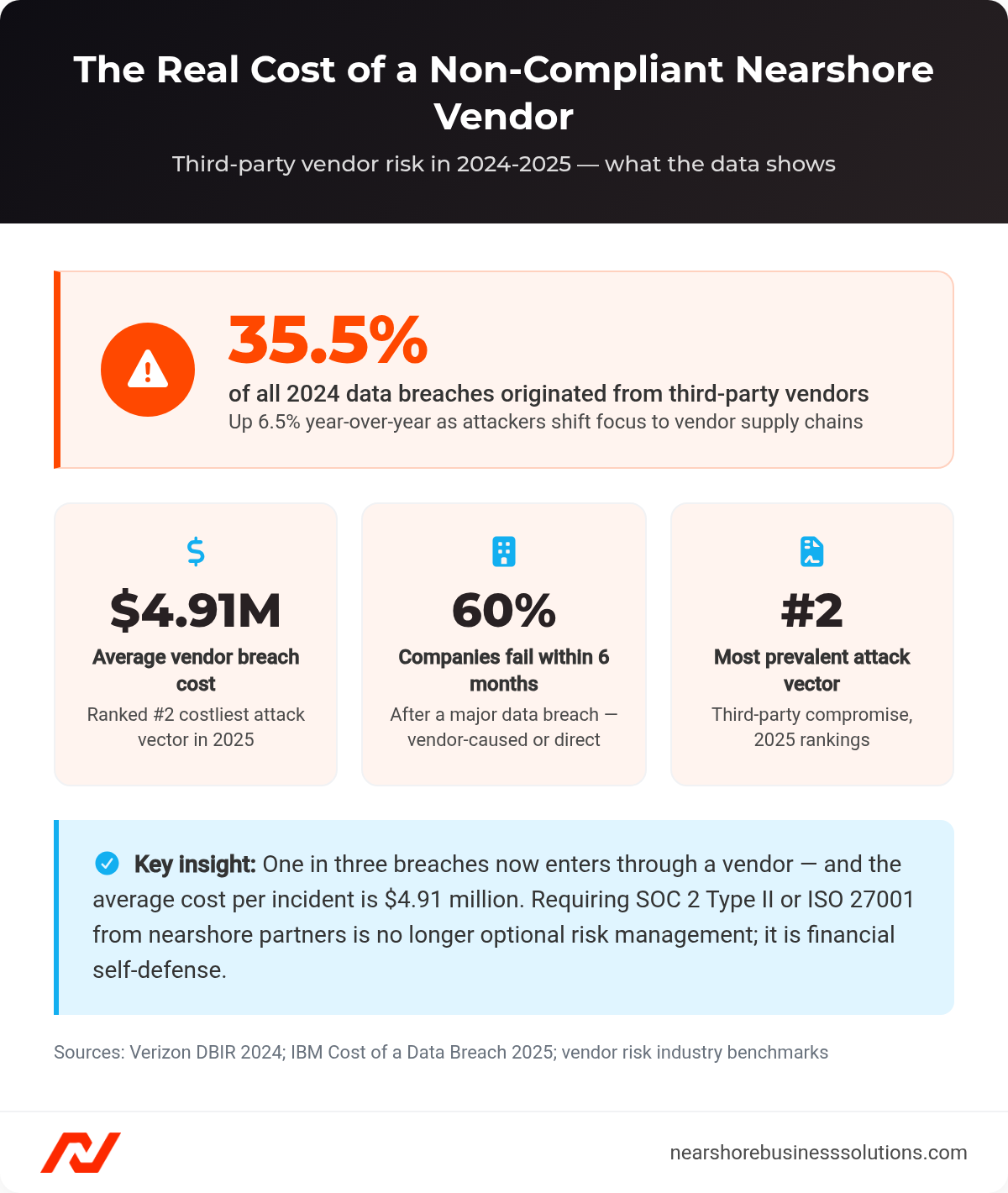
Third-party vendor breaches account for 35.5% of all incidents, averaging $4.91M per event.
How Does Partner Compliance Affect Your Own Audits?
Your nearshore vendor’s security failures can appear as exceptions in your own SOC 2 audit. External auditors review your vendor management program and will request compliance certifications, penetration test results, and control attestations from your partners. Missing documentation creates audit findings for your organization regardless of whether a breach occurred.
HealthTech companies must execute Business Associate Agreements under HITECH with any vendor handling protected health information. FinTech platforms must ensure partners touching cardholder data maintain PCI-DSS compliance. These requirements flow directly to your vendor selection criteria.
For a broader look at staff augmentation risk models, see our guide to nearshore staff augmentation.
Why Does Nearshore Security Compliance Require Both Frameworks?
An estimated 200-400 nearshore development firms across Latin America hold ISO 27001. Only 75-150 hold SOC 2 Type II. Hundreds of partners can demonstrate a governance system on paper but have never submitted their operational controls to CPA-firm scrutiny.
SOC 2 alone has one structural weakness. It is backward-looking. A partner can pass a Type II audit covering January through December and then dismantle security operations in January of the following year. ISO 27001 fills this gap. Its ISMS mandates risk assessment cycles, management reviews, and corrective action processes. ISO 27001 alone has the opposite weakness. It confirms a control objective exists but does not require the assessor to pull six months of access logs or verify MFA enforcement. SOC 2 Type II subjects that governance framework to independent, evidence-based verification on a recurring cycle.
A 2023 Everest Group analysis placed top-tier LATAM providers on par with Eastern European counterparts in security maturity. The gap with the most mature Indian providers is closing but only at the top tier, not across the market. Named firms holding both certifications include Encora (Mexico, Colombia, Costa Rica, Peru, Brazil) and Perficient (formerly PSL, Colombia). Gorilla Logic (Costa Rica, Colombia, Mexico) achieved SOC 2 Type II in January 2023. Azumo (Argentina, Colombia) followed in 2023. Brazil and Mexico lead the region in SOC 2 adoption, followed by Colombia and Costa Rica.
For more on how to structure a technical evaluation of nearshore partners, see our nearshore development partner evaluation checklist.
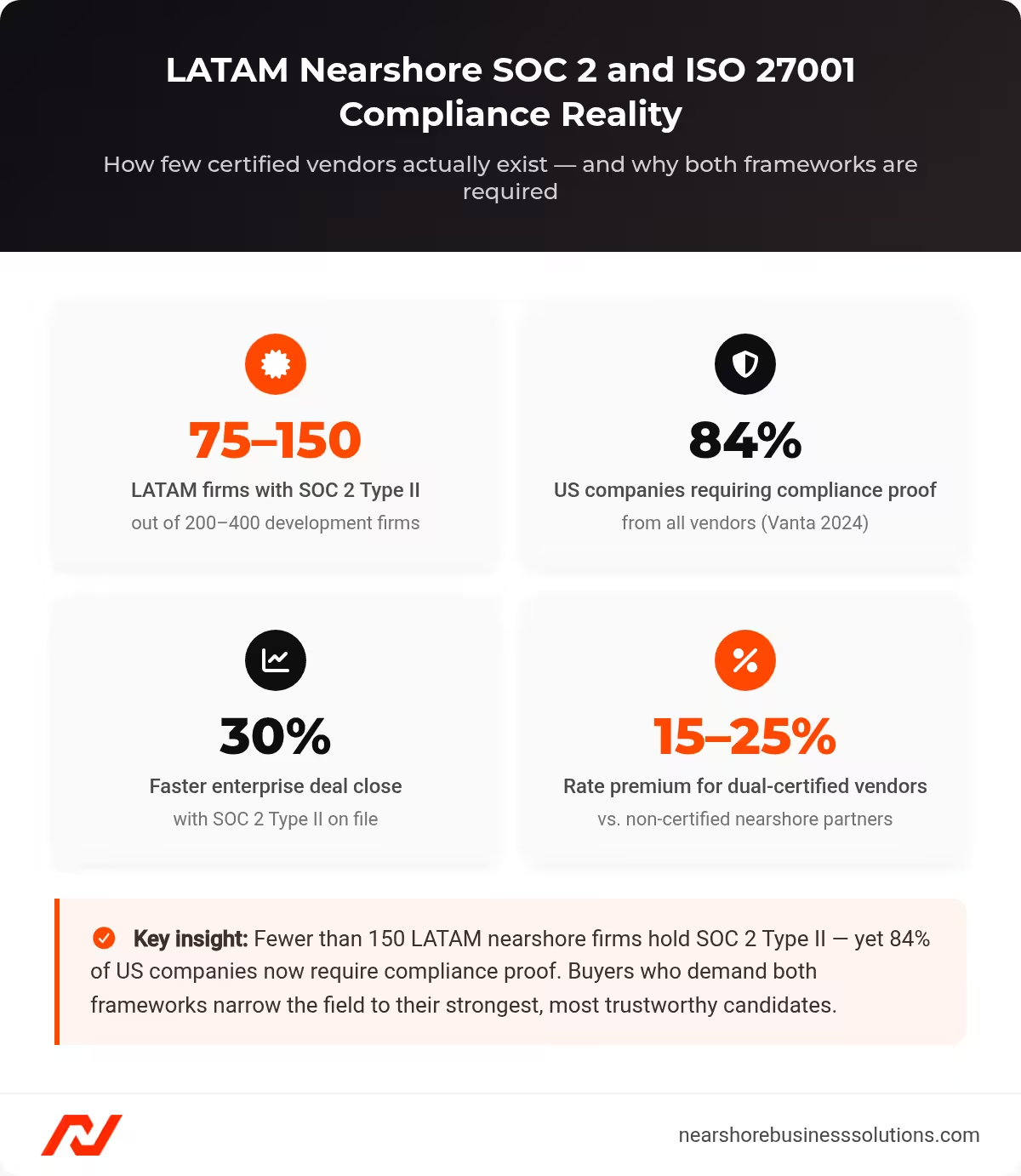
LATAM nearshore SOC 2 and ISO 27001 compliance snapshot: how few certified vendors exist and why demand for dual certification is rising.
Why Does Audit Timing Determine Real Assurance?
A SOC 2 Type I attests that controls exist at a single point in time. Type II proves they operated effectively over 6-12 months. ISO 27001 follows a parallel track. Stage 1 is a documentation review. Stage 2 is the operational audit. Certification is valid for three years with mandatory annual surveillance audits. A freshly issued ISO 27001 certificate with no surveillance audit history means the system has never been tested for sustained operation.
First-time SOC 2 Type II costs $30,000-$100,000 and takes 9-15 months. ISO 27001 initial certification costs $25,000-$80,000 over 6-12 months. Annual surveillance audits add $10,000-$25,000. A partner maintaining both frameworks commits $55,000-$180,000 upfront. This is a financial signal of seriousness.
Reject any partner presenting only a SOC 2 Type I or a first-year ISO 27001 certificate without at least one completed surveillance audit. These represent intent, not proven security.
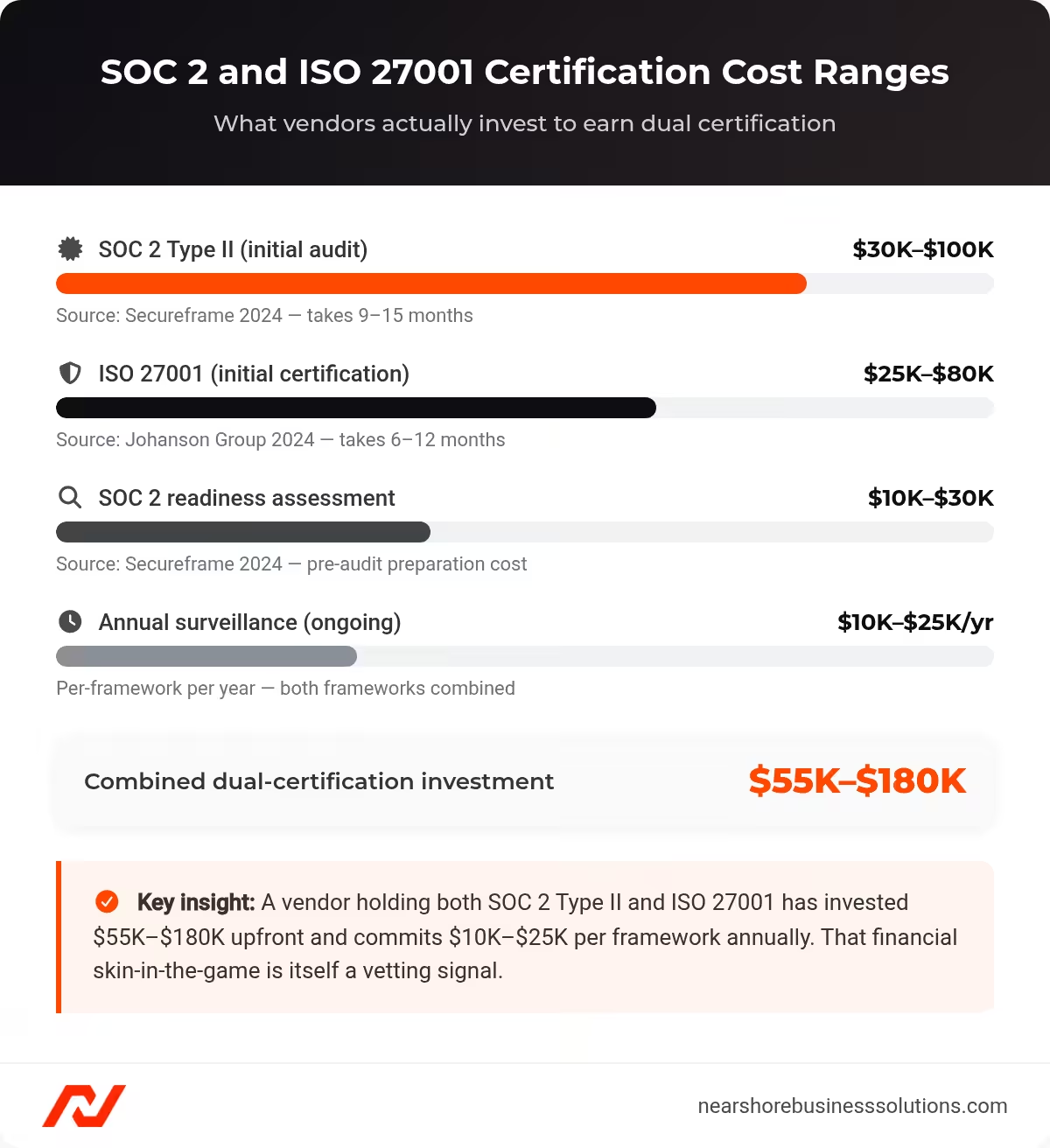
SOC 2 and ISO 27001 certification cost ranges: what vendors invest in upfront audits and ongoing surveillance to maintain dual compliance.
What Does It Mean When a Nearshore Partner Has Only One Certification?
A partner holding ISO 27001 without SOC 2 has proven that a risk management framework exists. Policies are documented. A risk register is maintained. Internal audits run. What it has not proven: whether the access control policy prevented unauthorized repository access last Tuesday. Whether encryption was enforced on every database during the past nine months. Whether the incident response plan executed within its stated SLA. SOC 2 Type II answers those questions. It pulls access logs, reviews change management tickets, tests encryption configurations, and interviews engineers.
A partner holding SOC 2 without ISO 27001 can pass an audit cycle and then regress. Controls degrade without a governance system enforcing their maintenance. Teams skip code reviews, grant overly permissive access, and defer patching. No external mechanism catches the drift until the next audit begins.
How Do You Evaluate a Partner That Says Certification Is “In Progress”?
If a partner cannot produce at least a completed SOC 2 Type I report or an ISO 27001 Stage 1 completion letter, they are pre-compliance, not in-progress. A partner genuinely pursuing certification has spent $10,000-$30,000 on readiness assessments and engaged a named auditor. A nearshore partner holding both certifications typically charges a 15%-25% premium over non-certified competitors. For a five-engineer team, that translates to $75,000-$125,000 per year. A partner quoting rates well below certified competitors while claiming certification is imminent has not absorbed these costs.
| Acceptable Interim Evidence | Stalling Signal |
|---|---|
| SOC 2 Type I completed; Type II underway with named CPA firm | “We plan to start next quarter” with no named auditor |
| ISO 27001 Stage 1 letter from accredited body; Stage 2 scheduled | “We’re ISO 27001 aligned” without formal audit engagement |
| Active compliance platform (Vanta, Drata) with evidence collection underway | “We use [tool]” but cannot show current control status |
| Named compliance lead who can articulate gaps and milestones | No dedicated compliance function or accountability point |
| Willing to accept contractual certification deadline with financial penalty | Refuses to tie milestones to contractual terms |
What Compliance Documentation Should You Require?
Require the full SOC 2 Type II report, not summary letters or attestation documents. The complete report shows which controls were tested, what evidence auditors reviewed, and any exceptions during the observation period. Partners who only share summaries or heavily redacted reports raise immediate red flags.
What Should You Look for in a SOC 2 Report?
Four items determine whether a SOC 2 report provides meaningful assurance:
- Unqualified opinion: Confirms controls met requirements throughout the observation period. A qualified opinion means the audit failed. Read the auditor’s opinion first.
- No material exceptions: Review for control failures in access management, change management, and encryption. Minor exceptions with documented remediation are less concerning than patterns of repeated failures.
- Complementary User Entity Controls: Section 4 specifies security responsibilities that fall on your organization, not the vendor. Vague or undefined CUECs create gaps attackers can exploit.
- Scope alignment: Confirm the report covers Security plus any additional criteria required by your industry. Check that the audit covers systems and locations relevant to your actual engagement.
What Should You Check on an ISO 27001 Certificate?
Four verification steps confirm ISO 27001 certification is genuine and current:
- Certificate issued by an accreditation body recognized by the International Accreditation Forum
- Scope covers the business units, locations, and services you will use
- Certificate falls within its three-year validity window
- Annual surveillance audits are completed and documented for the current certificate period
Request surveillance audit results directly. These reveal non-conformities and whether the vendor addresses findings promptly or reactively.
What Penetration Testing Evidence Should You Request?
Request the executive summary of the most recent external pentest and vulnerability management documentation covering at least the last two quarters.
Annual external pentests should be conducted by an independent firm: Bishop Fox, NCC Group, NetSPI, or a CREST-accredited provider. All critical findings should be remediated within 7 days. High-severity findings within 30 days. Vulnerability scanning should run at least weekly via Tenable, Qualys, or Snyk.
Red flags: automated scans (Nessus output) presented as “penetration tests.” Self-testing by the partner’s own security team. Critical findings marked “risk accepted” without a leadership-approved rationale.
Verification step: ask for the remediation timeline on the most recent critical finding. “When was it discovered, when was remediation completed, and what was the fix?” The answer tests whether the partner tracks remediation operationally or only notices findings when audit season arrives.
What Data Protection and Subcontractor Disclosures Are Non-Negotiable?
Background checks: Use reputable third-party vendors (HireRight, Sterling, TusDatos in Colombia). Checks should cover criminal records, education, and employment verification. The partner must be transparent about country-specific legal limitations. Background checks must complete before a developer is granted access to your systems.
Cyber insurance: Active Cyber Liability and E&O policy with limits appropriate for contract size. $5M-$10M coverage is common for mid-market vendors. Review exclusions: a ransomware exclusion negates coverage for the most common incident type.
Data processing agreements: DPA aligned to applicable regulations (GDPR, LGPD, CCPA/CPRA) with Standard Contractual Clauses where required. None of the major LATAM countries mandate local data residency for general commercial data. Data can be stored in the US in AWS, GCP, or Azure environments. Engagements that touch protected health information add another layer, which our guide to HIPAA-compliant nearshore healthcare teams covers through BAAs and mapped safeguards. Key LATAM laws: Brazil’s LGPD is modeled on GDPR and imposes requirements on Brazilian data subjects. Colombia’s Law 1581 requires explicit consent and SIC database registration. Argentina’s PDPA Law 25.326 holds EU adequacy recognition. Mexico’s LFPDPPP requires a privacy notice and INAI breach reporting. Confirm specific cloud regions where data will reside and verify breach notification timelines match your regulatory obligations.
Security awareness training: Annual training with completion rates above 95%. Phishing simulations with measurable improvement. Developer-specific secure coding training covering OWASP Top 10. Verification: during developer interviews, ask basic security questions. Inability to articulate their role in the security program is a red flag.
Subcontractor disclosure: Deloitte’s 2023 report identified failure to flow down security requirements contractually as among the most common audit failures. Request full transparency on any subcontracted personnel. Subcontractors must operate under equivalent controls: their own SOC 2/ISO 27001, or a binding security addendum. Include a contractual right-to-audit clause covering subcontractors. Many nearshore firms quietly subcontract. The subcontractor’s environment may be entirely unaudited.
What Security Controls Must Your Partner Have?
Compliance certifications confirm a security program exists. Specific technical controls determine whether that program protects your data. Define minimum requirements in vendor agreements before signing.
What Encryption Standards Are Required?
Data at rest must use AES-256 encryption across databases, file storage, and backups. Data in transit requires TLS 1.2 or TLS 1.3 (SSL 3.0, TLS 1.0, and TLS 1.1 contain known vulnerabilities). Weaker algorithms like AES-128 introduce unnecessary risk. Verify encryption at the filesystem or database layer, not just at the application level.
Require dedicated vault solutions (AWS Secrets Manager, HashiCorp Vault, or Azure Key Vault) for credential management. Hardcoded credentials or unencrypted environment variables allow attackers who compromise one system to pivot to production immediately. The Brazilian HealthTech breach demonstrated how an unencrypted secrets vault allowed lateral movement from a single developer account to AWS production infrastructure within hours.
What Access Controls Are Non-Negotiable?
Four access controls are non-negotiable for any nearshore partner:
- MFA on all systems: 60% of data breaches involve credential abuse. Cyber insurers routinely deny claims when MFA was not enabled. Verify MFA extends to email, code repositories, production environments, and administrative consoles.
- Role-based access control: Developers access only the repositories and environments required for their specific tasks. Frontend developers should not access production databases.
- Privileged access management: Just-in-time access or jump hosts for production changes. Administrative access should be time-limited, require approval workflows, and be fully logged.
- Automated offboarding: HR-IAM integration must revoke access within minutes of employee departure. Manual processes leave terminated employees with active credentials.
What Monitoring and Incident Response Is Required?
Endpoint Detection and Response tools are required over basic antivirus. EDR platforms detect sophisticated threats and provide forensic capabilities that signature-based antivirus cannot match. Security AI and automation identifies and contains breaches 80 days faster than manual environments.
Require a documented Incident Response Plan with regular tabletop exercises. Ask for evidence from exercises conducted in the past 12 months. Request mandatory notification within 24-48 hours of any suspected security incident. The 24-hour clock starts when the vendor becomes aware, not when their investigation concludes.
What Business Continuity Requirements Are Essential?
Ransomware involved 44% of breaches in 2024, up from 32% the previous year. Require immutable backups (storage-layer protection that ransomware cannot delete), off-site storage in a separate environment, and documented restoration tests with defined Recovery Time Objectives. Partners without tested backup procedures face extended downtime measured in weeks, not days, during a ransomware incident. The Brazilian HealthTech case resulted in 15% permanent data loss and three weeks of operational paralysis because backup procedures had never been tested.
Require partners to also apply critical patches within 30 days. This aligns with cyber insurance carrier requirements and reduces the vulnerability window between patch release and deployment. Unpatched systems remain the most common entry point for ransomware and supply chain attacks targeting LATAM development teams.
Mexico’s development hubs in Guadalajara and Monterrey include partners with mature BC/DR programs built for enterprise US clients. For partners in Buenos Aires and Bogota, verify BC/DR documentation covers infrastructure at the specific office locations where your team works, not just at the vendor’s headquarters.
What Contract Terms Protect Your Organization?
Contracts establish legal obligations that go beyond technical controls. Specific language creates accountability and enforcement mechanisms when vendors fail security requirements.
What Clauses Must Be in Every Nearshore Agreement?
Five contract clauses are essential for nearshore security agreements:
- Right to audit: Annual security audits of vendor facilities and systems, plus access to SOC 2 Type II reports and ISO 27001 surveillance results. Address confidentiality through NDAs rather than blocking access entirely.
- Incident notification: Mandatory notification within 24-48 hours of any suspected or actual security incident.
- Subcontractor flow-down: Any subcontractors must meet the same or stricter security standards. Without this clause, your vendor can outsource work to entities with minimal controls.
- Data return and deletion: Clear protocols for secure return or destruction of all data upon contract termination.
- Indemnification: Coverage for first-party costs (forensics, notification, legal) and third-party liabilities (regulatory fines, customer lawsuits) arising from vendor negligence.
How Should Cross-Border Data Transfers Be Addressed?
Standard Contractual Clauses are required when transferring personal data between the US and LATAM countries. Brazil’s LGPD, Argentina’s PDPA, and Mexico’s updated LFPDPPP (effective March 21, 2025) require personal data transfers only to countries with adequate protection levels. The US is often not deemed adequate under these frameworks.
SCCs provide contractual guarantees that transferred data receives equivalent protection. Failure to implement proper transfer mechanisms creates regulatory liability for US firms regardless of where data physically resides. Data protection authorities can penalize the controller for inadequate vendor agreements even when the vendor operates outside their jurisdiction.
Mexico’s LFPDPPP amendment (effective March 21, 2025) reinforces the duty of confidentiality and grants data subjects the right to object to automated behavioral processing. Oversight transferred from the autonomous INAI to the Executive Branch agency SABG, creating some enforcement uncertainty. HealthTech clients working with Mexican partners should review their DPA terms to confirm LFPDPPP obligations are addressed alongside HIPAA requirements.
For detailed guidance on working with developers in Mexico’s major tech cities, see our Mexico nearshore hiring guide.
How Do You Track Ongoing Compliance With Your Nearshore Partner?
Initial certification review covers security posture at contract signing. Risk profiles change as vendors grow, reduce headcount, or experience security events. Ongoing monitoring maintains visibility throughout the engagement.
Annual audits are the minimum baseline for partnerships involving production system access or sensitive data. These audits verify that controls documented in compliance reports function as designed in real operations. Beyond annual cycles, implement quarterly security reviews where your partner provides updates on incidents, control changes, audit findings, and risk environment changes.
What Metrics Show Whether Your Partner Is Secure?
Four performance metrics reveal whether a certified environment is actually more secure than a non-certified one:
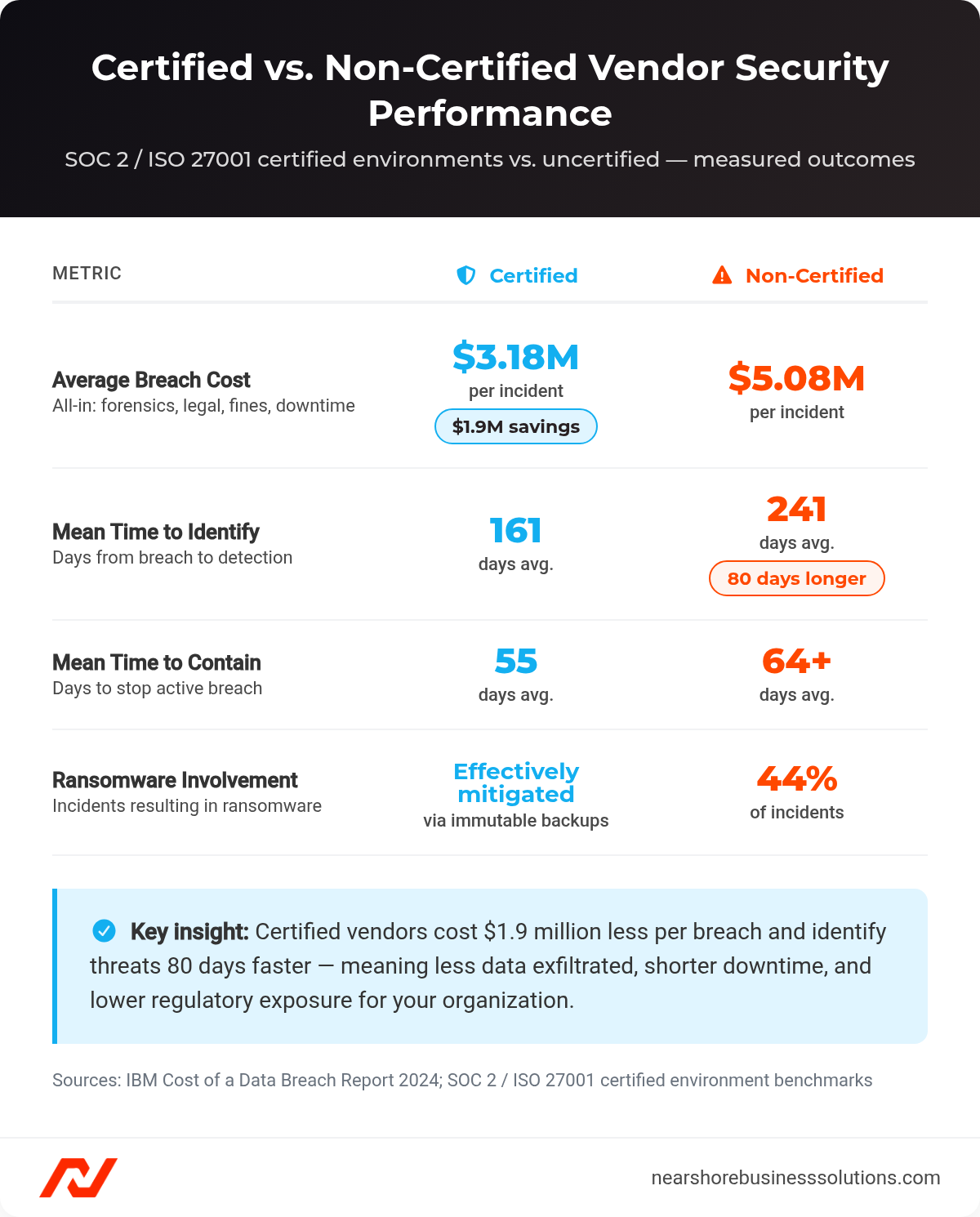
SOC 2 / ISO 27001 certified vendors average $1.9M less per breach and identify threats 80 days faster.
| Metric | Certified Environment | Non-Certified Environment |
|---|---|---|
| Average breach cost | $3.18 million | $5.08 million |
| Mean time to identify | ~161 days | ~241 days |
| Mean time to contain | ~55 days | ~64+ days |
| Ransomware involvement | Effectively mitigated with immutable backups | 44% of incidents |
The 80-day identification advantage directly limits data exfiltration volume. Faster containment prevents lateral movement. Track these metrics for your partner annually using incident reports and audit results.
What Risk Posture Changes Should Trigger a Review?
Four changes in your nearshore partner’s profile warrant an immediate compliance review:
- Certification lapses or delayed surveillance audits indicate financial constraints or control failures
- Increasing incident frequency signals deteriorating controls or expanding attack surface
- New exceptions appearing in updated audit reports, especially in access management or encryption
- Qualified audit opinions in any renewed SOC 2 Type II report
A vendor reporting one minor incident annually shows different risk posture than one with quarterly incidents involving customer data exposure.
What Tools Help Manage Multiple Vendor Relationships?
Vendor risk management platforms are recommended when managing more than five nearshore relationships. These platforms centralize compliance documentation, automate assessment workflows, and track certification expiration dates. Manual spreadsheet tracking fails as vendor portfolios grow. Select platforms that integrate with SIG Core or CAIQ questionnaire standards to standardize assessments across vendors. Integration with threat intelligence feeds provides alerts when vendors appear in compromise databases.
What Cyber Insurance Should Nearshore Partners Carry?
Require nearshore partners to carry insurance that matches your risk exposure. For clients with $5M-$100M revenue, the following coverage limits are standard market benchmarks:
| Coverage Type | Minimum Limit | What It Covers |
|---|---|---|
| Cyber Liability | $2-5 million | Forensics, breach notification, regulatory defense |
| Technology E&O | $2-5 million | Coding errors, failed deliverables, system outages |
| Combined E&O and Cyber | $5 million+ | Eliminates gaps between liability types |
| Crime and Fidelity | $1 million+ | Social engineering fraud, BEC, employee theft |
Match E&O and Cyber limits at identical amounts. Name your organization as Additional Insured. Require worldwide scope and a Waiver of Subrogation provision.
Insurers require MFA across all systems, critical patches applied within 30 days, EDR solutions, and annual phishing simulations before binding coverage. Verify your partner meets these requirements. The Brazilian HealthTech case showed that a 40% insurance claim denial resulted directly from failing to satisfy “Third-Party Vendor Audit” policy requirements, leaving over $2 million in uninsured losses.
What Compliance Gaps Do CTOs Find After Signing With a Nearshore Partner?
Certifications create a dangerous illusion when buyers stop at the certificate and never verify what the audit actually covered. The three gaps below surface repeatedly in post-signature security reviews and vendor risk reassessments.
How Can a Certification Scope Exclude Your Actual Developers?
This is the most common and dangerous post-signature gap. The ISO 27001 or SOC 2 scope covers the partner’s headquarters or a specific delivery center, but the developers assigned to your project work remotely or from an uncertified office.
A partner certifies its Guadalajara, Mexico office. It assigns your project eight engineers. Three work from that office. Two work from home in Monterrey. One works from a coworking space in Mexico City. One relocated to Bogota and never updated HR. One is a subcontractor from an intermediary firm in Buenos Aires. Five of eight developers operate entirely outside the certified scope. Controls verified by the auditor (physical access, on-premises SIEM sensors, MDM enforcement via the office network) do not apply to environments where your code is actually being written and pushed.
Read the ISMS scope statement before signing. Look for three elements. First: organizational boundaries. Does the scope name specific legal entities? Multi-country LATAM operations often use a holding company in Uruguay with operating entities in Colombia and Mexico. Confirm the entity employing your developers is included. Second: physical boundaries. Does the scope list specific office addresses, or does it use language like “all locations where services are delivered, including remote work environments”? A named address means remote developers fall outside scope. Third: technology boundaries. Does the scope cover the cloud accounts and CI/CD pipelines used for client engagements, or only corporate IT?
Read the SOC 2 system description (Section III) for four terms: “remote,” “work from home,” “subcontractor,” and “third party.” If none appear, the system description likely excludes distributed work environments. Check the infrastructure subsection for the specific platforms and hosting environments in scope. Check the people subsection for which personnel categories the controls apply to.
A 2023 survey by the Colombian IT industry association found that 35%-40% of engineers staffed on outsourced projects were engaged through intermediary firms. Subcontracting is pervasive in LATAM nearshore delivery. Require a written representation listing every personnel category that will touch your project: full-time employees, contractors, and subcontractors. Confirm each is covered by the certified scope or subject to documented compensating controls.
What Signals Indicate Security Theater Rather Than Real Controls?
Policies that are templated carry no meaningful assurance. Generic policy language, missing training completion records, and no tabletop exercise history are all concrete signals of performative compliance. Developers unable to articulate their role in the security program confirm it.
During developer interviews, ask: “What is your process when you receive a suspicious email?” and “How do you handle secrets in code?” These questions take under two minutes. A developer who can answer them has been trained. A developer who cannot has been given a compliance logo, not a compliance program.
A 2024 Coalfire analysis noted that 30% of SOC 2 report scope disputes during re-audits involved cloud infrastructure provisioned after the prior observation period ended: accounts and projects that were operational and serving clients but had never been included in the system description. During technical due diligence, ask the partner to identify the exact AWS account ID, GCP project ID, or Azure subscription ID that will host your workloads. Then open the SOC 2 system description and confirm that identifier appears.
Compliance drift between audit cycles is structural, not exceptional. A SOC 2 Type II report covers a 12-month observation period. The next period may not begin immediately. Some partners run a gap of 1-3 months between cycles. During report issuance delays and inter-cycle gaps, 3-5 months pass with no external oversight. During that window, MFA gets disabled to resolve an authentication issue and never re-enabled. A logging pipeline fails silently. An access review gets deferred from Q2 to Q3 to “next quarter.” Require the partner to grant read-only dashboard access to their compliance automation platform (Vanta, Drata, Secureframe). These platforms track control status in real time. A partner willing to share continuous monitoring data has nothing to hide between audit cycles.
Frequently Asked Questions About Nearshore Compliance
These are the most common questions US tech leaders ask about nearshore partner compliance requirements.
How Do I Verify My Nearshore Partner’s SOC 2 Certification Is Legitimate?
Request the full Type II report, not a summary letter. Confirm the auditing firm is registered with the AICPA and has demonstrable experience with SOC 2 in the technology sector. Check the audit opinion section first. An unqualified opinion confirms controls met requirements. Confirm the observation period end date falls within the past 12 months.
What Is the Risk of Hiring a Non-Certified Nearshore Partner?
Non-certified environments average $5.08 million per breach versus $3.18 million in certified environments. A December 2025 OFAC case imposed a $3.1 million settlement on a FinTech company for sanctions violations originating from their nearshore support team. Savings from a cheaper uncertified vendor are frequently eliminated by a single breach.
How Long Does It Take a LATAM Partner to Get SOC 2 Type II?
It takes 8-17 months from initiation to a first Type II report. The observation period alone runs 3-12 months. Prioritize partners already holding consecutive Type II reports spanning multiple years. These vendors demonstrate sustained compliance rather than temporary certification effort.
Do I Need My Partner to Have Both SOC 2 and ISO 27001?
Not always. SOC 2 Type II is sufficient for most US mid-market engagements. ISO 27001 adds value when you operate in European markets or need globally recognized certification for enterprise sales. SOC 2+ reports integrating both frameworks cover 9.6% of all SOC 2 reports and reduce dual audit complexity.
What Should I Do If My Nearshore Partner Has SOC 2 Type I Only?
Type I certifies control design at a single point in time. It does not verify whether those controls work under real operational conditions. Partners with only Type I certification have unproven operational discipline. Require Type II as a condition for production system access. Accept Type I only for low-risk development environments with no access to customer data.
How Do I Handle Nearshore Partners Who Refuse to Share Audit Reports?
Legitimate confidentiality concerns can be addressed through NDAs. Partners who refuse to share full audit reports under any conditions are obscuring problems. Require audit access rights in the contract before signing. If a vendor will not agree to this clause, treat it as a disqualifying red flag.
What Background Checks Should Nearshore Developers Pass?
All developers with access to production systems or customer data should pass background checks covering criminal history, employment history, and education verification. Use reputable third-party screening with multi-jurisdiction coverage. Combine background checks with NDAs and technical controls including data loss prevention tools, access logging, and network segmentation. Legal agreements cannot prevent data exfiltration by malicious insiders, so technical controls are required alongside contracts.
Ready to Build a Compliant Nearshore Engineering Team?
Nearshore Business Solutions sources and vets developers from Mexico City, Guadalajara, Buenos Aires, Bogota, and Medellin. We screen for technical skills, English fluency, and US work style fit.
Every placement includes a 90-day replacement guarantee. You receive the first pre-vetted candidates within 3 business days.
Get a free consultation to discuss your compliance requirements and receive a custom quote.