
Hiring freight brokers in Latin America cuts labor costs 46.55% to 60% while accessing 50,000+ logistics professionals trained in US systems.
Nearshore freight brokers cost $21,500 to $43,000 annually fully loaded versus $74,925 to $132,975 in the US. Colombia, Mexico, and Argentina provide 80-100% time zone overlap with US business hours. Regional logistics markets grew 20.8% annually from 2020-2024.
Below you’ll find cost comparisons by country, required skills, hiring processes, and country-specific legal frameworks for nearshore freight broker teams.
What Does It Mean to Hire Freight Brokers in Latin America?
Hiring freight brokers in Latin America means engaging logistics professionals in Mexico, Colombia, Argentina, Brazil, and Chile to handle load procurement and carrier negotiation. These professionals operate in time zones that provide 80% to 100% overlap with US business hours.
Nearshore freight brokers manage:
- Track and trace
- Proof of delivery retrieval
- Carrier sales support
- Freight billing
- Customer care
They work within your Transportation Management Systems and maintain carrier relationships.
The nearshore model differs from offshore outsourcing through:
- Geographic proximity
- Cultural alignment with North American practices
- Reasonable travel logistics for site visits
For broader context on Latin American talent pools, see our guide to hiring remote professionals in Latin America.
Why Should You Hire Freight Brokers in Latin America?
Four factors drive nearshore freight broker adoption: cost savings, time zone alignment, language proficiency, and specialized talent pools.
What are the cost advantages of hiring freight brokers in Latin America?
Labor expenses decrease 46.55% to 60% depending on market and seniority level. A 50-person nearshore team generates approximately $3.02 million in annual savings compared to equivalent US staffing.
| Position Level | US Loaded Cost | Colombia Loaded Cost | Savings | Argentina Loaded Cost | Savings | Mexico Loaded Cost | Savings |
|---|---|---|---|---|---|---|---|
| Junior Broker | $74,925 | $21,500 | 71.3% | $18,830 | 74.9% | $28,640 | 61.8% |
| Mid-Level Broker | $90,014 | $29,600 | 67.1% | $26,900 | 70.1% | $39,400 | 56.2% |
| Senior Broker | $132,975 | $43,000 | 67.7% | $40,280 | 69.7% | $57,280 | 56.9% |
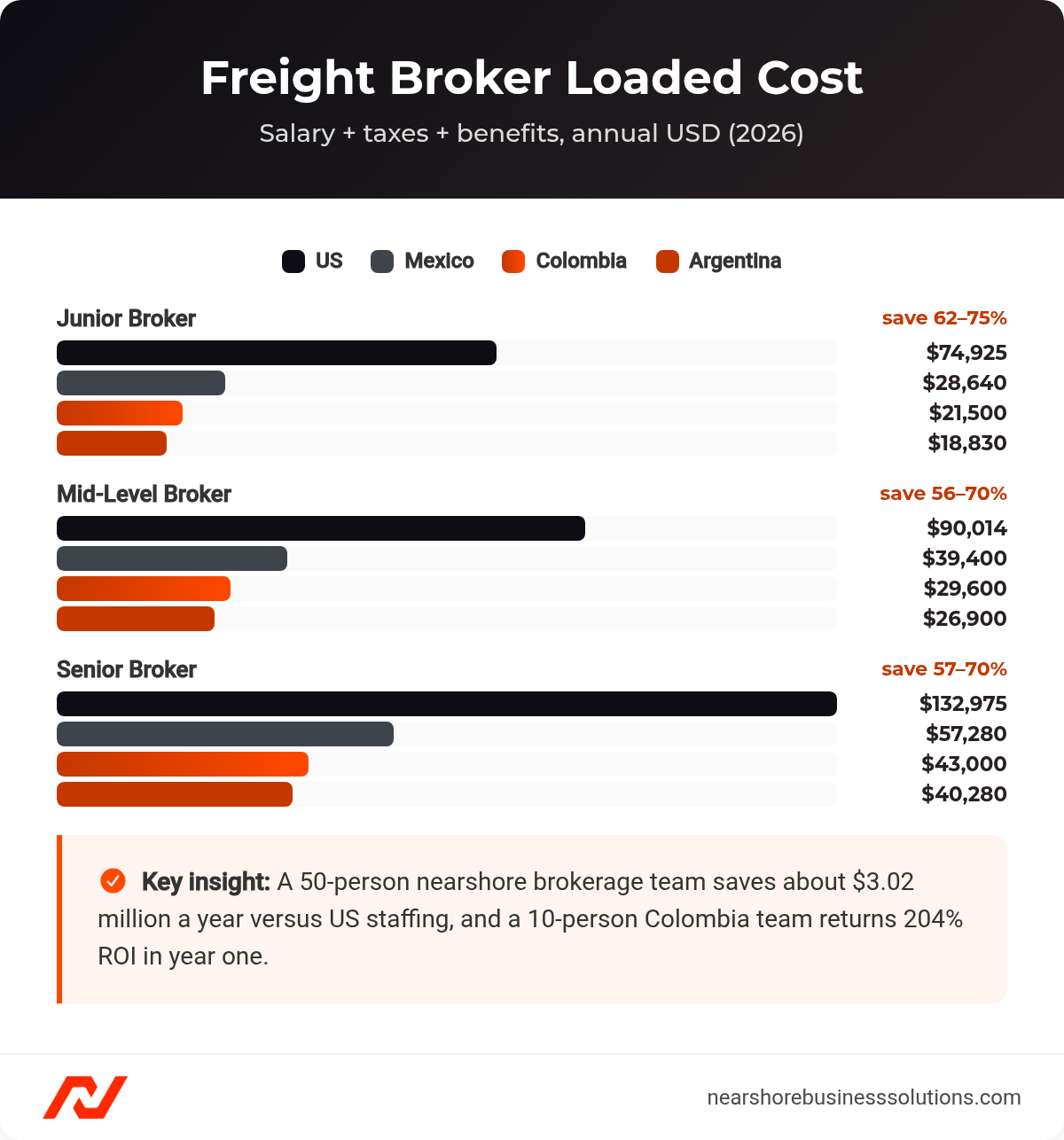
Fully loaded freight broker cost by seniority: US versus Mexico, Colombia, and Argentina.
These figures include base salary plus employer-paid taxes, mandatory benefits, and administrative overhead. A 10-person Colombia-based team delivers 204% return on investment within the first year when factoring in reduced tender response times.
How do time zones benefit operations when you hire freight brokers in Latin America?
Time zone alignment provides 80% to 100% business hour overlap with US time zones. Mexico City and Bogotá operate in time zones that provide 100% overlap with US Eastern Standard Time during 8 AM to 5 PM EST.
When a load faces detention or a carrier calls with equipment issues, your nearshore broker can coordinate resolution immediately rather than waiting for the next business day. Buenos Aires provides 80% overlap while Santiago delivers 90% overlap with US business hours. This synchronization proves valuable for drayage operations and time-sensitive shipments where delays cascade into detention fees.
What language and cultural advantages do nearshore freight brokers offer?
Argentina leads Latin America with an EF EPI score of 562, equivalent to TOEFL 85-95. Leading nearshore locations have invested heavily in business English training tailored to logistics terminology.
| Country | EF EPI Score | TOEFL Equivalent | Proficiency Classification |
|---|---|---|---|
| Argentina | 562 | 85-95 | High Proficiency |
| Costa Rica | 534 | 70-80 | Moderate Proficiency |
| Chile | 525 | 70-80 | Moderate Proficiency |
| Colombia | 485 | 60-70 | Moderate Proficiency |
| Mexico | 459 | 55-65 | Low-Moderate Proficiency |
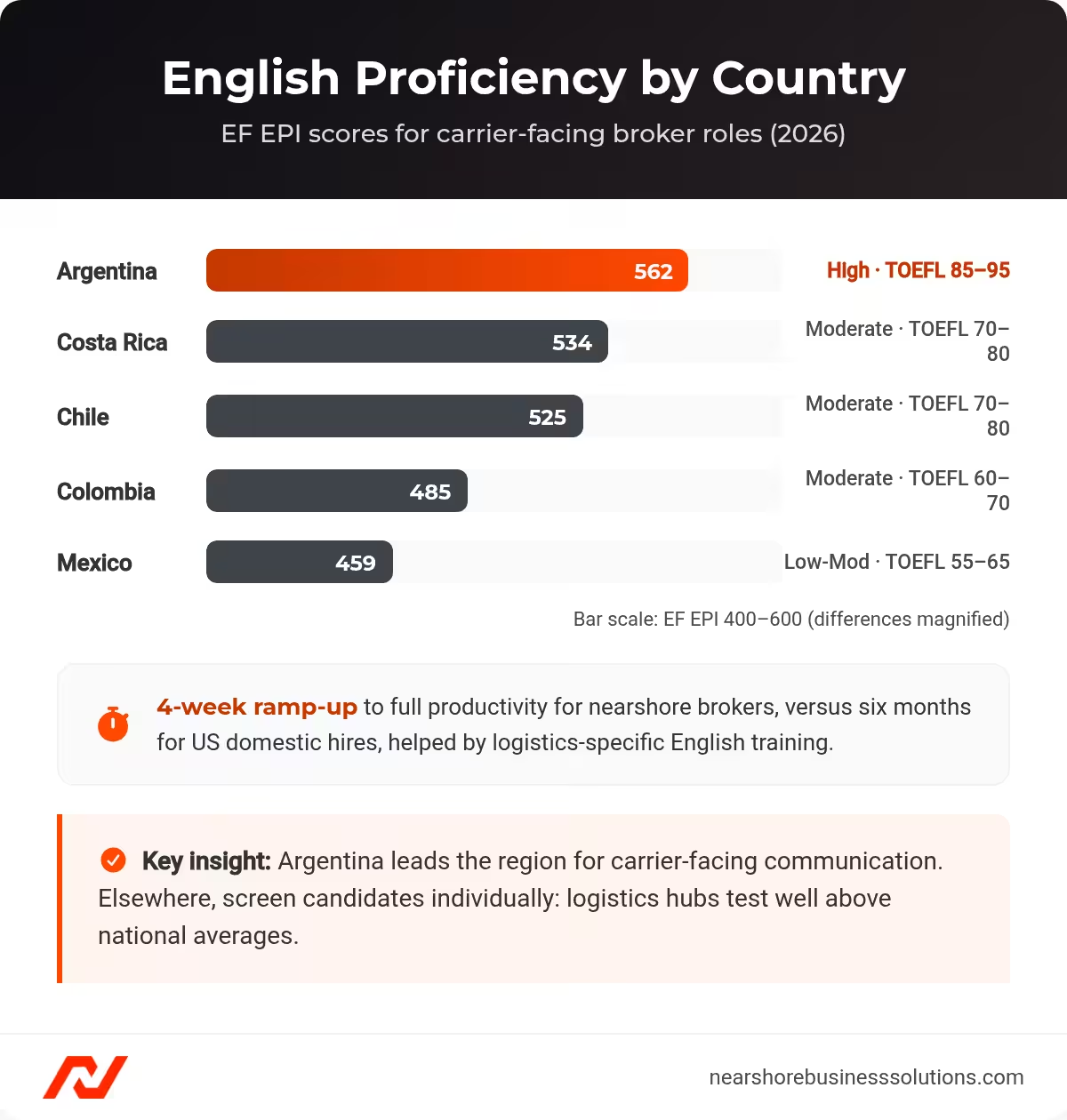
English proficiency by country for carrier-facing broker roles.
Cultural alignment represents an equally important advantage. Latin American business culture shares closer proximity to North American practices than Asian or Eastern European alternatives. Ramp-up time to full productivity averages four weeks for nearshore freight brokers compared to six months for US domestic hires.
What talent pool depth exists for freight brokers in Latin America?
Latin American logistics talent pools experienced 50%+ year-over-year growth from 2020 to 2024. The regional logistics market reached $360.2 billion in 2024 and is expected to grow to $527.5 billion by 2030.
| Country | Market Size | Annual Hiring Growth | Major Cities | Primary Specializations |
|---|---|---|---|---|
| Mexico | $120.5B | 54% | Mexico City, Monterrey, Guadalajara | Cross-border logistics, USMCA compliance |
| Colombia | $35.8B | 55% | Bogotá, Medellín, Cali | 3PL operations, customer success |
| Argentina | $28.4B | 54% | Buenos Aires, Córdoba, Rosario | High-level BPO, IT integration |
| Chile | $30.3B | 67% | Santiago, Valparaíso | Tech-enabled retail logistics |
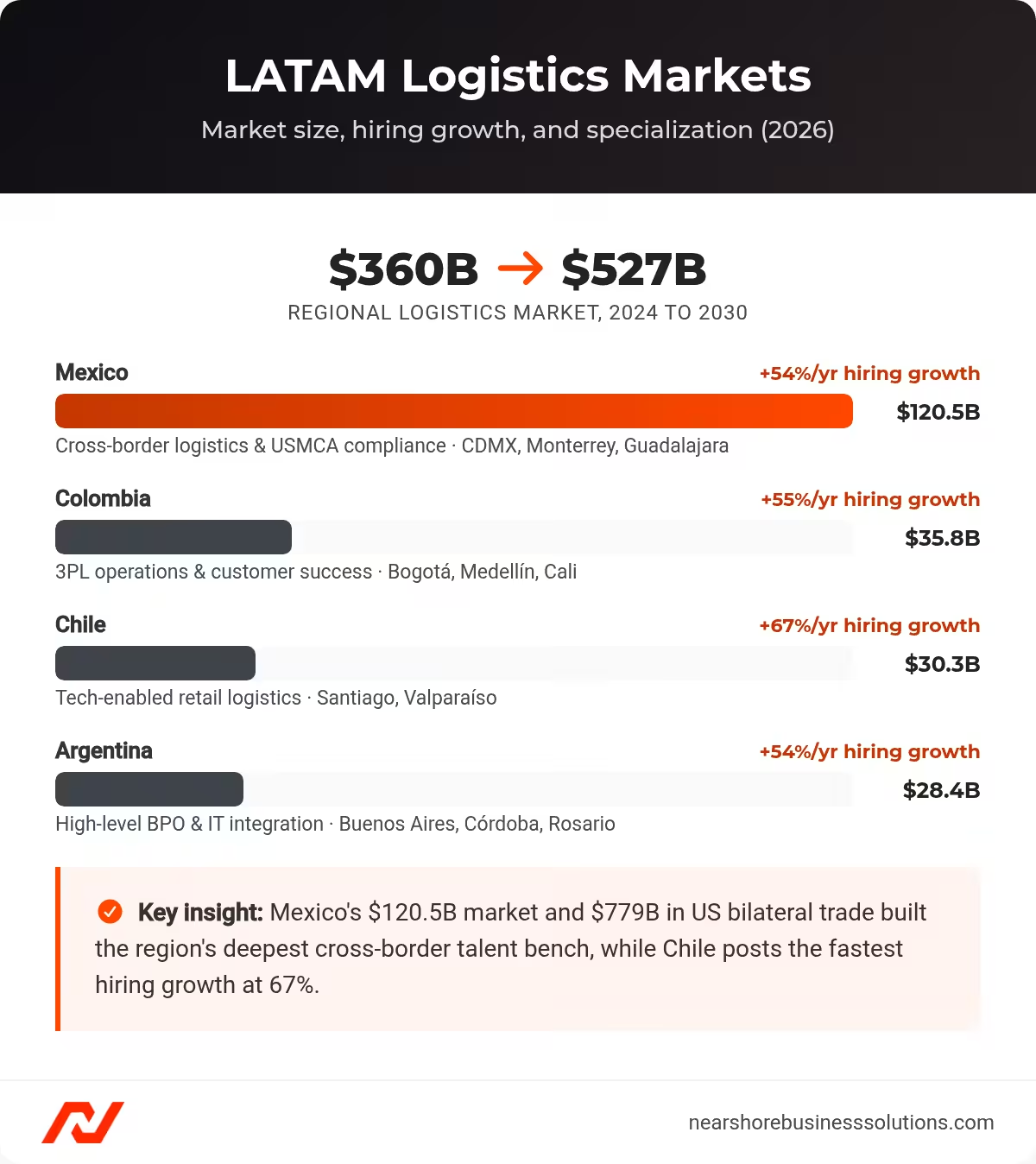
LATAM logistics markets: size, hiring growth, and what each country specializes in.
Mexico’s proximity to US manufacturing and bilateral trade volume exceeding $779 billion in 2022 created workforce specialization in cross-border trucking. Generation Z professionals entering these markets bring native fluency with AI-enhanced Transportation Management Systems.
What Skills and Qualifications Should Freight Brokers in Latin America Have?
Three skill categories separate effective nearshore freight brokers from transactional order-takers: TMS proficiency, carrier relationship management, and bilingual communication.
What TMS and software experience should freight brokers possess?
Nearshore freight brokers must demonstrate proficiency with McLeod PowerBroker, DAT One, and Truckstop platforms. Pre-hire verification of software experience proves essential.
- McLeod PowerBroker provides industry-leading TMS with autonomous capacity matching capabilities through Aurora Driver API integration
- DAT One offers comprehensive load board and rate verification platform essential for spot market pricing
- Truckstop provides carrier marketplace and credit verification system for expanding carrier networks
Beyond TMS platforms, nearshore brokers benefit from exposure to AI-enhanced invoice automation tools that use natural language processing. This technical comfort accelerates the transition from manual data entry to exception management.
What carrier relationship management skills matter for freight brokers?
Effective relationship management requires understanding carrier preferences beyond rate negotiations. This includes knowledge of preferred lanes, equipment specifications, detention tolerances, and communication preferences.
Long-term carrier relationships reduce the need to constantly source new capacity in tight markets. Volume-based drayage operations and carrier sales demand different relationship skills than full truckload brokerage. Nearshore staffing models that emphasize retention through meritocratic compensation maintain the relationship continuity that drives profitability.
How important is bilingual proficiency for freight brokers in Latin America?
Bilingual proficiency serves as the foundational requirement for nearshore freight brokers. English fluency enables high-pressure communications during rate negotiations, load recovery scenarios, and customer escalations.
The distinction between conversational English and business English matters significantly. Freight brokerage demands comfort with industry terminology, confidence in phone-based negotiations without visual cues, and ability to write clear email communications. Spanish-English bilingualism provides additional value for US brokerages handling Mexico cross-border freight or serving Hispanic-owned carriers.
What are the Disadvantages of Hiring Freight Brokers in Latin America?
Three primary challenges affect nearshore freight broker implementations: communication limitations, infrastructure variability, and legal complexity.
What communication challenges exist with Latin American freight brokers?
Communication challenges manifest most acutely in markets with lower English proficiency baselines. Mexico’s EF English Proficiency Index score of 459 and Colombia’s score of 485 indicate that broad population-level English skills fall below the threshold for complex business communications.
Margin leakage occurs when brokers accept carrier rate increases without proper pushback. A broker who cannot confidently explain market conditions may concede $50-$100 per load unnecessarily. Across hundreds of monthly transactions, this communication weakness erodes profitability significantly.
Mitigation strategies include:
- Targeted hiring within lower-scoring markets to identify candidates with advanced English capabilities
- Investing in specialized business English training programs
- Implementing AI-driven natural language processing tools
How does infrastructure affect freight brokers in Latin America?
Internet infrastructure reliability varies substantially across Latin American markets. Chile’s infrastructure surpasses US median speeds at 360.89 Mbps, making it the most reliable option from a connectivity perspective.
| Country | Median Internet Speed (Mbps) | Reliability Score (out of 10) | Comparison to US Baseline |
|---|---|---|---|
| Chile | 360.89 | 9.2 | +21% faster |
| Brazil | 215.58 | 8.8 | -28% slower |
| Colombia | 199.70 | 8.1 | -33% slower |
| Argentina | 105.42 | 7.5 | -65% slower |
| Mexico | 91.99 | 7.4 | -69% slower |
| US Baseline | 298.38 | 9.5 | — |
Mexico and Argentina present the greatest infrastructure challenges. Reputable nearshore staffing agencies mitigate these risks by establishing enterprise-grade office infrastructure with redundant internet connections, backup power supplies, and secure VPN access. Brokers work from managed office environments rather than home offices.
What legal and compliance complexities arise when you hire freight brokers in Latin America?
Latin American labor laws provide substantially more employee protections than US at-will employment models. Mexico’s 2021 labor reform introduced the REPSE registry, which mandates registration for all specialized services companies.
Brazil and Colombia apply a “reality over form” principle when evaluating contractor relationships. If the working arrangement exhibits employment characteristics such as controlled work hours and direct managerial oversight, the relationship will be classified as employment regardless of contract language. Misclassification triggers liability for backdated benefits, social security contributions, severance payments, and interest calculated from the relationship’s inception.
How Do You Hire Freight Brokers in Latin America?
Five steps structure the nearshore freight broker hiring process: role definition, channel selection, candidate screening, legal verification, and operational onboarding.
1. Define your freight broker role requirements
Segment operations into sales operations, accounting and billing, and customer care. Start pilot programs with lower-risk functions like track and trace coordination and proof of delivery retrieval before expanding to customer-facing roles.
2. Select recruitment channels for Latin American freight brokers
Most US brokerages opt for specialized nearshore staffing providers that handle sourcing, screening, and legal compliance. Lean Solutions Group grew from 7,000 employees in 2022 to over 10,000 in 2024, reporting 97% retention rates. Hubtek focuses on technology-enabled logistics roles in Colombia.
These providers function as Employers of Record, handling payroll, benefits administration, and tax withholding while you maintain operational control.
3. Screen and interview freight broker candidates
Emphasize Gen Z professionals born 1996-2012 who bring native fluency with AI-enhanced Transportation Management Systems. Verify hands-on experience through practical assessments: ask candidates to navigate McLeod PowerBroker screenshots or explain DAT One workflows. Test language through role-play scenarios involving carrier negotiations.
4. Verify legal compliance and employment structure
Employer of Record models transfer legal employment to local entity with compliance expertise. The EOR handles payroll, tax withholding, and regulatory reporting. Most US brokerages with fewer than 100 nearshore staff opt for EOR arrangements.
Data Processing Agreements must align with Brazil’s LGPD and Colombia’s Statutory Law 1581.
5. Onboard and integrate freight brokers into operations
Implement a train-the-trainer model that empowers senior nearshore staff to transfer knowledge. Cover North American logistics software interfaces before role-specific workflows. Establish key performance indicators: revenue per head, load-to-tender ratio, tender response time, and communication quality.
Ramp-up time averages four weeks, significantly faster than the six-month timeline for US domestic hires.
What is the Difference Between Hiring Direct and Outsourcing Freight Brokerage Operations?
Direct hiring provides maximum control over hiring, training, and performance management but requires navigating local tax systems and labor reforms. Outsourcing transfers employment relationships to BPO providers who handle recruiting, compliance, and service delivery.
How does direct hiring of freight brokers work?
Direct hiring requires navigating local tax identification systems: Mexico’s RFC, Colombia’s RUT, and Argentina’s CUIT. You assume responsibility for labor reforms and social security contributions. The direct model exposes you to compliance risk but provides complete transparency into team composition.
How does outsource freight brokerage work?
The Employer of Record model handles legal employment, payroll, and compliance while you maintain operational control. Established logistics BPO providers deliver track and trace, proof of delivery retrieval, carrier sales support, and freight billing according to service level agreements.
What are the cost differences between hiring and outsourcing?
Independent contractor models include base compensation only but carry hidden costs in legal exposure. Employer of Record models include 15-25% markup covering employment overhead. The provider assumes misclassification risk and compliance burden.
A 10-person nearshore team generating $5 million in annual gross profit absorbs the EOR markup while eliminating six-figure liability risk in misclassification disputes.
Which Latin American Countries are Best for Hiring Freight Brokers?
Colombia scores 8.5 on weighted evaluation metrics balancing cost, English proficiency, infrastructure, and logistics specialization. Argentina scores 8.1 for analytical roles while Mexico scores 7.2 but offers unique cross-border expertise.
What makes Mexico attractive for freight broker hiring?
Mexico represents the strategic epicenter for US freight brokerages given immediate proximity and USMCA framework advantages. Bilateral trade between the US and Mexico exceeded $779 billion in 2022, creating workforce specialization in US cross-border trucking.
The northern border states experienced 12% foreign direct investment growth in manufacturing during 2023. Mexican brokers understand Maquiladora program requirements, IMSS social security compliance, and specific documentation requirements for cross-border freight movement. Major logistics hubs include Mexico City, Monterrey, and Guadalajara.
Mexico’s unique cross-border expertise makes it irreplaceable for brokerages handling substantial Mexico-US freight volumes.
How does Colombia compare for freight brokerage talent?
Colombia provides optimal balance for high-volume 3PL support operations. The country’s specialization in third-party logistics operations and customer success management creates deep talent pools for operational coordination roles.
Bogotá, Medellín, and Cali host established BPO industries serving US clients. Colombia’s time zone provides 100% overlap with US Eastern Standard Time. The logistics market reached $35.8 billion in 2024 with 55% year-over-year hiring growth.
Colombia excels at high-volume operational roles: track and trace coordination, proof of delivery retrieval, carrier communication, and shipment status updates. The combination of cost efficiency and time zone alignment makes Colombia the default choice for brokerages scaling operational teams beyond 20 people.
Learn more about Colombia’s tech talent in our complete hiring guide for Colombia.
What advantages does Argentina offer for hiring freight brokers?
Argentina excels at high-level analytical roles requiring superior cognitive capabilities and English fluency. The country leads Latin America in English proficiency with an EF EPI score of 562.
Economic volatility and high inflation projected at 20-23% for 2026 drive Argentine professionals to strongly prefer US dollar-denominated compensation. This dynamic allows US brokerages to secure elite-level talent at rates unattainable for local Argentine firms paying in pesos. Buenos Aires, Córdoba, and Rosario host sophisticated talent pools with strong educational backgrounds.
Argentina represents the optimal choice for specialized roles requiring advanced analytical thinking, complex problem-solving, or software integration work. The cost advantage combined with superior English proficiency creates exceptional value for roles where communication precision matters.
Is Costa Rica a good option to hire freight brokers in Latin America?
Costa Rica offers moderate English proficiency with EF EPI score of 534 and established nearshore services infrastructure. The country’s political stability and strong educational system create quality talent pools for customer-facing roles.
Costa Rica excels at customer service, technical support, and administrative coordination functions that benefit from cultural alignment with US expectations. However, Costa Rica’s logistics market lacks the specialized freight brokerage talent depth found in Mexico’s cross-border corridors or Colombia’s 3PL concentrations.
Costa Rica serves as a viable option for brokerages prioritizing English proficiency and customer service quality over freight-specific experience.
What Technology Infrastructure Do You Need for Nearshore Freight Brokers?
Effective nearshore operations require:
- VoIP systems with call recording
- Real-time tracking dashboards
- TMS access
- Collaboration platforms like Slack or Microsoft Teams
What TMS platforms should nearshore freight brokers access?
Nearshore freight brokers require identical system access to domestic employees:
- McLeod PowerBroker provides industry-leading TMS with autonomous capacity matching
- DAT One offers load board and rate verification essential for spot market pricing
- Truckstop provides carrier marketplace and credit verification
System access requires secure authentication, role-based permissions, and audit logging.
How do you ensure data security with Latin American freight brokers?
Contracts must include Data Processing Agreements specifying data handling procedures and breach liability provisions. Brazil’s LGPD and Colombia’s Statutory Law 1581 establish strict data handling regimes.
Technical controls should include secure VPN access, multi-factor authentication, and encrypted communication channels. Reputable Employer of Record providers maintain SOC 2 Type II certification and ISO 27001 compliance.
How Much Does It Cost to Hire Freight Brokers in Latin America?
Base salaries range from $10,500 to $32,000 annually. Total loaded costs including employer taxes and benefits range from $18,800 to $57,300.
What are typical salary ranges for freight brokers in Latin America?
Annual base salaries range from $10,500 for junior brokers in Argentina to $32,000 for senior brokers in Mexico. Rates vary within countries based on city.
| Experience Level | Mexico | Colombia | Argentina | Chile | Brazil |
|---|---|---|---|---|---|
| Junior (0-2 years) | $16,000 | $12,000 | $10,500 | $14,000 | $13,500 |
| Mid-Level (3-5 years) | $22,000 | $16,500 | $15,000 | $19,500 | $18,500 |
| Senior (6+ years) | $32,000 | $24,000 | $22,500 | $28,000 | $27,000 |
What additional costs exist when you hire freight brokers in Latin America?
Employer load reaches 79.4% of base wage in some markets. This includes payroll taxes, social security contributions, mandatory 13th-month bonuses, vacation pay, health insurance, and severance accrual. Administrative overhead adds 10-15% for IT infrastructure, office space, and software licenses.
Project 5-7% annual wage increases for top-performing talent.
How do commission structures work for nearshore freight brokers?
Revenue-based commissions provide brokers 2-5% of gross profit on loads they coordinate. Performance tier systems combine base salary plus bonuses that increase as brokers exceed targets. Clear career paths from junior coordinator to senior account manager maintain engagement.
What Legal Considerations Apply When You Hire Freight Brokers in Latin America?
Mexico’s REPSE registry mandates registration for all specialized services companies. Brazil and Colombia apply “reality over form” principles when evaluating contractor relationships.
What employment laws govern hiring freight brokers in Mexico?
Mexico’s 2021 labor reform requires REPSE registration for all companies providing specialized services. REPSE compliance requires formal registration, proof of financial solvency, and quarterly reporting. Non-compliance exposes client companies to joint liability for employment obligations.
US firms without Mexican legal entities rely on Employer of Record services that maintain REPSE registration. The IMSS social security system requires contributions calculated as percentage of salary.
How do contractor vs employee classifications work in Latin America?
Latin American labor courts classify relationships as employment if they exhibit employment characteristics, regardless of contract language. Employment indicators include control over work hours, provision of tools, direct managerial oversight, and exclusive work relationships.
Misclassification liability includes backdated wages, benefits, social security contributions, and severance payments. A two-year contractor relationship could generate 3-4 times the actual paid compensation in backdated liabilities. Employer of Record arrangements eliminate this risk.
What tax obligations arise when you hire freight brokers in Latin America?
Employer of Record models transfer all payroll tax withholding, social security contributions, and VAT compliance to the provider. Your company pays a consolidated invoice to the EOR provider, which handles all underlying tax obligations. Employer load rates reach 79.4% of base wages in some markets.
How Do You Train Freight Brokers in Latin America?
Ramp-up time to full productivity averages four weeks for nearshore freight brokers. Train-the-trainer models work best, empowering senior nearshore staff to onboard new team members.
What training programs work best for nearshore freight brokers?
- Week one covers TMS platform navigation and documentation standards
- Week two addresses carrier communication basics and track and trace workflows
- Week three includes load coordination and proof of delivery retrieval
- Week four transitions to independent operation with oversight
Pre-training should cover McLeod PowerBroker interfaces, DAT One search functionality, and Truckstop marketplace basics. Specialized business English training tailored to logistics terminology accelerates communication effectiveness. Role-playing exercises that simulate high-pressure negotiations build confidence.
What ongoing development should you provide to Latin American freight brokers?
AI-driven natural language processing tools enable communication quality monitoring at scale. These systems analyze call recordings to identify coaching opportunities around negotiation techniques.
Monitor key performance indicators continuously:
- Revenue per head
- Load-to-tender ratio
- Tender response time
- Communication quality
Define progression from junior coordinator to senior account manager with explicit promotion criteria based on performance metrics rather than tenure.
Can Logistics Broker Outsourcing Replace Hiring Internal Freight Brokers?
Comprehensive logistics broker outsourcing companies deliver track and trace, proof of delivery retrieval, carrier sales support, freight billing, and customer care. Full-service outsourcing delivers defined outputs according to service level agreements, while staff augmentation provides individual professionals who integrate into your existing team.
When should you outsource freight brokerage vs hire direct?
Outsource for volume-based operations where standardized processes dominate. Seasonal fluctuations benefit from rapid scaling during peak periods without year-round overhead. Non-core functions like track and trace don’t require deep institutional knowledge.
Hire direct for strategic control over complex carrier negotiations and key account management. Institutional knowledge retention matters for long-term carrier relationships. ITG Transportation Services partnered with a nearshore sales division and reported 400% profitability increase.
How does logistics broker outsourcing impact your business control?
Service Level Agreements define performance expectations, response time requirements, accuracy standards, and availability guarantees. High retention rates of 97% for managed teams maintain institutional knowledge despite outsourced structure. Select providers that invest in culture development and meritocratic compensation.
How Do You Manage and Retain Freight Brokers in Latin America?
Track revenue per head ($300,000-$800,000 annually), load-to-tender ratio (60-75% for strong performers), tender response time (under 15 minutes for elite performance), and communication quality through AI-driven NLP analysis.
How do you maintain company culture with remote freight brokers?
Implement regional Team Lead structures that provide local management and HR support. Establish:
- Daily huddles
- Weekly one-on-ones
- Monthly all-hands meetings
Video-first communication builds personal connections. Involve nearshore brokers in process improvement discussions.
Implement recognition programs that celebrate achievements. Provide training opportunities and clear advancement pathways. Periodic visits from US leadership build personal relationships that virtual interaction alone cannot replicate.
What retention strategies work for freight brokers in Latin America?
Meritocratic compensation models drive engagement. Define progression from junior coordinator to senior account manager with explicit promotion criteria. Project 5-7% annual wage increases for top performers.
Modern office facilities with enterprise-grade technology signal company commitment. Ongoing training in advanced TMS features maintains skill currency. Effective Team Leads who provide coaching significantly impact retention.
Frequently Asked Questions About Hiring Freight Brokers in Latin America
These are the most common questions US brokerages ask about nearshore freight broker hiring.
How long does it take to hire freight brokers in Latin America?
It takes under 2 weeks to hire nearshore freight brokers through staffing agencies, with first vetted candidates within 3 business days. Direct recruitment typically requires 6-8 weeks for sourcing, screening, and legal setup. Onboarding to full productivity averages four weeks after hire.
What if a nearshore freight broker doesn’t work out?
Reputable nearshore staffing providers offer 90-day replacement guarantees. If a broker doesn’t meet performance standards, the provider replaces them at no additional cost. Direct hires follow local labor law termination procedures, which vary by country.
Do I need to provide equipment for nearshore freight brokers?
No, reputable Employer of Record providers furnish enterprise-grade computers, monitors, headsets, and office infrastructure. Your company provides TMS access and training materials. Home-based arrangements require verifying equipment and connectivity standards.
How do you pay Latin American freight brokers?
Employer of Record providers handle all payroll, tax withholding, and benefits administration. You pay a consolidated invoice to the EOR monthly. Independent contractors receive direct payment but require local tax ID registration and withholding compliance.
What’s the difference between nearshore and offshore freight brokers?
Nearshore brokers in Latin America provide 80-100% time zone overlap with US business hours versus 10-12 hour differences with Asian offshore teams. Geographic proximity enables site visits with 2-6 hour flights. Cultural alignment with North American business practices reduces communication friction.
Do I need a local entity to hire freight brokers in Latin America?
No, Employer of Record services eliminate the need for local legal entities. The EOR becomes the legal employer while you maintain operational control. Direct employment through a local entity provides maximum control but requires navigating registration, compliance, and tax obligations.
How do I ensure data security with nearshore freight brokers?
Verify providers maintain SOC 2 Type II certification and ISO 27001 compliance. Require Data Processing Agreements that specify handling procedures and breach liability. Technical controls should include secure VPN access, multi-factor authentication, encrypted communications, and activity logging.
Is Hiring Freight Brokers in Latin America Right for Your Business?
The domestic driver shortfall of 80,000 projected to double by 2030 creates unsustainable cost pressure on traditional high-wage operational models. Nearshoring has transformed from tactical cost-saving to foundational operational requirement.
Regional GDP growth projected at 1.9-2.3% maintains surplus of high-quality talent seeking US company employment. Emerging hubs include Honduras, Ecuador, and secondary Colombian cities offering wage discounts versus primary markets. Deep integration of AI-enabled human agents continues accelerating.
Successful nearshore implementation follows phased scaling. Launch pilot team of 5 coordinators focused on track and trace and POD retrieval in Colombia or Mexico during months 1-3. Scale to 15-20 brokers incorporating carrier sales support and freight billing during months 4-9. Scale to 50+ brokers with functional segmentation during months 10-18.
Colombia represents the default choice for most brokerages given optimal balance across critical dimensions. Argentina excels for specialized analytical roles. Mexico proves irreplaceable for cross-border freight given unique expertise. The 67-71% cost savings on mid-level brokers, combined with 97% retention rates, create compelling return on investment within 6-12 months for most implementations.
Ready to Build Your Nearshore Freight Brokerage Team?
Nearshore Business Solutions sources and vets freight brokers from Mexico City, Bogotá, Medellín, Buenos Aires, and Santiago. We screen for TMS proficiency, English fluency, and US work style fit.
Every placement includes a 90-day replacement guarantee. You receive the first pre-vetted candidates within 3 business days.
Get a free consultation to discuss your hiring needs and receive a custom quote.