
Nearshore IT solutions give US companies access to Latin American engineering talent at 40-60% below domestic cost, with just 1-3 hours of timezone separation from US Eastern Time and senior rates of $45-$95 per hour.
The global IT outsourcing market reached $617.69 billion in 2023 and is projected to hit $1.17 trillion by 2030 (Fortune Business Insights, 2024). Fifty-nine percent of US businesses that outsource now nearshore (2024 nearshore industry research). Latin America offers same-day collaboration that offshore models cannot match.
Below you will find the seven core service categories, six engagement models, rate benchmarks by role and country, and a 10-point scorecard for selecting a provider.
Why Are CTOs Prioritizing Nearshore IT Services Over Offshore and Onshore Models?
LATAM nearshoring has grown faster than any other outsourcing region since 2021 (ISG Q1 2024 Index). The Latin American IT services market reached $79.5 billion in 2023 and is projected to exceed $100 billion by 2026 (Statista, 2024). Of US firms not yet nearshoring, 34% plan to start soon (2024 nearshore industry research).
Three forces explain this shift. US senior engineering salaries now run $160K to $350K-plus depending on specialization (Levels.fyi, 2024), making domestic scaling expensive for mid-market companies. Offshore models in India and the Philippines offer lower hourly rates. They also impose 9.5 to 12.5 hours of timezone separation from US East Coast operations. That gap compounds into rework, delayed sprints, and management overhead.
Nearshore LATAM sits in the middle. Talent works 1 to 3 hours from Eastern Time, costs 40-60% less than onshore, and aligns culturally with US engineering teams. It functions as a genuine extension of your org rather than a vendor to manage. For a deeper look at velocity and retention gains, see our guide to nearshore outsourcing benefits.
What Talent Gap Are Onshore Hiring Cycles Failing to Close?
The Bureau of Labor Statistics projects software developer demand growing 25% through 2032, roughly five times the average for all occupations. CompTIA’s 2024 State of the Tech Workforce report identifies over 500,000 unfilled US tech positions. Average time-to-fill for a senior engineering role in major US metros now stretches to 90 to 120 days (LinkedIn 2024 hiring benchmarks).
For a CTO running a $20M ARR product company, 90 to 120 days of vacancy means deferred features and missed release windows. Nearshore recruitment compresses that cycle dramatically, filling specialist roles in under 2 weeks and standard roles within 30 days. It taps pre-vetted talent pools across Mexico, Colombia, Argentina, and Brazil. These markets collectively graduate over 700,000 STEM professionals annually (Coursera Global Skills Report, 2024). To staff roles directly, explore nearshore staff augmentation.
Where Does Offshore Efficiency Break Down?
Offshore efficiency breaks down at the communication layer, where timezone friction drives hidden rework costs. The table below compares onshore, nearshore, and offshore models across the dimensions that determine total cost.
| Dimension | Onshore (US) | Nearshore (LATAM) | Offshore (India/Philippines) |
|---|---|---|---|
| Timezone Overlap with US East Coast | Full overlap | 5-7 shared hours (1-3 hr offset) | 0-3 shared hours (9.5-12.5 hr offset) |
| Typical Senior Full-Stack Hourly Rate | $100-$180/hr | $45-$80/hr | $35-$55/hr |
| Cultural/Communication Alignment | Native | High: shared Western norms, strong English | Moderate: cultural gaps add async friction |
| Real-Time Collaboration Feasibility | Direct | Near-direct: same-day standups, paired programming viable | Severely limited: requires overnight overlap shifts |
| Hidden Rework/Management Overhead | Low | Low | High: communication lag drives ambiguity |
| Total Cost of Engagement Ranking | Highest | Lowest | Middle: rate savings offset by rework |
The Total Cost of Engagement inversion in the rightmost column is the insight most rate comparisons miss. HFS Research found that LATAM nearshore engagements deliver lower Total Cost of Engagement than offshore India. This holds despite hourly rates running 15-30% higher. Minimal timezone difference eliminates the communication delays and overhead that erode offshore velocity (HFS Research, August 2023).
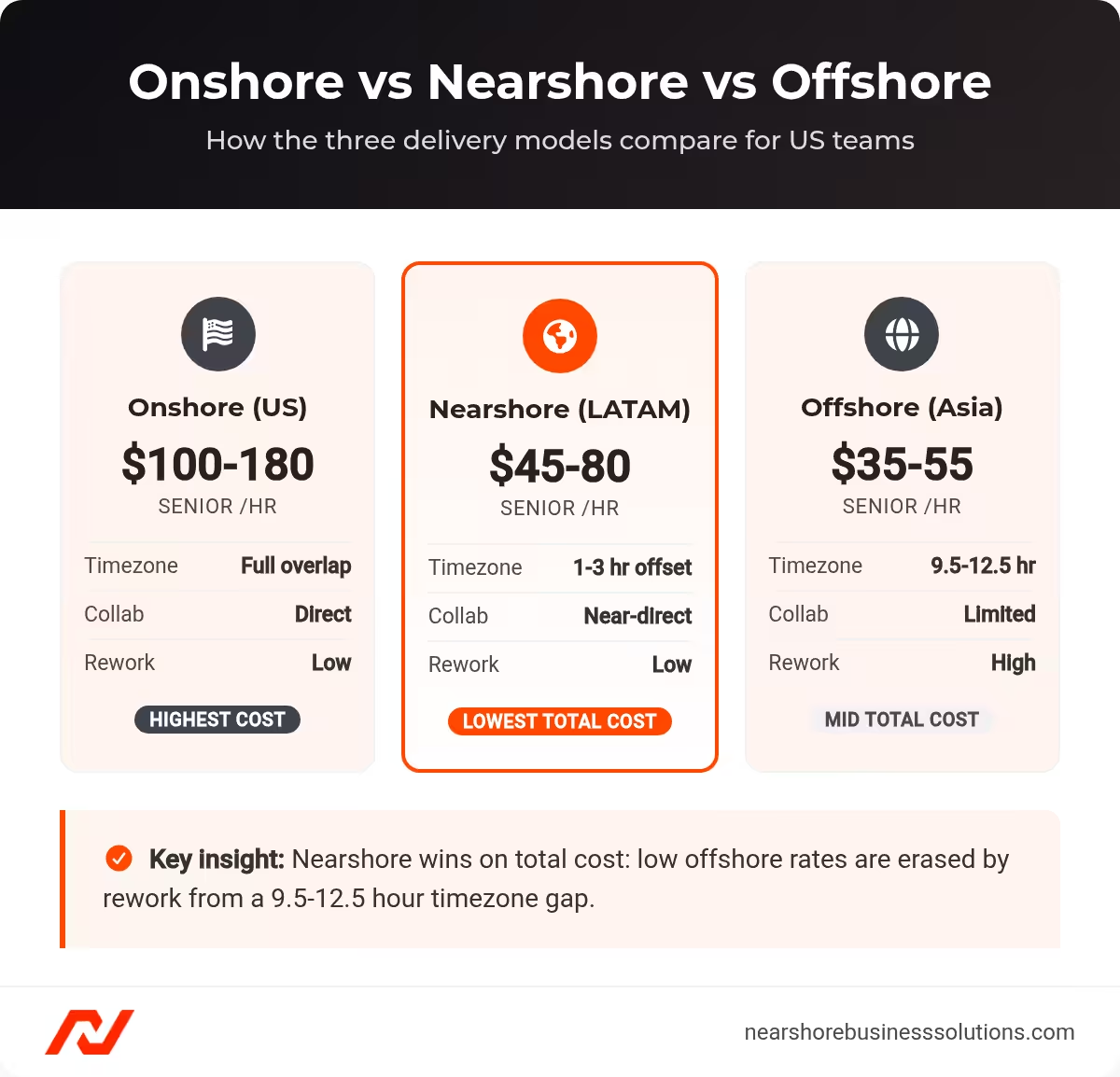
Onshore, nearshore, and offshore delivery models compared on rate, timezone, and rework.
Consider one sprint cycle. A nearshore engineer in Bogotá joins a 9 AM ET standup, pairs on an API integration by 11 AM, and pushes a reviewed PR before lunch. An offshore team in Bangalore finishes their workday as East Coast engineers log on. Questions sit unanswered for 12-plus hours, and a PM must bridge every handoff.
US companies report 40-60% fully-loaded cost savings using LATAM nearshore IT solutions versus domestic hiring (2024 nearshore industry research). Detailed rate benchmarks appear in the cost section below.
What Are the Core Nearshore IT Outsourcing Categories?
Nearshore IT services cover seven distinct operational categories. Each has different team structures, pricing models, and SLA benchmarks. The table below maps each category to its best-fit use case and key metrics.
| Service Category | What It Covers | Best For | Key SLAs/Metrics |
|---|---|---|---|
| Custom Software Development | Full-cycle product engineering: MVP builds, SaaS platforms, modernization | Long-term product builds needing sustained velocity | Sprint velocity, bug density per release |
| Managed IT Services | Outcome-based IT operations: app management, cloud infra, security ops | Non-core critical functions needing uptime guarantees | 99.9%-99.99% uptime, MTTR under 1 hour |
| DevOps as a Service | CI/CD automation, infrastructure-as-code, monitoring, SRE | Complex cloud-native stacks with scarce DevOps talent | Pipeline uptime over 99.9%, change failure rate under 15% |
| QA & Testing | Automated frameworks (Selenium, Cypress, Playwright), performance testing | Regression automation, pre-launch load testing | Over 80% code coverage, defect reduction |
| Help Desk / IT Support | L1/L2/L3 support, bilingual English/Spanish | B2B SaaS support scaling, internal IT help desk | First response under 15 min, consistently high CSAT |
| Cloud Infrastructure Management | Cloud ops (AWS, Azure, GCP), FinOps, security posture | Cloud cost reduction, HIPAA/SOC 2 compliance | Cloud spend reduction %, CIS benchmark scores |
| Cybersecurity Services | SOC as a Service, pen testing, vulnerability management, audits | 24/7 security monitoring, vulnerability remediation | MTTD under 30 min, remediation SLA adherence |
What Does Nearshore Custom Software Development Cover?
Custom software development covers full-cycle product engineering, backed by LATAM’s 1.2 million-plus engineers (Stack Overflow Developer Survey, 2024). The region concentrates in the stacks US product companies use most. React and Node.js dominate frontend and API layers across Colombian and Mexican developer communities. Python and Java anchor backend and data engineering in Brazil and Argentina. .NET remains heavily represented in Mexico’s enterprise sector. This stack alignment removes the technology translation layer that plagues offshore work.
The dedicated team model is the fastest-growing engagement structure. A typical team includes a PM, two backend engineers, two frontend engineers, and one QA engineer. It balances control with reduced management overhead. The team operates as a persistent extension of your org: same sprint cadence, same Jira board, same code review standards. Project-based delivery fits discrete efforts like a monolith-to-microservices migration or an 8 to 12 week MVP. For how engagements map to product stages, see our guide to nearshore software development services.
How Do Managed IT Services, DevOps, and Cloud Operations Work?
Managed IT services shift the model from buying hours to buying outcomes. You define the target, such as 99.95% application uptime or patching within 48 hours of CVE disclosure. The provider then staffs and manages the operation to hit those numbers.
DevOps as a Service has become one of the highest-demand categories for an economic reason. US DevOps and SRE engineers command $120 to $200/hr, or $180K to $280K per year (2024 nearshore rate benchmarks and developer-marketplace salary data). LATAM equivalents with the same certifications run $55 to $95/hr. The timezone argument matters more than the 50-55% cost delta. A CI/CD pipeline failure at 2 PM Eastern requires immediate diagnosis, not a handoff note reviewed 10 hours later. Use cases include migrating from Jenkins to GitLab CI, implementing Terraform-based IaC, standing up 24/7 SRE coverage, and managing multi-cloud Kubernetes.
How Does Nearshore QA and Automated Testing Improve Release Quality?
Nearshore QA improves release quality by embedding SDET engineers who write and maintain automated test suites against every pull request. US QA/SDET engineers run $80 to $130/hr. Equivalent talent in Colombia costs $40 to $60/hr and in Argentina $35 to $55/hr, a 50-60% savings (2024 nearshore rate benchmarks and developer-marketplace salary data). Same-timezone collaboration turns QA from a bottleneck into a continuous feedback loop. A nearshore SDET finds a failing test at 10 AM ET, messages the developer, reproduces the issue on a shared screen by 10:15, and the fix ships before the afternoon deployment.
What Does Nearshore IT Support and Bilingual Help Desk Provide?
Nearshore IT support provides SLA-driven, tiered coverage for B2B SaaS companies scaling from 200 to 2,000 customers. At that inflection point, ticket volume outpaces a small internal team. Nearshore help desk operations deliver first response under 15 minutes for critical issues, consistently high CSAT, and first contact resolution above 75%. Pricing scales linearly per ticket or per agent. The bilingual advantage is structural: LATAM agents handle US customers in near-native English while supporting Spanish-speaking end users without a separate team.
Which Nearshore Technology Solutions Engagement Model Fits Your Organization?
The wrong engagement model costs more than the wrong hourly rate. Model selection determines cost predictability, delivery velocity, and how much leadership bandwidth gets consumed by vendor coordination. The table below compares the six common models.
| Model | Control | Best For | Pricing | Monthly Benchmark | Risk Profile |
|---|---|---|---|---|---|
| Staff Augmentation | High: client manages | Skill gaps, surges, “try before you buy” | Per-resource monthly fee | $8K-$14K/mo per senior engineer | Low cohesion, knowledge loss on rotation |
| Dedicated Team | Medium-High | Long-term product, roadmap execution | Monthly retainer (fully loaded) | $48K-$60K/mo for 5-person team | Higher commitment; retention depends on provider |
| Time & Materials | High | Evolving requirements, R&D, discovery | Hourly/daily rate | Variable: no ceiling without governance | Budget overruns without PM discipline |
| Fixed Price | Low: provider owns delivery | Stable, well-documented requirements | Single fixed price | Project-dependent; change orders add 15-25% | Inflexibility; scope disputes |
| Outcome-Based / Managed | Low: KPI-governed | Non-core functions with measurable outputs | Fixed monthly fee tied to KPIs | Managed cloud ops: $15K-$40K/mo | Poor KPIs incentivize metric gaming |
| Hybrid | Variable | Multi-faceted programs: stable core plus flex | Combination of above | Sum of components | Contractual complexity |
Monthly benchmarks are representative figures for mid-market LATAM engagements.
How Does Staff Augmentation Embed Engineers Into Your Workflow?
Staff augmentation places individual nearshore engineers directly into your existing structure: your Jira board, your Slack channels, your code review process. It dominates as the most common entry point because it requires zero workflow changes. Best-fit scenarios include adding a senior React developer for six months, backfilling parental leave, or evaluating nearshore quality before a larger commitment.
The tradeoff is real. Every augmented engineer consumes the same management bandwidth as a domestic hire. When contractors rotate out, institutional knowledge leaves with them. For five or more engineers, the cumulative burden argues for a dedicated team. For vetting criteria and contract structures, see our guide to nearshore IT staffing.
What Makes a Dedicated Nearshore Team Different?
A dedicated team operates as a semi-autonomous engineering pod with its own internal cohesion: developers, QA, DevOps, and a delivery manager who owns sprint execution. At $48,000 to $60,000 per month for a five-person team from Colombia or Mexico (blended $60 to $75/hr), it delivers a full product squad for less than two senior US engineers. Standard SLAs codify sprint velocity, code quality metrics, and team retention above 85% annually.
This model solves the two problems staff augmentation cannot: knowledge retention and compounding velocity. A persistent team accumulates domain context that makes sprint 12 far more productive than sprint 2. Governance determines success. The client owns the product roadmap and acceptance criteria. The provider’s delivery manager owns sprint planning, resource allocation, and team health.
When Should You Use Project-Based or Managed Delivery?
You should use project-based or managed delivery when scope is fixed or outcomes are measurable, not when requirements evolve. Fixed-price engagements commit the provider to defined deliverables at a set cost. This eliminates budget variability but demands rigorous requirements documentation, because every ambiguity becomes a change order. It works for discrete, well-scoped projects and fails for iterative product development.
Outcome-based managed services extend the principle to ongoing operations. You contract for measurable outcomes, such as 20% cloud spend reduction or 99.95% uptime, and the provider decides how to deliver. KPI design matters more than KPI quantity. Measuring “tickets closed per day” rewards speed; measuring “first contact resolution above 75% with CSAT above 95%” rewards quality. For a detailed comparison of engagement and pricing structures, see our nearshore staff augmentation services.
What Do Nearshore IT Solutions Actually Cost?
Nearshore IT solutions cost 44-65% less than US onshore rates, depending on role and country. The table below benchmarks average hourly cost across the major LATAM markets.
What Is the Average Hourly Cost by Role Across LATAM Markets?
| Role | US (Onshore) | Mexico | Colombia | Argentina | Brazil | Savings vs. US |
|---|---|---|---|---|---|---|
| Senior Full-Stack Engineer | $100-$180/hr | $55-$80/hr | $50-$75/hr | $45-$70/hr | $55-$85/hr | 45-65% |
| Senior Backend Engineer | $110-$190/hr | $60-$85/hr | $55-$80/hr | $50-$75/hr | $60-$90/hr | 45-63% |
| DevOps / SRE Engineer | $120-$200/hr | $65-$95/hr | $60-$90/hr | $55-$85/hr | $65-$100/hr | 46-58% |
| QA / SDET Engineer | $80-$130/hr | $45-$65/hr | $40-$60/hr | $35-$55/hr | $45-$70/hr | 44-63% |
| AI/ML Engineer | $140-$250+/hr | $70-$110/hr | $65-$100/hr | $60-$95/hr | $75-$120/hr | 50-62% |
All LATAM rates are fully loaded: provider margin, benefits, equipment, and local employment taxes included. Sources: 2023-2024 nearshore rate benchmarks, global hiring data, and developer-marketplace salary data.
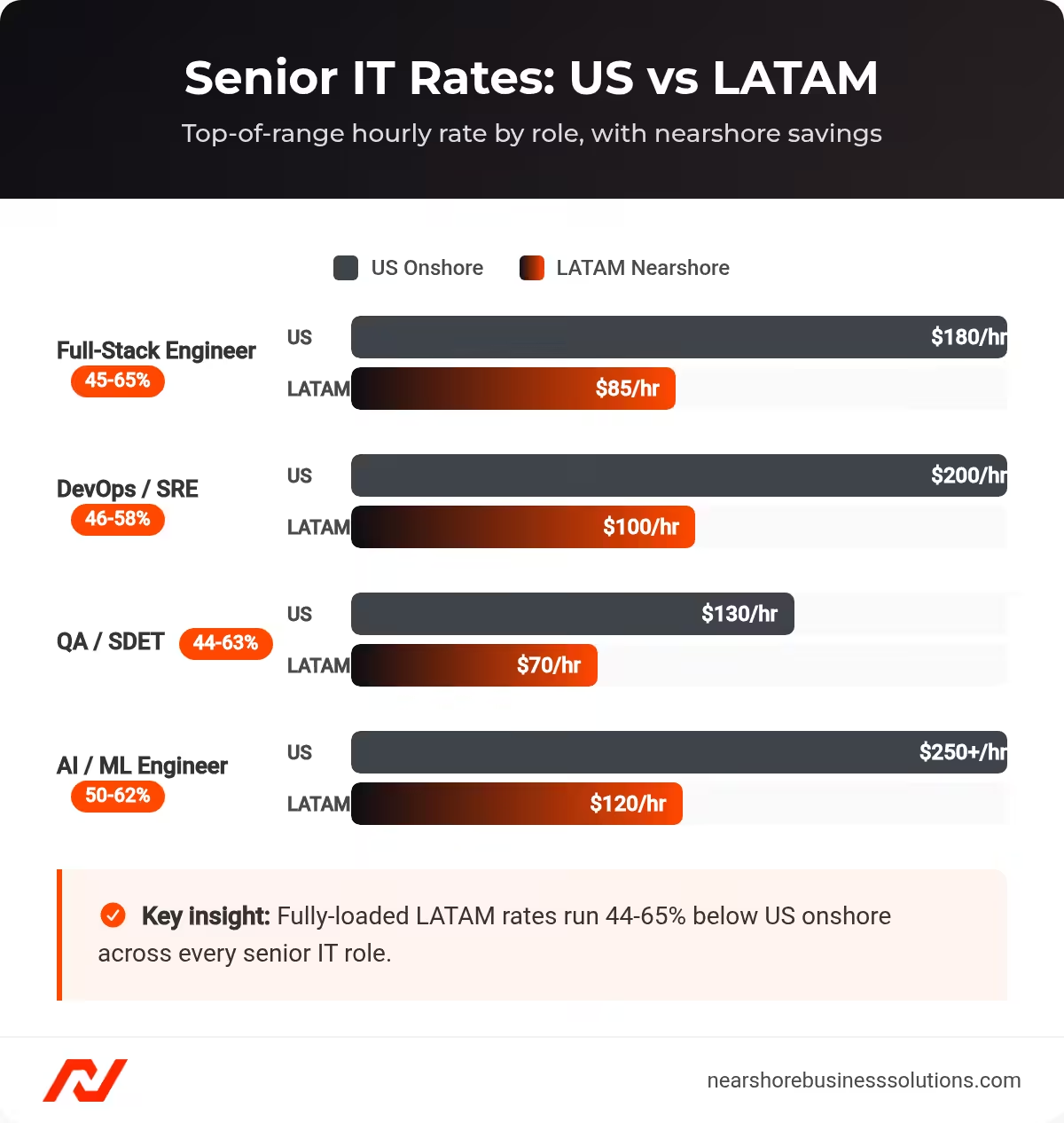
Senior IT hourly rates: US onshore versus LATAM nearshore, with savings by role.
Argentina delivers the lowest absolute rates across every role, driven by favorable exchange rate dynamics, though macroeconomic volatility introduces currency risk into multi-year contracts. Brazil commands a 10-15% premium. It reflects a 500,000-plus developer ecosystem and the region’s deepest AI/ML bench, concentrated in São Paulo, Recife, and Belo Horizonte. Mexico and Colombia occupy the value-optimized center. They combine $50 to $85/hr senior rates with the strongest English proficiency in LATAM. Over 300 Fortune 500 companies, including Google, Microsoft, Amazon, Oracle, and Walmart, already rely on these ecosystems (Nearshore Americas, 2023). Against Eastern European hubs like Poland ($55 to $80/hr for senior full-stack), LATAM rates undercut by 5-15% while eliminating the 6 to 8 hour timezone gap (2024 nearshore rate benchmarks and developer-marketplace salary data).
How Do You Calculate the True Total Cost of a Nearshore Engagement?
You calculate true Total Cost of Engagement by adding four hidden variables to the hourly rate. Onboarding ramp runs 2 to 4 weeks at 40-60% productivity per engineer. Management overhead adds a 10-15% premium in staff augmentation, or 3-5% in dedicated teams where the provider absorbs daily ops. Tooling and licenses run 1-3% of engagement cost. Travel for kickoffs costs $1,500 to $3,000 per person round-trip to major LATAM hubs.
Ignoring these variables is how a CTO approves a $65/hr rate and discovers six months later that effective cost per productive hour landed at $85. The reverse error is rejecting a $75/hr LATAM proposal for a $45/hr offshore bid that costs more per shipped feature after rework (HFS Research, 2023).
How Do You Evaluate and Select the Right Nearshore IT Provider?
You evaluate a nearshore IT provider against ten criteria spanning certifications, technical depth, SLAs, retention, and commercial transparency. The scorecard below converts each into a verifiable check.
What Belongs on the 10-Point Provider Evaluation Scorecard?
The scorecard covers ten checks, each with a benchmark you can verify before signing.
- Relevant Certifications (ISO 27001, SOC 2, CMMI). Non-negotiable for any engagement touching customer data or regulated workloads. Request current certificates, not “in progress” claims. Verify through independent audit reports.
- Stack Depth and Specialization Alignment. LATAM’s 1.2 million-plus developer base varies by country and stack. Request an architecture review or paid pilot sprint. Two days of real work reveals more than a portfolio deck.
- DevOps Maturity. Evaluate CI/CD practices, infrastructure-as-code adoption, and monitoring tooling. Benchmark: pipeline uptime over 99.9% and change failure rate under 15%.
- SLA Structure Clarity and Enforceability. Cross-reference against service-category benchmarks: 99.9%-plus uptime, MTTR under 1 hour, first response under 15 minutes, CSAT over 95%. Vague SLAs protect the provider, not you.
- Communication Cadence and Agile Alignment. Expect daily standups, weekly demos, and monthly business reviews as a minimum. Ask candidates to describe their retrospective process. The answer reveals whether agile is practiced or performed.
- English Proficiency and Cultural Affinity. Conduct technical interviews in English with the actual engineers who will staff your engagement, not sales engineers or account managers.
- Developer Retention Rate. Benchmark: over 85% annually. Below that, you pay for perpetual ramp-up. Ask for 24-month retention data, not 12-month snapshots that hide churn.
- Bench Depth and Time-to-Fill. Providers should present 3 qualified candidates within 5 to 10 business days. Longer timelines signal a thin pipeline.
- Client Reference Quality. Request references from companies at your stage and scale. Ask specifically about ramp-up friction, retention, and how the provider handled the first major production incident.
- Commercial Transparency. Fully-loaded rates should be itemized: base salary, benefits, overhead, margin. Providers who resist this breakdown are usually hiding margin structures. Tie renewal terms to performance metrics, not auto-renewal clauses.
Frequently Asked Questions About Nearshore IT Solutions
These are the most common questions CTOs ask when evaluating nearshore IT solutions in Latin America.
How long does it take to hire a nearshore IT team?
Nearshore recruitment fills specialist roles in under 2 weeks and standard roles within 30 days, versus 90 to 120 days for a senior US hire. Pre-vetted talent pools across Mexico, Colombia, Argentina, and Brazil compress the cycle. A dedicated five-person team typically reaches full sprint cadence within the first two sprints.
What is the difference between nearshore and offshore IT?
Nearshore IT places talent 1 to 3 hours from US Eastern Time, while offshore models in India or the Philippines sit 9.5 to 12.5 hours away. Nearshore rates run 15-30% higher than offshore but deliver lower Total Cost of Engagement because minimal timezone difference eliminates rework and overhead (HFS Research, 2023).
How much do nearshore IT solutions cost?
Nearshore IT engineers cost $40 to $120/hr depending on role and country, a 44-65% savings versus US rates. A five-person dedicated team runs $48,000 to $60,000 per month fully loaded. Always calculate Total Cost of Engagement, which adds onboarding ramp, management overhead, and tooling.
Which LATAM country is best for nearshore IT?
Mexico and Colombia offer the best value-to-quality balance, with $50 to $85/hr senior rates and the strongest English proficiency. Argentina delivers the lowest absolute rates but carries currency risk. Brazil commands a 10-15% premium for the deepest AI/ML talent bench.
Do I need a local entity to hire nearshore developers?
No, you do not need a local entity. Staff augmentation and dedicated team models place engineers through the provider, who handles local employment, payroll, and compliance. This removes the cost and delay of standing up a foreign subsidiary.
What certifications should a nearshore IT provider have?
A provider handling customer data or regulated workloads should hold current ISO 27001 and SOC 2 certifications, plus CMMI for mature delivery. Request the actual audit reports, not claims of “in progress” compliance.
Ready to Build Your Nearshore IT Team?
Nearshore Business Solutions sources and vets IT talent across Mexico, Colombia, Argentina, and Brazil. We screen for technical skills, English fluency, and US work style fit. You receive your first pre-vetted candidates within 3 business days, with a 90-day replacement guarantee on every placement.
Book a free consultation to scope your engagement model and receive a custom rate quote for your stack.