
Hiring software developers in Mexico saves 30-70% versus US rates while accessing 700,000+ IT professionals across Guadalajara, Monterrey, and CDMX.
Mexican developers cost $18,000-$113,000 annually depending on seniority and city. Guadalajara specializes in R&D with Intel and Oracle campuses. Monterrey leads in enterprise SaaS with the highest English proficiency. CDMX offers fintech depth with 320,000 tech professionals.
Below you’ll find salary benchmarks by city, legal compliance requirements, and hiring model comparisons. We cover USMCA IP protections, EOR options, and city-specific recommendations for CTOs at US growth-stage companies.
What Does It Mean to Hire Software Developers in Mexico?
Hiring software developers in Mexico means engaging talent in Guadalajara, Monterrey, or Mexico City through direct employment, contractor agreements, or staffing partnerships.
This model differs from offshore outsourcing. Geography enables real-time collaboration and direct oversight. Mexican developers work in time zones aligned with US business hours. This removes the coordination friction inherent in Asia-Pacific or European engagements.
Why is hiring software developers in Mexico beneficial for companies?
Companies hire in Mexico because salaries run 30-70% lower than US equivalents. Time zone alignment enables real-time collaboration. USMCA provides legal protections for IP and data flows.
The cost advantage is immediate. Mexican developer salaries create budget flexibility for scaling teams.
The 2025 software development landscape has shifted toward nearshoring. Mexico has evolved from manufacturing into a digital powerhouse. The Mexican IT services market is projected to reach $37.28 billion by 2030. It’s growing at an 11.87% CAGR. This reflects sustained investment in technical education and infrastructure.
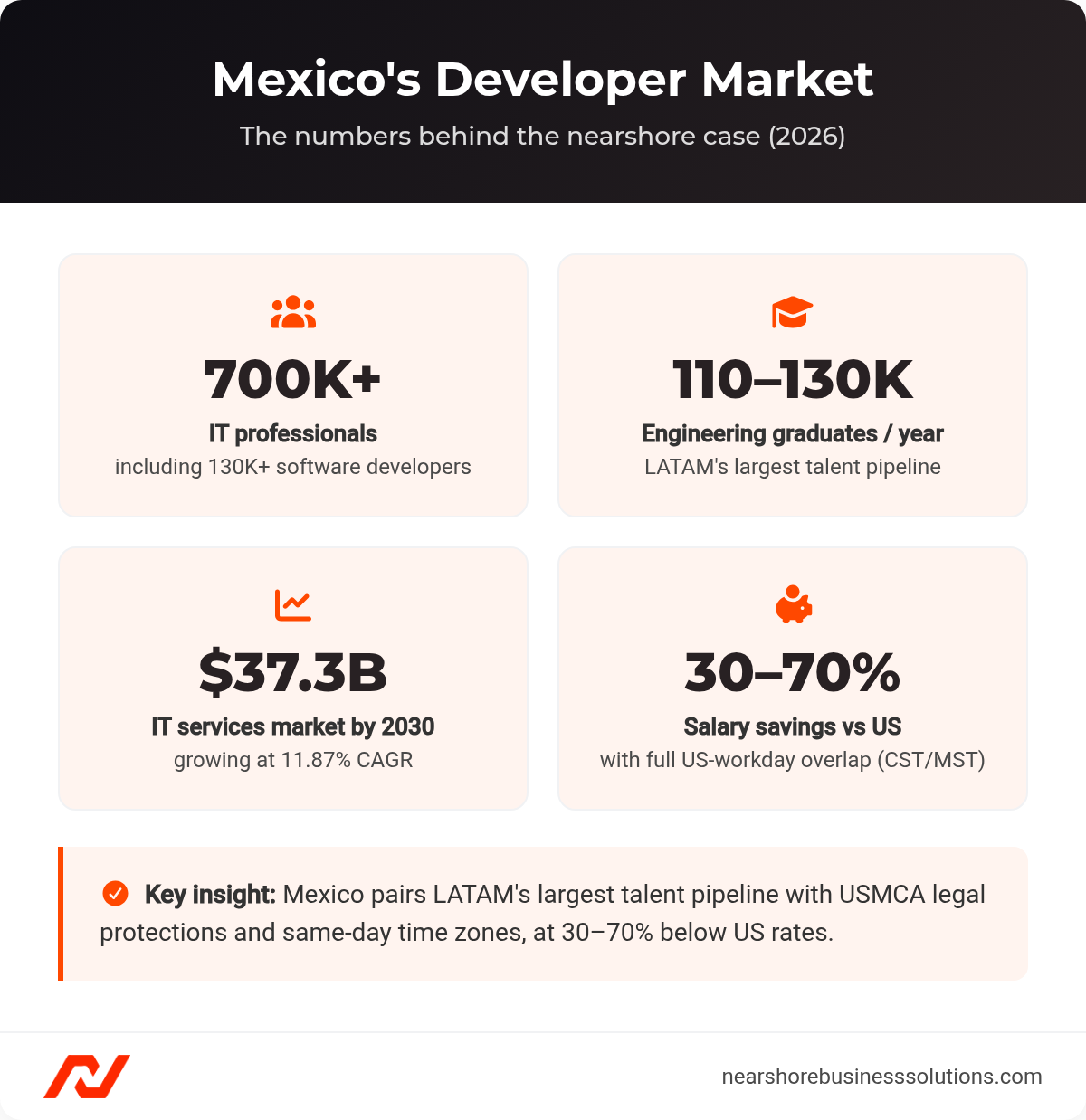
Mexico’s developer market: talent pipeline, market growth, and cost advantage.
The USMCA provides a stable legal framework for digital trade. It enforces high standards of IP protection. For CTOs, this treaty reduces legal ambiguity around cross-border data flows.
How does nearshore development work in Mexico?
You can hire nearshore developers through direct employment, contractor agreements, or staffing partnerships. Development firms provide embedded teams operating in CST/MST time zones.
All three cities operate in Central or Mountain Standard Time. This eliminates asynchronous delays that plague offshore models in Eastern Europe or Asia. Your Austin engineers join standups with Guadalajara developers at 9 AM local time for both parties.
US firms have moved beyond simple labor arbitrage. They establish engineering hubs that function as domestic team extensions. These hubs handle full-stack development, DevOps, QA automation, and infrastructure management. Teams report directly into US-based engineering leadership.
What is Guadalajara as a Tech Hub for Hiring Software Developers?
Guadalajara is Mexico’s premier R&D tech hub. Known as the “Mexican Silicon Valley,” it hosts major Intel and Oracle campuses. The workforce includes approximately 115,000 software developers and engineers.
The city’s specialization stems from decades hosting US multinationals. This created architects and senior leads accustomed to US work cultures. Guadalajara evolved from electronics manufacturing into high-end R&D. It’s the destination for companies prioritizing product design and technical depth over cost minimization.
What are the advantages of hiring software developers in Guadalajara?
Advantages include access to R&D-experienced senior talent trained by Intel and Oracle. Strong university pipelines produce 10,000 annual tech graduates. The city has 98 Clutch-listed vendors providing flexible engagement models.
Guadalajara houses major R&D centers for Intel and Oracle. These operations created knowledge transfer that elevated the regional talent pool. Developers have experience with systems architecture, hardware-software integration, and enterprise-scale deployments.
The University of Guadalajara and Tecnológico de Monterrey anchor the talent pipeline. ITESM ranks among Latin America’s best engineering schools. The city hosts tech events and innovation centers that facilitate recruiting.
Industrial and office space grew 50% in 2025 to meet nearshoring demand, signaling infrastructure investment keeping pace with market expansion.
What are the disadvantages of hiring software developers in Guadalajara?
Disadvantages include moderate growth rates compared to Monterrey and CDMX. Security requires vigilance outside primary tech corridors like Providencia.
The security situation demands operational awareness. Companies typically locate offices in established tech zones and implement standard corporate security protocols for employee safety.
Growth metrics lag behind Monterrey’s aggressive expansion. For companies betting on rapid ecosystem maturation, this slower pace may affect future talent availability or vendor selection.
What is the average salary range for developers in Guadalajara?
Junior developers with 1-3 years experience earn $18,000 to $30,000 USD annually. Middle developers with 3-6 years earn $30,000 to $48,000 USD annually. Senior developers with 5+ years earn $46,200 to $110,000 USD annually.
These ranges reflect market rates for direct hires in 2025. Contractor arrangements or vendor partnerships typically add 20% to 40% overhead depending on service model and engagement structure.
What tech specializations and industries dominate in Guadalajara?
Guadalajara specializes in embedded systems, hardware-software integration, and semiconductor R&D. These industries root in its electronics manufacturing legacy. They transitioned into research and product development for global tech companies.
The city produces approximately 10,000 tech and CS graduates annually. This pipeline feeds senior talent capable of architectural decisions and technical leadership.
What is Monterrey as a Tech Hub for Hiring Software Developers?
Monterrey is Mexico’s fastest-growing tech hub. Workforce expanded 112% over five years. It ranks #1 for ease of doing business. The city specializes in enterprise SaaS, logistics technology, and Industry 4.0.
The city combines industrial legacy with modern tech infrastructure. San Pedro Garza Garcia is Mexico’s safest municipality. It houses luxury office complexes and Softtek’s headquarters. Monterrey’s “business-first” culture aligns with enterprise software development.
What are the advantages of hiring software developers in Monterrey?
Advantages include the Triad’s highest English proficiency score of 556. Internet infrastructure delivers 94.3 Mbps fixed download with 86.2% reliability. Direct flights connect to Austin, Denver, Miami, and San Francisco.
Monterrey leads Mexico in World Bank ease of doing business rankings. Permit processes are streamlined. Contract enforcement is reliable. The Monterrey Digital Hub and WeWork Valle Oriente provide turnkey office solutions.
San Pedro Garza Garcia maintains high security perception scores. Companies operate with minimal security overhead. The municipality signals Mexico’s wealthiest and most industrially advanced zone.
The city produces approximately 9,000 tech and CS graduates annually from universities focused on engineering and industrial applications.
What are the disadvantages of hiring software developers in Monterrey?
Disadvantages include talent wars driving 12-18% annual wage growth for AI and cybersecurity roles. Cost of living averages $1,485 monthly, higher than other Triad cities.
Rapid growth created supply-demand imbalances for niche specializations. Companies competing for senior AI engineers face aggressive counteroffers. Compensation inflation erodes initial cost arbitrage.
Higher living costs flow through to salary expectations. Developers factor San Pedro rent premiums into negotiations. This narrows the US market gap faster than Guadalajara.
What is the average salary range for developers in Monterrey?
Junior developers with 1-3 years experience earn $14,000 to $28,000 USD annually. Middle developers with 3-6 years earn $28,000 to $42,000 USD annually. Senior developers with 5+ years earn $31,800 to $95,000 USD annually.
These ranges apply to direct employment in 2025. Specialized roles in AI, machine learning, and cybersecurity command premiums at the high end of senior bands, sometimes exceeding $100,000 for exceptional candidates.
What tech specializations and industries dominate in Monterrey?
Monterrey specializes in enterprise SaaS, logistics technology, and Industry 4.0 manufacturing systems. These domains align with its position as northern Mexico’s industrial IT engine. The city serves cross-border supply chains and advanced manufacturing.
The city produces approximately 9,000 tech and CS graduates annually. Senior talent concentrates in industrial automation and supply chain optimization.
What is CDMX (Mexico City) as a Tech Hub for Hiring Software Developers?
CDMX is Latin America’s largest tech talent market. It has 320,000 tech professionals specializing in fintech and e-commerce. The city hosts seven unicorns and 220 Clutch-listed vendors.
The city functions as Mexico’s corporate epicenter. Microsoft and Google offices anchor the ecosystem. VC funding reached $4.24 billion over three years, establishing CDMX as the region’s second-largest fintech hub. Workforce grew 95% in five years.
What are the advantages of hiring software developers in CDMX?
Advantages include access to 320,000 tech professionals with deep fintech expertise. World-class office spaces exist in Polanco and Santa Fe. Direct flights connect to major US tech hubs. Excellent private healthcare is available.
UNAM and the National Polytechnic Institute provide software engineering research and education. The city produces 24,346 tech graduates annually, the largest pipeline in Mexico. This scale enables recruitment for niche specializations.
CDMX hosts seven unicorns: Kavak in auto-tech, Bitso in crypto, and Konfio in SaaS fintech. These companies created senior talent experienced in scaling high-growth products. The financial sector concentrates talent in digital payments, risk management, and cybersecurity. Learn more about nearshore staff augmentation models for scaling fintech teams.
Polanco and Condesa are heavily patrolled and secure for international workers. Class A+ spaces in Polanco, Reforma, and Santa Fe offer enterprise-grade facilities. Condesa and Roma provide high-density coworking options.
The cultural environment matters for retention. CDMX offers world-class dining, arts, and entertainment that appeal to senior developers evaluating relocation or long-term assignments.
What are the disadvantages of hiring software developers in CDMX?
Disadvantages include Mexico’s highest median developer salaries. Safety varies by district, requiring careful office location selection. Internet speeds average 92.9 Mbps fixed with 83.3% reliability. Rent averages $1,336 for central one-bedroom apartments.
Compensation premiums erode cost advantages versus Guadalajara or Monterrey. Senior fintech engineers command salaries approaching US regional markets.
Infrastructure lags Monterrey despite CDMX’s size. Internet reliability at 83.3% creates friction for real-time collaboration tools.
Safety varies significantly by district. Companies must invest in location analysis and employee transportation to maintain security standards consistent with international operations.
What is the average salary range for developers in CDMX?
Junior developers with 1-3 years experience earn $14,500 to $33,600 USD annually. Middle developers with 3-6 years earn $30,000 to $54,000 USD annually. Senior developers with 5+ years earn $46,800 to $113,000 USD annually.
These ranges represent the highest median compensation in Mexico. Fintech specialists and senior architects frequently exceed upper bands, particularly at unicorns and US-backed startups competing aggressively for proven talent.
What tech specializations and industries dominate in CDMX?
CDMX specializes in fintech and e-commerce. It hosts nearly 1,100 active fintech companies. Talent pools are proficient in digital payments, risk management, and regulatory compliance.
The city produces 24,346 tech graduates annually from UNAM, IPN, and other institutions. Senior talent concentrates in financial infrastructure, payment processing, and fraud detection.
How Do Guadalajara, Monterrey, and CDMX Compare for Hiring Software Developers?
Guadalajara excels in R&D and senior talent depth. Monterrey leads in infrastructure and business efficiency. CDMX provides maximum scale and fintech specialization. Each city optimizes for distinct hiring strategies.
The comparison centers on talent availability, cost structures, and ecosystem maturity. Mexico hosts over 700,000 IT professionals including 130,000+ dedicated software developers. The educational system produces 110,000-130,000 engineering graduates yearly.
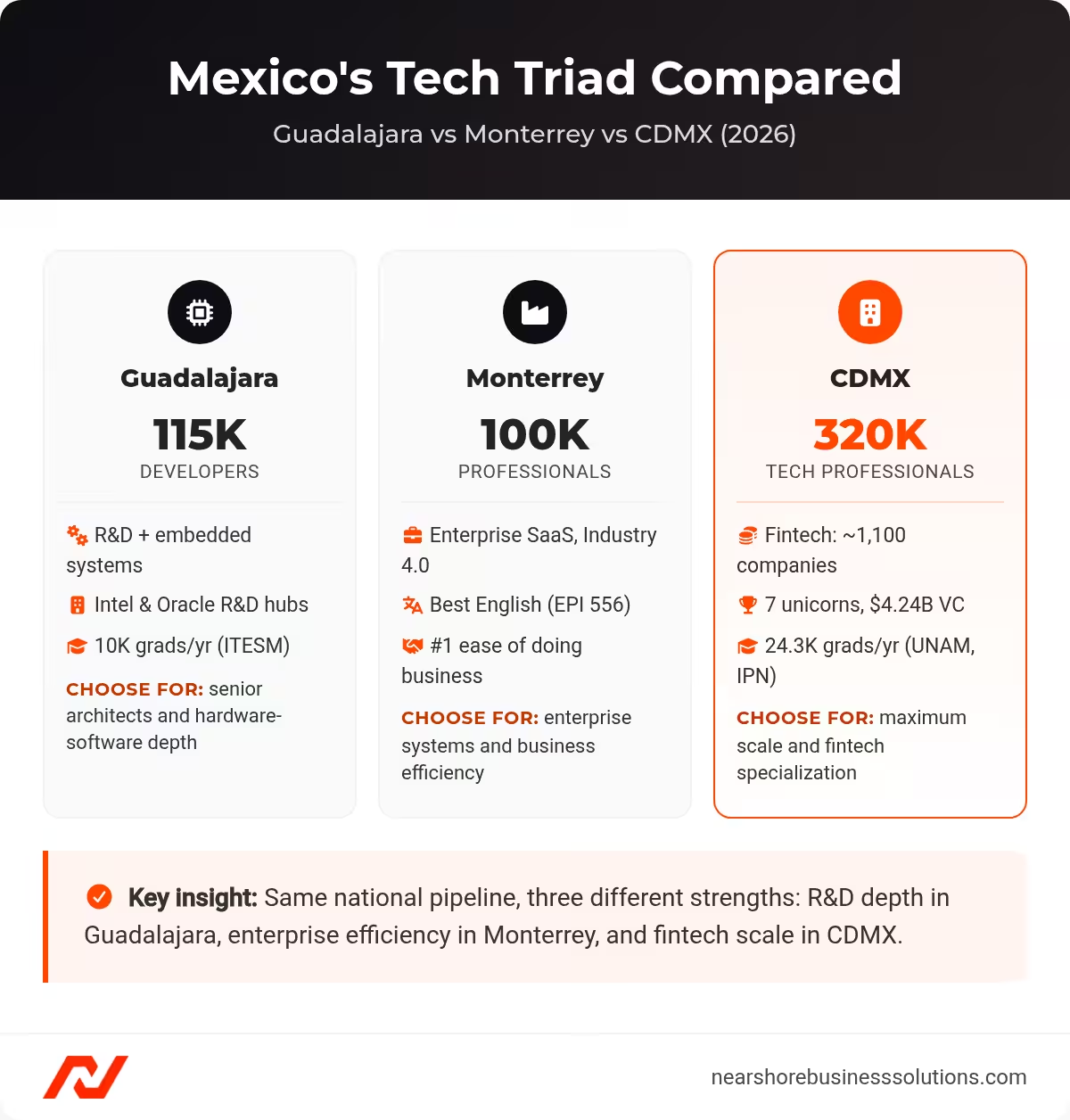
Mexico’s tech triad: what each city does best.
| Factor | Guadalajara | Monterrey | CDMX |
|---|---|---|---|
| Talent Pool | 115,000 | 100,000 | 320,000 |
| Specialization | R&D, Embedded | Enterprise SaaS | Fintech |
| Internet Speed | 93.9 Mbps | 94.3 Mbps | 92.9 Mbps |
| English EPI | Moderate | 556 (Highest) | Variable |
| Annual Grads | 10,000 | 9,000 | 24,346 |
| Clutch Vendors | 98 | Growing | 220 |
| Cost of Living | $620-925/mo | $1,485/mo | $1,336/mo |
How Do Talent Pools Compare Across the Three Cities?
CDMX maintains 320,000 tech professionals. Guadalajara has 115,000. Monterrey has 100,000. Quality differs by industry specialization, not technical capability. CDMX offers fintech depth. Guadalajara provides R&D experience. Monterrey delivers enterprise systems expertise.
All three cities draw from the same national pipeline of 110,000-130,000 annual graduates. Quality differences emerge from employer concentration and industry focus. CDMX’s fintech ecosystem creates payment specialists. Guadalajara’s Intel presence develops hardware-software experts. Monterrey’s industrial base produces manufacturing architects.
What Are the Salary Differences Between Cities?
Mexican developers cost 50-70% less than US equivalents. Senior Software Engineers average $57,000 versus $180,000 in SF/NYC.
| City | Junior (1-3 yrs) | Mid (3-6 yrs) | Senior (5+ yrs) |
|---|---|---|---|
| Guadalajara | $18,000-$30,000 | $30,000-$48,000 | $46,200-$110,000 |
| Monterrey | $14,000-$28,000 | $28,000-$42,000 | $31,800-$95,000 |
| CDMX | $14,500-$33,600 | $30,000-$54,000 | $46,800-$113,000 |
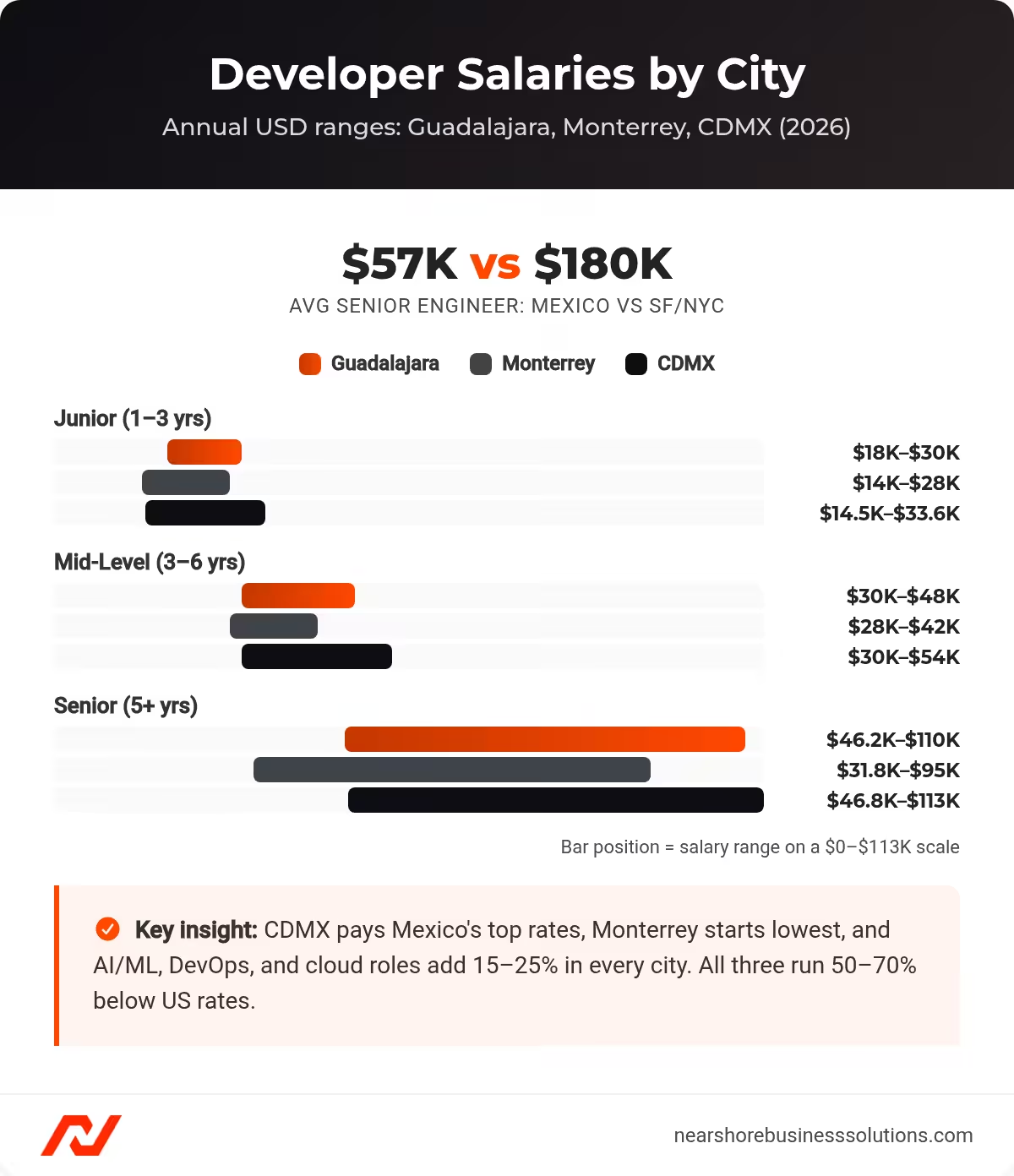
Developer salary ranges by city and seniority versus US senior rates.
AI/ML, DevOps, and Cloud Architecture roles command 15-25% premiums across all cities. CDMX commands Mexico’s highest base salaries, particularly for fintech. Monterrey experiences 12-18% annual wage inflation for specialized positions. Guadalajara offers the most stable compensation environment.
How Does Infrastructure Compare Across Cities?
Monterrey leads with 94.3 Mbps fixed download and 86.2% reliability. It ranks #1 for ease of doing business. Guadalajara delivers 93.9 Mbps fixed with direct routes to San Jose and Los Angeles. CDMX provides 92.9 Mbps fixed with 83.3% reliability.
Monterrey’s advantage extends beyond connectivity to permitting speed and contract enforcement. The World Bank ranking reflects operational efficiency that reduces administrative overhead.
Guadalajara offers direct flights to San Jose and Los Angeles. CDMX maintains the broadest network with service to San Francisco, Chicago, New York, Austin, and Dallas.
What Time Zone Benefits Do US Companies Gain?
All three cities operate in Central or Mountain Standard Time. This eliminates asynchronous delays and enables real-time standups, code reviews, and incident response.
This alignment is the fundamental nearshore value proposition. Your Austin team joins morning standups with Guadalajara developers. San Francisco product managers hold afternoon reviews with CDMX teams during normal business hours.
How Does English Proficiency Vary by City?
Monterrey leads the Triad with an EPI score of 556. Approximately 47.4% of tech professionals nationally speak advanced English. Monterrey and Guadalajara tech workforces achieve moderate to high proficiency.
National averages mask variance within tech sectors. Developers at multinationals and startups achieve business-level English through daily client interaction. Smaller regional shops may have lower proficiency rates.
Monterrey’s business culture and US corporate partnerships drive English adoption. Guadalajara’s Intel and Oracle presence created similar infrastructure. CDMX’s scale provides deep English-proficient pools despite lower averages.
How Mature Are the Tech Ecosystems?
Guadalajara offers 98 Clutch-listed vendors and decades of R&D infrastructure. Monterrey provides rapid growth with Softtek headquarters. CDMX delivers 220 Clutch-listed vendors plus seven unicorns and $4.24 billion in VC funding.
Maturity manifests differently across cities. Guadalajara’s maturity is depth: senior architects with 15+ years at Intel or Oracle. Monterrey’s maturity is efficiency: streamlined vendor onboarding reflecting business culture. CDMX’s maturity is breadth: vendor options spanning every specialization.
What Industries Dominate in Each City?
Guadalajara concentrates in R&D, embedded systems, and hardware-software integration. Monterrey focuses on enterprise SaaS, logistics technology, and Industry 4.0. CDMX specializes in fintech with nearly 1,100 active fintech companies.
Industry concentration determines talent availability. Payment platforms require CDMX’s regulatory specialists. IoT firmware benefits from Guadalajara’s embedded expertise. Supply chain software aligns with Monterrey’s logistics base.
How Does Remote Work Culture Support International Teams?
Mexico’s Temporary Resident Visa is valid for up to four years. It requires proof of $4,185 monthly income. Large communities of remote engineers and digital nomads thrive in CDMX and Guadalajara.
This policy created ecosystems beyond corporate offices. CDMX’s Condesa and Roma neighborhoods house coworking spaces and expat services. Guadalajara’s tech corridors provide similar infrastructure. This reduces friction for US companies sending employees on extended assignments.
How Does Cost of Living Affect Developer Retention?
Average monthly cost of living is $1,007 for single professionals. Private healthcare costs 70% less than the US. Guadalajara apartments average $620-$925 for one-bedroom center units. Monterrey and CDMX range higher.
Lower living costs extend developer purchasing power. A $50,000 salary in Guadalajara equals $120,000+ lifestyle in San Francisco. This gap creates retention advantages versus US relocation.
Healthcare quality matters for retention. CDMX offers excellent private healthcare. Guadalajara and Monterrey provide very good options. All three cities deliver care below US costs with international standards.
What Universities Feed Each City’s Talent Pipeline?
Guadalajara produces 10,000 annual graduates anchored by ITESM. Monterrey produces 9,000 with industrial focus. CDMX produces 24,346 from UNAM and IPN. Pipeline differences are volume and specialization, not quality.
ITESM ranks among Latin America’s best engineering schools. It benefits both Guadalajara and Monterrey campuses. UNAM’s research focus creates theoretical depth. IPN emphasizes applied engineering. All three pipelines meet enterprise hiring standards.
Which Mexican City Should You Choose for Hiring Software Developers?
Choose Guadalajara for R&D and senior technical depth. Choose Monterrey for enterprise software with superior infrastructure and safety. Choose CDMX for maximum scale and fintech specialization.
Quick decision guide:
- Choose Guadalajara if: Building R&D products, need senior architects, hardware-software integration, Silicon Valley work culture
- Choose Monterrey if: Enterprise SaaS, logistics/Industry 4.0, need highest safety and infrastructure, frequent US executive travel
- Choose CDMX if: Fintech/payments, need massive scale (50+ devs), establishing regional HQ for Latin America
The decision prioritizes operational needs over city rankings. Hardware-integrated products require different capabilities than payment infrastructure. Infrastructure requirements and talent depth vary by use case.
When should you hire developers from Guadalajara?
Hire from Guadalajara when building R&D-heavy operations. You need senior architects experienced with complex systems and hardware-software integration. Product design should align with Silicon Valley standards developed through Intel and Oracle presence.
Guadalajara serves companies prioritizing technical depth over cost minimization. Global tech giants created talent accustomed to long development cycles and rigorous testing. This culture aligns with developer tools, semiconductor software, and embedded systems.
The “Mexican Silicon Valley” designation reflects work culture, not just technical capability. Developers expect engineering-led decisions and design review processes.
When should you hire developers from Monterrey?
Hire from Monterrey when building enterprise SaaS, logistics technology, or Industry 4.0 applications. You need reliable infrastructure, business-first culture, and highest safety standards. The city offers closest logistical ties to the US border.
Monterrey optimizes for operational efficiency. The World Bank’s #1 ease of doing business means faster entity formation and streamlined compliance. Companies establishing subsidiaries encounter less administrative friction.
San Pedro Garza Garcia’s security enables standard corporate operations. International employees relocate with families more readily. Business culture emphasizes results, deadlines, and clear accountability.
Direct flights to Austin, Denver, Miami, and San Francisco facilitate executive oversight. Same-day travel options support bi-weekly sprint reviews.
When should you hire developers from CDMX?
Hire from CDMX when requiring massive scale across 320,000 tech professionals. You need deep fintech expertise in payments and regulatory compliance. The city suits regional headquarters serving broader Latin American markets.
CDMX’s scale enables recruitment strategies impossible elsewhere. Companies hiring 50+ developers simultaneously find sufficient supply. The 24,346 annual graduate pipeline supports sustained multi-year growth.
Fintech operations require CDMX’s regulatory expertise. Developers understand Mexican financial regulations and cross-border payment rails. The concentration of 1,100 fintech companies elevated the entire sector.
Regional headquarters benefit from CDMX’s corporate epicenter position. The city provides executive talent and legal infrastructure for Latin American operations. Companies expanding to Brazil, Colombia, or Argentina leverage CDMX’s regional connectivity.
How Do You Hire Software Developers in Mexico Successfully?
Hire successfully by establishing compliant legal structures through subsidiaries or EOR services. Implement senior-level technical vetting. Structure compensation to include Mexico’s 34-50% mandatory benefits burden beyond base salary.
Successful hiring requires understanding Mexican labor law and city-specific recruitment dynamics. The 2022 labor reforms changed contractor classifications and elevated compliance risk. Technical vetting standards must match US practices.
For a broader view, see our complete guide to hiring developers in Latin America.
What are the legal requirements for hiring developers in Mexico?
Legal requirements include Mexican subsidiaries, EOR arrangements, or contractor agreements structured to avoid misclassification. USMCA provides IP protection frameworks comparable to US and Canada standards.
USMCA fundamentally improved IP protection. US companies can enforce copyright, patent, and trade secret protections across borders. This reduces ambiguity around code ownership and confidentiality agreements.
Mexican labor law mandates specific termination procedures, severance calculations, and benefit administration. These differ substantially from US employment-at-will frameworks. Companies must comply with federal standards plus state-specific payroll taxes. Compare approaches in our Colombia hiring guide.
How do you structure employment contracts in Mexico?
Structure contracts through three primary models. Mexican Subsidiary provides direct control and tax incentives for long-term operations. Employer of Record enables rapid scaling without local entities. Contractor Model carries criminal tax fraud risk after 2022 reforms.
Mexican Subsidiary suits companies committing to sustained operations. It provides direct control over employment terms and local tax incentives. The tradeoff is administrative overhead: entity formation, accounting, and compliance management.
Employer of Record is the safest path for rapid scaling. EOR providers assume legal employer status and manage compliance. Companies retain operational control while outsourcing complexity. This works for teams of 5-50 developers.
Contractor Model is risky following 2022 reforms. Misclassification is criminal tax fraud and can forfeit IP. Companies must ensure genuine project-based scopes and variable engagement.
What recruitment channels work best in each city?
Recruitment channels vary by seniority and specialization. LinkedIn remains primary for senior hires across all cities. Guadalajara benefits from ITESM and UdeG partnerships for juniors. Monterrey’s business districts enable referral networks. CDMX requires vendor partnerships given its 320,000-professional scale.
Technical communities provide quality channels for senior developers. Guadalajara hosts R&D conferences drawing Intel and Oracle alumni. Monterrey Digital Hub runs enterprise software networking events. CDMX’s startup ecosystem creates founder-to-developer networks.
Vendor partnerships accelerate hiring in all cities. Guadalajara has 98 Clutch-listed vendors. CDMX has 220. Vendor margins add 20-40% but eliminate sourcing overhead.
How long does the hiring process typically take in Mexico?
Mid-level hiring takes 4-8 weeks from posting to offer acceptance. Senior positions extend to 8-12 weeks with multiple technical rounds. Subsidiary-based hiring adds 2-4 weeks for entity formation.
Timeline compression depends on preparation. Established entities and standardized offer templates enable faster hiring. First-time entrants need additional cycles for legal setup and benefits benchmarking.
Candidate availability affects timelines. Senior developers in Monterrey often entertain multiple offers simultaneously. Guadalajara’s stable environment produces faster decisions. CDMX’s scale enables parallel candidate evaluation.
What interview strategies work for Mexican tech talent?
Emphasize technical depth through live coding and architecture discussions. Accommodate communication styles that may be less direct than US norms. Establish psychological safety so candidates demonstrate expertise.
Mexican professional culture emphasizes relationship building before technical challenges. Open with context about your company, product vision, and team structure. This creates rapport for authentic technical discussions.
Live coding remains essential but structure it with clear problem statements. Mexican developers accustomed to US cultures handle algorithmic challenges comfortably. Those serving domestic markets demonstrate strong practical implementation skills.
Architecture discussions reveal senior capability better than algorithm puzzles. Ask candidates to design systems they’ve built and explain scalability decisions. This format plays to Guadalajara’s R&D depth and Monterrey’s enterprise experience.
How do you verify technical skills of Mexican developers?
Verify skills through multi-round coding assessments, architecture exercises, and code review simulations. Include reference checks with previous technical managers. Quality standards must match US hiring bars.
US firms must prioritize senior-level technical vetting. Talent exists across all cities but signal-to-noise ratios vary. Structured technical screens filter candidates effectively.
Coding assessments should cover practical implementation, not just algorithms. Ask candidates to build features, debug production issues, or refactor legacy code. These reveal real engineering capability.
Code review simulations test senior judgment. Present pull requests with intentional issues: security vulnerabilities or performance bottlenecks. Evaluate how candidates identify and articulate concerns.
Reference checks matter more in Mexico’s relationship-driven culture. Technical managers provide feedback about collaboration style and code quality. These conversations validate interview performance.
What compensation beyond salary matters to Mexican developers?
Mandatory benefits add 34-50% to base salary. Budget for these costs when comparing Mexican versus US compensation.
Required employer contributions:
- Social Security (IMSS): 24.95-33.58% of salary for healthcare, disability, and retirement
- Housing Fund (INFONAVIT): 5% flat contribution toward employee housing accounts
- Aguinaldo (Christmas bonus): Minimum 15 days’ salary by December 20 (competitive employers pay 30 days)
- Vacation Premium: 25% bonus on 12+ vacation days annually
- Profit Sharing (PTU): 10% of taxable income distributed to employees (capped at 3 months’ salary)
- State Payroll Tax: 1-4.25% depending on location (Jalisco, Nuevo León, Mexico City vary)
IMSS is the largest cost. It covers healthcare, disability, and retirement. INFONAVIT credits help employees access subsidized mortgages.
Frequently Asked Questions About Hiring Developers in Mexico
These are the most common questions US tech leaders ask about Mexican developer hiring.
How long does it take to hire developers in Mexico?
Mid-level hires take 4-8 weeks from job posting to offer acceptance. Senior positions extend to 8-12 weeks with multiple technical rounds. EOR-based hiring starts within weeks. Subsidiary formation adds 2-4 weeks.
Do I need a Mexican entity to hire developers?
No. Employer of Record services let you hire without local entities. EORs handle compliance, payroll, and labor law risks. This works for teams of 5-50 developers where subsidiary overhead isn’t justified.
What if a developer doesn’t work out?
Most EOR contracts include 30-day notice periods. Staff augmentation vendors typically offer replacement guarantees. Mexican labor law requires severance for direct employees, calculated based on tenure and salary.
How do you pay Mexican developers?
Through Mexican subsidiary payroll, EOR provider payments, or direct contractor invoicing. Subsidiaries and EORs handle peso conversion and mandatory withholdings. Contractors invoice directly in USD or MXN.
What’s the difference between nearshore and offshore?
Nearshore means same or overlapping time zones. Mexico operates in CST/MST, matching US business hours. Offshore typically refers to Asia-Pacific or Eastern Europe with 8-12 hour gaps.
Do Mexican developers speak English?
47.4% of tech professionals speak advanced English nationally. Monterrey leads with EPI 556. Developers at multinationals and startups achieve business-level English through daily client interaction. Tech sector rates exceed national averages.
What Are the Main Advantages of Hiring Software Developers in Mexico?
Main advantages include 30-70% salary savings versus US equivalents. Time zone alignment enables real-time collaboration. USMCA provides IP protections. You access 700,000+ IT professionals across specialized ecosystems.
Cost arbitrage remains foundational but no longer represents the entire value proposition. Mexico is now a sophisticated digital powerhouse, not simply a low-cost alternative.
Time zone alignment eliminates asynchronous delays. Your engineers join standups and code reviews during overlapping business hours. No night shifts or weekend coverage required.
The Mexican IT services market will reach $37.28 billion by 2030 at 11.87% CAGR. This growth creates vendor diversity and specialized talent pools across all three cities.
USMCA provides stable legal frameworks for digital trade and IP protection. This reduces ambiguity around cross-border data flows and code ownership.
Educational pipelines produce 110,000-130,000 engineering graduates annually. Major cities maintain 47.4% of tech professionals speaking advanced English.
What Are the Common Challenges When Hiring Software Developers in Mexico?
Common challenges include navigating cultural communication differences and managing labor law compliance. Retention strategies must address 12-18% wage inflation in competitive markets. Administrative requirements like the Chair Law add overhead.
Understanding challenges enables proactive mitigation. Companies entering Mexican markets with realistic expectations succeed more consistently.
How do you manage cultural differences in work expectations?
Establish explicit communication norms around feedback directness and decision-making authority. Mexican professional culture emphasizes relationship-building and consensus. Adapt management approaches from US-centric playbooks.
Mexican work culture values interpersonal relationships and hierarchical respect. Developers may hesitate to challenge senior decisions without established psychological safety.
Communication styles tend toward politeness and indirect feedback. “That might be challenging” may mean “that’s impossible” in US terms. Managers must calibrate interpretation.
Decision-making involves more consultation and consensus-building. Mexican teams may expect managerial approval for decisions US developers would make independently.
Building trust precedes maximum productivity. Invest time in team formation and establish regular 1-on-1 check-ins. This overhead pays dividends in retention.
How do you handle labor law compliance across Mexican states?
Partner with Mexican legal counsel or EOR providers for labor law compliance. They navigate federal standards plus state-specific payroll taxes. The Chair Law (June 2025) requires physical workplace modifications.
Federal law establishes baseline requirements: IMSS, INFONAVIT, Aguinaldo, vacation premiums, and profit sharing. State-level variations create complexity.
State payroll taxes range from 1% to 4.25%. Jalisco, Nuevo León, and Mexico City maintain different rates. Companies across multiple cities must manage separate registrations.
The Chair Law mandates ergonomic seating and workplace modifications. It adds administrative overhead requiring office audits and compliance documentation.
Labor reforms continue evolving. The 2022 contractor rules created criminal fraud liability. Companies need ongoing legal monitoring.
EOR providers maintain knowledge of federal and state requirements. They handle registrations and compliance documentation as regulations change.
What retention strategies work best for Mexican developers?
Combine competitive total compensation with career development pathways and modern tech stacks. The Mexican Peso shows relative stability, providing budget predictability.
Compensation alone doesn’t retain top talent long-term. Mexican developers evaluate career growth and technical challenge alongside salary. Cost arbitrage without professional development causes higher attrition.
Career pathways matter significantly. Developers want clear technical ladders with transparent promotion criteria. Companies offering IC growth tracks differentiate competitively.
Technical stack modernization attracts ambitious developers. Legacy systems struggle to retain talent. React, Kubernetes, and cloud-native architectures pay retention dividends.
The Mexican Peso provides predictability but limits currency arbitrage gains. Retention strategies must address total value proposition.
Plan México offers 91% accelerated depreciation on new fixed assets. This offsets rising labor costs for companies with office buildouts or infrastructure investment.
Monterrey wage inflation reaches 12-18% annually for AI and cybersecurity roles. Companies conducting annual benchmarking retain talent more effectively.
What Are the Different Hiring Models Available in Mexico?
Four hiring models serve different company needs. Selection depends on commitment timeline, team size, and risk tolerance.
| Model | Best For | Timeline | Cost Premium | Risk Level |
|---|---|---|---|---|
| Subsidiary | 50+ devs, long-term | 2-4 months | Lowest (after setup) | Low |
| EOR | 5-50 devs, rapid scaling | Under 30 days | 15-25% fees | Low |
| Contractor | Project-based only | Immediate | Variable | High (post-2022) |
| Staff Aug | Flexible scaling | 1-2 weeks | 20-40% margin | Low |
Subsidiaries provide full control and tax incentives. EOR handles compliance without local entities. Contractors carry misclassification risk after 2022 reforms. Staff augmentation adds margins but eliminates sourcing overhead.
Can you hire full-time employees directly in Mexico?
Yes, you can hire directly by establishing a Mexican subsidiary. This provides long-term control and access to Plan México’s 91% accelerated depreciation. It requires entity formation and ongoing compliance management.
Subsidiaries represent the most committed hiring model. Companies gain operational control over employment terms without intermediary dependencies.
Plan México enables immediate write-offs of up to 91% on new fixed assets. This includes office buildouts, equipment, and infrastructure. The benefit offsets rising labor costs.
The tradeoff is administrative complexity. Subsidiary formation requires legal counsel and Mexican tax identification. Ongoing operations demand local accounting for IMSS, INFONAVIT, and payroll taxes.
This model scales efficiently. Adding employees costs less once infrastructure exists. Companies planning 20+ developers within 18 months should evaluate subsidiaries.
Should you use an Employer of Record (EOR) for hiring in Mexico?
Use an EOR when requiring rapid scaling without local entity formation. EORs handle all compliance, payroll, and labor law risks. You retain operational control. This is the safest path for teams of 5-50 developers. Service fees run 15-25%.
EOR services provide immediate market entry. Companies hire within weeks rather than 2-4 months for subsidiaries. The EOR becomes legal employer while you direct technical decisions.
Compliance risk transfers to the EOR provider. They manage IMSS, mandatory benefits, payroll taxes, and Aguinaldo. This protects against criminal tax fraud liability.
Service fees typically range 15-25% of total employment costs. A $70,000 total cost developer incurs $10,500-$17,500 annual EOR fees.
The sweet spot is 5-50 headcount. Below 5, fees may exceed value. Above 50, cumulative fees justify subsidiary investment.
Can you engage developers as independent contractors in Mexico?
Engage contractors only with genuine project-based scopes and variable engagement terms. 2022 reforms classify misclassification as criminal tax fraud with potential IP forfeiture. This model is risky for ongoing work relationships.
The contractor model worked historically but 2022 reforms changed risk profiles. Tax authorities aggressively audit contractor relationships with severe penalties.
Genuine contractor relationships require specific characteristics: project-based scopes, variable hours, multiple clients, own equipment, and independence in how work gets completed.
Most software development relationships fail these tests. Developers working 40 hours weekly on your roadmap are employees under Mexican law regardless of contract language.
Mexican counsel can structure legitimate agreements for truly project-based work: building specific features, conducting audits, or delivering defined consulting.
Criminal fraud exposure and IP forfeiture make misclassification unacceptable. Default to EOR or subsidiary models unless counsel confirms genuine contractor status.
How do staff augmentation services work in Mexico?
Staff augmentation provides pre-vetted developers through vendor partnerships. Vendors handle sourcing, screening, and legal employment. You direct technical work. Margins add 20-40% above developer costs.
Staff augmentation is the fastest path to operational teams. Vendors maintain benches of React engineers, DevOps specialists, and QA experts. You interview and select. The vendor handles employment.
Guadalajara has 98 Clutch-listed vendors. CDMX has 220. Some specialize in stacks: MEAN, Java/Spring, .NET. Others focus on industries: fintech, e-commerce, manufacturing.
Margins range 20-40% above fully-loaded costs. A $70,000 all-in senior developer generates $84,000-$98,000 in vendor billings.
The model provides scaling flexibility. Companies adjust headcount without termination liability. Contracts typically allow 30-day notice periods.
Quality varies by vendor. Top firms implement rigorous vetting and maintain high retention rates. Due diligence on vendor standards and references predicts success.
Staff augmentation suits project-based scaling or capability gaps. Long-term needs justify transition to direct employment.
Ready to Scale Your Engineering Team?
Nearshore Business Solutions connects you with vetted developers across Mexico. We handle sourcing, vetting, and placement. You focus on building your product. Our developers are pre-screened for technical skills and English proficiency, with a 90-day replacement guarantee.
Get a free consultation to discuss your hiring needs and receive a custom quote.