
Staff augmentation and nearshoring compare 4 distinct models. Each carries different cost structures, control levels, and risk profiles for US engineering teams.
Staff augmentation in Latin America delivers vetted engineers in 7-14 days at $6,500-$13,000 per engineer per month. Dedicated nearshore teams cost $7,000-$14,000 per month per engineer with 8-12% annual attrition versus 15-25% for augmented roles. Over 60% of CTOs now blend engagement models rather than committing to one approach (Deloitte, “Global Outsourcing Survey,” 2022).
Nearshoring is not a standalone model. It is a delivery location strategy that layers onto staff augmentation, dedicated teams, or project outsourcing. This guide breaks down what each model costs, who controls what, and which scenario each wins in. You will find a comparison matrix, scenario decision guides, and a hybrid strategy framework for scaling engineering orgs.
How Does Each Engagement Model Work in Day-to-Day Engineering Operations?
Four engagement models dominate nearshore hiring conversations: staff augmentation, dedicated teams, project-based outsourcing, and managed services. CTOs conflate them constantly. The distinctions below are operational: who reports to whom, how billing works, and what your Monday morning standup actually looks like.
How Does Staff Augmentation Embed Engineers into Your Existing Sprints?
Staff augmentation places individual engineers directly into your existing squads. Your Jira board, your CI/CD pipeline, your sprint ceremonies. The vendor handles payroll, benefits, and HR compliance. Your engineering managers handle everything else.
Client control sits at 9/10. Billing is time-and-materials: a monthly fee per engineer with no fixed deliverable obligations on the vendor’s side. Typical engagements run 4-9 months with 1-5 engineers. Most vendors onboard new engineers in 1-3 weeks. Platforms like Toptal claim 48-72 hours for pre-vetted generalists.
The key distinction from outsourcing: you delegate zero decision-making authority. The augmented engineer writes code inside your repo, under your tech lead, following your definition of done. See how our staff augmentation service embeds vetted LATAM engineers into existing squads.
How Does a Dedicated Team Differ from Staff Augmentation?
A dedicated team stands up a cross-functional pod, typically 3-15 engineers including developers, QA, and often a project manager. This pod works exclusively on your product. Client control remains high at 8/10: you direct what the team builds while the vendor ensures the team stays healthy and staffed.
That shared responsibility produces measurably better stability. Average engagement duration reaches 2.5 years versus 4-9 months for augmented roles (published nearshore vendor case studies, 2023-2024). The tradeoff is speed: building a full dedicated team takes 4-6 weeks, and scaling down requires 30-60 days’ notice.
Dedicated teams in cities like Bogota, Medellin, Guadalajara, and Buenos Aires deliver an additional advantage: developers trained at universities like Universidad de los Andes (Colombia), EAFIT (Colombia), and Tecnologico de Monterrey (Mexico) bring strong technical foundations and high English proficiency.
How Do Project-Based Outsourcing and Managed Services Delegate Outcomes?
Project-based outsourcing inverts the control model. You define scope, timeline, and deliverables. The vendor returns a fixed-price proposal and owns the entire execution. Client control drops to 3/10. Typical engagements involve 5-25 team members over 6-12 months.
Managed services go further. They transfer ongoing operational responsibility for an entire function to a vendor. Think 24/7 SRE coverage or continuous QA testing governed by SLAs. Client control sits at 2/10. You define business outcomes. The vendor chooses how to achieve them.
Both outcome-based models carry an IP nuance: custom code belongs to you, but vendors retain rights over their proprietary platforms and internal tooling used during delivery.
How Does Staff Augmentation vs Outsourcing Compare on Control, Cost, and Risk?
Staff augmentation gives you the highest control at 9/10, while managed services sit at 2/10. Project-based outsourcing carries the highest dispute rate at 15-20%, while dedicated teams achieve under 5% failure once established (KPMG, ISG advisory reports, 2023).
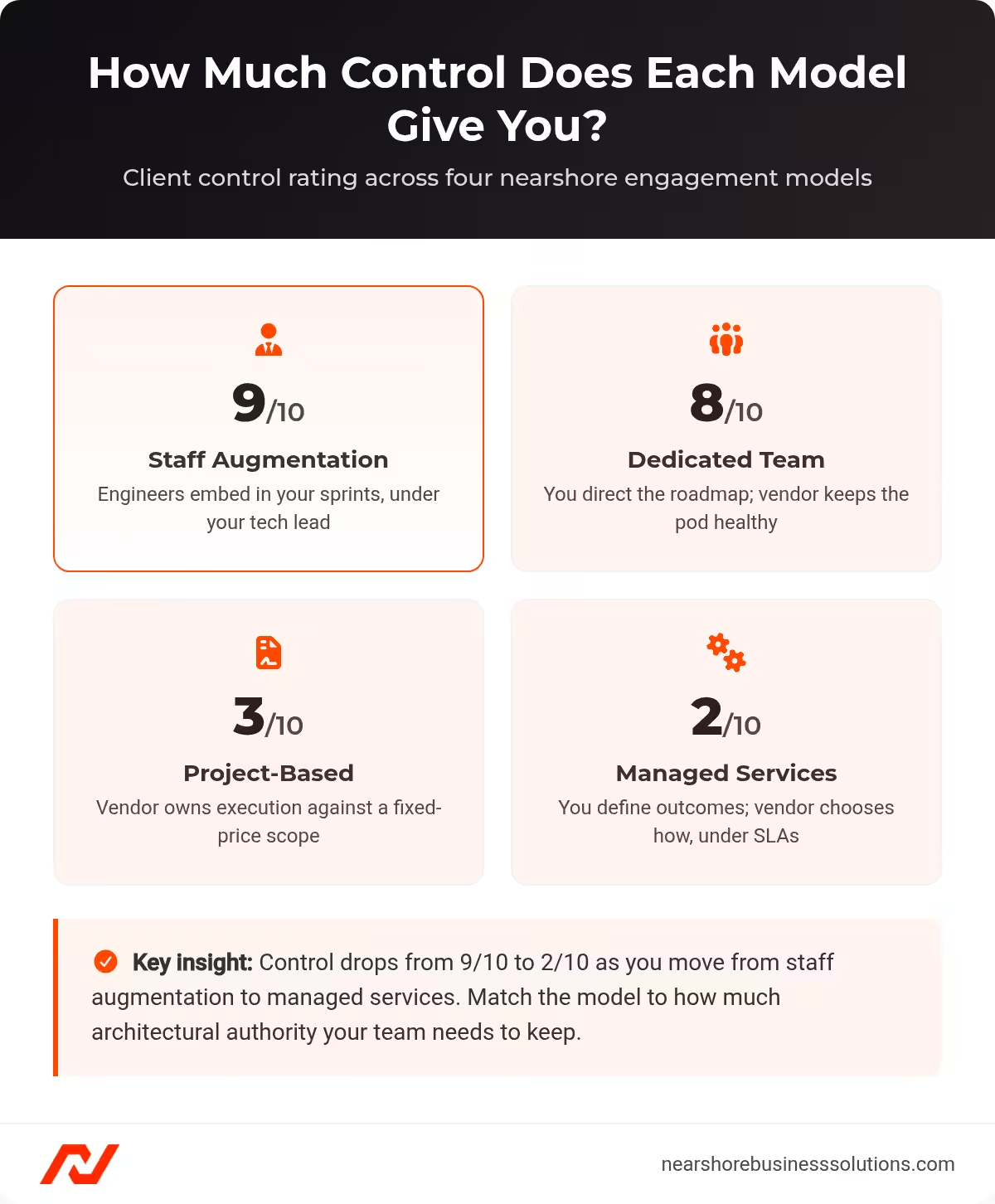
Client control rating across four nearshore engagement models, from staff augmentation to managed services.
| Criteria | Staff Augmentation | Dedicated Team | Project-Based Outsourcing | Managed Services |
|---|---|---|---|---|
| Control | Very High (9/10) | High (8/10) | Low (3/10) | Very Low (2/10) |
| Cost Predictability | Medium | High | Very High | Very High |
| Speed to Start | Very High (7-14 days) | High (4-6 weeks) | Medium (4-8 weeks scoping) | Medium |
| Scalability | Very High (1-3 weeks) | High (4-8 weeks) | Low (new SOW required) | Medium (quarterly) |
| IP Security | High | Very High | High with clear SOW | Medium |
| Quality Oversight | Client-led | Client-led | Vendor-led | Vendor-led (SLA-driven) |
| Long-Term Cost Efficiency | Medium | Very High | Low | High (for its function) |
| Risk Bearer | Client bears most risk | Shared risk | Vendor bears most risk | Vendor bears performance risk |
| Attrition Rate (Annual) | 15-25% | 8-12% | N/A (vendor-managed) | N/A (vendor-managed) |
| Failure or Dispute Rate | Lower engagement failure | Under 5% once established | 15-20% (highest) | Tied to SLA clarity |
The US tech industry in-house attrition average runs 13-15% annually (Radford, 2023). Staff augmentation’s 15-25% range exceeds that baseline because augmented engineers lack organizational belonging. Dedicated teams invert that dynamic: the 8-12% rate undercuts even domestic benchmarks because vendors invest in pod-level culture and career progression.
The 15-20% dispute rate for project-based outsourcing traces almost entirely to the contracting phase. Fixed-price models push vendors to interpret scope narrowly and clients to interpret it broadly.
How Do Cost Structures Shift Across Billing Models?
Staff augmentation bills $6,500-$9,000 per month for mid-level engineers and $8,500-$13,000 for senior engineers in Latin America (2024 developer-marketplace and global-hiring rate data). Dedicated teams run $500-$1,500 more per month per engineer but buy a management and platform fee broken out as a separate line item. That is more transparent than staff augmentation’s blended rate.
| Billing Model | Mid-Level Rate | Senior Rate | Markup or Premium | Scaling Behavior |
|---|---|---|---|---|
| Staff Aug (T&M) | $6,500-$9,000/mo | $8,500-$13,000/mo | 1.7x-2.0x over loaded cost | Linear, no volume discount |
| Dedicated Team | $7,000-$10,000/mo | $9,500-$14,000/mo | 15-25% management fee | Sub-linear, retention amortizes ramp-up |
| Project-Based | Bundled | Bundled | 30-50% premium over T&M | Rigid, change orders at vendor leverage |
| Managed Services | Abstracted behind SLA | Abstracted behind SLA | Opaque | Vendor-optimized |
The long-term efficiency advantage for dedicated teams compounds through stability. Every replacement cycle in staff augmentation carries 2-4 weeks of reduced output during offboarding plus 4-6 weeks of ramp-up for the replacement.
Hidden costs across all models: Budget 5-8 hours per week of your engineering managers’ time per 4-5 person team during the first 3-6 months (Gartner, 2023). At loaded cost of $120-$160 per hour, that is $2,400-$5,120 per month that never appears on the vendor bill. Add $5,000-$15,000 in one-time legal fees for MSA review and $500-$1,500 per engineer per year in tooling licenses.
For a deeper breakdown of what each engagement model costs, see our guide to staff augmentation costs.
Which Engagement Model Wins in Which Scenario?
The right model depends on your team stage, workstream type, and internal management bandwidth. Staff augmentation wins for 4-9 month skill gaps. Dedicated teams win for 12-36 month product builds. Project outsourcing wins for bounded, fully specifiable workstreams with stable scope.
| Model | Best Scenario | Company Stage | Duration | Key Prerequisite |
|---|---|---|---|---|
| Staff Augmentation | Filling capacity gaps in existing squads | Series A-C, 15-80 engineers | 4-9 months | EMs with bandwidth for additional reports |
| Dedicated Team | Building a new product pillar | Series B-D, 40-200 engineers | 12-36 months | Functioning PM layer |
| Project-Based | Bounded, fully specifiable workstream | Any stage | 6-12 months | Scope stability |
| Managed Services | Ongoing, non-differentiating operations | $50M ARR or above | Ongoing | Measurable SLA targets |
When Is Staff Augmentation the Strongest Play?
Staff augmentation wins when you need fewer than five engineers, the engagement lasts fewer than nine months, and your engineering managers have capacity for additional direct reports.
Your React Native team ships a mobile checkout flow in Q3. The two senior iOS engineers you need do not exist on your bench. Your recruiting pipeline shows a 45-60 day median time-to-fill domestically (Hired.com, 2023). Staff augmentation compresses the entire sequence to 7-14 days: source, vet, embed, ship.
The failure mode: a “temporary” augmented engineer who stays 14 months without conversion creates a dependency with none of the retention protections of a dedicated team. One LinkedIn message from a competitor and your sprint velocity drops 20% overnight.
When Does a Dedicated Team Outperform Staff Augmentation?
Dedicated teams outperform when the workstream has 12 months of defined roadmap, you have a product manager who can own prioritization, and you accept a 4-6 week assembly period.
Your Series C company closes a $40M round with a mandate to build a data analytics platform over 24 months. The work requires a cohesive pod with deep domain context that compounds over time.
| Cost Component | San Francisco (5 engineers) | LATAM Dedicated Team (5 engineers) |
|---|---|---|
| All-in annual total | $1,380,000-$1,785,000 | $600,000-$700,000 |
That $680,000-$1,085,000 delta recurs annually. Beyond cost, an engineer who has spent 18 months inside your data model produces output a newly onboarded replacement cannot match for months. Dedicated teams in Bogota, Medellin, Guadalajara, and Buenos Aires deliver 30% higher retention rates than staff augmentation (published nearshore provider analyses).
For a detailed look at how to source and structure nearshore teams, see our nearshore IT staffing guide.
When Do Project-Based Outsourcing or Managed Services Deliver?
Project-based outsourcing works for bounded, fully specifiable workstreams: database migrations, admin dashboard rebuilds, marketing microsites. Every engineering hour your core team spends on a migration is an hour not spent on features that drive ARR.
But this model carries the highest failure rate at 15-20% of all four models, driven entirely by misaligned scope expectations. ScopeCreep is a vendor leverage point in fixed-price contracts.
Managed services suit companies at $50M ARR needing to offload critical but non-differentiating functions. The hard constraint: SLA specificity determines everything. A contract defining “high availability” without a number gives the vendor interpretive latitude that always resolves in their favor.
Compare these tradeoffs in detail in our guide to managed services vs staff augmentation.
Why Does Nearshoring Change the Cost and Collaboration Math on Every Model?
Nearshoring delivers 45-60% cost savings compared to fully loaded US hires while adding 5-6 hours of daily timezone overlap that offshore alternatives cannot match (Nearshore Americas, 2024). Demand for LATAM talent from US companies surged 38% from 2022 to 2023, with 2024 projections indicating 30-35% year-over-year growth (2023 global hiring report data).
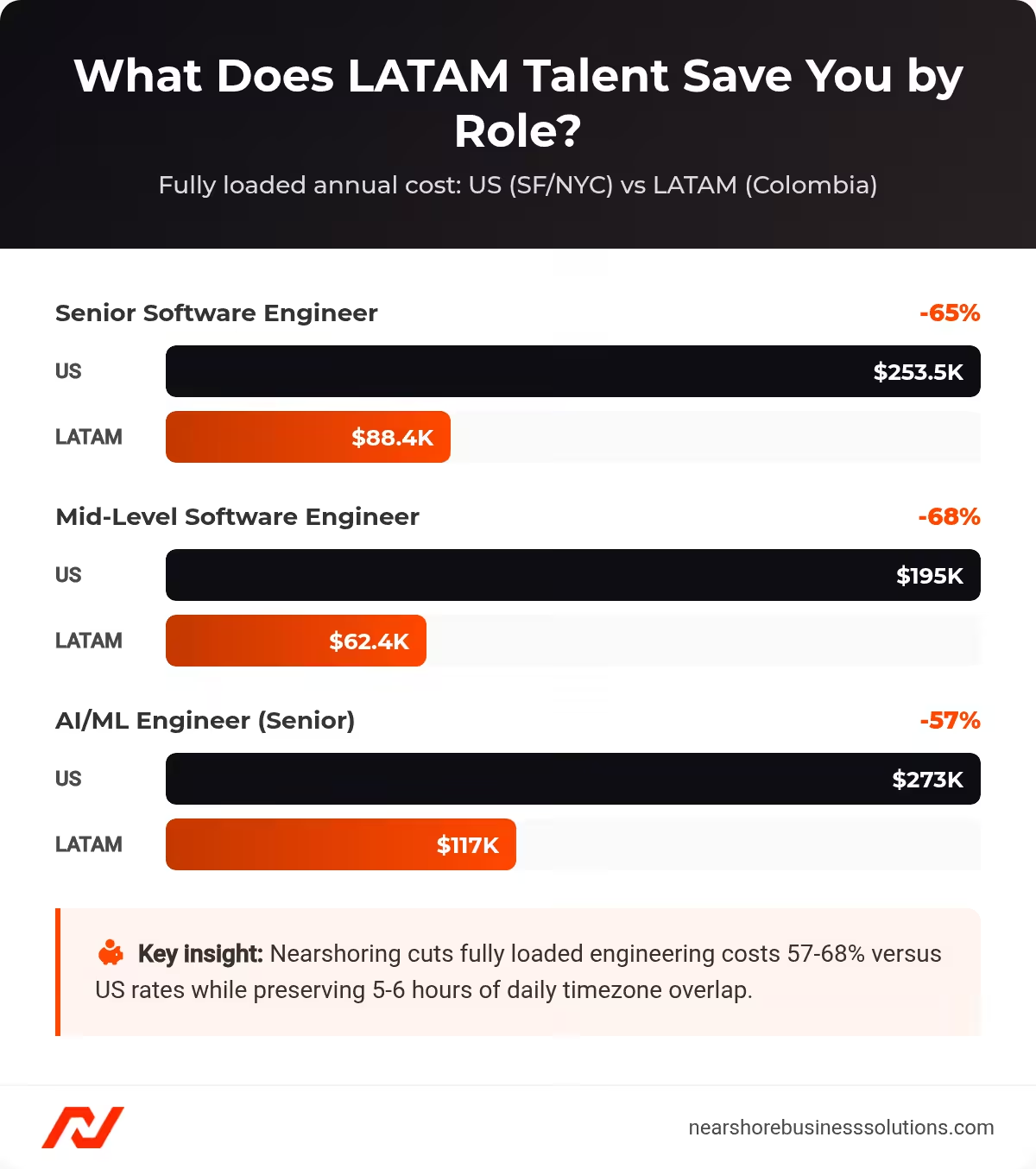
Fully loaded annual engineering costs, US versus LATAM, by seniority and role.
| Role | US (SF or NYC) Fully Loaded | LATAM (Colombia) Fully Loaded | LATAM Savings vs. US |
|---|---|---|---|
| Senior Software Engineer | $253,500/yr | $88,400/yr | -65% |
| Mid-Level Software Engineer | $195,000/yr | $62,400/yr | -68% |
| AI/ML Engineer (Senior) | $273,000/yr | $117,000/yr | -57% |
A 2023 survey found 42% of US executives currently offshoring to Asia are actively considering moving operations to Latin America. The top two drivers: timezone alignment (78%) and cultural affinity (61%) (Ryan Strategic Advisory, 2023).
A nearshore engineer typically reaches 80% productivity in 4-6 weeks versus 6-8 weeks for a domestic hire (HBR, 2022). Timezone overlap of 5-6 concurrent working hours compresses the feedback loops that extend ramp-up for offshore hires.
Tech hubs in Medellin (Ruta N innovation district), Guadalajara (often called Mexico’s Silicon Valley), Buenos Aires, and Bogota produce thousands of STEM graduates annually from schools like Universidad Nacional de Colombia, UNAM, and Universidad de Buenos Aires. These hubs feed a talent pipeline with strong English proficiency and experience at companies like Globant, MercadoLibre, and Rappi.
| Model + Nearshore | Primary Advantage | Best Use Case | Typical Savings vs. US |
|---|---|---|---|
| Staff Augmentation + Nearshore | Best control-to-cost ratio | Tactical skill gaps, 3-9 months | 55-65% |
| Dedicated Team + Nearshore | Best for long-term product builds | Core product verticals, 18 months or more | 50-60% |
| Project Outsourcing + Nearshore | Quality oversight with defined scope | Non-core projects, clear deliverables | 45-55% |
How Do You Build a Hybrid Engagement Strategy That Scales?
Most mature engineering orgs do not pick one model. They layer them. The most common evolution path starts with 2-3 augmented engineers to validate cultural and technical fit, then formalizes into a dedicated pod once the working relationship is proven.
The standard evolution path:
- Validate: Hire 2-3 augmented engineers to test cultural and technical fit. Time-to-start of 7-14 days allows rapid validation.
- Formalize: Promote the working relationship into a dedicated pod with its own PM and QA. Core team assembly takes 4-6 weeks.
- Stabilize: Benefit from lower attrition (8-12% vs. 15-25%) and deeper institutional knowledge as the pod matures. Failure rate drops below 5% once established.
- Scale: Expand the pod or spin up additional pods as product needs grow.
Keep core product in-house and outsource the periphery. Use staff augmentation or dedicated teams for revenue-critical systems where IP security matters. Use project outsourcing or managed services for internal tools, DevOps infrastructure, or compliance workstreams where proprietary IP is not at stake.
This portfolio approach avoids the trap of misclassifying a workstream. Using a project-based vendor for core product development is the single most common cause of engagement model failure.
What Should a CTO Evaluate Before Choosing an Engagement Model?
Three questions determine which model fits. Answer them honestly and the model selection becomes mechanical.
1. How much architectural control does your platform require?
Total control means staff augmentation. You run standups, assign tickets, and own architecture decisions entirely. Directional control means dedicated team. The vendor handles team health while you own the roadmap. “Just deliver it” means project outsourcing or managed services.
2. Does your engineering leadership have bandwidth to manage additional headcount?
Staff augmentation requires the most internal management overhead. Your EMs become direct managers for augmented engineers on top of their existing reports. If your EMs are already at capacity, a dedicated team or managed services model distributes that overhead to the vendor.
3. Is this workstream core to your product differentiation or peripheral?
Core workstreams belong in staff augmentation or dedicated teams. Peripheral workstreams can be delegated to project outsourcing or managed services. Misclassifying a workstream as “peripheral” when it touches your revenue-critical systems is the primary cause of engagement model failure.
The choice between staff augmentation, dedicated teams, and outsourcing is not about finding the best model. It is about matching model to moment. Nearshoring amplifies whichever model you choose by delivering 50-65% cost savings with timezone-compatible collaboration that offshore alternatives cannot match.
Frequently Asked Questions About Staff Augmentation vs Nearshoring
These are the most common questions US engineering leaders ask when comparing engagement models for LATAM hiring.
How Quickly Can You Get a Nearshore Engineer Started?
Staff augmentation delivers first engineers in 7-14 days. Dedicated team assembly takes 4-6 weeks. Those timelines compare to 45-60 days median time-to-fill for a senior engineering role hired domestically (Hired.com, 2023).
What Happens If a Nearshore Engineer Does Not Work Out?
Reputable staff augmentation and dedicated team vendors include replacement guarantees of 30-90 days. For staff augmentation, a poor fit is typically resolved by requesting a replacement without penalty during the first 30 days. For dedicated teams, the vendor is contractually responsible for maintaining team quality.
Who Owns the Code That Nearshore Engineers Write?
You own all IP produced by staff augmentation and dedicated team engineers. Standard MSAs include work-for-hire clauses that assign all code to the client. For project-based outsourcing, ensure your SOW explicitly transfers IP upon final payment. Verify that the vendor contract assigns IP from the individual engineer to the vendor and then to you.
Do I Need a Local Legal Entity to Hire Nearshore?
No. Staff augmentation and dedicated team vendors handle all local employment, payroll, tax compliance, and HR obligations in the engineer’s country. You contract with the vendor entity, not directly with the engineers. This eliminates the need for an employer of record setup.
How Does Staff Augmentation vs Outsourcing Differ for IP Security?
Staff augmentation carries very high IP security because engineers work inside your systems under your direct supervision. Project-based outsourcing carries higher IP risk because the vendor controls the entire execution environment. Ensure your SOW includes clear IP transfer language and prohibits use of vendor-proprietary tools whose licenses the vendor retains.
What Is the Difference Between Nearshore and Offshore?
Nearshore means hiring in countries with minimal timezone difference from your headquarters, typically Latin America for US companies. Offshore means hiring in significantly different timezones, typically India or Eastern Europe. Nearshore delivers 5-6 hours of daily overlap with US teams. Offshore typically delivers 1-2 hours of overlap.
How Do I Pay Nearshore Developers?
You pay the vendor directly in USD under your MSA. The vendor handles currency conversion, local payroll taxes, social security contributions, and benefits administration in the engineer’s country. You never need to manage cross-border payments to individual engineers.
Ready to Find the Right Engagement Model for Your Team?
Nearshore Business Solutions sources and vets senior engineers from Bogota, Medellin, Guadalajara, Monterrey, Buenos Aires, and Sao Paulo. We screen for technical skills, English fluency, and US work style fit.
Every placement includes a 90-day replacement guarantee. You receive the first pre-vetted candidates within 3 business days.
Explore how our remote talent acquisition process matches senior engineers to your exact engagement needs, whether you are augmenting, building a dedicated pod, or both.