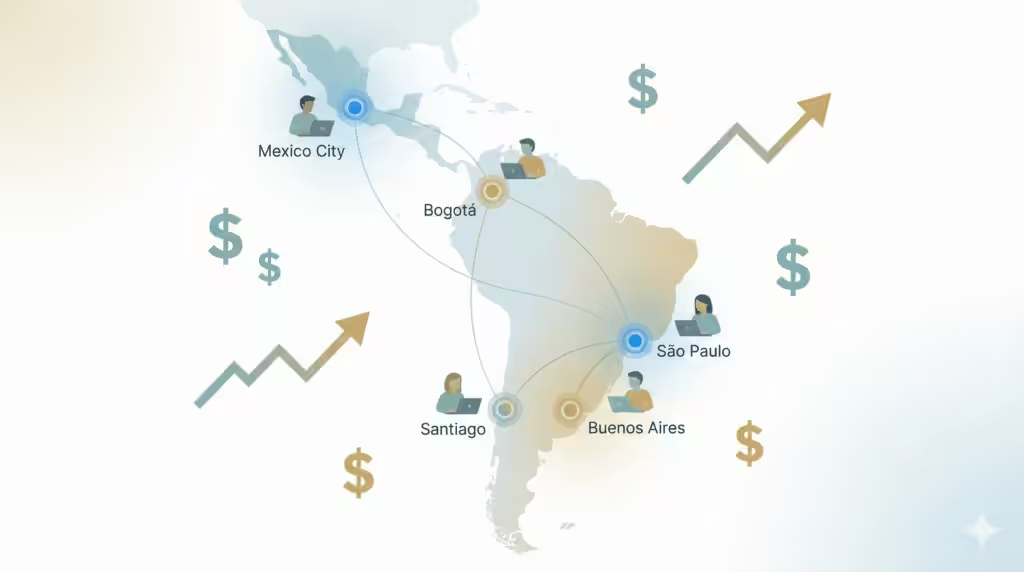
LATAM developers cost 60–65% less than US hires, with senior salaries ranging from $50,000 to $75,000 USD annually.
The region offers access to 2+ million qualified tech professionals across Brazil, Mexico, Argentina, Colombia, and Chile. Time zone alignment with US Eastern and Central enables real-time collaboration.
This guide covers salary benchmarks by country and role, total cost of employment, hiring compliance risks, and strategic recommendations for building distributed engineering teams.
What Can You Expect from LATAM Developer Salaries?
LATAM developer salaries deliver substantial cost savings without sacrificing quality. Senior developers earn $50,000 to $75,000 USD annually. Junior developers start at $18,000 to $35,000.
The Total Employer Cost (TEC) tells the full story. US senior engineers cost approximately $160,000 fully loaded. LATAM equivalents run $65,000 fully loaded. This creates a guaranteed 60–65% savings floor.
The region’s IT market grows at 6.5% CAGR through 2030. Education investment continues expanding the talent pipeline. Mexico produces 110,000+ engineering graduates annually. Brazil adds 50,000 STEM graduates yearly.
What Are Average Developer Salaries in Latin America?
LATAM developers earn $18,000 to $100,000 annually, saving you 50–70% versus US rates. Chile tops out at $100,000 for senior architects. Brazil starts at $18,000 for juniors. The tables below break down salaries by experience level.
What Do Junior Developers Earn by Country?
Junior developers (0–2 years experience) earn $18,000 to $40,000 depending on location. Chile leads with the highest junior rates. Brazil offers the most competitive entry-level pricing.
| Country | Annual Salary (USD) |
|---|---|
| Chile | $30,000–$40,000 |
| Mexico | $25,000–$38,000 |
| Colombia | $20,000–$32,000 |
| Peru | $20,000–$30,000 |
| Argentina | $18,000–$30,000 |
| Brazil | $18,000–$28,000 |
What Do Mid-Level Developers Earn?
Mid-level developers earn $30,000 to $70,000 annually versus $115,000 to $150,000 in the US. This saves $45,000 to $80,000 per hire. Chile leads at $70,000 ceiling. Argentina offers the lowest floor at $30,000 with superior English.
| Country | Annual Salary (USD) |
|---|---|
| Chile | $40,000–$70,000 |
| Mexico | $40,000–$65,000 |
| Brazil | $35,000–$60,000 |
| Colombia | $35,000–$58,000 |
| Peru | $35,000–$50,000 |
| Argentina | $30,000–$54,000 |
What Do Senior Developers Earn?
Senior LATAM developers cost $42,000 to $100,000 versus $155,000 to $210,000 in the US. You save $55,000 to $110,000 per hire. Chile commands $100,000 maximum. Argentina starts at $42,000 with the region’s best English proficiency.
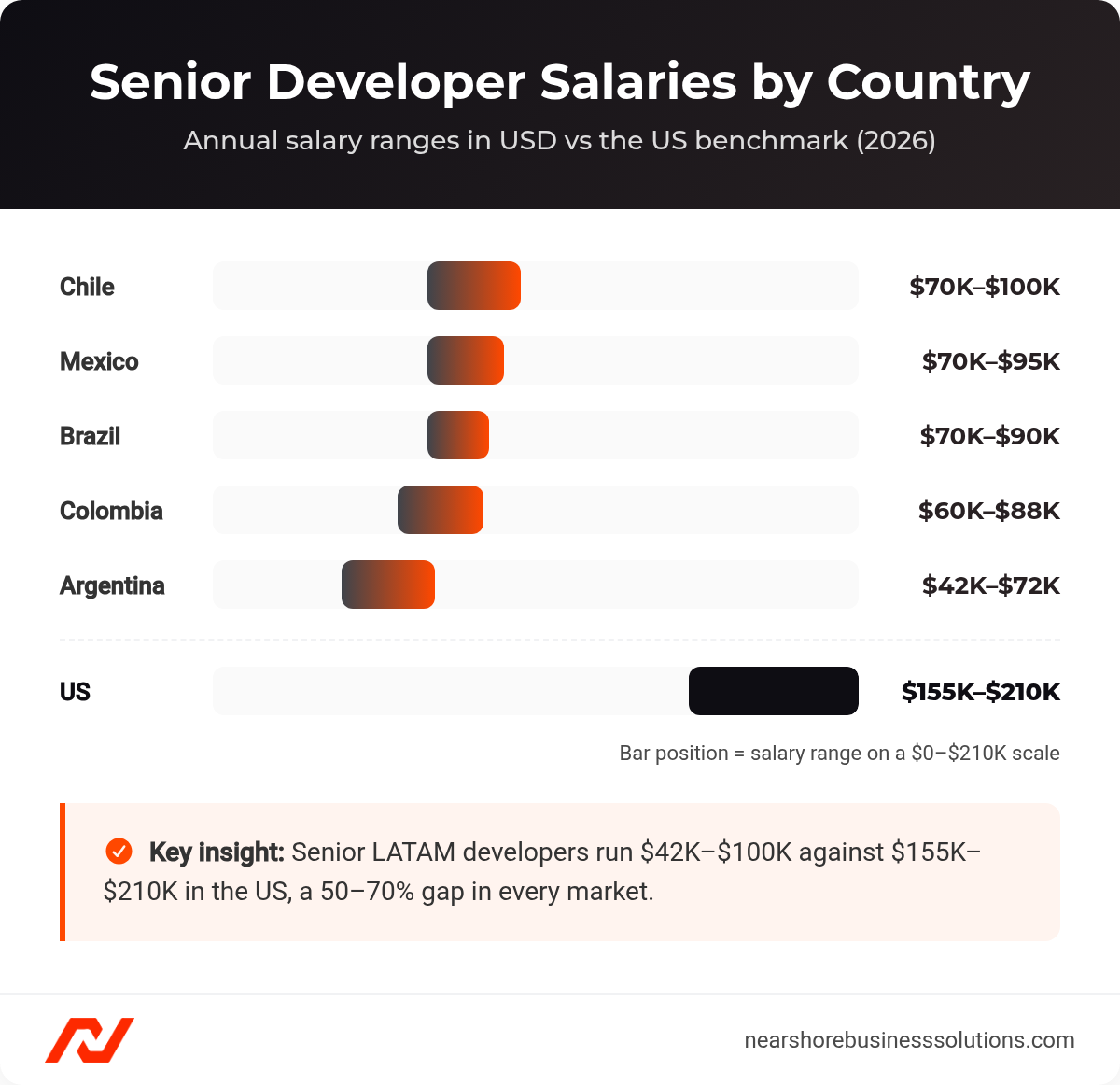
Senior developer salary ranges across five LATAM markets versus the US benchmark.
| Country | Annual Salary | Hourly Rate |
|---|---|---|
| Chile | $70,000–$100,000 | $80–$100/hr |
| Mexico | $70,000–$95,000 | $75–$95/hr |
| Brazil | $70,000–$90,000 | $70–$90/hr |
| Colombia | $60,000–$88,000 | $68–$88/hr |
| Uruguay | $60,000–$75,000 | $55–$70/hr |
| Peru | $50,000–$70,000 | $45–$65/hr |
| Argentina | $42,000–$72,000 | $65–$85/hr |
What Do Tech Leads and Architects Earn?
Tech leads and architects earn $65,000 to $95,000 USD annually. Chile leads with architects earning up to $100,000. Argentina, Uruguay, and Chile rank as top-paying markets.
For US companies, even premium LATAM rates deliver savings. A $100,000 architect in Santiago costs 40–60% less than equivalent talent in San Francisco or New York.
How Do LATAM Salaries Compare to US Rates?
A $160,000 US senior engineer costs $65,000 in LATAM, saving $95,000 per hire. Five engineers save $475,000 annually. Savings range from $67,000 (junior) to $155,000 (architect) per role. For a complete guide to hiring remote developers in Latin America, see our detailed overview.
What Is the Salary Gap Between LATAM and the US?
US senior software engineers earn $122,000 to $193,000 in total compensation. LATAM seniors top out around $75,000. This creates consistent 50–70% savings depending on role.
Specialized roles show wider gaps:
- Machine Learning Engineers: $162,000 (US) vs $50,000–$75,000 (LATAM)
- DevOps Engineers: $150,000 (US) vs $78,000–$90,000 (LATAM)
- Senior Front-End Developers: $139,000 (US) vs $50,000–$70,000 (LATAM)
What Is the Total Cost of Employment?
Total Cost of Employment includes base salary, benefits, taxes, and statutory obligations. US engineers cost $160,000 fully loaded. LATAM equivalents cost $65,000 fully loaded.
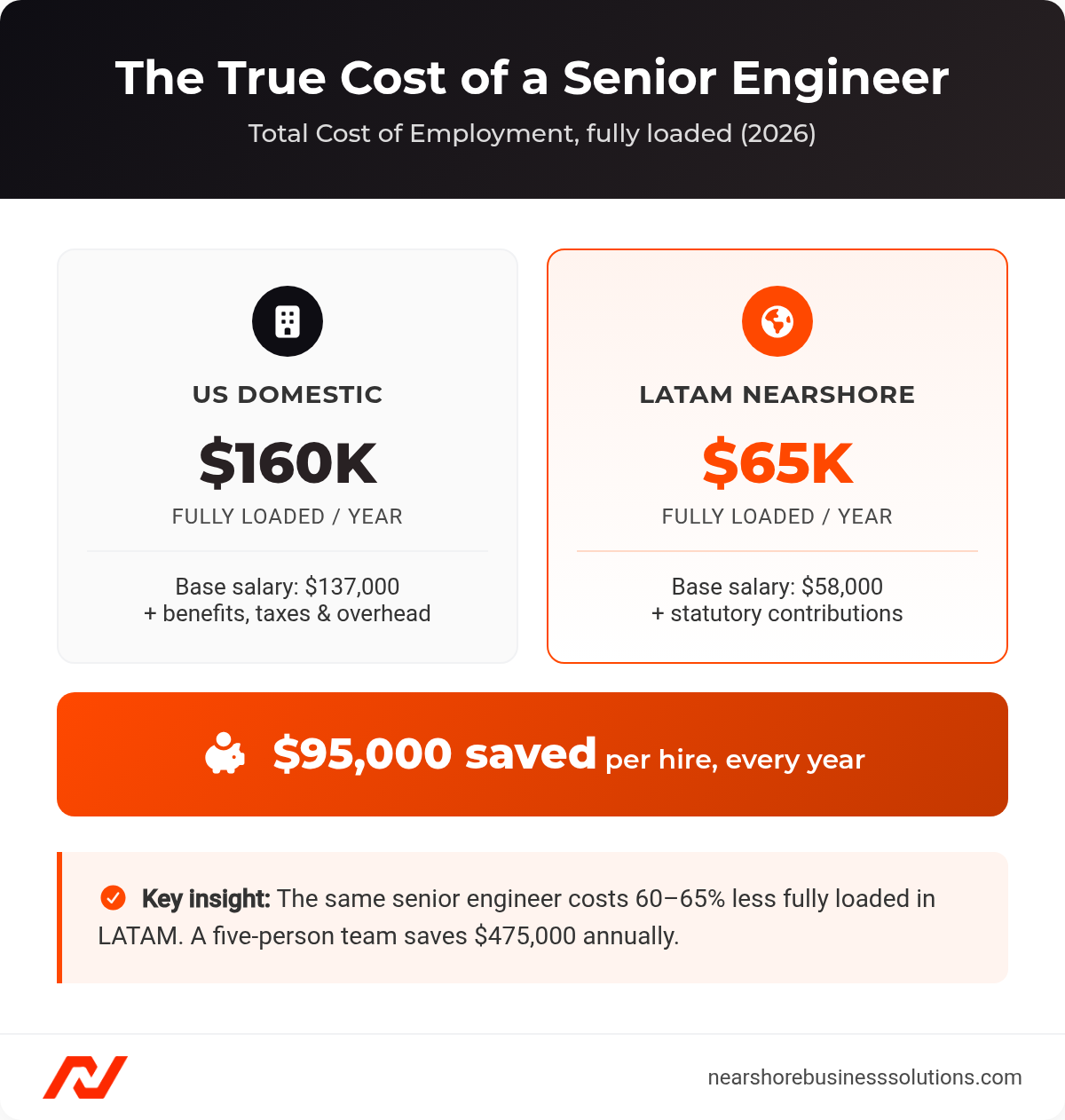
Total Cost of Employment for a senior engineer: US domestic versus LATAM nearshore.
| Cost Component | US Domestic | LATAM Average |
|---|---|---|
| Base Salary | $137,000 | $58,000 |
| Fully Loaded Cost | $160,000 | $65,000 |
LATAM statutory obligations add 25–40% to gross salary. This covers social security, mandatory bonuses, and severance provisions. Even with these additions, total cost runs 60% below US equivalents.
How Much Can You Save?
You can save 60–65% on Total Employer Cost compared to US hires. Specialized roles deliver the highest absolute savings.
Five senior engineers nearshored to LATAM save $400,000+ annually. A single ML engineer saves $80,000–$100,000 per year versus US hiring.
The arbitrage remains durable. Even with annual increases, LATAM costs stay 50–60% below US equivalents.
Which Markets Should You Prioritize?
Prioritize Chile and Uruguay for specialized roles at $60,000–$100,000. Use Brazil and Mexico for volume hiring at $35,000–$90,000. Consider Argentina for elite talent at $42,000–$72,000 with mandatory USD contracts.
What Are the Tier 1 Markets?
Tier 1 markets (Chile, Uruguay, Costa Rica) offer high stability and high cost. These countries command premium salaries. They deliver superior English proficiency and established legal frameworks.
Choose Tier 1 for:
- Mission-critical roles requiring minimal communication friction
- Specialized positions in cybersecurity or regulatory compliance
- Leadership roles where stability outweighs cost savings
What Are the Tier 2 Markets?
Tier 2 markets (Brazil, Mexico) provide high volume with dynamic pricing. These countries host the largest talent pools. Brazil offers 630,000+ engineers. Mexico provides 700,000+ IT professionals.
Choose Tier 2 for:
- Large-scale team growth
- Standard development roles
- Cost-sensitive positions with dedicated language vetting
What Are the Tier 3 Markets?
Tier 3 markets (Argentina) deliver elite talent with mitigation requirements. Argentina offers some of LATAM’s best developers. The catch: hyperinflation requires USD-denominated contracts.
Choose Tier 3 for:
- Maximum cost savings with proper currency protections
- Superior English proficiency needs
- Teams comfortable managing economic volatility
What Should You Know About Each Country?
Each LATAM market has distinct characteristics. The following deep dives cover talent pools, salary ranges, key cities, and strategic considerations.
What Are Developer Salaries in Brazil?
Brazil hosts LATAM’s largest developer community with 630,000+ software engineers. São Paulo alone produces 13 unicorns including Nubank and Gympass.
Talent Pool: 630,000+ developers with 50,000 new STEM graduates annually
Salary Ranges:
- Junior: $18,000–$28,000
- Mid-Level: $35,000–$60,000
- Senior: $70,000–$90,000 ($70–$90/hour)
Key Markets: São Paulo leads as Brazil’s tech salary benchmark. Campinas follows with strong university partnerships. Florianópolis attracts remote-first companies.
Premium Skills: Backend engineers with Java/Python expertise average $71,700 annually. DevOps, cloud architecture, and AI/ML roles command upper salary bands.
Consideration: English proficiency ranks moderate. Focus recruitment on candidates with multinational experience in major hubs.
What Are Developer Salaries in Mexico?
Mexico offers the largest IT professional pool in LATAM. Geographic proximity enables same-day travel and real-time collaboration across US time zones.
Talent Pool: 700,000+ IT professionals with 110,000+ engineering graduates annually
Salary Ranges:
- Junior: $25,000–$38,000
- Mid-Level: $40,000–$65,000
- Senior: $70,000–$95,000 ($75–$95/hour)
Key Markets: Mexico City, Guadalajara (“Silicon Valley of Mexico”), and Monterrey dominate. Salaries in these hubs run 20–30% above national averages.
Premium Skills: Mexico leads LATAM in AI engineer salaries at $58,075 average. FinTech and e-commerce expertise commands premiums.
Strategic Advantage: Time zone alignment with US Central and Mountain enables real-time collaboration. The graduate pipeline positions Mexico as LATAM’s long-term talent leader.
What Are Developer Salaries in Argentina?
Argentina offers elite talent at competitive rates. Superior English proficiency reduces communication friction for US teams.
Talent Pool: 167,000+ developers concentrated in Buenos Aires
Salary Ranges:
- Junior: $18,000–$30,000
- Mid-Level: $30,000–$54,000
- Senior: $42,000–$72,000 ($65–$85/hour)
Currency Requirements: All contracts must be USD-denominated. Hyperinflation (approximately 300% in 2024) makes peso-based pay unworkable. USD contracts are non-negotiable for talent retention.
Strategic Advantage: Argentina ranks highest in LATAM for English proficiency. Developers trained at Universidad de Buenos Aires (UBA) and ITBA meet US quality standards. Costs run 25–40% below other LATAM markets.
What Are Developer Salaries in Colombia?
Colombia offers rapid growth and strong time zone alignment. Bogotá and Medellín anchor a thriving FinTech and SaaS ecosystem.
Talent Pool: 85,000+ developers growing steadily. 68% of engineers hold Bachelor’s or Master’s degrees in computer science.
Salary Ranges:
- Junior: $20,000–$32,000
- Mid-Level: $35,000–$58,000
- Senior: $60,000–$88,000 ($68–$88/hour)
Key Markets: Bogotá leads alongside São Paulo and Santiago as a major FinTech hub. Medellín’s Ruta N innovation district attracts startups. Graduates from Universidad de los Andes and EAFIT meet international standards.
For detailed salary benchmarks and compliance requirements, see our complete guide to hiring developers in Colombia.
Critical Risk: Colombian labor law applies a “subordination test” to contractor relationships. Close management of ICs triggers employee reclassification. Use an Employer of Record for all long-term hires.
Consideration: Employer social security contributions average 29%. English proficiency ranks lower (EF EPI #76). Screen candidates carefully for communication skills.
What Are Developer Salaries in Chile?
Chile commands LATAM’s highest developer rates. Stability, regulatory transparency, and niche expertise justify the premium.
Talent Pool: 59,000+ developers. Smallest among major LATAM markets.
Salary Ranges:
- Junior: $30,000–$40,000
- Mid-Level: $40,000–$70,000
- Senior: $70,000–$100,000 ($80–$100/hour)
Premium Positioning: Limited supply and strong domestic demand drive pricing. Chile specializes in cybersecurity and regulatory compliance. Ideal for FinTech and HealthTech companies.
Key Markets: Santiago concentrates most tech talent. Graduates from Pontificia Universidad Católica de Chile and Universidad de Chile meet international standards.
Regulatory Update: Pension reform enacted in 2025 added 8.5% to mandatory employer contributions. These increased costs are now in effect. Factor this into your budget planning.
What Are Developer Salaries in Other LATAM Countries?
Costa Rica, Peru, and Uruguay serve specific strategic needs. Each offers distinct advantages.
Costa Rica:
Costa Rica averages $39,800 in local developer salaries. This is among the highest in Central America. Time zone alignment (UTC-6) matches US Central. Strong US diplomatic ties create familiar work culture. Developers understand US business practices.
Peru:
- Junior: $20,000–$30,000
- Mid-Level: $35,000–$50,000
- Senior: $50,000–$70,000
Peru’s 32,000 developers concentrate in Lima. Time zone (UTC-5) matches US Eastern exactly. Lower employer contribution burden than Colombia. English proficiency requires focused screening.
Uruguay:
Uruguay commands premium rates. Seniors earn $60,000–$75,000. Junior median salaries ($18,000) rank highest in the region. High English proficiency and exceptional stability define the market. This “boutique market” delivers high senior density. Choose Uruguay for reliability over maximum savings.
How Do Salaries Vary by Developer Role?
DevOps engineers earn 12–15% more than generalists ($78,000–$90,000 senior). Backend developers earn 5–15% premiums ($39,880 average). Frontend averages $35,450. AI/ML specialists command $80,000–$115,000 at senior level.
What Do Frontend, Backend, and Full-Stack Developers Earn?
Salaries vary by specialization with backend commanding slight premiums. Frontend supply keeps rates moderate despite high demand.
Frontend Developer: $35,450 average annually. React and Vue.js expertise in demand. High candidate supply moderates premiums.
Backend Developer: $39,880 average annually. Java and Python dominate SaaS and banking sectors. Earns 5–15% above general developer rates.
Full-Stack Developer: Falls within standard seniority ranges. No significant premium for dual-stack capability. The market values depth over breadth.
Mobile Developer: $43,150 average annually. iOS (Swift) commands 15% premium over Android (Kotlin).
What Do DevOps and Cloud Engineers Earn?
DevOps and SRE roles command 12–15% premiums over general developer rates. These roles deliver maximum ROI for nearshoring.
Apply the premium to baseline senior rates. A $70,000 senior developer market means $78,000–$80,000 for equivalent DevOps talent.
US DevOps engineers average $150,000 total compensation. LATAM equivalents at $80,000–$90,000 fully loaded save $60,000+ annually per hire.
What Do AI, ML, and Data Engineers Earn?
AI and ML roles represent LATAM’s highest-premium specializations. They also offer the widest arbitrage window.
US senior AI engineers command $150,000 to $250,000. LATAM AI engineers average $18,547 to $58,075. Mexico leads at $58,075 average.
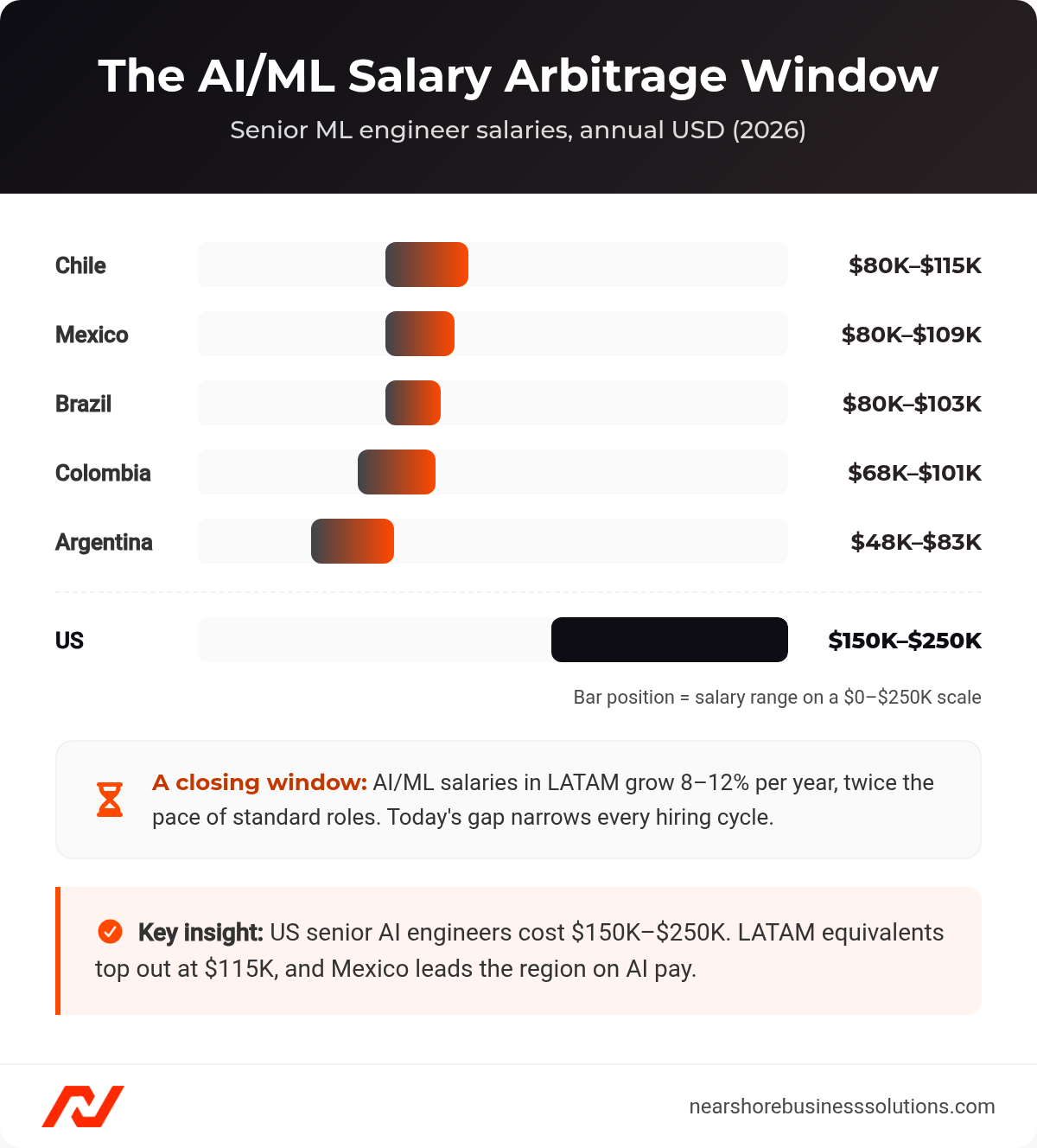
Senior ML engineer salaries by country versus US rates, an arbitrage window closing 8-12% yearly.
| Country | Senior ML Engineer Salary |
|---|---|
| Chile | $80,000–$115,000 |
| Mexico | $80,000–$109,000 |
| Brazil | $80,000–$103,000 |
| Colombia | $68,000–$101,000 |
| Argentina | $48,000–$83,000 |
This salary gap represents a temporary strategic window. Local competition will inevitably drive specialized salaries upward. Act now to build AI/ML capacity at discounted rates.
What Factors Influence LATAM Salaries?
English fluency adds 10–20% to salary expectations. Major tech hubs (São Paulo, Mexico City) inflate rates 15–25%. DevOps and AI specializations command 12–15% premiums. Remote US work pays 2–5x local market rates.
How Does English Proficiency Affect Salaries?
English fluency directly impacts compensation. Budget 10–20% above market rates for English-fluent candidates in moderate-proficiency countries.
| Country | Proficiency Level |
|---|---|
| Argentina | Superior |
| Uruguay | High |
| Brazil | Moderate |
| Chile | Moderate |
| Costa Rica | Moderate |
| Colombia | Low (EF EPI #76) |
| Mexico | Very Low (EF EPI #103) |
What Is the Difference Between Local and Remote Salaries?
Developers targeting US remote roles expect 2–5x local market pay. Local market figures are irrelevant for US hiring.
A junior Node.js developer in Brazil might earn $10,000 locally. A senior Mexican developer could make $29,000 in peso-denominated roles. These figures do not apply to nearshore hiring. Developers working for US companies expect USD-benchmarked compensation.
How Does Specialization Affect Salaries?
Specialization drives predictable premiums above baseline rates:
- DevOps/SRE and Data Engineering: 12–15% above baseline
- Machine Learning Engineers: 12–15% above baseline
- Cybersecurity Specialists: 10% above baseline
- FinTech Specialists: 10–12% above baseline
How Does Location Affect Salaries?
Geography compounds specialization premiums. São Paulo, Santiago, and Bogotá concentrate FinTech headquarters. This creates salary inflation beyond national averages.
Budget 15–25% above country baselines when hiring from:
- São Paulo and Campinas (Brazil)
- Mexico City, Guadalajara, Monterrey (Mexico)
- Santiago (Chile)
- Buenos Aires (Argentina)
- Bogotá and Medellín (Colombia)
What Are the Legal Risks of Hiring in LATAM?
Contractor misclassification represents the single greatest operational risk. Understanding local labor law protects against severe financial liability.
What Is the Subordination Test?
Latin American labor laws, especially in Colombia and Mexico, apply a “subordination test” to contractor relationships. If the US team mandates schedules, controls methodology, or provides equipment, authorities may reclassify the individual as an employee.
This reclassification triggers:
- Retroactive social security contributions (potentially years of back pay)
- Mandated severance payments
- Severe administrative penalties
- Mexico requires three months’ pay plus yearly perks upon termination
The signed IC agreement provides no protection. Local authorities examine actual working conditions, not contract language.
When Should You Use Independent Contractors?
Use contractors only for short-term, project-based work with minimal direct management. This means:
- Fixed deliverables, not ongoing responsibilities
- Contractor controls their own schedule and methods
- No company equipment or email addresses
- Multiple clients (not exclusive to your company)
For long-term, mission-critical roles with close US management, use full-time employment through an Employer of Record.
What Is an Employer of Record?
An Employer of Record (EOR) transfers legal liability for payroll, benefits, and taxation to a local entity. The EOR becomes the legal employer. You manage the day-to-day work.
EOR services cost $300–$500/month flat fee or 8–12% of salary. Setup takes 3–7 days. This administrative cost is trivial compared to misclassification exposure.
Use EOR for all full-time hires in:
- Colombia (high subordination test risk)
- Brazil (complex labor law)
- Any country where you lack a local entity
How Should You Structure Competitive Compensation?
Pay $70,000–$75,000 for senior talent to compete with Google and Amazon LATAM offices. Add $2,000–$5,000 in annual benefits (health, learning, PTO). Budget 5–10% currency buffer for Argentina and Brazil.
What Benefits Do LATAM Developers Expect?
LATAM developers working for US companies expect US-standard perks. Competitive packages include:
- Private health insurance (local public healthcare varies in quality)
- Meal allowances ($150–$300 monthly)
- Professional development (conferences, certifications, learning stipends)
- Home office stipends and equipment
- Generous PTO beyond local minimums
- Wellness programs
Benefits cost less than equivalent salary increases. A $2,000 annual learning budget often outweighs $3,000 in base salary for retention.
How Should You Handle Currency Fluctuations?
USD-indexed salaries are non-negotiable in volatile markets. Argentina requires USD contracts. Brazil benefits from USD protection.
Index to dollars and pay in dollars where legally possible. Build 5–10% currency buffer into Argentina and Brazil budgets.
Paying in stable currency signals commitment. It protects employee purchasing power. It ensures long-term retention against economic turbulence.
What Are Mandatory Employer Costs by Country?
Statutory contributions add 25–40% to gross salary. Factor these into budget planning.
| Country | Employer Costs | $60K Base → Loaded | Notes |
|---|---|---|---|
| Brazil | 30–40% | $84K–$96K | Most expensive |
| Colombia | ~29% | ~$77,400 | High contributions |
| Chile | <40% | $84K → $89K+ | 8.5% increase now in effect |
| Argentina | 25–30% | $75K–$78K | USD contracts essential |
| Mexico | ~25% | ~$75,000 | Most predictable |
What Are the Key LATAM Hiring Trends for 2026?
AI/ML salaries grow 8–12% annually versus 4–6% for standard roles. Remote work added 2+ million developers to the nearshore talent pool. EOR adoption continues rising, with costs at $300–$500/month per hire.
Which Skills Are Growing Fastest?
Three specializations drive salary acceleration:
- FinTech: LATAM’s most mature high-growth sector. Concentrated in São Paulo, Santiago, and Bogotá.
- AI and Cloud Computing: Demand exceeds supply. Expect double-digit annual salary growth.
- Cybersecurity: Infrastructure automation and security expertise remain undersupplied.
Budget 8–12% annual increases for AI/ML and cybersecurity talent. Standard development roles remain stable at 4–6% growth.
How Has Remote Work Affected Compensation?
Remote work standardized international hiring. Employment structure now impacts total costs more than location alone.
Employer of Record (EOR): $300–$500/month flat fee or 8–12% of salary. Setup in 3–7 days. Best for 1–9 employees per country.
Entity Establishment: $10,000–$20,000 upfront. Makes sense at 10+ employees in a single country.
Contractor Model: Eliminates 30–70% in statutory costs. Carries severe misclassification risk. Use only for genuine project-based work.
What Should You Budget for Annual Salary Increases?
LATAM salary inflation remains moderate. Budget 5–8% annual increases for standard roles. Budget 8–12% for specialized roles.
The talent pipeline explains this stability. Mexico produces 110,000+ engineering graduates annually. Brazil adds 50,000 STEM graduates yearly. Supply scales with demand.
Even with annual increases, LATAM costs stay 50–60% below US equivalents. Plan for gradual compression, not sudden parity.
Frequently Asked Questions About LATAM Developer Hiring
These are the most common questions tech leaders ask about hiring developers in Latin America.
How Long Does It Take to Hire a Developer in LATAM?
Using an Employer of Record, you can onboard a developer in 3–7 days. Traditional hiring through a local entity takes 30–90 days for setup. Staffing agencies typically deliver qualified candidates within 2–4 weeks.
Do I Need a Local Entity to Hire in Latin America?
No. An Employer of Record (EOR) lets you hire compliantly without a local entity. EOR makes sense for 1–9 employees per country. Consider entity establishment at 10+ employees.
How Do I Pay LATAM Developers?
Pay through your EOR provider for full-time employees. The EOR handles local payroll, taxes, and benefits. For contractors, use international payment platforms. Always pay in USD for Argentina and Brazil.
What If a Developer Does Not Work Out?
Most staffing agencies offer 90-day replacement guarantees. EOR providers handle termination according to local labor law, including required severance. Termination costs vary by country.
What Is the Difference Between Nearshore and Offshore?
Nearshore refers to countries in nearby time zones. LATAM qualifies as nearshore for US companies. Offshore refers to distant time zones like India or Eastern Europe. Nearshore enables real-time collaboration during US business hours.
Do LATAM Developers Work US Hours?
Yes. Most LATAM developers working for US companies align with US Eastern or Central time. Time zone overlap ranges from full alignment (Mexico, Colombia, Peru) to substantial overlap (Brazil, Argentina, Chile).
Is LATAM Nearshoring Right for Your Team?
LATAM offers a compelling value proposition for distributed engineering teams. You access 2+ million qualified developers at 50–70% cost savings compared to US rates.
The region has evolved from cost-center to capability-center positioning. Specialized talent in FinTech, AI/ML, and cloud infrastructure rivals US quality.
Strategic Recommendations:
- Use tiered hiring by country. Brazil and Mexico for volume. Chile and Uruguay for specialized roles.
- Mandate EOR for long-term roles. Avoid contractor misclassification liability.
- Budget toward the high end. Pay $70,000–$75,000 for senior talent to compete with multinationals.
- Capitalize on the AI/ML window. Current salary gaps represent temporary arbitrage.
- Require USD contracts in Argentina. Non-negotiable for talent retention.
With proper compensation strategy, LATAM nearshoring delivers sustainable cost efficiency without sacrificing technical capability.
Ready to Scale Your Engineering Team?
Nearshore Business Solutions connects you with vetted developers across Latin America. We handle sourcing, vetting, and placement. You focus on building your product. Our developers are pre-screened for technical skills and English proficiency, with a 90-day replacement guarantee.
Get a free consultation to discuss your hiring needs and receive a custom quote.