
Hiring software developers in Uruguay saves 45-55% versus US engineering rates while accessing the highest technical talent density in South America at 64 developers per 10,000 inhabitants.
Uruguay’s 33,000 IT professionals concentrate in Montevideo, giving you a focused, high-skill pool. Senior developers cost $35,000-$64,000 annually versus $95,000-$138,000 for US equivalents. The University of the Republic trains 7,000+ engineering students, while Plan Ceibal has built a tech-literate pipeline for over a decade.
We connect you with vetted Montevideo developers screened for technical skills, English fluency, and US work style fit. Below you’ll find salary benchmarks by role, hiring models, legal requirements, and a step-by-step process to build your Uruguay team.
What Makes Uruguay a Strategic Hub for Hiring Software Developers?
Uruguay combines political stability (A3 rating), first-in-LATAM infrastructure, and tax exemptions that eliminate corporate income tax for IT exporters. Three factors make it attractive: talent quality, infrastructure reliability, and a legislative framework built for software exports.
What is Uruguay’s Tech Ecosystem and Developer Community?
Uruguay’s tech ecosystem spans 550 software companies and ranks fifth in South America for startups. 85% of the 33,000-developer workforce concentrates in Montevideo, creating network density impossible in dispersed markets. Multinational operations from Microsoft, Amazon, Google, IBM, Oracle, and Sabre provide enterprise-grade project exposure. Free Trade Zones contribute 4.2% of GDP, and Montevideo ranked second globally for fintech growth velocity in 2021.
Why is Uruguay Called LATAM’s Best-Kept Tech Secret?
Uruguay earns the “best-kept secret” label because its talent density of 64 developers per 10,000 inhabitants is the highest in South America. Brazil has 750,000 developers and Mexico has 700,000, but they spread across massive geographies with inconsistent quality. Montevideo’s concentration eliminates multi-city recruitment complexity. You get a focused, high-value pool in one location.
What are the Key Advantages of Hiring Developers in Uruguay?
Five advantages stand out for US tech companies. Uruguay ranks first in LATAM for ICT adoption with 90%+ broadband and 80% fiber-to-home. Google’s Firmina Cable (2025) provides a direct South Carolina-to-Punta del Este subsea link. GMT-3 delivers 6-7 hours overlap with US Eastern Time. Corporate income tax is 100% exempt for IT exports, with an 11-year tax holiday for foreign tech professionals. 99% renewable electricity satisfies ESG mandates.
Who are Uruguay’s Software Developers and What is Their Skill Profile?
76% of Uruguayan developers hold university degrees, with over 60% completing five-year programs equivalent in depth to a US Master’s degree. The workforce grew 16% since 2021, and developers rank 82nd percentile globally for statistical programming.
What Programming Languages and Technologies Do Uruguayan Developers Specialize In?
Uruguayan developers cover four specializations. Cloud and backend: Ruby on Rails, React.js, and Java for SaaS architectures. AI/ML: Python, R, and TensorFlow. Uruguay ranks third in LATAM for AI adoption with the highest regional AI talent density, backed by a UNESCO-supported national strategy. Fintech: payment gateways, cross-border processing, and high-security implementations from dLocal’s ecosystem. Blockchain: Ethereum and Solana dApps with smart contract security (SpaceDev is Clutch-recognized).
What is the Education and Training Background of Software Developers in Uruguay?
Uruguay’s educational pipeline covers four tiers. The University of the Republic (UdelaR) enrolls 7,000+ engineering students. Private institutions ORT and UCUDAL contribute 32% of graduate output. Vocational programs including Jóvenes a Programar, Holberton, and SoyHenry produce 5,000+ annual graduates. Plan Ceibal (2007) expanded in 2023-2024 to AI training for 80,000 students, creating a uniquely tech-literate younger generation.
How Does Uruguay’s Developer Talent Compare to Other LATAM Countries?
Uruguay ranks fourth in LATAM for English proficiency at 68%. Additional languages include 15% Portuguese and 4% Italian. Middle and senior engineers average 1.6-2.5 year tenure, well above high-churn markets.
| Country | Talent Pool | English | Strengths | Stability |
|---|---|---|---|---|
| Uruguay | 33,000 | #4 | AI, FinTech, SaaS | Very High |
| Argentina | 115,000-130,000 | #1 | Data Science, AI | Low |
| Brazil | 500,000-759,000 | Low-Mod | Enterprise, Cloud | Moderate |
| Mexico | 700,000 | Very Low | Automotive, Cloud | Moderate |
For maximum political stability and concentrated senior talent, Uruguay outperforms larger LATAM markets. For absolute lowest cost, Colombia or Peru are a better fit.
How Much Does It Cost to Hire Software Developers in Uruguay?
Senior developers cost $35,000-$64,000 annually versus $95,000-$138,000 for US equivalents, delivering 45-65% savings. Mid-level hourly rates run $45-$65; senior specialists command $70-$120.
What are the Average Salary Ranges for Software Developers in Uruguay?
Uruguayan developer salaries vary by role and seniority. The table below shows 2024-2025 annual rates for senior-level engineers.
| Role | Uruguay Annual | US Annual | Savings |
|---|---|---|---|
| DevOps Engineer | $62,500-$64,000 | $138,000 | 54% |
| AI/ML Engineer | $54,000-$60,000 | $130,000-$132,000 | 56% |
| Python Developer | $57,500-$58,000 | $125,000-$126,000 | 54% |
| Full Stack Developer | $35,000-$55,000 | $117,000-$132,000 | 65% |
| Data Scientist | $43,000-$45,500 | $126,000 | 65% |
| Web Developer | $43,000 | $95,000 | 55% |
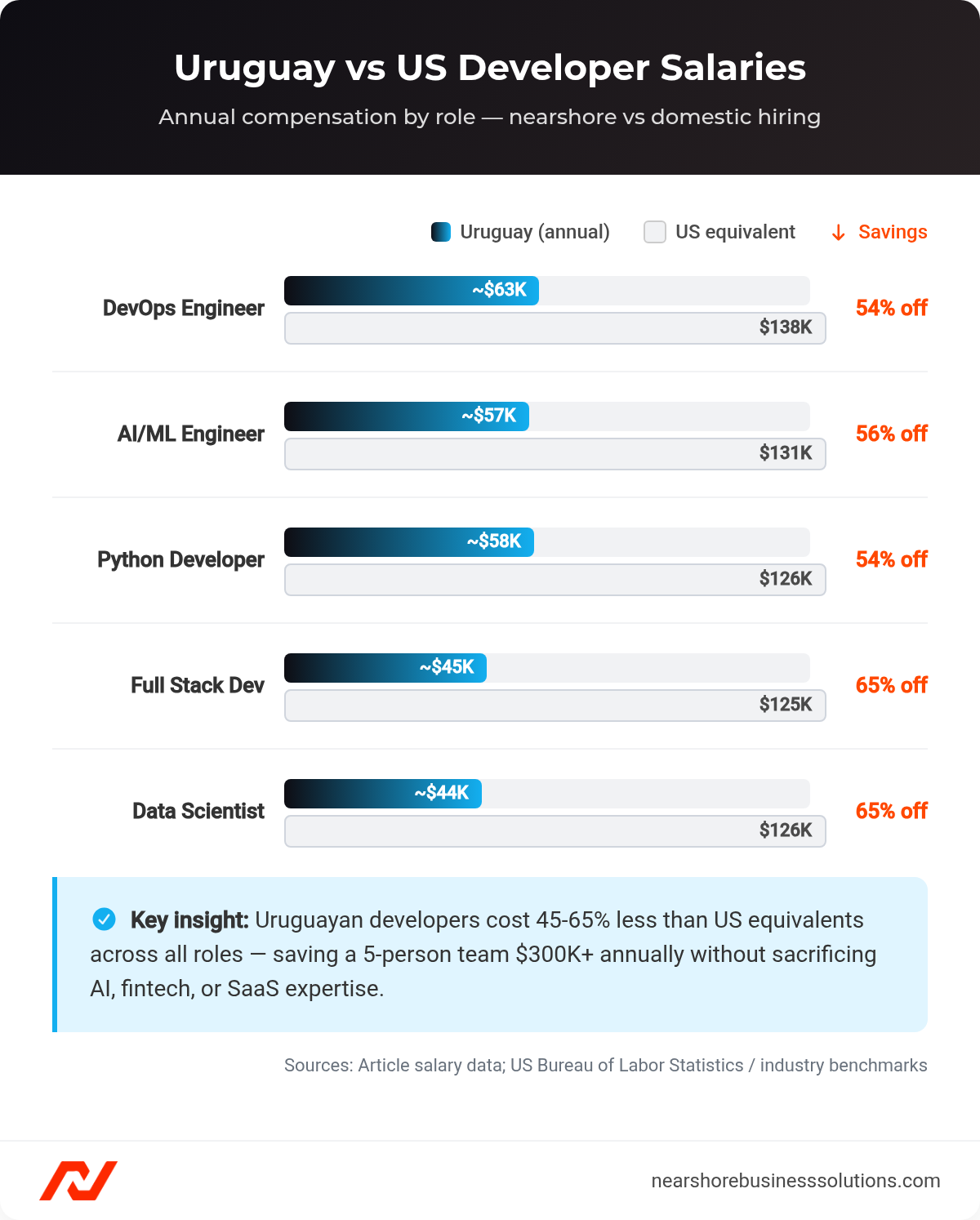
Uruguayan developers cost 54-65% less than US equivalents across AI/ML, DevOps, and full stack roles.
For full stack developer hiring, Uruguay’s 65% savings rate is among the strongest in LATAM.
How Do Uruguay Developer Rates Compare to the US, Europe, and Other LATAM Markets?
Uruguay saves you 45-55% versus the US, which is less than Colombia’s 60-70% but more than Argentina’s comparable 50-60%. The key difference is what you get for that cost. Uruguay delivers superior political stability (A3 vs. Argentina’s B), first-ranked LATAM infrastructure, and higher English proficiency than Brazil or Mexico. For complex, security-sensitive projects, the premium over Colombia is worth it. For commodity development at maximum cost reduction, Colombia or Peru may be a better fit.
What Additional Costs Should You Consider When Hiring in Uruguay?
Total employment cost runs 22-27% above base salary. Employer social security (BPS) is 12.625% of gross salary. A mandatory 13th-month salary (Aguinaldo) is paid in June and December. Employees receive 20 days vacation plus a vacation bonus. Employee IRPF income tax runs 0-36%; social security withholdings run 18.1-23.1%. Contractors pay a flat fee but carry misclassification risk. Uruguay’s 11-year tax holiday exempts foreign professionals from taxes on foreign-sourced income.
What are the Different Ways to Hire Software Developers in Uruguay?
Three models exist for hiring in Uruguay: direct employment, independent contractors, and Employer of Record (EOR). Each trades off control, compliance burden, and speed.
How Do Direct Hire, Staff Augmentation, and Outsourcing Compare?
Direct employment requires a local legal entity for payroll and compliance. It offers maximum IP control and is justified for teams of 10 or more developers. Staff augmentation means partner firms handle the legal entity, payroll, and HR while you direct the work. DevsData has used this model to deliver for CarbonCapture, Inc. and GlossGenius, Inc. Outsourcing transfers full project ownership to a vendor. SpaceDev delivered Ethereum and Solana dApps for US clients. NetSuite partnered with Cubox for test-driven development using this model.
For a broader comparison of staff augmentation models across LATAM, see our complete guide.
Remote Hiring vs. Establishing a Local Presence in Uruguay?
Remote hiring works for most teams. Google’s Firmina Cable links South Carolina to Punta del Este with low latency. Tannat Cable connects Uruguay with the US, Brazil, and Argentina. 5G is nationwide. Starlink and Amazon Kuiper are authorized as backup options. Establishing a local presence in a Free Trade Zone (Zonamerica, Aguada Park) makes sense for 15+ employees, because the 100% exemption from corporate income tax, VAT, and import duties offsets setup costs.
Freelance Developers vs. Full-Time Employees in Uruguay?
Full-time employees cost 22-27% more than base salary but average 1.6-2.5 year retention. Contractors cost a flat monthly fee with no benefits overhead. The tradeoff is classification risk. Uruguay labor law can reclassify long-term contractors as de facto employees, triggering back-payments. Use local legal counsel or an EOR to manage this risk.
What is the Step-by-Step Process to Hire Software Developers in Uruguay?
Hiring in Uruguay follows five phases: define requirements, select engagement model, source candidates, navigate regulations, and onboard the team. Most companies hire their first developer within 2-8 weeks depending on the model chosen.
Step 1: Define Your Technical Requirements and Team Needs
Match your requirements to Uruguay’s specializations. Fintech projects benefit from local expertise in payment gateways and cross-border processing. AI/ML projects tap Python, TensorFlow, and NLP skills backed by a UNESCO-supported national strategy. SaaS products fit well with Ruby on Rails and React.js experience. Blockchain work aligns with Ethereum and Solana development. HealthTech and EdTech projects have direct local precedent through Plan Ceibal legacy teams. With 68% English proficiency as a baseline, language screening remains essential for every hire.
Step 2: Choose Your Hiring Model and Engagement Type
Your team size and timeline determine the right model.
| Model | Best For | Cost | Timeline |
|---|---|---|---|
| Direct Employment | 10+ developers | Base + 22-27% | 2-3 months |
| Employer of Record | 1-20 developers | Base + 30-42% | 2-4 weeks |
| Contractor | Under 6 months | Flat fee, 20-30% below FTE | Immediate |
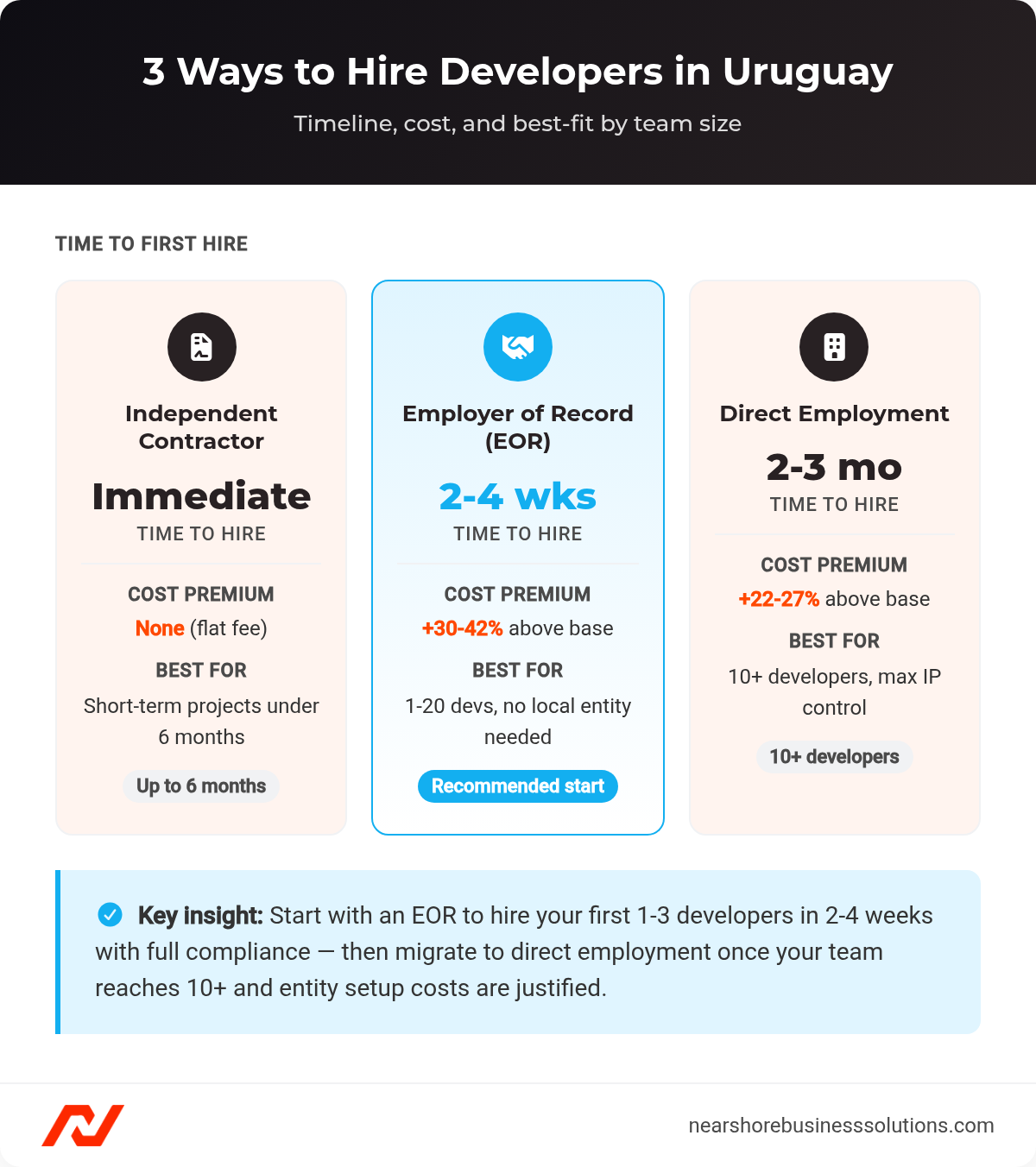
Three hiring models compared by timeline, cost premium, and team size fit for Uruguay developers.
Step 3: Source and Evaluate Uruguayan Developer Candidates
Source candidates through LinkedIn, Bumeran Uruguay, and InfoJobs Uruguay. Community sourcing through PyUy, JavaScript Montevideo, and DevOps Uruguay reaches passive candidates. Evaluate using code samples, GitHub contributions, system design interviews, stack-specific tests, and English proficiency assessment.
Step 4: Navigate Legal, Tax, and Employment Regulations in Uruguay
EOR services from providers like Multiplier and Alcor eliminate entity establishment and provide turnkey compliance for an 8-15% fee. Uruguay’s legal system treats foreign and domestic investments equally under Law 19,637, which provides robust IP protections. Work-for-hire provisions must be explicitly stated in contracts for US company IP ownership. No comprehensive US double taxation treaty exists, but the 2023 Tax Information Exchange Agreement enhances transparency.
Step 5: Onboard and Integrate Your Uruguay-Based Development Team
GMT-3 provides 6-7 hours of overlap with US Eastern. Schedule standups at 10am EST (11am-12pm Uruguay). Core collaboration runs 9am-3pm EST. Explicitly encourage challenging technical decisions during onboarding. Uruguayan developers have strong technical skills but may default to hierarchical deference. Model flat communication and “Agile disagreement” from day one to get full value from the team.
What Legal and Compliance Considerations Exist When Hiring in Uruguay?
Uruguay treats foreign and domestic investment equally with strong IP protections under Law 19,637. Two considerations stand out: the lack of a comprehensive US double taxation treaty and the need for explicit work-for-hire clauses in contracts.
What are Uruguay’s Employment Laws and Developer Contract Requirements?
Software production is protected by specific Uruguayan IP laws, a prerequisite for claiming corporate income tax exemptions. Work-for-hire provisions must be explicit for US companies to own IP created by Uruguayan developers. No restrictions apply to foreign ownership of Uruguayan service companies. Misclassification of contractors as employees creates liability for back-payments and penalties under labor law.
How Do Taxes and Social Security Work for Software Developers in Uruguay?
Four tax incentives benefit US companies hiring in Uruguay. The IT export exemption provides 100% corporate income tax relief for technology companies exporting services. R&D credits give a 35% credit on eligible expenses, rising to 45% when collaborating with certified universities. Free Trade Zones (Zonamerica, Aguada Park) offer 100% exemption from corporate income tax, VAT, and import duties. The foreign professional tax holiday exempts relocated foreign workers from taxes on foreign-sourced income for 11 years.
What is an Employer of Record and When Should You Use One in Uruguay?
An EOR employs developers on your behalf and handles payroll, taxes, benefits, and compliance without requiring you to establish a local entity. Use an EOR when you want 2-4 week hiring speed, have 1-20 developers, or want to test the market before committing to entity formation. Cost is base salary plus benefits (22-27%) plus EOR fee (8-15%), totaling a 30-42% premium over base. For teams over 20 developers, direct entity establishment typically becomes more cost-effective.
How Does Uruguay’s Time Zone and Work Culture Benefit International Teams?
GMT-3 delivers 6-7 hours of daily overlap with US Eastern, 5-6 hours with Central, and 3-4 hours with Pacific. This enables real-time Agile ceremonies throughout the standard US workday. 68% English proficiency keeps communication friction low.
What are the Time Zone Advantages for US and European Companies?
Uruguay’s GMT-3 outperforms Eastern Europe (+6-7 hours) and Asia (+12-13 hours).
| US Region | Time Difference | Daily Overlap |
|---|---|---|
| Eastern | +1 to +2 hours | 6-7 hours |
| Central | +2 to +3 hours | 5-6 hours |
| Pacific | +4 to +5 hours | 3-4 hours |
Schedule standups at 10am EST. Core collaboration runs 9am-3pm EST.
What is the Work Culture and Communication Style of Uruguayan Developers?
Uruguayan developers are hard-working, highly educated, and Western in business ethos. One nuance: they may default to hierarchical deference rather than publicly challenging management. Explicitly model “Agile disagreement” during onboarding so developers know pushback is welcome. Average tenure is 1.6-2.5 years, well above high-churn markets. The close-knit Montevideo community means employer reputation directly affects talent attraction.
How Does English Proficiency Among Uruguay Developers Compare Regionally?
68% of developers possess English skills, ranking fourth in LATAM behind Argentina, Chile, and Costa Rica. Montevideo and Punta del Este show moderate-to-high proficiency in tech roles. Additional languages: 15% Portuguese, 4% Italian. English assessment during screening remains essential as proficiency varies across roles.
What are the Common Challenges When Hiring Software Developers in Uruguay?
The primary challenge is the limited talent pool. Uruguay’s 33,000 developers create intense local competition, especially for senior engineers. Multinationals including Microsoft, Amazon, and Google actively recruit from the same Montevideo pool. Plan for this by building a strong employer value proposition and acting fast once you identify strong candidates.
What is the Competition for Top Tech Talent in Uruguay?
Competition for senior engineers is intense because multinationals recruit from the same Montevideo pool. Google’s $850 million data center (2024) and dLocal’s unicorn status signal continued enterprise demand. The 85% Montevideo concentration eliminates multi-city strategy but increases local competition intensity.
How Do You Retain Software Developers in Uruguay’s Competitive Market?
Three practices drive retention. Track Montevideo rates quarterly: mid-level earns $45-$65/hour, senior earns $70-$120/hour. Falling 10% below market increases turnover risk. Provide clear progression paths from mid to senior roles with equity where possible. Give access to complex projects. Developers who leave before the 1.6-year average typically leave for more interesting work, not higher pay.
What are the Infrastructure and Technology Considerations?
Uruguay leads LATAM in infrastructure quality. 90%+ broadband, 80% fiber-to-home, 5G nationwide, and two redundant subsea cables (Firmina and Tannat) ensure reliable connectivity. 99% renewable electricity provides stable power. Verify individual home office setup during onboarding as individual setups vary.
Where Can You Find and Recruit Software Developers in Uruguay?
Source Uruguayan developers through local job boards, tech communities, and specialized recruitment agencies. Microsoft’s AI/IoT Insider Lab in Montevideo is the only one in Latin America and doubles as a talent evaluation venue for AI/ML hires.
What are the Best Job Boards and Platforms for Hiring in Uruguay?
LinkedIn works well given 68% English proficiency. Bumeran Uruguay is the leading local job board. InfoJobs Uruguay offers tech-focused filtering. GitHub (Uruguay location search), Stack Overflow regional board, and Meetup.com groups (Python, JavaScript, DevOps) provide community-level sourcing.
Which Tech Communities and Meetups Connect You with Uruguayan Developers?
Five communities are most effective. Microsoft AI/IoT Insider Lab events attract senior AI/ML talent. PyUy (500+ members), JavaScript Montevideo, DevOps Uruguay, and Women in Tech Uruguay reach active developers. University of the Republic, ORT, and UCUDAL pipelines cover junior to mid-level roles.
How Can Recruitment Agencies and Outsourcing Partners Help?
Agencies add 15-25% of first-year salary in fees but reduce time-to-hire. DevsData has a US base and Montevideo presence. SpaceDev is Clutch-recognized for blockchain. Cubox specializes in test-driven development. EOR providers like Multiplier and Alcor bundle recruitment with payroll and compliance. Agency-plus-EOR combinations deliver candidates in 2-4 weeks.
What Industries and Companies Successfully Hire Developers from Uruguay?
Fintech, AI/ML, SaaS, HealthTech, EdTech, and blockchain projects align with Uruguay’s technical specializations. Microsoft, Amazon, Google, and dLocal demonstrate that the ecosystem handles mission-critical, enterprise-grade systems.
What Types of Projects are Uruguayan Developers Best Suited For?
Six project types match Uruguay’s strengths. FinTech: payment gateways, cross-border transactions, high-security processing. AI/ML: machine learning, NLP, and computer vision (third in LATAM for AI adoption). SaaS: cloud-native work using Ruby on Rails, React.js, and Java. Blockchain: Ethereum and Solana dApps with smart contract security. HealthTech: medical data management. EdTech: remote learning with Plan Ceibal legacy. Anti-pattern: mass-scale commodity development (use Brazil or Mexico).
Which Global Companies Have Development Teams in Uruguay?
Microsoft, Amazon, Google, IBM, Oracle, and Sabre maintain Montevideo hubs. Google announced an $850 million hyperscale data center in Canelones (2024). Microsoft operates the only AI/IoT Insider Lab in Latin America from Montevideo. dLocal became Uruguay’s first unicorn and is listed on NASDAQ. Jetpack and Paack serve EU and North American markets from Montevideo.
How Have Startups and Enterprises Benefited from Uruguay’s Tech Talent?
Four partnerships illustrate the range of successful engagements. CarbonCapture, Inc. (San Francisco) built a resource planning application through DevsData. GlossGenius, Inc. expanded its engineering team for a beauty and wellness SaaS platform using DevsData’s recruitment process. A US entertainment and education company deployed Ethereum and Solana dApps through SpaceDev (Clutch-recognized for smart contract security). NetSuite partnered with Cubox for customer development as a service using test-driven development before the acquisition.
How Does Hiring Developers in Uruguay Compare to Other LATAM Tech Hubs?
Uruguay ranks highest for political stability (A3), leads LATAM in ICT infrastructure, and concentrates high-value talent in one city. The tradeoff is a smaller pool (33,000) and higher rates than Peru or Colombia.
For a full comparison across the region, see our guide to hiring software developers in Latin America.
How Does Uruguay Compare to Argentina for Developer Talent and Costs?
| Factor | Uruguay | Argentina |
|---|---|---|
| Talent Pool | 33,000 | 115,000-130,000 |
| English | #4 (Mod-High) | #1 (High) |
| Stability | Very High (A3) | Low (B) |
| Cost Savings | 45-55% | 50-60% |
Argentina offers a larger pool and highest LATAM English proficiency. Uruguay trades some depth for significantly higher stability. Choose Argentina if risk tolerance permits. Choose Uruguay for predictable long-term operations.
How Does Uruguay Compare to Brazil’s Tech Ecosystem?
Brazil has 500,000-759,000 developers but requires multi-city recruitment with inconsistent quality. Low-to-moderate English increases overhead. Uruguay’s 64-per-10,000 density concentrates high-value engineers in one city. Choose Brazil for 50+ team commodity work. Choose Uruguay for 5-30 engineers on complex, security-sensitive projects.
Uruguay vs. Colombia and Mexico: Which LATAM Hub is Right for You?
Colombia saves 60-70% versus US rates but has lower English proficiency and moderate infrastructure. It suits budget-constrained projects where communication friction is acceptable. Mexico has 700,000 developers and favorable timezone alignment but very low English proficiency creates friction for US-facing projects. Uruguay costs more than both but delivers superior English, infrastructure, and stability. Choose Uruguay for quality-first strategies. Choose Colombia for maximum cost reduction. Choose Mexico for scale.
Frequently Asked Questions About Hiring Developers in Uruguay
These are the most common questions US tech leaders ask about hiring in Uruguay.
How Long Does It Take to Hire a Developer in Uruguay?
It takes 2-4 weeks using an EOR, 2-3 months for direct entity establishment, and immediately for contractors. Most teams start with the EOR path to validate the market before committing to entity formation.
What Happens if a Developer Does Not Work Out?
Use a 90-day replacement guarantee when working with a staffing partner. For direct hires, Uruguayan labor law requires severance of one month per year of service. EOR providers handle termination compliance and can often source a replacement within 2-4 weeks.
Do I Need to Provide Equipment for Uruguayan Developers?
Most developers in Montevideo work with their own equipment. Verify individual home office setup during onboarding. For security-sensitive projects, consider providing company-managed laptops with remote device management. Uruguay’s 80% fiber-to-home rate means connectivity is rarely the issue.
How Do I Pay Uruguayan Developers?
You pay through your EOR or payroll provider in Uruguayan Pesos or USD depending on the contract. EOR providers handle BPS social security contributions (12.625%), IRPF withholding, and Aguinaldo payments. For contractors, payment is typically in USD via wire transfer or platforms like Deel or Wise.
What is the Difference Between Nearshore and Offshore for Uruguay?
Nearshore means Uruguay, where GMT-3 gives you 6-7 hours of daily overlap with US Eastern. You can run real-time standups and code reviews within normal business hours. Offshore typically refers to Asia or Eastern Europe, where timezone gaps of 10-13 hours force asynchronous-only workflows. For Agile teams, the nearshore timezone advantage alone justifies the cost premium over offshore alternatives.
Do I Need a Local Legal Entity to Hire in Uruguay?
No. An EOR handles employment compliance without requiring entity establishment. You need a local entity only if you plan to hire 15+ developers, want to operate in a Free Trade Zone, or prefer full payroll control. Entity formation takes 2-3 months. EOR services launch in 2-4 weeks.
Is Uruguay’s Intellectual Property Protection Reliable?
Yes. Uruguay adheres to international IP standards and software production is explicitly protected under Law 19,637. Work-for-hire clauses must be included in all contracts to confirm US company ownership. The 2023 Tax Information Exchange Agreement strengthens legal transparency between Uruguay and the US.
Is Uruguay the Right Choice for Your Software Development Hiring Needs?
Uruguay suits CTOs prioritizing product quality, security, and cultural alignment over absolute lowest cost. It works best for AI/ML, fintech, and SaaS projects requiring 45-55% cost savings, 6-7 hours of US timezone overlap, and ESG compliance.
What are the Final Considerations Before Hiring in Uruguay?
Three use cases drive the strongest ROI in Uruguay. Fintech and security-critical projects benefit from the stable environment and dLocal ecosystem expertise. AI/ML development aligns with Uruguay’s third-in-LATAM AI adoption ranking. SaaS products find Ruby on Rails, React.js, and Java depth in Montevideo. The IT services market is projected to reach $1 billion by 2029 at 32% annual growth. AI and cybersecurity demand grows 27% annually. Uruguay’s 2030 target is for IT to reach 10% of GDP.
Anti-patterns: mass commodity development (use Brazil or Mexico), absolute lowest cost priority (use Colombia or Peru), or projects not requiring English fluency.
How to Get Started with Your Uruguay Hiring Strategy Today?
Start with a 1-3 developer EOR pilot to validate fit before scaling. Weeks 1-2: evaluate EOR providers (2-4 week timeline) or direct entity options (2-3 months for teams of 10-30). Weeks 2-6: post on LinkedIn, Bumeran, and InfoJobs with English requirements. Engage DevsData or a local agency. Weeks 4-8: run code samples, system design interviews, and English assessments. Weeks 8-12: schedule standups at 10am EST, model flat communication culture, and establish a retention plan. After a 3-6 month pilot, scale to a full team with entity establishment if fit is confirmed.
Uruguay represents LATAM’s boutique engineering hub: concentrated expertise, world-class infrastructure, and tax incentives designed for US tech companies that cannot compromise on quality, security, or communication.
Ready to Build Your Uruguay Engineering Team?
Nearshore Business Solutions sources and vets developers from Montevideo. We screen for technical skills, English fluency, and US work style fit. Our acceptance rate is 16%.
Every placement includes a 90-day replacement guarantee. You receive pre-vetted candidates in 2-4 weeks.
Get a free consultation to discuss your hiring needs and receive a custom quote.