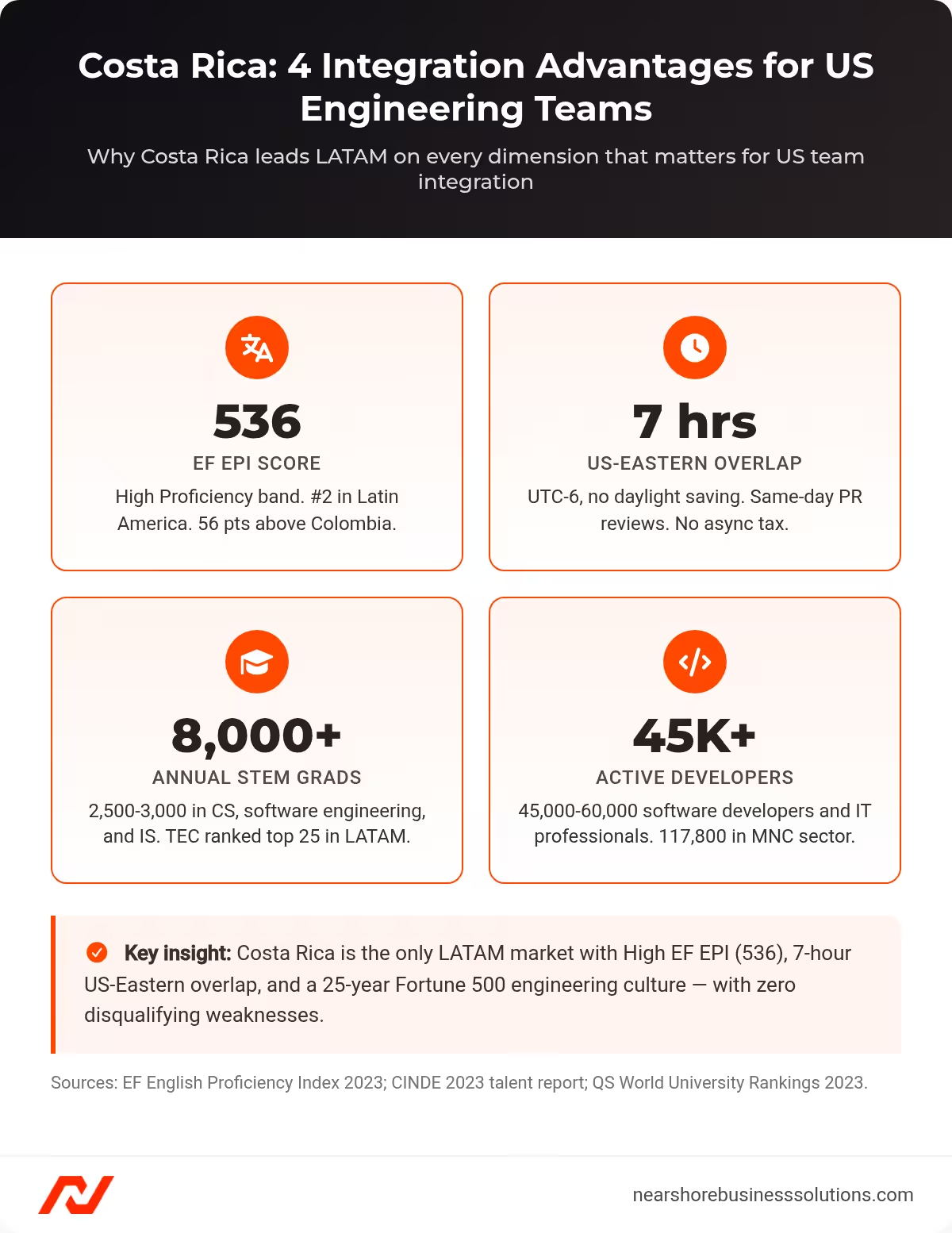
Outsource to Costa Rica and save 40-55% on development costs while working with 45,000+ developers in your time zone.
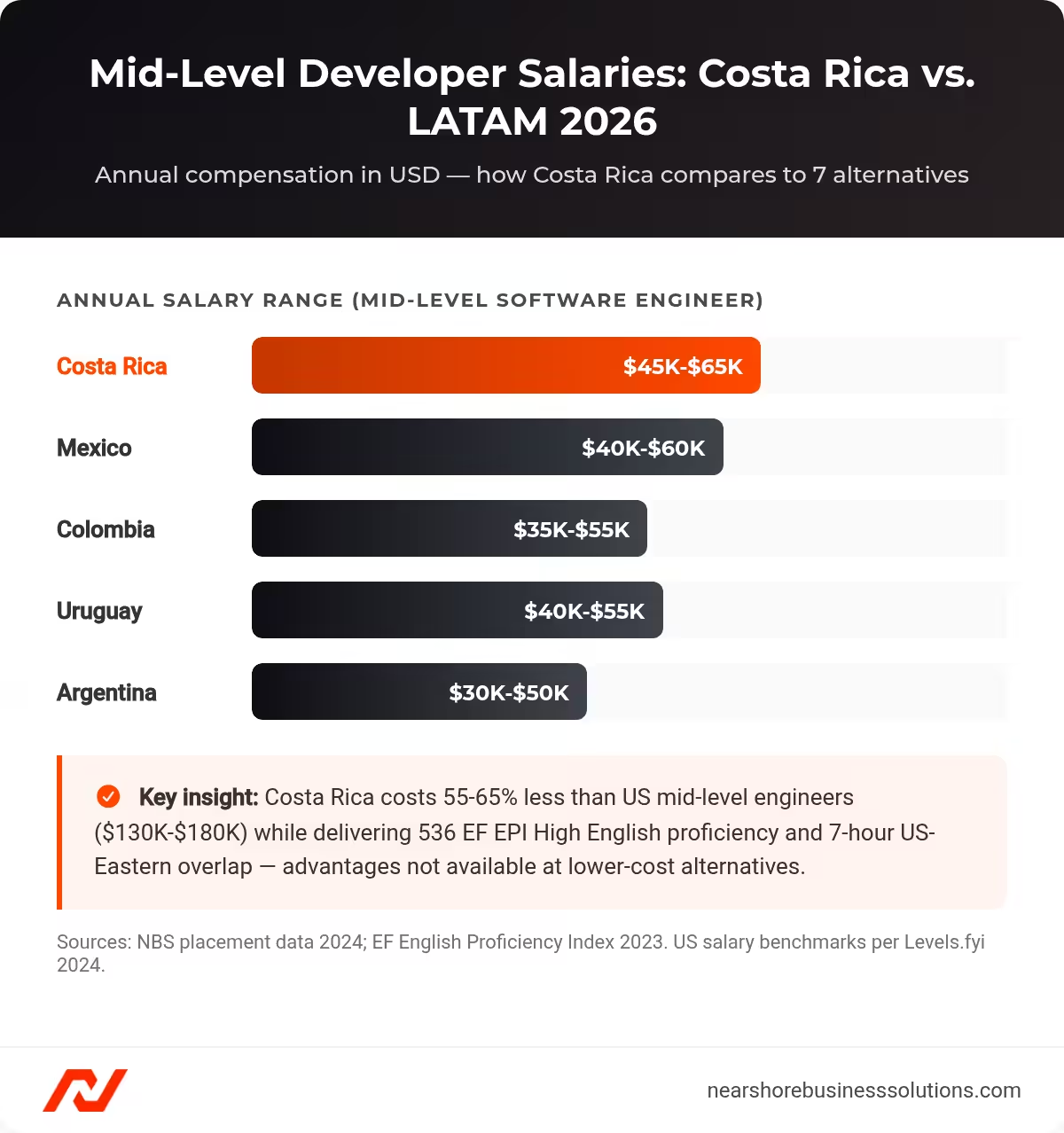
Costa Rican agencies charge $50-$120/hour versus $125-$200 for US developers. Developers trained at Universidad de Costa Rica and TEC work in CST timezone with 604 English proficiency scores. San José and Heredia tech hubs provide staff augmentation and project-based teams.
We connect you with vetted agencies offering SOC 2 certified developers across Costa Rica’s established nearshore ecosystem. Below you’ll find agency rate benchmarks, vendor evaluation criteria, outsourcing model comparisons, and partnership management strategies for working with Costa Rican development firms.
Why Should Companies Outsource Software Development to Costa Rica?
Costa Rica delivers 40-55% cost savings on outsourced development while providing real-time collaboration and high developer retention. Agencies offer 24+ month average tenure versus 14 months for US teams.
US development agencies charge $125-$200/hour for senior engineers. Specialized roles in distributed systems or AI command $175-$225/hour. Costa Rican agencies offer equivalent talent at $60-$120/hour without sacrificing technical capability.
Retention advantages compound savings beyond initial rate reduction. Costa Rican agencies report 15-20% annual developer turnover versus 35-40% in US tech hubs. Each prevented departure eliminates recruiting costs and knowledge transfer overhead for the vendor.
Nearshore agencies can staff projects in 7-14 days versus 6-8 weeks domestically. This velocity matters when product roadmaps have hard deadlines. You scale teams rapidly without internal recruiting overhead.
The economic case is straightforward. Lower rates plus higher retention plus faster onboarding creates measurable ROI within the first fiscal quarter.
What Are the Advantages of Outsourcing Software Development to Costa Rica?
Costa Rica provides substantial operational advantages for outsourcing partnerships that extend beyond cost savings:
Time Zone Alignment
- Full 8-hour workday overlap with U.S. teams
- Costa Rica operates on CST year-round with no Daylight Saving Time
- Complete schedule alignment with Chicago, Dallas, and Denver
- Significant overlap with San Francisco and New York
English Proficiency
- IT industry average score: 604 (“High” proficiency band)
- Leads Central America on EF English Proficiency Index
- Second regionally only to Argentina
- Nearly 98% literacy rate
Educational Investment
- Costa Rica allocates 6.5% of GDP to education vs. OECD average of 4.9%
- Universities grant average of 2,600 computer science diplomas annually
Infrastructure Quality
- Fiber-optic penetration: ~90% in urban areas
- Speeds up to 1000 Mbps available
- Median download speeds: 240.66 Mbps
- 5G Standalone network launched February 2025
Cultural Factors
- Working for U.S. companies considered high-status professional achievement
- Fosters long-term loyalty and commitment
- Costa Rican developers ranked among most innovative in region (second only to Chile)
What Are the Disadvantages of Outsourcing to Costa Rica?
Costa Rican outsourcing comes with specific tradeoffs compared to other nearshore destinations:
Higher Regional Costs
- Raw labor costs exceed Colombia or Argentina by 10-20%
- Hourly rates surpass some emerging Asian markets
- Premium pricing compared to lower-tier LATAM countries
Regulatory Complexity
- Misclassification penalties: 20-50% of total compensation plus interest
- Highly protective labor laws require careful contract structuring
- Legal review necessary for all engagement structures
Limited Cost Arbitrage
- Not the cheapest nearshore option available
- Better suited for quality optimization than maximum cost reduction
- Early-stage startups on tight budgets may prefer lower-cost alternatives
The disadvantages are cost-based and regulatory. They’re manageable with proper budgeting and legal structure, but they exist.
Who Should Outsource Software Development to Costa Rica?
US technology companies facing talent scarcity and domestic salary inflation benefit from outsourcing to Costa Rican development agencies and staff augmentation firms.
Three outsourcing models serve different operational needs. Staff augmentation places agency developers temporarily on your team. Project outsourcing transfers entire deliverables to vendors. Dedicated development teams provide long-term capacity through vendor-managed developers.
Companies preferring direct employment over outsourcing should review our guide to hiring in Costa Rica covering EOR services and entity establishment.
The outsourcing models aren’t mutually exclusive. Companies frequently start with staff augmentation for short-term needs. They transition to dedicated teams as projects mature. They use project outsourcing for discrete deliverables with clear specifications.
What Skills and Technologies Do Costa Rican Software Developers Specialize In?
Primary Programming Languages
- JavaScript (most popular)
- Python
- Java
Framework Adoption
- React.js: 41% adoption (leading front-end framework)
- Node.js: 38% adoption (leading back-end framework)
Developer Type Distribution
- Full-Stack: 23%
- Front-End: 21%
- Back-End: 18%
- IT System Engineers: 15%
- Data Science/BI: 11%
- Mobile: 5%
Experience Levels
- Approximately 50% have 3+ years of experience
- 14% have 10+ years of experience
The technology stack aligns with North American enterprise requirements. JavaScript dominates front-end development. Python supports data science and backend systems. Java powers legacy enterprise applications and Android development.
The skill distribution means you can build complete product teams locally. You don’t need distributed expertise across multiple geographies to cover your technology requirements.
How Do You Select Costa Rican Outsourcing Partners Successfully?
You select partners successfully by evaluating vendor capabilities, verifying client references, and assessing technical vetting processes. The execution details determine whether you capture the cost and retention advantages or encounter the same quality issues that plague offshore outsourcing.
What Is the First Step to Selecting a Costa Rican Agency?
The first step is defining technical requirements, engagement model, and budget parameters before initiating vendor outreach.
You need clarity on three dimensions before contacting agencies. Technical requirements specify the languages, frameworks, and experience levels your projects demand. Engagement model determines whether you need staff augmentation, project outsourcing, or dedicated teams. Budget parameters establish your hourly rate range and contract minimums.
Most outsourcing failures trace back to ambiguity in one of these three areas. Companies start vendor conversations without determining staff aug versus project model. They request proposals without understanding Costa Rican agency rate benchmarks. They sign contracts without legal review of IP assignment clauses.
The preparation work prevents expensive corrections later. Switching from fixed-price to time-and-materials mid-project creates scope disputes. Discovering your MSA lacks proper work-for-hire provisions creates IP ownership conflicts. Realizing your budget sits 40% below market wastes evaluation time.
Define the structure first. Source vendors second.
How Do You Source Qualified Costa Rican Outsourcing Agencies?
You source agencies through nearshore directories, LinkedIn company searches, Clutch/GoodFirms listings, and referrals from other tech leaders.
Nearshore directories like Clutch, GoodFirms, and UpCity maintain vendor listings with client reviews and project portfolios. Search filters let you narrow by technology stack (React, Node.js, Python), team size, and hourly rates. These platforms aggregate verified client feedback and case studies.
LinkedIn company searches for “Costa Rica software development” or “San José nearshore” surface agencies with detailed company pages. Review employee counts, office locations (San José, Heredia, Escazú), and technology specializations. Check for client testimonials and project examples on company websites.
Tech conferences like EXMA Costa Rica and Central American tech events provide face-to-face vendor meetings. Agencies showcase capabilities through booth demos and speaking sessions. You assess communication skills and cultural fit in person.
Referrals from other CTOs and engineering leaders produce the highest-quality agency matches. Ask your network which Costa Rican firms they’ve worked with successfully. Peer recommendations carry more weight than marketing materials. Request introductions to their account managers.
How Do You Evaluate and Screen Costa Rican Vendor Agencies?
You evaluate agencies through case study review, client reference calls, vetting process assessment, and technical leadership verification.
Case studies reveal project complexity and domain expertise. Request examples matching your industry (FinTech, HealthTech, EdTech) and technology stack. Review project timelines, team sizes, and outcomes. Ask about challenges encountered and how the agency resolved them. Look for measurable results like performance improvements or user growth.
Client reference calls provide unfiltered feedback from current and past customers. Request 3-5 active client contacts working with the agency now. Ask about developer quality, communication responsiveness, and how the agency handles problems. Inquire about developer turnover on their projects and replacement speed.
Vetting process transparency separates quality agencies from resume factories. Ask how they screen developers before placement. What’s their candidate acceptance rate? Do they conduct live coding tests or just resume reviews? Verify their technical leadership. Do they employ CTOs or senior architects who review code quality?
Certification verification confirms security and compliance capabilities. Request SOC 2 Type II or ISO 27001 certifications if you handle sensitive data. Check HIPAA compliance documentation for healthcare projects. Review data processing agreements for GDPR/CCPA requirements.
What Legal Requirements Apply When Outsourcing to Costa Rica?
You must execute Master Service Agreements with proper IP assignment, data protection agreements for compliance, and SLA definitions for deliverables.
Master Service Agreement review establishes the legal framework for your outsourcing relationship. The MSA should include work-for-hire provisions transferring all IP rights to your company. Standard vendor templates may favor agency IP retention. Have your legal counsel review before signing. Verify termination clauses allow project wind-down without excessive penalties.
IP assignment clauses require explicit language under Costa Rican law. The agreement must state that all code, documentation, and designs become your exclusive property upon creation. Ambiguous IP provisions create ownership disputes later. Include source code escrow requirements for business continuity if the vendor dissolves.
Data protection agreements address GDPR, CCPA, and Costa Rican Law 8968 compliance. If your project processes personal data, execute a Data Processing Agreement (DPA) designating roles. The vendor becomes your data processor with specific security obligations. Verify they maintain SOC 2 Type II or ISO 27001 certifications for sensitive data handling.
SLA definitions establish performance expectations and remedies. Define uptime requirements, response times for critical bugs, and deliverable acceptance criteria. Specify payment terms (NET-30, NET-60) and holdback percentages pending acceptance. Include escalation procedures and penalty clauses for missed milestones.
How Do You Onboard a Costa Rican Outsourcing Partner?
You onboard partners through kickoff meetings with account managers, communication protocol setup, code repository access, and sprint cadence establishment.
Kickoff meetings align expectations between your team and the agency. Include the vendor’s account manager, technical lead, and assigned developers. Review project goals, technical architecture, and success criteria. Establish primary points of contact on both sides. Define escalation paths for urgent issues and scope changes.
Communication protocol setup prevents misalignment on response expectations. Designate Slack channels for daily updates versus email for formal deliverables. Specify response time SLAs (2 hours for critical bugs, 24 hours for general questions). Schedule recurring meetings (daily standups, weekly sprint reviews, monthly retrospectives). Confirm meeting times work across time zones.
Code repository access and branching strategy require technical coordination. Grant GitHub or GitLab permissions to vendor developers. Establish branching conventions (feature branches, pull request requirements, protected main branch). Configure CI/CD pipelines to run automated tests on vendor commits. Set up code review assignments.
Sprint cadence establishment defines delivery rhythm. Agree on sprint length (1-week or 2-week cycles). Set story point commitment expectations. Define definition of done and acceptance criteria. Establish demo schedule for stakeholder reviews. Create project management tool access (Jira, Linear, Asana) with appropriate permissions.
What Are the Different Outsourcing Models for Costa Rican Partnerships?
Costa Rican outsourcing offers three primary engagement models. Staff augmentation places agency developers on your team temporarily. Project outsourcing transfers entire deliverables to vendors. Dedicated teams provide long-term capacity through vendor-managed developers.
Companies preferring direct employment over outsourcing should review our complete guide to hiring in Costa Rica covering Employer of Record services and entity establishment for direct hires.
What Is a Dedicated Development Team Model?
The dedicated team model provides long-term vendor relationships where the agency maintains employment while you direct daily work exclusively for your projects.
Dedicated teams work as extensions of your internal organization. The vendor handles recruitment, HR, benefits, and retention. You control sprint planning, task prioritization, and product roadmap decisions. Developers commit full-time to your projects (40 hours/week) for contract durations of 6-12+ months.
This model suits companies needing sustained development capacity without hiring overhead. You scale teams up or down with 30-day notice periods. The vendor manages developer replacement if team members leave. You maintain consistent velocity without recruitment interruptions.
Pricing uses monthly per-developer rates ranging $6,000-$15,000 depending on seniority and specialization. Senior full-stack developers cost $8,000-$12,000/month. DevOps engineers and data scientists command $10,000-$15,000/month. Contracts include service-level agreements on availability and response times.
Dedicated teams excel for ongoing product development with evolving requirements. You adapt priorities weekly without contract renegotiation. The vendor’s tech leads participate in architecture discussions and code reviews alongside your internal engineers.
What Is Staff Augmentation Through Costa Rican Agencies?
Staff augmentation places pre-vetted agency developers temporarily on your team with flexible contract lengths from 3-12 months. Agencies handle employment while you direct daily work and project priorities.
Agencies in San José and Heredia maintain benches of developers across technology stacks (React, Node.js, Python, Java). You specify requirements (senior full-stack, 5+ years, FinTech experience), they propose 2-3 candidates within 48 hours, and you interview before placement. The developer joins your team within 7-14 days.
Contract lengths range from 3-month minimum commitments to 12-month engagements. Most agencies require 30-day termination notice. Shorter contracts cost 10-15% premiums versus long-term commitments. You can extend contracts month-to-month after the initial term.
Replacement guarantees shift quality risk to vendors. Most agencies offer 30-90 day replacement windows. If a developer underperforms or leaves voluntarily, the agency provides a replacement within 5-10 business days at no additional cost. You avoid recruiting delays and knowledge loss.
Pricing models include hourly billing ($50-$140/hour) or monthly rates ($8,000-$18,000/developer). Hourly billing suits variable-hours projects. Monthly rates work better for full-time commitments. Rates include 35-45% agency margins covering recruitment, HR, benefits, and profit.
Staff augmentation excels for short-term capacity spikes. You scale up 5 developers for a 6-month product launch. You scale down after release without severance obligations. The agency manages employment continuity while you control resource allocation.
What Is Project Outsourcing to Costa Rican Development Companies?
Project outsourcing transfers complete project ownership to a Costa Rican development company that manages developers, deliverables, and timelines while you provide requirements and accept finished work.
Development companies operate as turnkey vendors. You provide detailed specifications (PRD, wireframes, technical requirements). They estimate effort, propose team composition, and quote fixed-price or time-and-materials pricing. The vendor assigns developers, architects, QA engineers, and project managers. You receive weekly status updates and attend milestone demos.
Fixed-price contracts work best for well-defined projects with clear scope. Mobile app development ($25k-$150k), API integrations ($10k-$50k), or data migration projects ($15k-$75k) fit this model. You pay agreed amounts upon milestone completion. The vendor absorbs cost overruns from underestimation.
Time-and-materials contracts suit projects with evolving requirements. You pay hourly rates ($60-$140/hour blended rate) for actual hours worked. The vendor provides weekly timesheets and burn-rate tracking. Change orders get approved within sprint cycles rather than requiring contract amendments. This flexibility costs 15-20% more than fixed-price but prevents scope rigidity.
Project sizes range from $10k tactical builds to $500k+ platform development. Small projects (under $50k) often use fixed-price. Large projects (over $100k) typically use T&M with not-to-exceed caps. Medium projects ($50k-$100k) blend both: fixed-price for Phase 1, T&M for enhancements.
Contract structures include milestone-based payments (30% upfront, 40% mid-project, 30% upon acceptance), acceptance criteria defining “done,” change order processes for scope modifications, and warranty periods (30-90 days) for bug fixes post-launch.
Vendor accountability mechanisms include code escrow agreements, staged payments tied to deliverables, penetration testing requirements, and performance guarantees (page load times, uptime SLAs). These protections reduce delivery risk compared to staff augmentation where you manage outcomes.
How Do the Three Outsourcing Models Compare?
Each model suits different project needs and management preferences. The comparison helps you choose the right engagement approach.
| Factor | Staff Augmentation | Dedicated Team | Project Outsourcing |
|---|---|---|---|
| Control Level | High (you direct daily work) | Medium (you set priorities) | Low (vendor manages delivery) |
| Pricing Model | Hourly or monthly per developer | Monthly per developer | Fixed-price or T&M per project |
| Contract Length | 3-12 months | 6-12+ months | Project duration (1-12 months) |
| Your Management | Daily task assignment | Sprint planning oversight | Milestone reviews only |
| Vendor Management | Employment and HR only | Employment, HR, team coordination | Full project management |
| Best For | Short-term capacity spikes | Ongoing product development | Discrete projects with clear scope |
| Flexibility | High (scale weekly) | Medium (scale monthly) | Low (scope changes need amendments) |
| Typical Cost | $8k-$18k/month per developer | $6k-$15k/month per developer | $10k-$500k per project |
Choose staff augmentation when you need temporary capacity with high control. Choose dedicated teams when you need sustained development without hiring overhead. Choose project outsourcing when you want turnkey delivery without management burden.
How Much Does It Cost to Outsource Software Development to Costa Rica?
Agency billing rates range from $50-$150/hour depending on seniority, specialization, and vendor positioning. Rates include developer salaries, benefits, overhead, and 35-45% agency margins.
What Are Average Agency Rates for Costa Rican Developers?
Costa Rican agencies charge $50-$120/hour for developers versus $125-$200 for US agencies. Senior full-stack developers cost $62-$90/hour through Costa Rican vendors, saving you 30-40% on project costs.
Agency Billing Rates (2025):
| Technical Role | Seniority | CR Agency Rate (USD/hour) | US Agency Rate (USD/hour) | Savings (%) |
|---|---|---|---|---|
| Full-Stack Developer | Junior (0-2y) | $48-$67 | $80-$105 | 35-40% |
| Full-Stack Developer | Mid-Level (3-5y) | $67-$106 | $110-$145 | 30-39% |
| Full-Stack Developer | Senior (6y+) | $62-$91 | $125-$175 | 35-50% |
| Back-End Engineer | Senior | $67-$100 | $130-$165 | 35-48% |
| Front-End Engineer | Senior | $65-$86 | $125-$155 | 35-48% |
| DevOps/Cloud Architect | Senior | $72-$110 | $140-$200 | 35-48% |
| Data Scientist/ML Engineer | Senior | $77-$115 | $145-$200 | 35-47% |
Monthly Rates for Full-Time Developers (160 hours/month):
- Junior: $7,700-$10,700/month
- Mid-Level: $10,700-$17,000/month
- Senior: $9,900-$14,600/month
- Tech Lead: $11,500-$17,600/month
Rates reflect Costa Rican market conditions as of 2025. Premium agencies in San José and Heredia command upper-range pricing. Boutique firms focusing on specific technologies (FinTech, HealthTech) add 10-15% premiums. Note that rates include all agency overhead, meaning no separate fees for project management or account coordination.
What Additional Costs Should Companies Expect When Outsourcing?
Most Costa Rican agencies include project management and account coordination in quoted rates. Additional costs apply for specific services or contract structures.
Common Additional Fees:
- Project Management Premium: 10-15% surcharge for dedicated PM on larger teams (5+ developers) at enterprise agencies. Boutique firms typically include PM in base rates.
- Onboarding/Knowledge Transfer: 1-2 weeks billing for initial project setup, codebase familiarization, and process alignment. Ranges $2,000-$8,000 depending on project complexity.
- Contract Minimums: Most agencies require 3-6 month minimum commitments. Breaking contracts early may trigger 30-60 day notice period charges.
- Infrastructure Costs: AWS, Azure, or development tool licenses may be separate line items or included in rates. Clarify during vendor selection. Typical add: $500-$2,000/month for team tools.
Staff augmentation costs $153k-$337k for 6 months with 3 developers. Project outsourcing provides more predictable budgets at $106k-$114k for a $100k fixed-price project.
Typical Total Project Cost Example (6-Month Engagement):
| Cost Component | Staff Augmentation (3 developers) | Project Outsourcing ($100k project) |
|---|---|---|
| Developer/Team Costs | $144,000-$270,000 | $100,000 (fixed) |
| Project Management | Included or +$14k-$40k | Included |
| Onboarding | $6,000-$15,000 | $3,000-$8,000 |
| Infrastructure | $3,000-$12,000 | $3,000-$6,000 |
| Total Cost Range | $153,000-$337,000 | $106,000-$114,000 |
Staff augmentation costs vary based on developer seniority and contract length. Project outsourcing provides more predictable budgets but less flexibility for scope changes.
How Do Costa Rican Agency Rates Compare to Other Nearshore Countries?
Costa Rica ranks mid-range among LATAM nearshore destinations. Mexican agencies charge similar rates while Colombian and Argentine vendors cost 10-20% less. Chilean agencies match or exceed Costa Rican pricing.
LATAM Regional Agency Rate Comparison:
| Country | Junior | Mid-Level | Senior | Tech Lead |
|---|---|---|---|---|
| Costa Rica | $25-$40 | $40-$65 | $70-$100 | $90-$140 |
| Mexico | $28-$38 | $45-$65 | $75-$95 | $100-$130 |
| Brazil | $25-$35 | $40-$60 | $70-$90 | $95-$120 |
| Argentina | $20-$30 | $35-$55 | $65-$85 | $90-$115 |
| Colombia | $22-$32 | $38-$58 | $68-$88 | $85-$110 |
| Chile | $30-$40 | $50-$70 | $80-$100 | $110-$140 |
Costa Rica remains highly competitive with Mexico while offering advantages in maturity of high-tech ecosystem. Intel’s semiconductor operations and medical device manufacturing create developer exposure to complex engineering problems. This ecosystem maturity justifies premiums over lower-cost nearshore alternatives.
Annual project cost savings range 35-50% compared to US agencies. A 6-month project with 3 senior developers costs $150k-$250k through Costa Rican agencies versus $260k-$400k domestically. For role-specific rate benchmarks, see our guides on backend developer rates across Latin America.
What Are the Time Zone Benefits of Outsourcing to Costa Rica?
Time zone alignment eliminates asynchronous delays that plague offshore outsourcing. Agency teams in San José and Heredia work synchronously with US clients enabling real-time collaboration.
How Does Costa Rica’s Time Zone Align with North American Business Hours?
Costa Rica operates on Central Standard Time year-round without Daylight Saving Time. It aligns with CST in winter and Mountain Standard Time in summer. This provides significant overlap with San Francisco and New York.
The year-round CST operation creates consistent scheduling without biannual adjustment disruptions. During winter months, Costa Rica aligns perfectly with Central Standard Time zones. This covers Chicago, Dallas, Houston, and other major U.S. tech hubs.
Summer alignment shifts to Mountain Standard Time equivalence when U.S. zones adopt Daylight Saving Time. This maintains synchronization with Denver and other Mountain Time markets.
Coastal hub overlap remains significant despite multi-hour differences. San Francisco operates three hours behind Costa Rica. Business hours still provide 5-6 hours of daily overlap. New York runs one hour ahead, creating nearly complete workday alignment.
The consistency matters operationally. You don’t recalculate meeting times twice yearly. Developers don’t adjust schedules seasonally. Calendar invitations remain valid throughout the year.
What Is the Impact of Real-Time Collaboration on Project Success?
Real-time collaboration eliminates overnight wait times common in offshore models and increases productivity through immediate communication during overlapping business hours.
The overnight wait problem destroys development velocity. A question asked at 4 PM Eastern Time gets answered at 9 AM the next day with offshore teams in Asia. That 17-hour delay blocks progress, forces context switching, and creates compounding delays across multiple interactions.
Vendor teams answer Slack messages within minutes during business hours. Code review feedback from agency developers arrives the same day. Blocking issues get resolved through quick video calls instead of email chains spanning multiple days.
Productivity gains manifest in sprint velocity. Outsourced teams complete more story points per sprint when blockers resolve immediately. Product launches hit target dates when last-minute bugs get fixed through real-time debugging sessions with vendor engineers.
Collaboration quality improves with synchronous communication. Design discussions happen through screen sharing and live feedback. Architecture decisions emerge through real-time conversation with agency tech leads. Pair programming becomes practical when vendor developers work the same hours.
What Is the English Proficiency Level of Costa Rican Development Teams?
English proficiency directly impacts communication effectiveness with outsourcing partners. Agencies in Heredia and San José recruit developers with high proficiency enabling seamless collaboration with US clients.
How Does Language Proficiency Affect Team Communication?
Language proficiency determines whether developers can participate in technical discussions, write clear documentation, and integrate into team culture, with Heredia scoring 576 and San José scoring 540 on proficiency assessments in areas where multinational corporations create continuous English usage environments.
Heredia achieves the highest proficiency score at 576, driven by concentration of multinational technology companies including Intel, HP, and Amazon. The continuous English usage environment in these companies elevates language skills across the regional workforce. San José follows with a score of 540, reflecting its role as the capital and primary business center.
These proficiency levels enable developers to participate fully in technical discussions without translation delays or misunderstandings. Code reviews contain nuanced feedback. Pull request descriptions explain architectural decisions clearly. Slack conversations flow naturally without awkward phrasing that requires interpretation.
Documentation quality reflects language capability. Costa Rican developers produce README files, API documentation, and technical specifications that meet North American standards. They write commit messages that explain the “why” behind changes, not just the “what.”
Team integration accelerates when language barriers don’t exist. Developers join sprint retrospectives, contribute to brainstorming sessions, and participate in company-wide meetings. They understand cultural references, follow conversational humor, and build relationships beyond purely transactional work interactions.
The multinational corporation presence creates a self-reinforcing cycle. Companies establish operations because of existing talent. That presence improves talent through English-language work environments. Improved talent attracts more companies.
What Legal Considerations Apply When Outsourcing to Costa Rica?
Outsourcing to Costa Rica requires attention to IP assignment, data protection compliance, and vendor contract terms. The agency handles local labor law and tax obligations.
How Do IP Rights Work with Costa Rican Vendors?
Your MSA must include explicit work-for-hire provisions transferring all IP ownership to your company. Standard vendor templates may retain agency IP rights.
Costa Rican law recognizes IP transfer when contracts include specific assignment language. The MSA should state that all code, documentation, designs, and technical specifications become your exclusive property upon creation. Ambiguous clauses create ownership disputes later when you need to assert rights.
Source code escrow agreements provide business continuity protection. If the vendor dissolves or breaches contract, you access code repositories through escrow. Include escrow requirements in contracts for mission-critical projects. Typical cost: $500-$2,000 annually through third-party escrow services.
Have your legal counsel review vendor MSAs before signing. Costa Rican agencies may use contracts drafted under local law. Ensure IP assignment clauses meet requirements in both countries. Courts generally respect IP rights with proper documentation.
What Data Protection Rules Apply to Costa Rican Outsourcing?
Data protection depends on where your customers reside and what data you process. GDPR applies to EU customers. CCPA applies to California residents. Costa Rican Law 8968 governs local data handling.
Execute Data Processing Agreements (DPA) when vendors process personal data. The DPA designates you as data controller and the vendor as data processor. It defines security obligations, breach notification procedures, and data deletion requirements. Most enterprise agencies provide DPA templates compliant with multiple frameworks.
Verify vendor security certifications for sensitive projects. SOC 2 Type II certification demonstrates audited security controls. ISO 27001 certification covers information security management. HIPAA compliance applies to healthcare projects handling protected health information. Request certification documentation during vendor evaluation.
Data residency requirements may restrict where data gets processed or stored. Confirm vendor developers work from Costa Rica, not subcontracted to other countries. Specify data storage locations (US, EU, Costa Rica) in contracts. Cloud infrastructure (AWS, Azure) should match your residency requirements.
What Is the Technology Ecosystem Like in Costa Rica?
The technology ecosystem concentrates in San José and Heredia with established infrastructure and multinational company presence. Development agencies cluster in these tech hubs creating a mature outsourcing marketplace.
What Are the Major Tech Hubs and Cities in Costa Rica?
Technology concentrates in the Greater Metropolitan Area covering San José and Heredia, with specialized infrastructure and talent distribution across key cities.
Talent Concentration by Specialization:
- Full-Stack Developers: San José, Heredia, Alajuela
- Front-End Developers: San José, Heredia
- Back-End Developers: San José, Cartago
- IT System Engineers: San José, Alajuela
- Data Science/BI: San José, Heredia
- Mobile Developers: San José
Coworking Spaces and Tech Hubs:
Ultrapark II and Americas Free Zone (AFZ):
- LEED-certified buildings
- Redundant fiber-optic connectivity
- 24/7 security
- Onsite amenities (gyms, food courts)
WeWork and Regus:
- Multiple locations in Escazú, Heredia, San Pedro
- High-speed Wi-Fi
- “Plug and play” office solutions
The infrastructure quality matches North American standards. Buildings meet international environmental certifications. Internet connectivity provides enterprise-grade reliability. Security protocols address physical and data protection requirements.
What Global Companies Have Development Centers in Costa Rica?
Major multinational corporations have established significant technical operations in Costa Rica, validating the ecosystem’s capability to support complex engineering work.
Intel Corporation
- Presence since 1998 (started as microprocessor assembly plant)
- Evolved into Engineering and Design center by 2024
- Employs 2,400+ people focused on chip design and testing
- Semiconductor sector contributes 7.2% to Costa Rica’s GDP
- Annual semiconductor exports: $3.8 billion
- Costa Rica is second-largest exporter of medical devices in Latin America
Microsoft
- Grew from 80 to 800 staff
- Provides Tier 3 engineering support for Azure, Office 365, and Teams
- Handles complex technical support requiring deep product knowledge
Hewlett Packard Enterprise (HPE)
- First R\&D center outside U.S. located in Costa Rica
- Holds 40+ patents developed locally
- Focuses on “Intelligent Edge” networking products and embedded software
IBM
- Global Security Center monitors security events for hundreds of clients across 130 countries
- Cybersecurity academy certified 850 specialists in 2024
Other Major Companies
- ActiveCampaign and 6sense maintain highly-rated operations
The multinational presence validates Costa Rica’s capability to support complex engineering work. These companies wouldn’t maintain operations for decades if the talent, infrastructure, or business environment failed to meet requirements.
What Universities Produce Software Engineering Talent in Costa Rica?
Costa Rica’s university system produces well-trained software engineers through institutions offering different specializations and educational approaches.
University of Costa Rica (UCR)
- Ranked first nationally
- Largest volume of systems and software engineers
- Known for strong theoretical foundations and research capabilities
Costa Rica Institute of Technology (TEC)
- Premier engineering school in Cartago
- Specializes in electronics, mechatronics, and computer science
- Primary feeder for semiconductor companies like Intel
Latin American University of Science and Technology (ULACIT)
- Leading private institution
- Focus on innovation and digital transformation
Texas Tech University (Costa Rica Campus)
- Provides direct bridge for American standards in engineering education and professional readiness
The university diversity creates talent with different strengths. UCR graduates bring theoretical depth. TEC graduates understand hardware-software integration. ULACIT graduates focus on practical innovation. Texas Tech graduates match U.S. expectations immediately.
How Do You Manage Costa Rican Outsourcing Partners and Vendor Teams?
Managing vendor relationships requires clear communication protocols, output-based performance metrics, and regular sprint reviews. Costa Rican agencies adapt naturally to US engineering practices.
What Project Management Tools Work Best with Costa Rican Vendors?
Costa Rican agencies use standard US tools without adaptation. Jira, GitHub, Slack, and Zoom integrate seamlessly. Most agencies in San José and Heredia already employ these platforms for existing clients.
The culture emphasizes meaningful data utilization and technical problem-solving. This orientation matches U.S. engineering organizations that rely on metrics-driven development and evidence-based decision-making.
Agile methodologies used in U.S. engineering organizations translate directly to Costa Rican teams. Sprint planning, daily standups, retrospectives, and kanban boards function identically. You don’t need to modify your existing processes.
Jira supports sprint management and backlog prioritization with the same workflows your domestic teams use. GitHub enables code review, branching strategies, and CI/CD pipelines without regional differences. Slack provides real-time communication during overlapping hours. Zoom handles video calls with sufficient bandwidth.
The tooling compatibility extends to monitoring and observability platforms. Datadog, New Relic, and PagerDuty work identically. Costa Rican developers interpret metrics, respond to alerts, and debug production issues using the same dashboards as U.S. teams.
Documentation practices align with North American standards. Confluence wikis, Google Docs, and Notion databases organize information effectively. Costa Rican developers write clear technical documentation without translation overhead or cultural communication gaps.
How Do You Maintain Productivity with Costa Rican Vendor Teams?
You maintain vendor productivity through sprint velocity tracking, SLA compliance monitoring, and code quality metrics. Define clear deliverable expectations and review outputs in weekly demos.
Clear objectives define what success looks like for each sprint and project. Costa Rican developers need the same clarity as domestic teams about priorities, acceptance criteria, and definition of done. Ambiguity reduces productivity regardless of location.
Daily standups during overlapping hours create accountability and surface blockers quickly. The 8-hour time zone alignment makes 9 AM or 10 AM calls practical for both U.S. and Costa Rican participants. Fifteen-minute standups maintain connection without disrupting deep work.
Asynchronous communication protocols allow developers to work independently when time zones don’t overlap perfectly. Clear documentation of decisions, well-written tickets, and comprehensive pull request descriptions enable progress without constant synchronous interaction.
Output-based performance metrics focus on deliverables rather than hours logged. Story points completed, bugs fixed, features shipped, and code quality metrics provide objective productivity measures. Activity monitoring through screenshot tools or time tracking creates distrust and reduces autonomy.
Code review turnaround time impacts productivity directly. Setting expectations for 4-hour review cycles during overlapping hours prevents developers from blocking on feedback. Automated testing and CI/CD pipelines provide fast feedback loops independent of human review.
How Do You Build Relationships with Costa Rican Vendor Teams?
You build vendor relationships by including agency developers in company rituals and strategic discussions. Costa Rica’s “Pura Vida” culture emphasizes collaboration and adaptability making vendor integration smoother.
The “Pura Vida” culture translates to professional environments characterized by politeness, collaboration, and high adaptability. These cultural traits align naturally with healthy engineering cultures that value psychological safety and teamwork.
Including Costa Rican developers in company rituals creates belonging. All-hands meetings should accommodate their time zones. Quarterly planning sessions should include remote participants with full speaking rights. Performance reviews should use identical criteria for remote and local teams.
Decision-making inclusion matters more than social events. Costa Rican developers should participate in architectural discussions, technology selection, and process improvements. Exclusion from strategic conversations creates second-class team members regardless of social integration efforts.
Social interactions beyond work tasks build relationships. Virtual coffee chats, online game sessions, or shared Slack channels for non-work topics create informal connections. Annual in-person gatherings provide face-to-face interaction when budgets allow.
Recognition and celebration work across borders. Highlighting contributions in public channels, celebrating project launches, and acknowledging individual achievements create positive reinforcement. The recognition mechanisms should be identical for remote and local team members.
What Challenges Can Arise When Outsourcing to Costa Rica?
Challenges exist despite Costa Rica’s advantages. Understanding common pitfalls helps you select the right vendors and structure contracts appropriately.
What Cultural Differences Should Companies Be Aware Of?
Companies should understand that Costa Rican “Pura Vida” politeness may lead to indirect communication about problems, requiring explicit encouragement of direct feedback and creating psychological safety for disagreement.
The politeness characteristic of “Pura Vida” culture can manifest as indirect communication about problems or concerns. Costa Rican developers may avoid contradicting managers directly or raising issues that could create conflict. This indirectness delays problem surfacing until situations become critical.
Creating psychological safety for direct feedback requires explicit permission and modeling. Tell Costa Rican team members you expect them to raise concerns early. Demonstrate receptiveness when they do. Reward constructive criticism publicly to reinforce the behavior.
Hierarchy consciousness differs from flatter U.S. tech culture. Costa Rican developers may defer to senior engineers or managers more than U.S. counterparts. This deference can reduce initiative or prevent junior developers from proposing improvements.
Relationship building takes priority over transactional efficiency in Costa Rican culture. Spending time on personal connection before diving into work topics improves collaboration. Brief personal conversations at meeting starts create rapport.
How Do Agencies Retain Top Developer Talent?
Agencies retain talent through competitive local compensation, career development, and meaningful project work. Your risk is minimal since vendors handle replacement within 30-90 days under most contracts.
Retention strategies covered in the advantages section highlighted 24+ month average tenure and working for U.S. companies as high-status achievement. These factors create natural retention advantages, but they require reinforcement through deliberate practices.
Competitive compensation adjusted for local market rates prevents talent loss to competitors. Annual salary reviews should account for Costa Rican market movement, not just U.S. cost-of-living adjustments. Falling below market creates retention risk.
Career development opportunities matter more than marginal salary differences for many developers. Clear growth paths, mentorship programs, and skill development budgets demonstrate investment in individual careers. Stagnation drives attrition regardless of salary.
Meaningful project work retains top talent better than compensation alone. Developers want to work on challenging problems using modern technology stacks. Legacy maintenance work on outdated frameworks increases attrition risk.
Recognition of contributions creates emotional connection beyond paycheck. Public acknowledgment of achievements, opportunities to present work to broader company audiences, and inclusion in strategic planning discussions reinforce value and belonging.
What Infrastructure or Connectivity Issues Might Impact Development Work?
While Costa Rica’s infrastructure generally meets enterprise standards with 90% fiber penetration and 240+ Mbps median speeds, occasional power outages in some regions and bandwidth variability in rural areas can disrupt work requiring backup connectivity plans.
The infrastructure statistics presented earlier show strong connectivity in urban areas where tech talent concentrates. Fiber-optic penetration reaches 90% in these regions with speeds up to 1000 Mbps. Median download speeds of 240.66 Mbps exceed requirements for video conferencing and large file transfers.
Power outages occur occasionally in some regions despite generally reliable electrical infrastructure. Developers should have backup power solutions like UPS systems to prevent data loss and maintain connectivity during brief outages. Companies can subsidize this equipment as part of remote work setup.
Bandwidth variability affects developers in rural areas outside primary tech hubs. While the majority of tech talent concentrates in San José and Heredia with excellent connectivity, developers living in less developed areas may experience inconsistent speeds during peak usage times.
Mobile connectivity provides backup option during fixed-line outages. Costa Rica’s 5G Standalone network launched in February 2025 creates alternative path for internet access. Developers can use mobile hotspots temporarily when primary connections fail.
Companies should establish connectivity requirements during hiring and provide stipends for business-class internet service. Setting minimum speed requirements and requiring redundant connectivity options prevents productivity loss from infrastructure issues.
How Does Outsourcing to Costa Rica Compare to Other Latin American Countries?
Costa Rica’s position in the Latin American nearshore landscape reflects specific tradeoffs between cost, stability, and ecosystem maturity that vary by comparison country.
What Is the Difference Between Costa Rica and Mexico for Outsourcing?
Mexico serves as primary nearshore competitor with similar pricing, but Costa Rica offers advantages in high-tech ecosystem maturity, particularly in semiconductor and medical device sectors that create developer exposure to complex engineering.
Mexico represents the largest nearshore market for U.S. firms based on geographic proximity and talent pool size. The countries compete directly for the same client base seeking Central American and North American nearshore options.
Costa Rica’s advantage lies in maturity of the high-tech ecosystem. The semiconductor sector contributing 7.2% to GDP and medical device manufacturing create environments where developers work on complex problems. Intel’s chip design center and medical device R\&D facilities expose local talent to advanced engineering practices.
Mexico’s scale provides larger absolute talent numbers. Costa Rica’s ecosystem depth provides higher average technical sophistication. The choice depends on whether you prioritize team size or technical complexity.
What Is the Difference Between Costa Rica and Colombia for Outsourcing?
Colombia offers lower raw labor costs, while Costa Rica provides higher institutional stability, superior English proficiency, and legal frameworks more friendly to foreign direct investment.
Colombia’s labor costs undercut Costa Rica by 10-20% across seniority levels based on the hourly rate comparison presented earlier. This cost advantage matters for companies optimizing purely on price per developer hour.
Costa Rica counters with institutional stability advantages. The country maintains consistent government policies toward foreign investment. Political transitions don’t disrupt business operations. Regulatory frameworks remain predictable across election cycles.
English proficiency leads significantly in Costa Rica. The IT industry score of 604 versus Colombia’s lower proficiency creates fewer communication barriers and faster integration with U.S. teams.
Legal framework friendliness to foreign direct investment shows in the Free Trade Zone incentives, territorial tax system, and established processes for corporate entity formation. Colombia’s framework works, but Costa Rica’s has longer track record with technology companies.
What Is the Difference Between Costa Rica and Argentina for Outsourcing?
Argentina offers lower raw labor costs but faces currency instability, while Costa Rica positions as a “boutique” hub with higher institutional stability and FDI-friendly framework commanding premium pricing.
Argentina provides technical talent at the lowest costs in the regional comparison. The hourly rates of $20-$115 across seniority levels represent significant savings compared to Costa Rica’s $25-$140 range.
Costa Rica’s “boutique” positioning means higher costs buy reduced risk. Institutional stability prevents sudden policy changes that disrupt operations. Currency stability using the colón tied to the U.S. dollar avoids the exchange rate volatility that affects Argentine contracts.
The FDI-friendly framework in Costa Rica creates easier entity establishment, clearer tax treatment, and more predictable regulatory compliance. Argentina’s framework carries more complexity and uncertainty.
Argentina’s advantage is pure cost arbitrage. Costa Rica’s advantage is risk-adjusted return. The decision depends on your risk tolerance and operational complexity preferences.
What Industries Benefit Most from Outsourcing to Costa Rica?
Specific industries align particularly well with Costa Rica’s technical capabilities, regulatory environment, and existing ecosystem strengths.
Which Costa Rican Agencies Specialize in FinTech and Blockchain?
Latin American FinTech experienced 340% startup growth between 2017-2023, with Costa Rican companies like Tilopay and Bankify specializing in payments, banking apps, and decentralized finance development.
The FinTech sector in Latin America grew 340% in startups between 2017-2023. This explosive growth created demand for developers experienced in financial systems, regulatory compliance, and security-critical applications.
Key Costa Rican players include Tilopay and Bankify focusing on mobile banking and payment infrastructure. These companies built engineering teams experienced in PCI compliance, payment gateway integration, and banking API development.
Specializations cover payments processing, banking application development, and decentralized finance platforms. Costa Rican developers working in FinTech understand regulatory requirements, security protocols, and financial industry best practices.
Companies building payment systems, cryptocurrency platforms, or banking applications find Costa Rica’s combination of financial sector experience and technical talent particularly valuable.
Which Costa Rican Agencies Specialize in HealthTech and Life Sciences?
HuliHealth serves hundreds of thousands of patients through telemedicine platforms, while Establishment Labs employs in-house software teams for medical device integration, leveraging Costa Rica’s position as second-largest Latin American medical device exporter.
HuliHealth operates the premier telemedicine and medical appointment scheduling platform serving hundreds of thousands of patients. The engineering team builds HIPAA-compliant systems handling sensitive health data and real-time video consultations.
Establishment Labs maintains in-house software teams for medical device integration and regulatory compliance. This work requires understanding FDA regulations, quality management systems, and embedded software for medical applications.
Costa Rica’s position as second-largest exporter of medical devices in Latin America creates ecosystem expertise in healthcare technology. Developers understand regulatory requirements, quality standards, and medical industry workflows.
Siftia focuses on healthcare data systems and web application development, adding to the local healthtech talent pool.
Companies building telemedicine platforms, medical device software, or healthcare data systems benefit from Costa Rica’s existing healthtech ecosystem and regulatory familiarity.
Which Costa Rican Agencies Specialize in EdTech and SaaS?
Companies like 10Pearls and Rootstrap specialize in integrating AI/ML into e-learning solutions for global institutions, focusing on personalized learning paths and adaptive platforms.
10Pearls and Rootstrap represent Costa Rican development firms specializing in EdTech. They integrate AI and machine learning into e-learning solutions for global educational institutions.
The focus on personalized learning paths and adaptive e-learning platforms requires developers experienced in recommendation algorithms, student data analytics, and educational content delivery systems.
SaaS development broadly benefits from Costa Rica’s full-stack developer concentration and cloud architecture expertise. The 23% full-stack developer representation supports rapid SaaS application development.
What Are the Growth Projections for Costa Rica’s Tech Sector?
CINDE projects 19% compound annual growth for digital technology through 2030, with 2,000+ new engineering positions expected in 2025 as FDI shifts toward transformation services and digital solutions.
The Costa Rican Investment Promotion Agency projects 19% compound annual growth rate for the digital technology sector through 2030. This growth rate significantly exceeds general economic growth.
Projected new engineering positions reach 2,000+ for 2025 alone. This expansion indicates sustained demand and ecosystem growth rather than temporary hiring surge.
FDI diversification shifts from basic business services toward transformation services and digital solutions. This evolution means companies are establishing higher-value operations requiring more sophisticated technical capabilities.
What Is the Venture Capital Activity in Costa Rica’s Tech Scene?
Top three Costa Rican startups raised $119 million+ by 2025, with Carao Ventures leading at 4 investments, targeting Seed and Series A rounds with $100k-$5M check sizes.
Total venture funding for top three startups reached $119 million+ by 2025. This capital influx supports startup ecosystem growth and creates employment opportunities for developers.
Top investors include Carao Ventures with 4 investments, plus Epakon Capital and NXTP Ventures. These firms focus on Latin American opportunities with Costa Rica representing key market.
Target stages concentrate on Seed and Series A funding with check sizes ranging $100k-$5M. This early-stage focus means startups are building initial engineering teams and establishing product-market fit.
The venture capital activity indicates ecosystem health and startup formation rates that create alternatives to traditional employment for developers.
Frequently Asked Questions About Outsourcing to Costa Rica
These are the most common questions tech leaders ask about outsourcing to Costa Rica.
How Long Does It Take to Start with a Costa Rican Outsourcing Agency?
You can start within 7-14 days from contract signature to first developer on project. Agencies in San José and Heredia maintain benches of pre-vetted developers. Onboarding includes kickoff meeting, tool access setup, and sprint planning.
What If a Developer from the Agency Doesn’t Work Out?
Most agencies offer 30-90 day replacement guarantees. If a developer underperforms or leaves voluntarily, the vendor provides a replacement within 5-10 business days at no additional cost. You avoid recruiting delays and knowledge loss.
Do I Need a Local Entity in Costa Rica to Outsource?
No. You contract directly with the Costa Rican vendor using standard international Master Service Agreements. The vendor handles all local tax, legal, and employment obligations. You pay invoices like any other vendor relationship.
How Do Agencies Price Their Services?
Staff augmentation uses hourly ($50-$140/hour) or monthly rates ($8k-$18k per full-time developer). Project outsourcing uses fixed-price contracts ($10k-$500k) or time-and-materials billing. Monthly rates work better for long-term commitments while hourly suits variable-hours projects.
What’s the Difference Between Staff Augmentation and Project Outsourcing?
Staff augmentation places agency developers on your team temporarily. You direct daily work and manage deliverables. Project outsourcing transfers entire project ownership to the vendor. They manage developers and deliver completed features while you review milestones.
Can I Visit the Agency’s Offices in Costa Rica?
Yes. Most agencies welcome client visits to San José or Heredia offices. In-person team meetings strengthen relationships and build trust. Budget $2,000-$3,000 for flights, hotel, and meals for a 3-4 day visit.
What Certifications Should I Look for in a Costa Rican Vendor?
Look for SOC 2 Type II certification for security-conscious projects. ISO 27001 demonstrates information security management. HIPAA compliance applies to healthcare projects handling protected health information. Ask for certification documentation during vendor evaluation.
Ready to Explore Costa Rican Outsourcing Partners?
Nearshore Business Solutions connects you with vetted development agencies and staff augmentation firms across Costa Rica. We handle vendor evaluation, contract negotiation, and partnership management. Our partners are pre-screened for technical capabilities, English proficiency, and client satisfaction.
Get a free consultation to discuss your outsourcing needs and receive vendor recommendations with pricing estimates.
Is Outsourcing Software Development to Costa Rica Right for Your Business?
Costa Rica delivers 35-50% cost savings while providing time zone alignment, English proficiency averaging 604, and institutional stability. Agencies in San José and Heredia offer mature outsourcing partnerships with proven track records.
Total project cost savings extend beyond hourly rates. Lower agency rates ($50-$120/hour versus $125-$200 domestically) combine with reduced coordination overhead. Real-time collaboration accelerates delivery timelines. Vendor-managed retention eliminates replacement costs.
Time zone alignment enables synchronous communication during US business hours. Cultural compatibility reduces misunderstandings with vendor teams. English proficiency prevents communication bottlenecks on technical calls. Institutional stability avoids disruptions from regulatory changes.
5G networks launched in February 2025 ensure infrastructure supports enterprise requirements. High concentration of senior developers in San José provides access to specialized expertise through agencies.
Costa Rica positions as the quality-focused nearshore destination. The decision framework is straightforward. Companies optimizing purely on lowest cost should evaluate Colombian or Argentine vendors. Companies optimizing for risk-adjusted ROI and partnership quality benefit from Costa Rican agencies.
The right fit includes US technology companies needing flexible capacity, organizations requiring real-time collaboration, and businesses valuing vendor stability over marginal rate savings. Companies seeking turnkey project delivery or staff augmentation find mature agency options in San José and Heredia.