
Seven of the top ten outsourcing risks CTOs report have nothing to do with engineering talent. Governance failures, misaligned contracts, and structural gaps end 20-25% of all outsourcing engagements (Gartner, 2023).
When a $300,000 nearshore contract collapses, total unwinding costs reach $450,000 to $600,000 for companies in the $5M to $100M ARR range (UpperEdge / CIO Magazine, 2023). Vendor switching alone runs $50,000 to $150,000. Lost productivity consumes four to six months of internal team bandwidth.
This guide covers the five risk domains every nearshore contract must address, a 15-criterion vendor assessment scorecard, IP assignment requirements across Mexico, Colombia, Argentina, and Brazil, and exit clause essentials that protect your code and data.
Why Do Most Software Outsourcing Risks Come from Structural Gaps, Not Talent?
Seven of the top ten risks CTOs report trace back to governance and contracts, not engineering quality. Cybersecurity tops the list at 72% (KPMG, “Global Tech Report 2023”). IP protection comes second at 65% (Deloitte, “2024 Global Outsourcing Survey”). Hidden costs rank third at 58% (Everest Group, “Market Vista: Q1 2024”). Vendor lock-in follows at 52% (Gartner, 2023), regulatory violations at 49% (KPMG, 2023), communication misalignment at 45% (a 2024 nearshore outsourcing survey), and vendor viability at 40% (Deloitte, 2023).
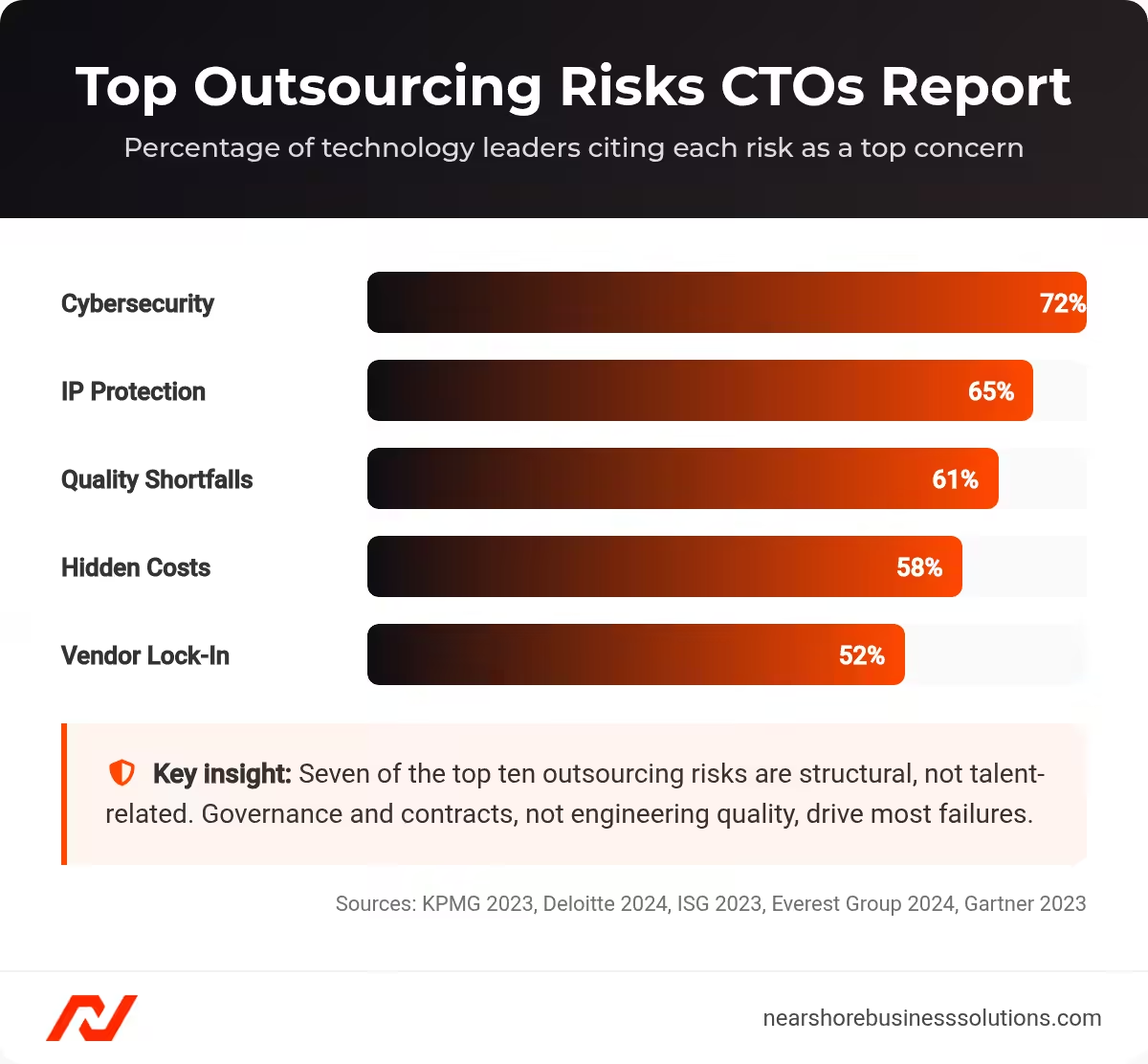
Top outsourcing risks ranked by percentage of technology leaders citing each as a top concern.
What Does Termination Data Reveal About Outsourcing Failures?
Gartner pegs early termination or non-renewal at 20-25% of all outsourcing engagements. The causes are structural. Failure to meet SLAs drives 55% of terminations. Poor deliverable quality accounts for 48%. Cost overruns and transparency gaps cause 42%. Lack of proactivity adds another 35%. Every one of these failures traces back to how the relationship was architected, not who wrote the code.
What Is the True Financial Cost of a Failed Outsourcing Engagement?
For companies in the $5M to $100M ARR range, total failure costs reach 150-200% of the first year’s contract value (UpperEdge / CIO Magazine, 2023). Vendor switching runs $50,000 to $150,000 in legal, recruitment, and overlap costs. Lost productivity and rework consume four to six months of internal bandwidth, valued at $200,000 to $500,000.
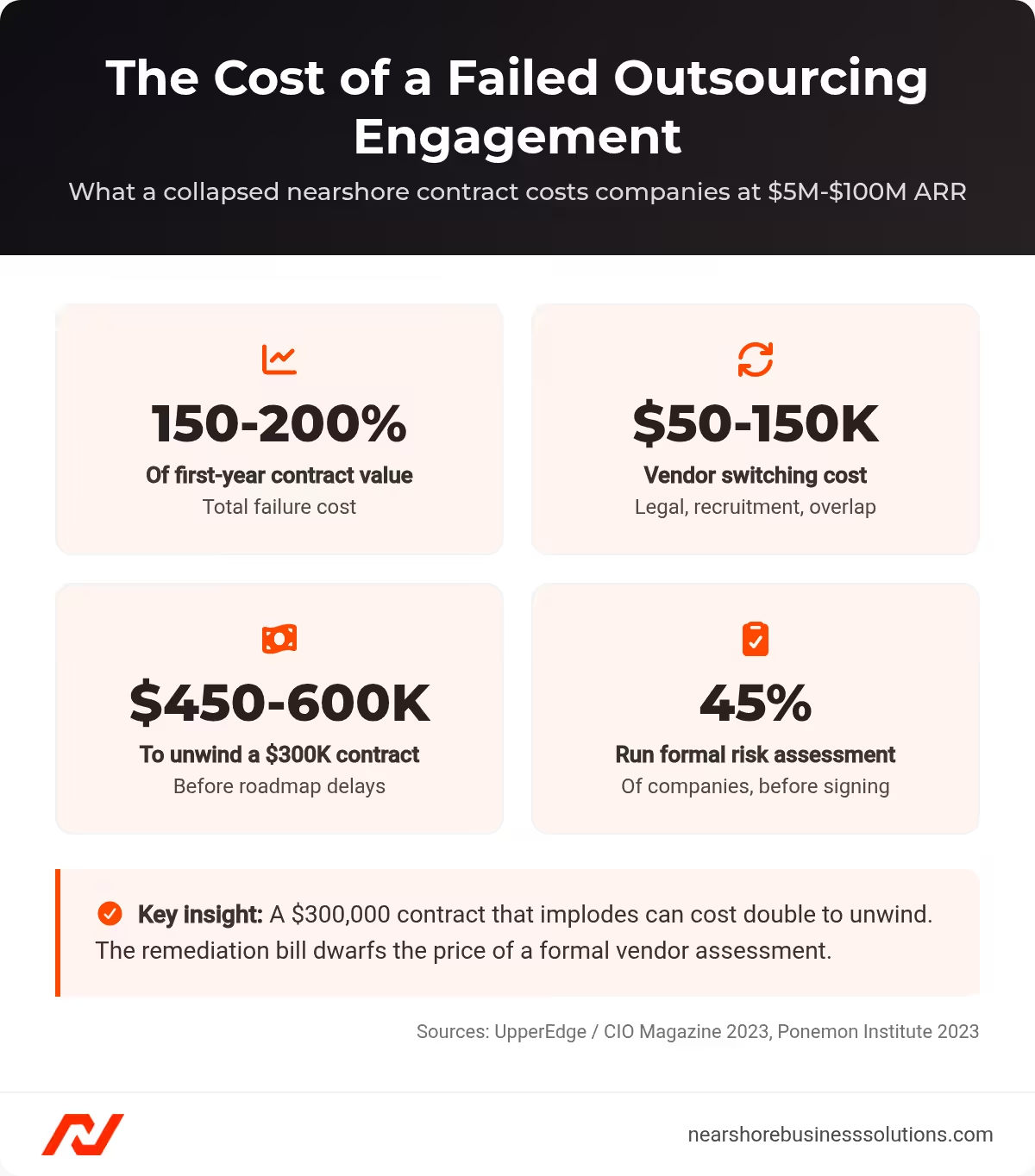
What a collapsed nearshore contract costs companies in the 5 to 100 million dollar ARR range.
Consider a real example. A US fintech startup outsourced mobile app development to an Argentine team. The MSA lacked an IP assignment clause. Twelve months later, investors’ counsel flagged the ownership ambiguity during Series A due diligence. The funding round stalled six months. The startup spent over $100,000 in legal fees to fix it. The engineers had delivered quality code. The contracts had not. Structuring the engagement correctly from day one is the whole point of building compliant nearshore FinTech teams.
What Are the Five Risk Domains Every Nearshore Framework Must Address?
Five domains cover the full risk surface of a nearshore outsourcing engagement. No domain operates in isolation. A weak IP clause amplifies exit risk. A vendor with no continuity plan makes security compliance unauditable.
| Risk Domain | Core Question | Key Mitigation |
|---|---|---|
| Vendor Risk | Is this vendor financially and operationally capable? | Weighted 15-criterion scorecard and ongoing monitoring |
| IP and Legal Risk | Who owns the code across jurisdictions? | IP assignment clauses, NDAs, and source code escrow |
| Security and Compliance Risk | Can the vendor protect our data and meet regulatory obligations? | SOC 2 Type II or ISO 27001 attestation plus contractual controls |
| Operational Continuity Risk | What happens if key people leave or the vendor destabilizes? | Knowledge transfer protocols, SLAs, and redundancy requirements |
| Exit and Transition Risk | Can we leave cleanly without losing code, data, or momentum? | Exit clauses, transition playbook, and data destruction certification |
Addressing all five domains as an integrated system is what separates a de-risked nearshore partnership from a contract waiting to fail.
Why Does the Integrated Framework Matter More Than Checking Boxes?
A common mistake is treating the five domains as a compliance checklist rather than an interdependent system. Consider what happens when you address security (Domain 3) but ignore exit (Domain 5). You get SOC 2 Type II certification from the vendor, which confirms controls were audited. But if the vendor owns the build pipeline and your MSA contains no code delivery obligation on termination, you have compliant code you cannot access after the relationship ends.
The same interdependency runs in reverse. Strong exit clauses (Domain 5) are useless if the vendor never implemented knowledge transfer protocols (Domain 4). You can legally demand the code but receive a repository with no documentation, no runbooks, and no context for the architecture decisions embedded in it. For companies in the $5M to $100M ARR range, the ramp cost for a new team starting from an undocumented codebase typically runs three to five months of engineering burn. That is a structural failure the exit clause cannot fix.
The framework works only when CTOs treat all five domains as a system and verify each domain’s controls before the contract is signed, not after problems surface.
How Do You Assess Outsourcing Risk Before Signing a Vendor Contract?
Only 45% of companies perform a formal security and risk assessment of all their third-party vendors before signing (Ponemon Institute, 2023). That gap explains much of the 20-25% early termination rate. A structured vendor scorecard converts subjective impressions into quantifiable scores across financial stability, security posture, legal readiness, and operational maturity.
Leading companies use established frameworks. Over 50% of large tech companies use the NIST Cybersecurity Framework as a baseline. 65% require vendors holding ISO 27001 certification. 40% deploy the Standardized Information Gathering (SIG) Questionnaire for detailed due diligence (Deloitte, 2023). Our checklist for verifying a partner’s SOC 2 and ISO 27001 shows exactly what evidence to request from each vendor.
The cost of skipping the assessment is steep. Companies that skip formal vendor risk reviews before outsourcing account for a disproportionate share of the 20-25% early termination rate. A structured 15-criterion scorecard takes two to four weeks to complete. Legal fees to remediate a bad vendor relationship average $75,000 to $150,000, not counting lost engineering time or delayed product timelines.
For a deeper look at how pricing structures affect risk exposure, see our guide on nearshore development pricing models.
How Does a Weighted Vendor Scorecard Work?
A weighted vendor scorecard converts the assessment into a number you can defend. Each of the fifteen criteria below receives a score from 1 (non-existent) to 5 (fully implemented and independently audited), multiplied by its assigned weight. Maximum possible score is 330. Minimum threshold to proceed: 264 (80%), with no critical-weight item scoring below 3.
| # | Assessment Criterion | What to Evaluate | Weight |
|---|---|---|---|
| 1 | Corporate Information | Legal name, ownership structure, jurisdictional registration | 3 |
| 2 | Financial Stability | Audited financials, credit score, client revenue concentration | 5 |
| 3 | Insurance Coverage | Cyber Liability, E&O, General Liability certificates | 4 |
| 4 | Security Certifications | ISO 27001, SOC 2 Type II report within last 12 months | 5 |
| 5 | Data Privacy Compliance | GDPR, CCPA, LGPD policies and designated DPO | 5 |
| 6 | Business Continuity | BCDR plan with defined RTO/RPO and last test date | 5 |
| 7 | IP Protection Policies | IP assignment agreements, code segregation, open-source policy | 5 |
| 8 | Physical Security | Office access controls and remote work compensating controls | 3 |
| 9 | HR Security | Background checks, security training frequency, offboarding | 4 |
| 10 | Endpoint Security | MDM/UEM, full-disk encryption, automated patching | 4 |
| 11 | Network Security | Firewall rules, IDS/IPS, VPN, network segmentation | 4 |
| 12 | Access Control | IAM/PAM, least privilege, MFA, quarterly access reviews | 5 |
| 13 | Vulnerability Management | Patching SLAs, monthly scans, annual penetration testing | 4 |
| 14 | Secure SDLC | OWASP alignment, code review, SAST/DAST in CI/CD | 5 |
| 15 | Incident Response | Documented plan, last tabletop exercise, client notification SLA | 5 |
Request evidence, not self-attestation. Self-reported questionnaires are the vendor assessment equivalent of trusting a passing test report without running the test suite. For critical-weight items (security certifications, financial stability, IP protection policies, access controls), require documentation: the actual SOC 2 Type II report with the auditor’s letter, audited financials, and a sample IP assignment agreement the vendor has executed with other clients.
What Red Flags in a Vendor Proposal Signal Downstream Risk?
Eight proposal red flags reliably predict downstream problems. LATAM engineer attrition averaged 15-20% annually in 2023. Only 15-20% of LATAM nearshore vendors hold SOC 2 Type II, compared to 35-40% in India (A-LIGN, 2024). Both figures make the first two red flags especially costly.
| Red Flag | Risk Domain | Why It Matters |
|---|---|---|
| No knowledge transfer plans | Operational Continuity | 15-20% annual attrition means undocumented knowledge leaves with developers |
| Vague IP assignment language | IP and Legal | “Jointly owned” suggests the vendor may claim shared ownership under local law |
| Resistance to SOC 2 or ISO 27001 disclosure | Security and Compliance | Only 15-20% of LATAM vendors hold SOC 2 Type II. Refusal signals controls that cannot withstand scrutiny |
| Unwillingness to agree to source code escrow | IP and Legal / Exit | A vendor resisting escrow plans to use your dependency as a retention mechanism |
| No BCDR plan or refusal to share RTO/RPO | Operational Continuity | Infrastructure problems reveal organizational failure, not regional constraint |
| Fixed-price with no change order process | Vendor Risk | Cost overruns surface as adversarial disputes rather than managed change |
| Subcontracting clauses with no disclosure | Security / Vendor Risk | Undisclosed subcontracting voids the entire due diligence process |
| No named account manager or escalation path | Vendor / Continuity | Signals a vendor that sells talent, not outcomes |
For a detailed breakdown of how vendor lock-in risk compounds over time, see our guide on nearshore vendor lock-in risk.
How Do Outsourcing Pricing Models Create or Amplify Vendor Risk?
The 58% cost overrun rate (Everest Group, 2024) correlates most strongly with fixed-price contracts where scope was poorly defined and T&M contracts with no burn-rate monitoring. Your pricing model choice is a risk management decision, not just a finance decision.
| Risk Dimension | Time and Materials | Fixed-Price | Staff Augmentation |
|---|---|---|---|
| Cost Risk | Buyer bears overrun risk. Hour caps and sprint budgets help. | Vendors pad 20-35% to absorb uncertainty | Predictable per-unit cost, unpredictable in aggregate |
| Quality Risk | Misaligned: vendor revenue increases with hours billed | Partially aligned: incentivizes efficiency but also corner-cutting | Buyer-dependent: quality depends on your engineering management |
| Scope Flexibility | High. Requirements evolve without renegotiation | Low. Changes require formal change orders | High. Buyer directs priorities in real time |
| Vendor Lock-in | Moderate. Vendor holds process knowledge | High. Vendor owns delivery process and architecture | Low. Knowledge lives in your systems |
| Best For | Mid-stage products with evolving requirements | Bounded projects with stable specs | Core product development requiring deep team integration |
A vendor that proactively shares rate cards and offers multiple engagement models demonstrates transparency that reduces cost risk before the first invoice.
Staff augmentation reduces vendor lock-in risk more than any other model because knowledge stays in your systems, not the vendor’s. When a key developer exits (15-20% annual attrition in LATAM), you own the architecture decisions, the runbooks, and the codebase. That ownership is structural, not contractual.
What Are the Biggest IP Risks in Outsourcing and How Do You Neutralize Them?
Sixty-five percent of technology leaders cite IP theft or leakage as a top concern (Deloitte, 2024). Most CTOs misdiagnose the threat. The dominant IP risk is not malicious theft. It is structural ambiguity. Nobody clarified who owns the code. A developer introduces a copyleft-licensed library that obligates you to open-source your application. A contractor reuses architecture from a previous client and contaminates your codebase with infringement liability.
What Is the Difference Between IP Assignment and IP Licensing for Nearshore Code?
IP assignment transfers ownership. IP licensing grants permission to use. These are not interchangeable, and the distinction determines who actually owns the software your nearshore team builds.
Most CTOs assume paying for development work confers ownership. Under US law, the work-made-for-hire doctrine assigns ownership to the hiring party, but only for W-2 employees or nine narrow statutory categories. Independent contractors, which is how nearly every nearshore vendor classifies its engineers, fall outside this framework. Without an explicit written assignment, the contractor retains copyright.
Four elements make an IP assignment clause enforceable:
- Explicit Statement of Intent: Invokes the work-for-hire doctrine where applicable.
- Contingent Assignment: If work-for-hire fails, operates as a direct, irrevocable transfer of all right, title, and interest upon creation.
- Waiver of Moral Rights: Where full waiver is unenforceable (Argentina, Brazil), a covenant not to exercise is a practical substitute.
- Further Assurances: Requires the vendor to execute additional documents for patent or copyright filings after the engagement ends.
How Do IP Laws Differ Across LATAM Jurisdictions for Nearshore Contracts?
Every major LATAM nearshore country enshrines moral rights as foundational principles. These rights cannot be waived or transferred in most cases. General language like “all IP transfers to Client” is legally insufficient across all four jurisdictions without the additional elements above.
| Jurisdiction | Work-for-Hire Recognition | Moral Rights | Key Requirement |
|---|---|---|---|
| Mexico | Recognized with explicit written agreement | Generally non-waivable but contractually limitable | Explicit written agreement. Most aligned with US concepts |
| Colombia | Not recognized by default. Economic rights require separate assignment | Strong and inalienable. Covenant not to exercise is a practical substitute | Explicit assignment clause mandatory |
| Argentina | Recognized in employment but not for contractors | Cannot be waived | Separate transfer and assignment agreement essential for contractors |
| Brazil | Requires explicit assignment specifying scope, conditions, duration, and territory | Inalienable. Neither waiver nor transfer recognized | General language is insufficient under Brazilian judicial interpretation |
Sources: DLA Piper, “IP Protection in Latin America,” 2023; Berne Convention.
The practical implication for CTOs: do not rely on a vendor’s template MSA. Standard vendor MSA templates are written to protect the vendor. Your legal counsel needs to review and insert all four elements of the IP assignment clause before signature. The cost of that review ($5,000 to $15,000 in legal fees) is a fraction of the remediation cost if IP ownership is contested post-termination.
For teams already managing an existing vendor relationship, the staff augmentation costs guide covers how to structure engagement terms that preserve IP clarity across billing cycles.
Frequently Asked Questions About Outsourcing Risk Management
These are the most common questions CTOs and VPs of Engineering ask before signing a nearshore outsourcing contract.
What Percentage of Outsourcing Contracts Fail?
Gartner reports 20-25% of outsourcing engagements terminate early or go unrenewed. Structural failures drive most of those terminations: SLA failures account for 55%, poor deliverable quality for 48%, and cost overruns for 42%. Having a formal risk framework before signing significantly reduces your exposure to all three categories.
Do I Need a Formal Vendor Risk Assessment Before Outsourcing?
Yes. Only 45% of companies perform a formal third-party risk assessment before outsourcing (Ponemon Institute, 2023). Companies that skip formal assessment disproportionately appear in the 20-25% termination rate. A 15-criterion weighted scorecard takes two to four weeks to complete and identifies disqualifying gaps before contracts are signed.
What Is Source Code Escrow and When Do I Need It?
Source code escrow deposits your codebase with a neutral third party (Iron Mountain, EscrowTech, or NCC Group). If the vendor ceases operations, misses a critical SLA, or enters bankruptcy, the escrow releases the code to you. You need escrow when the vendor hosts proprietary infrastructure or manages a build process you cannot independently replicate.
What SOC 2 Certification Should I Require from Nearshore Vendors?
Require SOC 2 Type II (not Type I). Type I is a point-in-time assessment. Type II covers a 6-12 month audit period and confirms controls actually operate as described. Only 15-20% of LATAM nearshore vendors hold SOC 2 Type II certification compared to 35-40% in India (A-LIGN, 2024). Request the full audit report with the auditor’s letter, not just the certification badge.
How Do I Protect Continuity When a Key Developer Leaves?
LATAM engineer attrition averaged 15-20% annually in 2023. Require the vendor to maintain current architecture documentation, runbooks, and onboarding guides as contractual deliverables with defined update cadences. Require a minimum two-person overlap on critical modules. Insert an SLA for replacement timelines (typically 30-45 days for senior engineers) and a knowledge transfer period of at least 20 hours before departure.
What Exit Clauses Should Every Nearshore MSA Include?
A complete exit clause package includes: a 60-90 day notice period, vendor-funded transition assistance for the notice period, source code and documentation delivery within 5 business days of notice, data deletion certification within 30 days of termination, and a covenant prohibiting the vendor from soliciting your employees for 12 months post-termination. Without a transition assistance obligation, you will fund your own transition out of your own budget.
What Is the Difference Between Nearshore and Offshore Outsourcing for Risk Management?
Nearshore vendors in Latin America work within 0-3 hours of US time zones, enabling real-time oversight and reducing communication-gap risks. Offshore vendors in India or Eastern Europe operate with 8-13 hour time zone differences, which increases the window between problem detection and remediation. From a risk management perspective, nearshore arrangements give you faster SLA response verification, more synchronous code review cycles, and easier on-site audit access.
Ready to Build a De-Risked Nearshore Partnership?
Nearshore Business Solutions sources and vets developers across Latin America. We screen for technical skills, English fluency, and US work style fit.
Every placement includes a 90-day replacement guarantee. You receive the first pre-vetted candidates within 3 business days. Our vendor vetting process applies the same 15-criterion scorecard framework described above to every partner we recommend.
Book a free risk-framework consultation to review your current vendor agreements and identify your highest-priority exposure gaps.