
Among US technology companies, 81% now offer remote flexibility, and McKinsey research shows 87% of workers offered flexibility take it. Remote-tagged engineering roles attract 2-3x more applicants than on-site equivalents.
Remote engineering teams ship faster when managers stop replicating office rituals and start building systems for distributed work. Doist cut internal meetings to less than 5% of work time using async-first workflows. Async standups alone recover 150+ hours per engineer per year, per Forrester research. Companies using OKRs are 32% more likely to report strategic alignment across distributed locations, per Perdoo’s 2023 survey.
NBS embeds senior Latin American engineers directly into remote engineering workflows. Each developer is screened for technical skills, English fluency, and US work style fit before your first interview. Below you’ll find the communication architecture, rituals, performance systems, and 90-day roadmap that separate high-performing remote teams from those that slowly drift apart.
Why Do Most Approaches to Managing a Remote Team Fail?
61% of software engineers would consider quitting if forced back to the office full-time. That figure is 16 percentage points higher than the cross-industry average, per Blind’s 2023 survey data. Companies with strict on-site mandates saw 3.3% higher attrition over six months compared to flexible peers, according to Scoop’s Flex Report. Most engineering leaders still manage remote teams using frameworks designed for hallway conversations and shared whiteboards. That mismatch grows sharper when the team spans continents, a challenge our guide to leading distributed global teams takes on directly.
Three failure modes account for most remote management breakdowns.
Why Does Copying Office Rituals Backfire for Distributed Teams?
Knowledge workers in async-first environments are 49% more likely to report high productivity than those in sync-heavy workflows, per Qatalog and GitLab’s 2022 research. The core mistake is translating every in-person ritual directly onto video calls. The daily standup becomes a daily Zoom. The quick desk tap becomes a Slack message expecting an instant reply. Each translation preserves the form of co-located collaboration while destroying what made it work.
Stanford researcher Jeremy Bailenson identified four causes of Zoom fatigue: excessive close-up eye gaze triggering hyperarousal, cognitive overload from decoding non-verbal cues, increased self-awareness from seeing oneself on screen, and physical immobility reducing cognitive function. Microsoft neuroimaging research confirmed that back-to-back virtual meetings spike beta brainwave activity linked to compounding stress.
The foundational shift is async-first communication. Design workflows where the default interaction is a written artifact, such as a Notion document, a Loom video, or a detailed pull request description, not a synchronous conversation. Async-first does not mean async-only. It means synchronous time becomes scarce, protected, and reserved for decisions that genuinely require real-time debate.
Does Employee Monitoring Help Remote Teams Perform?
No. Employees whose managers focus on strengths and outcomes are 6x more likely to be engaged than those whose managers fixate on hours logged, per Gallup’s 2023 State of the Global Workplace report. Monitoring software correlates with lower trust, higher stress, and increased attrition. Your highest-performing engineers leave first because they have the most options and the lowest tolerance for surveillance.
The alternative is outcome-based accountability. 78% of remote-first companies already use OKRs, and those companies are 32% more likely to report strategic alignment, according to Perdoo’s 2023 State of OKRs report. OKRs replace presence tracking as the primary accountability mechanism. Measure what engineers ship, not when their Slack status turns green.
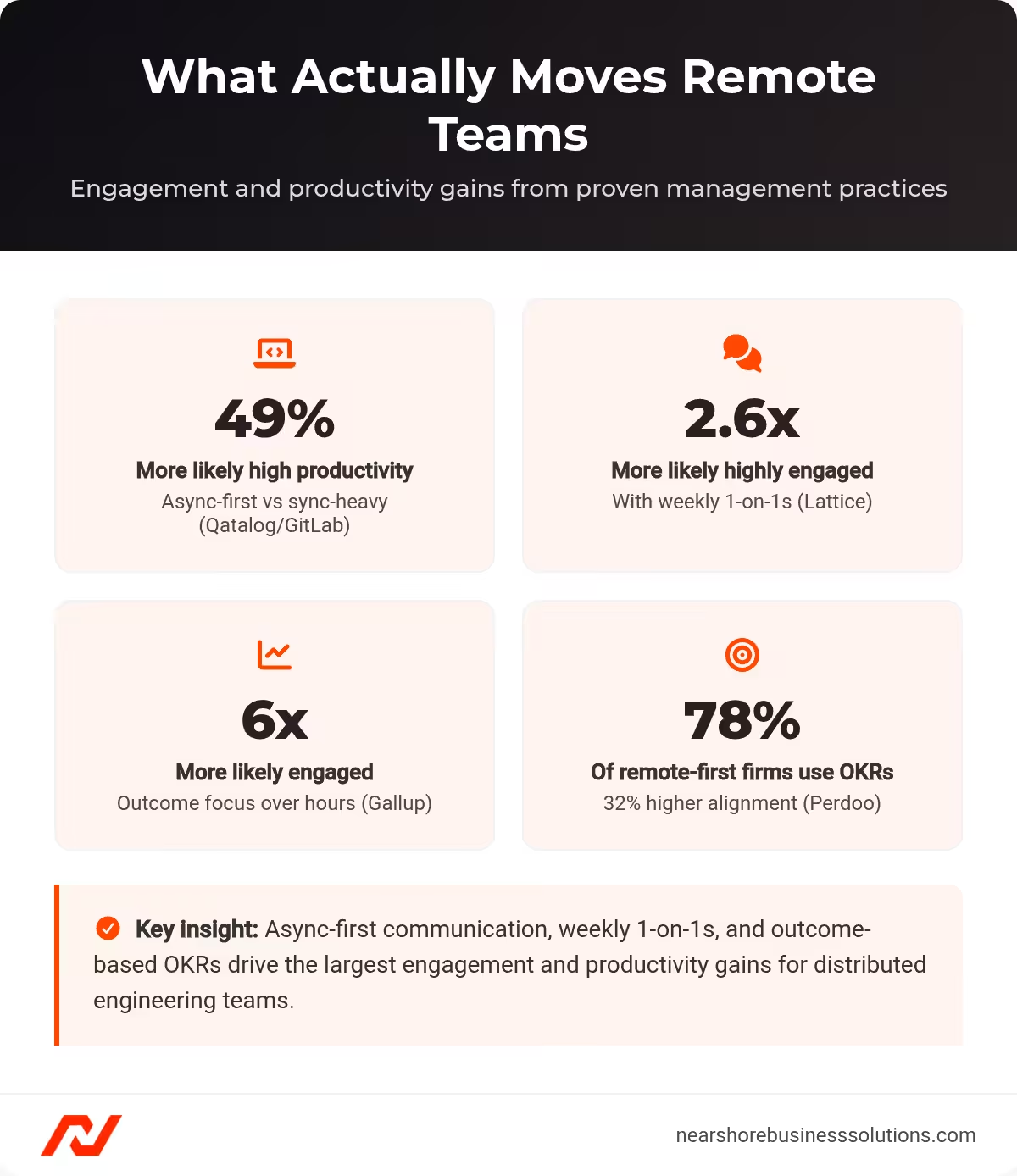
Engagement and productivity gains from async-first work, weekly 1-on-1s, and OKRs.
For context on building high-retention remote engineering teams, see our guide on staff augmentation retention.
What Is Documentation Debt and Why Does It Kill Remote Teams?
Companies with strong documentation cultures resolve issues 33% faster because answers are findable without interrupting a colleague, per Slite’s 2022 knowledge management report. That speed advantage matters most across the 3-6 hour time zone gaps typical in distributed teams. Remove physical proximity and every informal knowledge-transfer mechanism disappears. What replaces it is either intentional documentation or nothing. “Nothing” manifests as repeated questions, duplicated work, and onboarding that stretches from weeks into months.
GitLab’s 2,000+ page public handbook enables a fully asynchronous company to operate across 65+ countries. Their handbook-first approach reduces onboarding time for new engineers by up to 50%, per GitLab’s own reporting. Engineering organizations that treat documentation as infrastructure build teams that scale without proportional increases in coordination overhead. Documentation is one lever among many for handling the biggest remote work challenges distributed teams run into.
How Do You Build a Communication Architecture for a Remote Team?
Asynchronous, text-based decision-making groups generate 22% more unique ideas and show lower susceptibility to groupthink than verbal brainstorming groups, per research published in the Journal of Organizational Computing. When you lead a remote team, communication is not a soft skill. It is a system you design with the same rigor you apply to your deployment pipeline.
What Belongs in Async vs. Sync Communication?
Async communication is the default mode. Synchronous time is the exception that requires justification. Amazon’s 6-pager writing culture decouples ideas from presenters. Detailed narrative documents are read silently before any discussion, forcing rigorous thinking before requesting anyone’s time. Doist reduced internal meetings to less than 5% of total work time by building an explicit async communication architecture.
Use this decision framework for every message type:
| Message Type | Channel | Response SLA | Example |
|---|---|---|---|
| Status updates | Async standup tool | Read within 4 hrs | “PR #482 merged; starting integration tests” |
| Technical questions | Slack #help-[topic] thread | 4-8 hours | “How does the rate limiter handle burst traffic?” |
| Architecture decisions | RFC doc + 48-72 hr comment period | 72-hour window | “RFC: Migrating to event-driven architecture” |
| Urgent production issues | #alerts-[service] + PagerDuty | 15 minutes | “P1: Payment latency over 5s across US-East” |
| Feedback and praise | DM (constructive) or public channel (praise) | 24 hours | “Your caching refactor cut p95 latency by 40%” |
| Conflict or sensitive topics | DM + scheduled 1:1 video | Schedule within 24 hrs | “Let’s discuss the API versioning disagreement” |
Four triggers that require escalating from async to sync:
- The 10-message rule. A thread exceeds 10 messages without resolution. Schedule a 25-minute call within 4 hours. Post a written summary within 1 hour of the call ending.
- Emotional tone shift. Defensive language signals that written communication has stripped too much context. Move to a 1:1 video call and use the Situation-Behavior-Impact model.
- Cross-team dependency stalled 24+ hours. Both tech leads join a 15-minute triage call, identify the single next action, and post the outcome publicly.
- Tradeoffs affecting multiple stakeholders. Schedule a 45-minute decision meeting with a pre-read document sent 24 hours in advance.
How Do You Calculate Core Hours Across Time Zones?
Core hours are the 3-4 hour daily window where all team members are expected to be online for synchronous collaboration. Zapier mandates a 4-hour core overlap window. Automattic lets teams establish their own collaboration hours, which consistently converge on 3-4 hours, per their remote work documentation.
Use this formula:
Core Hours = Latest Team Start + 1 hour to Earliest Team End minus 1 hour
For a team spanning San Francisco (UTC-8) and Buenos Aires (UTC-3), this yields roughly 3 hours of synchronous overlap. That window holds every standing sync: sprint planning, architectural reviews, pair programming, and 1:1s. Everything outside that window is protected async time. If your time zone overlap drops below 3 hours, restructure your squad topology. Do not add more meetings.
For nearshore teams with natural US timezone alignment, see our nearshore agile development playbook for detailed squad topology guidance.
What Remote Team Rituals Actually Drive Alignment?
Companies implementing “No Meeting Wednesdays” saw a 44% increase in self-reported productivity and a 35% decrease in stress, per Asana’s 2023 research. The lesson is not that meetings are destructive. Most meetings on a remote team’s calendar exist because no one questioned whether they should. Every recurring meeting must earn its place weekly or be eliminated.
Should Remote Teams Replace Daily Standups With Async Updates?
Yes. Developers report that only 40% of synchronous video standup time is relevant to them, per Forrester’s 2022 Total Economic Impact study of Slack. Async standups recover 30-45 minutes per engineer per day, or over 150 hours per engineer per year. For a 10-person squad, that is 1,500+ hours of engineering capacity returned to actual building annually.
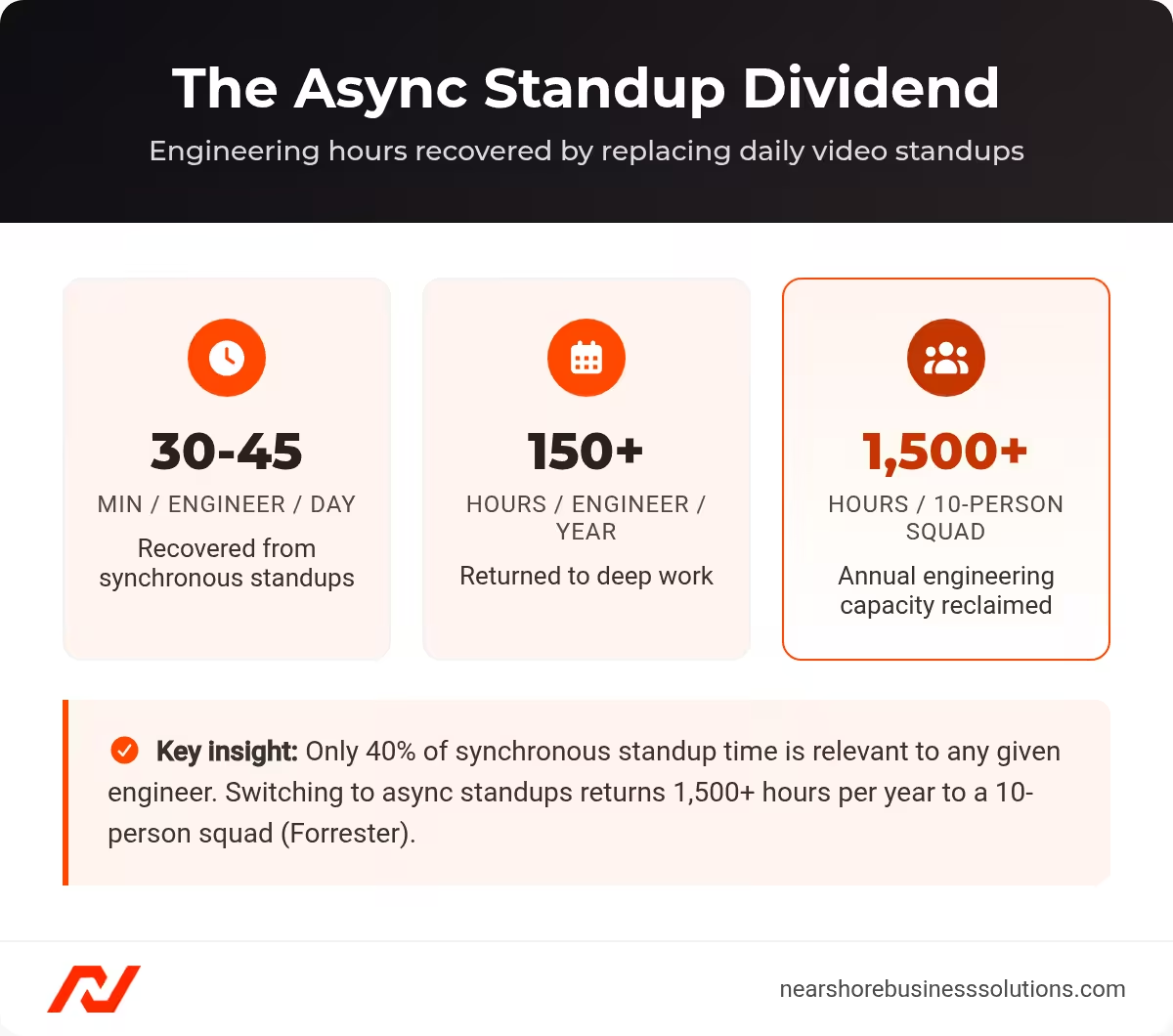
Engineering hours recovered by replacing daily video standups with async updates.
Use this 4-field async standup template:
- What I shipped yesterday. Completed work only: merged PRs, closed tickets, deployed features.
- What I’m working on today. The single most important task, plus one secondary item maximum.
- Blockers or dependencies. Tag the specific person who can unblock.
- Confidence level on sprint commitment: Green / Yellow / Red. Yellow means over 25% chance of missing commitment without intervention.
Configure automated prompts at each engineer’s local start-of-day. Mandate a 4-hour response SLA on tagged blockers. Reserve synchronous standups for sprint-start alignment and active incident response only.
How Often Should Engineering Managers Run 1-on-1s?
Weekly. Employees who have weekly 1-on-1s are 2.6x more likely to be highly engaged, per Lattice’s 2023 State of People Strategy report covering 4,000+ companies. Harvard Business Review identifies consistent 1-on-1s as the single most important practice for remote manager effectiveness and retention. Remote work eliminates every ambient signal that managers rely on to detect disengagement. The weekly 1-on-1 is the only reliable replacement.
Buffer mandates weekly 30-minute 1-on-1s anchored by a shared agenda the direct report populates first. Structure each session so the first 15 minutes belong to the engineer for career development, concerns, and friction. The second 15 minutes are yours: feedback, context, and coaching.
Five questions that surface problems early:
- What is the biggest obstacle slowing your work that I could help remove?
- Is there anything about our team’s process that frustrates you?
- Do you feel you are learning and growing in your current role?
- Is there anyone on the team you are finding difficult to collaborate with?
- What is one thing I could do differently as your manager?
Cancel only for genuine emergencies. Reschedule within the same week.
How Do You Run Effective Sprint Reviews and Retros With Distributed Teams?
Use a hybrid format: async pre-work feeds a focused sync discussion, which produces async action-item tracking. This three-phase structure maximizes participation equity across time zones.
Phase 1 (48 hours before). Engineers add items to a retro board with specific examples, not vague sentiments. Anonymous posting increases candor.
Phase 2 (30 minutes maximum). Dot-vote on top items, discuss root causes, and assign every action item an owner and due date before the call ends.
Phase 3 (ongoing). Action items post to a #retro-actions channel. The next retro opens by reviewing last sprint’s items: completed, in progress, or abandoned with a stated reason.
For managing distributed team rituals at scale, see our complete guide to managing distributed teams.
What Does a Strong Remote Team Performance System Look Like?
Remote teams need more structure around performance clarity, not less. Engineering leaders building or scaling distributed teams often pair performance systems with staff augmentation to maintain velocity. See our staff augmentation services for how NBS embeds engineers who arrive with remote-ready workflows. Ambient feedback from hallway conversations and overheard praise does not exist in distributed environments. High-performing remote engineering organizations replace ambient accountability with three explicit systems: cascading OKRs, continuous feedback loops, and structured onboarding.
How Do OKRs Work for Remote Engineering Teams?
OKRs function as the connective tissue between an engineer’s daily work and the VP of Engineering’s quarterly targets. 78% of remote-first companies use OKRs, and those companies report 32% higher strategic alignment, per Perdoo’s 2023 survey. Google pioneered OKRs internally, and remote-first companies like Doist use them to align their globally distributed team with quarterly company-wide reviews.
A sample OKR cascade for remote team management:
| Level | Objective | Key Result |
|---|---|---|
| Company | Build world-class engineering capacity | Engineering eNPS from +20 to +45 |
| Team | Reduce coordination overhead | Cut average cycle time from 8 days to 5 days |
| Individual | Ship reliable code faster | Achieve 90%+ PR review participation rate |
Publish all OKRs transparently in Notion or your shared workspace. Remote team members perform better when they understand why their work matters, not just what is due.
How Do You Give Continuous Feedback in a Remote Engineering Team?
Weekly micro-feedback in 1-on-1s, monthly growth check-ins, and quarterly formal calibrations replace annual reviews that arrive too late to change behavior. Async kudos in public Slack channels reinforce positive behavior in real time. Structured feedback in 1-on-1s using the Situation-Behavior-Impact model prevents misinterpretation in text-based communication.
How Long Does Onboarding Take for Remote Engineers?
Remote engineers without a structured onboarding playbook take 2-3x longer to reach full productivity compared to those with a clear 30-60-90 day plan. The essentials are: pre-Day 1 access provisioning, an assigned onboarding buddy, and a documentation-first orientation in Notion. Engineers should merge their first meaningful PR within the first two weeks.
For detailed onboarding playbooks for remote engineers, see our staff augmentation onboarding guide.
What Is the Right Tooling Stack for a Remote Engineering Team?
The average remote engineering team uses 12-15 core applications, and context switching between those apps costs the average knowledge worker up to 4 hours per week in lost productivity, per Qatalog’s 2023 research. The principle is minimal viable toolstack: every tool must serve a clear function in your communication architecture. Tool sprawl is a symptom of unclear communication norms, not a tooling problem.
What Tools Should the Communication Layer Include?
Slack serves as the real-time nervous system for remote engineering teams, with 91% adoption among tech organizations per Okta’s 2024 Businesses at Work report. Loom handles async video walkthroughs for code reviews and architecture decisions. Email is reserved for external communication only. Configure Slack notification schedules aligned with core hours. Set Do Not Disturb defaults for off-hours across all time zones.
Why Is Your Team Wiki the Most Important Remote Infrastructure?
A well-maintained wiki, which Slite research shows reduces issue resolution time by 33%, is the closest system remote teams have to institutional memory. Every document in Notion or your wiki needs a DRI (directly responsible individual) and a quarterly review cadence. Engineers who can find answers without interrupting colleagues are more productive and less likely to experience the “documentation debt” burnout cycle.
What Tools Power the Collaboration and Delivery Layer?
Jira (83% adoption) and Linear (40% adoption, growing rapidly in startups) handle project management. GitHub (95% adoption) manages code collaboration. Figma (75% adoption) covers design collaboration, per Okta’s 2024 data. Tool selection matters less than consistent usage patterns documented in your team handbook. Every tool should support async-first workflows with defined sync escalation paths.
Frequently Asked Questions About Managing a Remote Team
Engineering managers scaling distributed teams ask these questions most often.
How Many Hours of Overlap Do Remote Teams Need Each Day?
Three to four hours of daily overlap is the research-backed minimum for effective distributed collaboration, per Twist (Doist’s remote work research division). This window is sufficient for pair programming, design sessions, and sprint ceremonies without forcing an entire workday to be synchronous. Below three hours, restructure your squad topology rather than compressing more meetings into a narrower window.
Do Remote Engineers Need Video Cameras On During Meetings?
No. Mandatory camera-on policies accelerate Zoom fatigue and correlate with lower engagement for senior engineers who need deep work blocks. Reserve camera-on time for 1-on-1s, team retrospectives, and high-stakes decisions. Normalize camera-off for all-hands and informational meetings. Monitor camera-off trends during 1-on-1s as an early signal for burnout or disengagement, not as a compliance issue.
How Do You Handle Underperformance in a Remote Engineering Team?
Start with data. Remote performance gaps in cycle time, sprint completion rate, or documentation contribution are visible in your engineering intelligence platform (LinearB, Jellyfish, or Pluralsight Flow) before they become interpersonal issues. Address gaps in the weekly 1-on-1 with specific, written feedback using the Situation-Behavior-Impact model. If the gap persists after 30 days of documented support, initiate a formal performance improvement plan with clear written targets.
What Is the Best Way to Build Trust in a Remote Team?
Weekly 1-on-1s are the highest-leverage trust-building practice per HBR’s remote management research. Beyond 1-on-1s: budget for at least one in-person offsite per year. It is the highest-ROI culture investment for remote teams. Virtual coffee pairings (randomized 15-minute async-scheduled video chats) and interest-based Slack channels (not mandatory engagement) also build ambient connection without forced participation.
How Do You Detect Burnout Early in Remote Engineers?
Watch for four signals: a camera-off trend in 1-on-1s, shorter message length in async updates, declining PR activity over two or more consecutive sprints, and withdrawal from social channels. When you see two or more signals simultaneously, initiate a direct check-in within 24 hours. Ask specifically about workload and ask the engineer to identify one thing that would reduce friction this week.
How Long Does It Take to Get a Remote Engineer to Full Productivity?
Engineers with a structured 30-60-90 day onboarding plan reach full productivity in 4-6 weeks. Engineers without one take 8-12 weeks or longer. The variables that matter most are: pre-Day 1 system access, an assigned buddy for the first 30 days, a documented team handbook in Notion, and a clear first-PR target within the first two weeks.
What Does a 90-Day Plan Look Like to Manage a Remote Team Effectively?
This phased roadmap is designed for engineering leaders who want to implement a complete remote management system without trying to change everything at once. Three months is enough time to audit, build, and measure the core systems.
What Should You Do in the First 30 Days?
Seven first-month priorities will stop the most common sources of remote management bleeding:
- Audit all recurring meetings and eliminate at least 30% immediately.
- Establish core hours: identify your 3-4 hour daily overlap window across all team locations.
- Migrate daily standups to async via Geekbot or Standuply.
- Set up Notion as the team wiki starting with onboarding docs and a decision log.
- Implement weekly 30-minute 1-on-1s with every direct report.
- Publish the async-first decision framework in your team handbook.
- Configure Slack channel taxonomy and archive dead channels.
What Should You Build in Days 31-60?
Five system-building priorities in the second month:
- Launch cascading OKRs from team level to individual level, with all OKRs visible in Notion.
- Run a toolstack audit. Consolidate ruthlessly. The average team uses 12-15 apps, and sprawl costs 4 hours per week per engineer in switching overhead.
- Document your team’s full operating manual: communication norms, escalation paths, and meeting cadence.
- Set up the hybrid async retro format (48-hour pre-work + 30-minute sync + async action tracking).
- Assign documentation owners with quarterly review cadences for all critical docs.
How Do You Measure Remote Team Health After 90 Days?
Six measurement and investment priorities for the final month:
- Run a team health survey. Benchmark eNPS and remote work effectiveness scores.
- Review your first full quarter of OKR progress. Calibrate targets based on actual velocity.
- Host a retro on the operating model itself, not just the last sprint.
- Plan and budget for an in-person team offsite. This is the single highest-ROI culture investment for remote teams.
- Review burnout signals: camera-off trends, declining PR activity, and withdrawal from social channels. Conduct proactive check-ins before performance gaps appear.
- Publish results and iterate. The operating model is a living system, not a one-time implementation.
Ready to Scale Your Remote Engineering Team?
Nearshore Business Solutions connects you with vetted senior engineers from Latin America who are async-ready and integration-tested from Day 1. We screen for technical skills, English fluency, and US work style fit.
Every placement includes a 90-day replacement guarantee. You receive the first pre-vetted candidates within 3 business days.
Get a free consultation to discuss your remote team needs and receive a custom quote.