
Distributed engineering teams using structured talent management frameworks retain senior engineers 40% longer and spend 2.5x less on annual turnover than teams without formal programs (Mercer, 2023). The following practices apply specifically to nearshore and remote engineering contexts.
Companies with high-maturity talent management programs see 2.5x higher revenue growth and 40% lower voluntary attrition than low-maturity peers (Mercer, 2023). Voluntary attrition for US software engineers hit 13.2% in 2023 (Radford/Aon). At a 50-engineer team, that is 6-7 departures per year, costing $1.6M-$2.7M annually in replacement costs.
Engineering organizations that manage co-located and distributed teams identically miss the structural gap that drives remote attrition. This article covers career laddering, performance review cadences, OKR design, feedback rituals, and onboarding structures proven to retain Latin American nearshore engineers.
Why Does Traditional Talent Management Fail Distributed Engineering Teams?
Traditional talent management relies on proximity. Promotion decisions form around visible effort in a shared office. Mentorship happens organically over lunch. Feedback travels through hallway conversations. Distributed engineering teams in Mexico City, Bogota, and Buenos Aires get none of this infrastructure.
Managers of remote teams spend 15-20% more time on direct communication, 1-on-1s, and documentation than managers of co-located teams (Harvard Business Review, 2023). That overhead is not optional. It is the minimum investment to maintain alignment and team health. Yet most engineering organizations treat distributed management as a minor variant of in-office management rather than a different operating model entirely.
Only 34% of venture-backed tech companies have formally documented compensation bands and career ladders (Carta, 2023). The majority rely on ad hoc processes that structurally disadvantage engineers who are not physically present.
Why Does Proximity Bias Cause “Out of Sight, Out of Growth” for Remote Engineers?
Remote workers receive 15% lower promotion rates than in-office counterparts, despite producing slightly higher productivity metrics (Stanford, 2022). 67% of managers admit to perceiving remote workers as more easily replaceable (SHRM, 2023). That perception converts directly into under-investment: fewer stretch assignments, less sponsorship for leadership roles, and weaker advocacy during calibration sessions.
The downstream effect is attrition. Lack of career growth is the number one reason engineers leave, cited by 45% of departing engineers. Compensation follows at 41%, poor management at 35%, flexibility concerns at 31%, and unchallenging work at 28% (Stack Overflow, 2023; Hired, 2024). Distributed teams that fail to formalize career progression lose their senior engineers to companies that make the growth path explicit and geographically equitable.
Why Can’t Engagement Surveys Alone Predict Engineering Attrition?
Only 49.8% of developers report being “very satisfied” with their job (Stack Overflow, 2023). Pulse surveys capture this dissatisfaction in aggregate but fail to identify which engineers are actively disengaging. They surface the problem weeks or months too late.
Engineering teams generate behavioral data that predicts attrition far earlier. PR review turnaround time is one reliable leading indicator. High-performing teams at GitHub and Shopify maintain a median PR review time under 4 hours. When an engineer’s review times drift from 3 hours to 12+ hours over a 4-week window, that pattern signals disengagement before any survey question captures it. 74% of employees report they are not reaching their full potential due to lack of development opportunities (Axonify, 2023). Engineering leaders need both: pulse surveys for macro-level health, and DORA-aligned engineering metrics to flag individual-level disengagement before it converts into resignation.
What Is the Real Cost of Replacing a Senior Engineer in 2026?
The fully loaded replacement cost for a single senior software engineer earning $180,000 is $270,000-$450,000, representing 150% to 250% of annual salary (SHRM, 2022).
| Seniority Level | US Average Salary | Replacement Cost (150-250%) | Source |
|---|---|---|---|
| Mid-Level | $140,000 | $210,000-$350,000 | SHRM, 2022 |
| Senior | $180,000 | $270,000-$450,000 | SHRM, 2022 |
| Staff/Principal | $240,000 | $360,000-$600,000 | SHRM, 2022 |
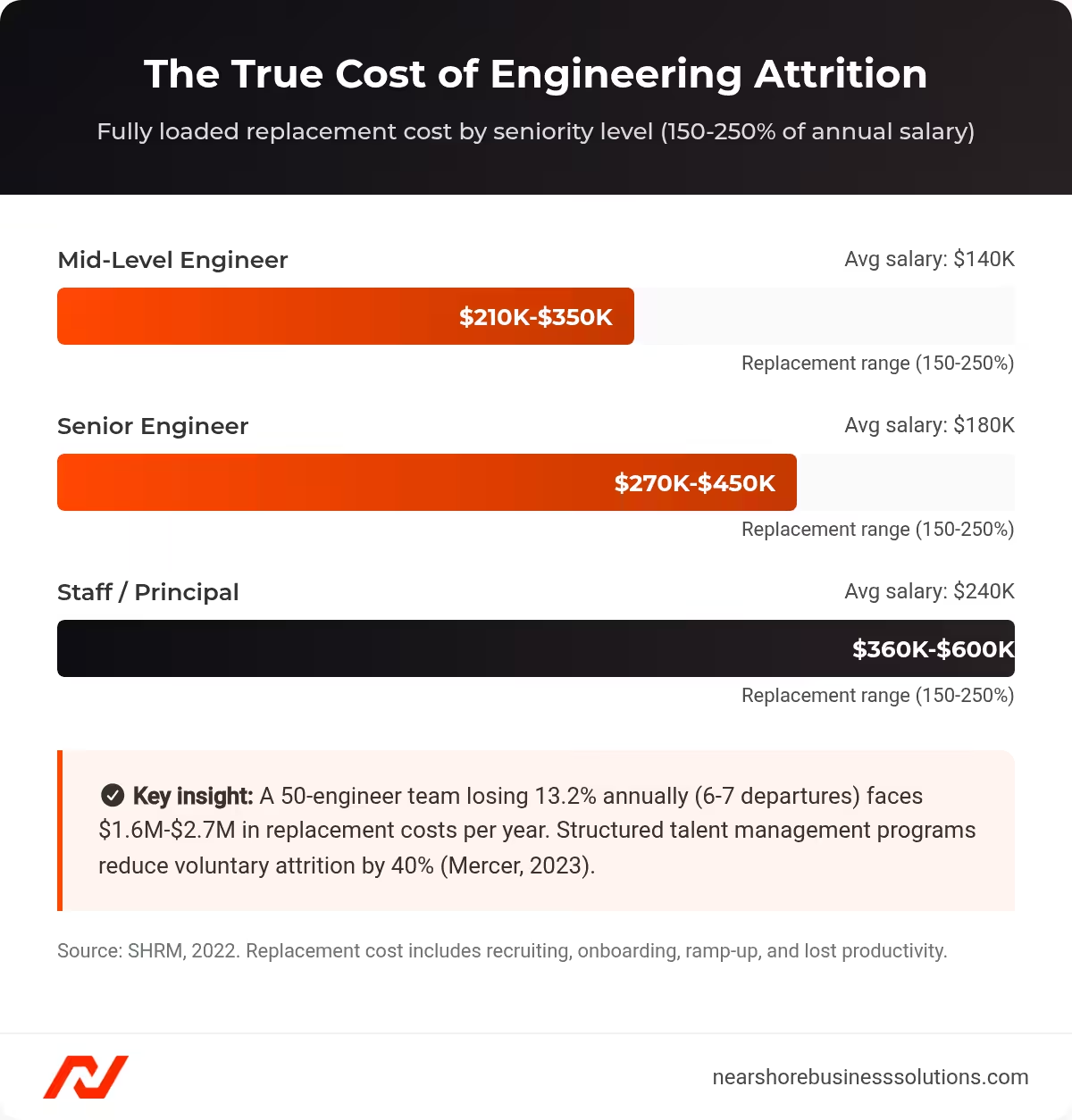
Fully loaded engineer replacement costs by seniority level (SHRM, 2022).
Average software engineer tenure at US tech companies dropped to approximately 2.2 years as of early 2024 (Hired, 2024). Voluntary attrition for US software engineers hit 13.2% in 2023 (Radford/Aon). At a 50-engineer organization, that is 6-7 departures per year: a potential $1.6M-$2.7M annual cost from turnover alone. Structured talent management converts that line item from overhead into an engineering budget priority.
What Are the Core Talent Management Best Practices for Remote Engineering Teams?
Five pillars separate distributed engineering organizations that retain senior talent from those that spend $270,000+ per replacement cycle:
- Structured career laddering with competency-based promotion packets
- Async-first performance management on a quarterly cadence
- Continuous feedback loops designed for time-zone-spanning teams
- Equitable compensation and recognition decoupled from office presence
- Intentional culture building that compounds across geographies
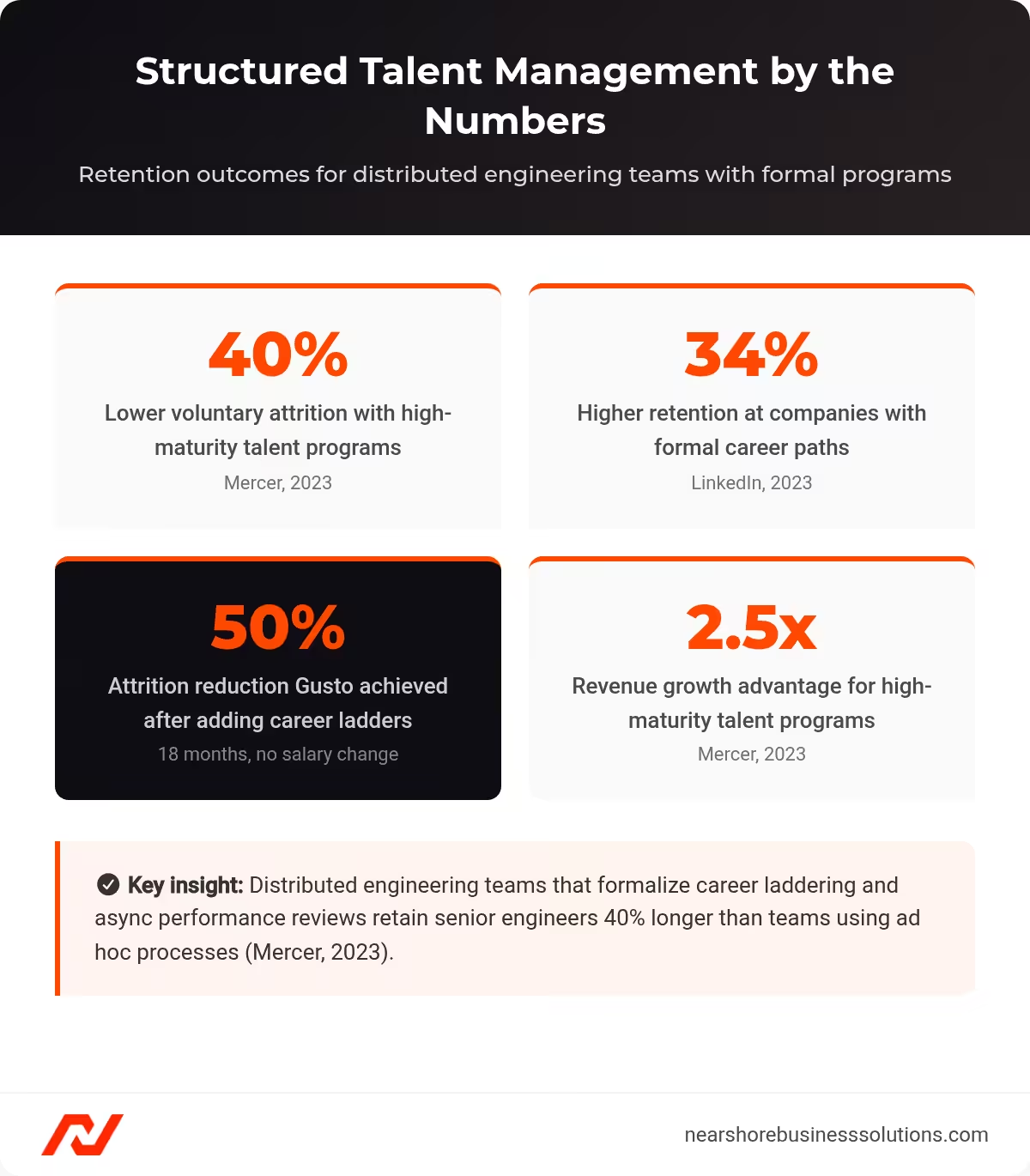
Key retention outcomes for engineering teams with structured talent management programs.
Companies using continuous feedback are 3.5x more likely to have highly engaged employees (Gallup). Structured engagement tactics reinforce that effect, and our roundup of ideas to boost remote team morale details twenty ways distributed teams stay connected between review cycles. 78% of companies now conduct performance reviews at least twice a year, with 35% operating on quarterly or continuous cadences (Lattice, 2023).
For companies building nearshore teams, staff augmentation retention requires applying these same five pillars from day one. The structural investment pays off fastest when installed during onboarding rather than retrofitted after attrition starts.
How Do You Build a Career Ladder Engineers Can Navigate Without a Co-Located Manager?
Companies with formal career paths achieve 34% higher retention than those without (LinkedIn, 2023). After implementing a structured engineering ladder, Gusto reduced voluntary attrition among engineers by 50% over 18 months without raising base compensation.
A well-built career ladder for distributed teams includes these components:
- Dual IC and management tracks running in parallel from Senior level onward. A Staff Engineer in Medellin can advance to Principal without ever managing a direct report.
- Competency-based level definitions across 4-6 dimensions: Technical Skill, Scope of Impact, Communication, Leadership, and Mentorship. Tenure thresholds alone are not sufficient.
- Behavioral anchors with concrete examples at every level. “A Senior Engineer mentors junior engineers on at least one project per quarter” is evaluable. “Demonstrates leadership” is not.
- Published time-to-promotion benchmarks: Junior to Mid-level at 1.5-2.5 years, Mid to Senior at 2-4 years, Senior to Staff at 3-5 years, Staff to Principal at 4-6+ years (Levels.fyi/Glassdoor, 2024).
- Formalized promotion packets assembled collaboratively by the engineer and their manager. Packets document concrete evidence: design docs, code reviews, project impact metrics, and mentorship artifacts reviewed by a calibrated committee against published rubrics.
- Calibration committee review with cross-functional representation. A promotion packet from a nearshore engineer receives the same structured evaluation as one from an engineer sitting near the VP of Engineering.
- Public framework documentation accessible to every engineer on day one. A new hire in Sao Paulo has identical career visibility to a new hire in San Francisco.
- Annual framework review incorporating promotion outcome data. Companies using formal, competency-based career ladders promoted 15% more women and people of color into management roles compared to companies relying on informal processes (Harvard Business Review).
How Do Async-First Performance Reviews Reduce Recency Bias for Remote Engineers?
Adobe replaced annual reviews with a continuous Check-in system and measured a 30% reduction in voluntary turnover (Adobe internal data). Annual reviews amplify recency bias, privilege engineers whose most visible work landed in Q4, and disadvantage anyone whose manager has limited synchronous overlap.
| Cadence Model | Recency/Proximity Bias Risk | Best Fit for Distributed Teams? |
|---|---|---|
| Annual | Very High | No: disadvantages async workers |
| Biannual | High | Marginal improvement |
| Quarterly | Low | Yes: aligns with OKR cycles |
| Continuous (weekly check-ins + quarterly synthesis) | Lowest | Ideal: async-native |
The continuous model separates data collection from evaluation. Weekly async check-ins generate a documented performance record. The quarterly synthesis then operates from shared evidence rather than unaided recall.
Cross-team calibration panels counteract remote work siloing. Microsoft Research’s 2023 study of 60,000 employees found that fully remote work produced a 10-20% decrease in cross-team collaboration. Calibration panels composed of the engineer’s direct manager, one skip-level leader, and one peer from an adjacent team ensure distributed engineers receive appropriate recognition. Async pre-reads submitted 48 hours before calibration meetings eliminate time-zone disadvantage. Work artifacts: design docs, RFC contributions, and code review depth replace visibility as calibration evidence.
Culturally adaptive feedback matters. Latin American engineering cultures often embed critical feedback within relational context. The Situation-Behavior-Impact (SBI) model provides a culturally neutral framework that separates the work artifact from the person, enabling candid performance conversations across cultural communication norms. Hofstede’s Cultural Dimensions research shows LATAM countries score significantly higher on Power Distance (Mexico: 81 vs. US: 40). Managers must explicitly create psychological safety and solicit dissenting opinions.
For tooling, Lattice ($11-$16/user/month) provides career ladder and calibration infrastructure for teams of 20-80 engineers. 15Five ($8-$14/user/month) optimizes for manager behavior change through structured weekly check-ins that take 15 minutes to write and 5 minutes to review.
How Do You Build Feedback Loops That Work Across a 10,000-Mile Distance?
GitLab’s optimal distributed squad size is 5-7 engineers, slightly smaller than the traditional “two-pizza team,” to reduce communication overhead (GitLab, 2023). 55% of workers would consider leaving a job that did not offer async flexibility (GitLab, 2023 Remote Work Report).
Six feedback rituals create the structural backbone:
| Ritual | Cadence | Format | Purpose |
|---|---|---|---|
| Async Stand-ups | Daily | Async (Slack) | Surface blockers, maintain visibility |
| Manager 1:1 | Biweekly | Sync (video) | Coaching, career development |
| Skip-Level | Monthly | Sync (video) | Surface issues, build senior leadership trust |
| Weekly Demo | Weekly | Sync (video) | Showcase working software |
| RFC | As needed | Async (written) | Equalize architectural influence across geographies |
| Quarterly Virtual Offsite | Quarterly | Sync (half-day video) | Strategic planning and team bonding |
Schedule synchronous rituals during the 10 AM-2 PM CT overlap window. Mexico City and Bogota share 100% timezone overlap with US Central Time. Buenos Aires and Sao Paulo maintain 75% overlap with CT: a decisive scheduling advantage over Asian and Eastern European time zones.
For more on structuring distributed team communication, see remote team management tips for nearshore engineers.
How Do You Align OKRs With Engineering Talent Development Across Time Zones?
Aligning OKRs with talent development requires encoding both delivery and growth outcomes in the same quarterly framework. 70-80% of high-performing Silicon Valley companies run on OKRs (WorkBoard, 2023). Most engineering organizations deploy OKRs exclusively as a delivery tool. For distributed teams, OKRs are also the most scalable mechanism for connecting a backend engineer in Guadalajara to both company strategic priorities and their own career trajectory: but only when the framework explicitly encodes both delivery and development outcomes.
How Do You Connect Individual Growth OKRs to Team-Level Engineering Outcomes?
A WorkBoard client measured a 25% increase in product release velocity within two quarters of implementing a structured OKR cascade. The gain came from alignment, not additional hiring (WorkBoard, 2023).
| Level | Objective | Key Results |
|---|---|---|
| Company | Accelerate product velocity | KR1: Ship 3 major features per quarter. KR2: Reduce median time-to-merge by 20%. |
| Team | Improve backend reliability and capability | KR1: Achieve 99.95% uptime. KR2: Each engineer completes 1 cross-domain pairing rotation per quarter (growth). |
| Individual (70/30) | Deliver API migration and grow system design skills | KR1: Complete API v3 migration by end of Q2 (delivery). KR2: Lead 2 architecture reviews with peer feedback of 4/5 or higher (growth). |
The 70/30 delivery-to-growth ratio is the critical design decision in OKR architecture for distributed teams (WorkBoard framework). The 30% growth allocation forces both the engineer and their manager to define capability-building outcomes each quarter, mapped directly to competency dimensions in the career ladder. Growth KRs make invisible work visible: mentoring junior engineers, writing runbooks, and providing substantive code review. Without explicit encoding, the engineer in Mexico City who spends 8 hours per week on mentorship receives less credit during calibration than the engineer in Austin who ships a visible feature.
The weekly-to-quarterly rhythm prevents the number one OKR failure mode: “set-it-and-forget-it,” which affects 65% of OKR implementations (Betterworks, 2023). Weekly async check-ins with the prompt “Which Key Result did your work advance this week?” generate 12-13 data points per quarter. Jointly owned KRs link to 2x higher goal commitment (Deloitte, 2023).
For Latin American engineers who operate within cultural frameworks emphasizing collective achievement, managers should reframe growth KRs in terms of team impact. “Raise the team’s architectural decision quality by leading 2 reviews incorporating input from at least 3 engineers across geographies.” The outcome is identical; the framing aligns with a collectivist orientation that produces stronger intrinsic motivation.
What Remote Team Management Tactics Measurably Reduce Engineering Attrition?
Buffer’s 2023 State of Remote Work survey ranked distributed team retention factors in this order: flexibility in working hours, professional development opportunities, clear career path, and strong positive remote culture. The frameworks above build structural foundations. The tactics below translate them into Monday-morning execution.
How Do You Use Onboarding to Retain Distributed Engineers in the First 90 Days?
20% of employee turnover occurs within the first 45 days (BambooHR, 2023). Organizations with a standardized onboarding program experience 50% greater new-hire productivity and 62% greater new-hire retention (Brandon Hall Group).
A structured 90-day program for distributed nearshore engineers:
- Pre-start (Days -7 to 0): Ship equipment, provision all accounts, assign an onboarding buddy in a compatible time zone, and send a welcome packet including the career ladder documentation and team OKRs.
- Week 1: Synchronous orientation covering product architecture. The new engineer pairs with their buddy to complete a first PR: merging a real change to production on Day 2 or 3.
- Weeks 2-4: Two scoped starter tickets exposing core codebase. Biweekly 1:1 with their manager and a skip-level introduction with senior leadership.
- Weeks 5-8: Full sprint participation. The 30-day check-in focuses on blockers, tooling gaps, and drafting the first growth KR.
- Weeks 9-13: The engineer presents at a weekly demo, contributes to an RFC, and completes a 90-day self-assessment against the career ladder. The formal 90-day review establishes their baseline performance narrative.
Companies that provide a dedicated L&D budget of $1,500-$3,000 per engineer per year see a 30-50% increase in retention for participating employees (Axonify, 2023). Combined with structured onboarding, transparent career ladders, and the OKR cascade described above, these investments convert talent management from an overhead cost into the highest-ROI line item in the engineering budget.
Frequently Asked Questions About Talent Management Best Practices
What tools do distributed engineering teams use for talent management?
Lattice ($11-$16/user/month) covers career laddering, calibration, and OKR tracking for teams of 20-80 engineers. 15Five ($8-$14/user/month) is optimized for manager behavior change through structured weekly check-ins. Culture Amp provides engagement survey tooling with segmentation by team and geography.
How long does it take to see results from structured career laddering?
Gusto reduced voluntary attrition by 50% over 18 months after implementing a structured engineering ladder. Teams typically see initial impact within two quarterly review cycles, when engineers begin submitting their first competency-based promotion packets.
How do you run performance reviews across multiple time zones?
Async pre-reads submitted 48 hours before calibration meetings eliminate time-zone disadvantage. Weekly async check-ins throughout the quarter replace unaided recall. The quarterly synthesis then uses documented evidence: design docs, RFC contributions, and code review depth.
What is the 70/30 OKR rule for distributed engineering teams?
The 70/30 OKR design framework allocates the majority of quarterly Key Results to delivery outcomes and the remaining portion to growth outcomes (WorkBoard framework). The growth allocation forces explicit documentation of mentoring, architectural reviews, and cross-team collaboration: work that would otherwise be invisible during calibration for geographically distributed engineers.
How do you retain nearshore Latin American engineers long-term?
The highest-impact retention levers for Latin American nearshore engineers are: a published career ladder accessible from day one, a culturally adaptive feedback model using the SBI framework, skip-level relationships with senior US leadership, and async OKR check-ins that make their contributions visible without requiring synchronous presence during US business hours.
What is the ROI of formal talent management for a 50-person engineering team?
A 50-engineer team with 13.2% annual attrition loses 6-7 engineers per year. At $270,000-$450,000 per senior engineer replacement, that is $1.6M-$2.7M annually in turnover costs. Companies with high-maturity talent management programs reduce voluntary attrition by 40% (Mercer, 2023), reducing that exposure to under $1M per year.
How does proximity bias affect engineers at nearshore partner companies?
67% of managers admit to perceiving remote workers as more easily replaceable (SHRM, 2023). Remote workers receive 15% lower promotion rates despite higher productivity (Stanford, 2022). Without a structured calibration process and published career ladder, nearshore engineers face a systematic disadvantage regardless of contribution quality.
Ready to Build a Nearshore Engineering Team With Structured Retention?
Nearshore Business Solutions sources and vets engineers from Mexico City, Bogota, Buenos Aires, Guadalajara, and Medellin. We screen for technical skills, English fluency, and US work-style fit.
Every placement includes a 90-day replacement guarantee. You receive the first pre-vetted candidates within 3 business days. Our remote talent acquisition process includes career ladder alignment and onboarding protocols as standard deliverables.
Get a free consultation to discuss your hiring needs and receive a custom talent retention plan.