
Paying international employees in Latin America saves 60-68% versus US rates while accessing 2 million+ skilled IT professionals across Mexico, Brazil, Argentina, Colombia, and Chile.
Total loaded costs for senior engineers run $72,000-$105,000 per year in LatAm, versus $185,000 in the US. EOR platforms set up in 1-2 weeks. Direct entities take 3-6 months and exceed $50,000 in upfront costs. Four main methods exist: direct entity, Employer of Record (EOR), Professional Employer Organization (PEO), and contractor arrangements.
This guide covers payroll tax obligations by country, statutory benefits, currency payment options, and how to choose between EOR and direct entity based on headcount thresholds.
What Does It Mean to Pay International Employees?
Paying international employees means compensating workers in foreign countries while complying with local labor laws, tax codes, and mandatory benefits. You need a legal entity in that country, an Employer of Record, or contractor arrangements.
Latin America’s IT market is projected to reach $59.7 billion by end of 2025. North American SaaS, FinTech, and HealthTech firms use LatAm as a primary talent corridor to fill persistent domestic shortages.
Why Do US Companies Hire International Employees?
US companies hire international employees to solve two problems at once: cost and talent scarcity. Senior engineers in Guadalajara, Bogota, Buenos Aires, and Santiago cost $72,000-$105,000 fully loaded versus $185,000 in the US. That’s a 60-68% reduction per hire.
Beyond cost, Latin America produces over 130,000 engineering graduates annually from universities like Tecnologico de Monterrey (ITESM), UNAM, Universidad de los Andes, EAFIT, and Universidad de Buenos Aires (UBA). These developers work in compatible time zones with US teams, enabling real-time collaboration impossible with offshore teams in Asia.
What Is International Payroll?
International payroll calculates and disburses compensation according to foreign labor codes, tax withholding rules, and mandatory benefits. It requires tracking regulatory changes, currency fluctuations, and statutory payment deadlines across jurisdictions.
How Does International Payroll Differ From Domestic Payroll?
Latin American employment law is fundamentally distinct from US at-will employment. Labor codes in LatAm protect workers with non-negotiable statutory benefits. Total employment costs run 130-150% of base salary once you add mandatory bonuses, social security taxes, and severance fund contributions.
The US work-for-hire doctrine also differs from LatAm civil law tradition. LatAm distinguishes between Moral Rights (creator recognition, inalienable) and Economic Rights (commercial exploitation). Standard US IP assignment clauses often fail in LatAm jurisdictions.
What Are the Components of International Payroll?
International payroll in Latin America includes six cost layers beyond base salary.
- Base salary (60-70% of total employment costs)
- Mandatory 13th month bonuses (Aguinaldo in Mexico, SAC in Argentina, Prima de Servicios in Colombia)
- Social security taxes (20-47% depending on country)
- Severance fund contributions (Brazil’s FGTS requires 8% of gross salary monthly)
- Vacation premiums (25% in Mexico)
- EOR or entity overhead costs (8-15% of payroll)
Total employment costs run 130-150% of base salary regardless of method.
What Are the Legal Requirements for Paying International Employees?
You must comply with local labor codes, tax withholding rules, mandatory benefits, and data protection laws in each country where you employ workers. Each jurisdiction has distinct requirements.
What Employment Laws Apply When You Pay International Employees?
Employment laws vary by country. Here is what changed in 2024-2025 across the top five LatAm markets.
Mexico: The “Chair Law” (Ley Silla) introduced in June 2025 requires adequate seating and prohibits bans on seated breaks. Mexico’s minimum wage saw a 13% increase for the 2026 cycle. A 40-hour workweek proposal is under active discussion, forcing companies to model staffing costs under a reduced-hour framework.
Brazil: The Consolidation of Labor Laws (CLT) governs almost every aspect of employment. Brazil’s FGTS severance penalty is 40% of total accumulated balance for termination without just cause. Brazil’s LGPD data protection law underwent significant upgrades in 2024, adding stricter penalties and mandatory standard contractual clauses for international data transfers.
Argentina: Under President Milei’s labor liberalization, probationary periods extended from 3 months to 6-12 months for some sectors. Specific fines for administrative errors in employment registration were eliminated. The mandatory 13th month salary (SAC) remains required, paid in June and December. Argentina uses USD-referenced or Blue Chip Swap contracts to protect purchasing power in a hyper-inflationary environment.
Colombia: Colombia is transitioning to a 42-hour workweek. Maximum hours were set at 44 as of July 2025. Employers must manage the Prima de Servicios (one month salary per year) and contribute to Parafiscal funds supporting national training through INNpulsa Colombia programs.
Chile: Chile’s 2024 Cybersecurity Act created the National Cybersecurity Agency (ANCI), establishing strict incident reporting for FinTech and infrastructure firms. Chile is often the most business-friendly market in South America, with an employer burden of just 5-10%.
What Are Payroll Tax Obligations for International Employees?
Employer payroll tax burdens range from 5% in Chile to 47% in Brazil. Most LatAm markets fall in the 17-29% range.
| Country | Employer Burden | Employee Deductions |
|---|---|---|
| Chile | 5-10% | 18-20% (health and pension) |
| Mexico | 17-20% | Varies |
| Argentina | 20-25% | Varies |
| Colombia | 25-29% | Varies |
| Brazil | 35-47% | Varies |
Despite Brazil’s high employer burden, US companies still achieve 60-68% cost savings versus domestic hiring in a Tier 1 US city.
What Is Global Payroll Compliance?
Global payroll compliance means adhering to labor regulations, tax codes, and data protection laws across jurisdictions. Brazil’s LGPD and Peru’s 2025 data privacy law require US companies to maintain localized data processing registries. Peru imposes fines up to $70,000 for failing to inform employees about personal data processing.
What Is the Difference Between Hiring an International Employee and an International Contractor?
Employees work under your direction with fixed schedules and company equipment. Contractors operate independently. Latin American labor courts apply the “Reality over Form” doctrine and will reclassify contractors as employees based on actual working conditions, not contract language.
How Does Contractor vs. Employee Classification Work Internationally?
The “Reality over Form” doctrine is universal in Latin American civil law. Four markers trigger reclassification: subordination, fixed schedules, company-provided equipment, and exclusivity. SaaS and FinTech sectors are particularly exposed.
For more on contractor compliance, see our guide to paying international contractors: payment methods and compliance.
What Are the Risks of Misclassifying International Workers?
Misclassification triggers four costly outcomes.
- Requirement to pay all back-dated mandatory benefits (13th month salary, vacation premiums)
- Liability for unpaid social security contributions and income tax withholdings
- Compound interest and statutory fines reaching 100% of the principal amount
- Aggressive auditing by labor courts in Mexico, Brazil, and Colombia (2024-2025 regulatory cycle)
What Are the Main Methods to Pay International Employees?
Four methods exist for paying international employees. Each trades speed against legal control.
| Method | Setup Time | Monthly Cost | Best For | IP Protection |
|---|---|---|---|---|
| Own Entity | 3-6 months | $2,500-$5,000 + payroll | 20+ employees | Absolute |
| EOR | 1-2 weeks | $400-$800/employee | 1-20 employees | High |
| Payroll Provider (PEO) | 4-8 weeks | $150-$400/employee | 10-50 employees | Medium |
| Contractors | 1-3 days | $0 base fee | 1-5 hires | Contractual only |
The core tension is speed-to-market versus long-term legal control. Your headcount in a single jurisdiction determines the right method.
Can You Pay International Employees Through Your Own Entity?
Yes, you can use a direct entity, but upfront costs in Brazil and Mexico frequently exceed $50,000 with 3-6 month setup timelines. Monthly administrative costs run $2,500-$5,000. This option becomes economical at 20 or more hires in a single jurisdiction. It provides absolute IP protection and requires registration with national industrial property offices (INAPI in Chile, INPI in Brazil).
Can You Pay International Employees Through an Employer of Record?
Yes, EOR has become the default infrastructure for organizations scaling beyond initial hires. Monthly platform fees run $400-$800 per employee with 1-2 week setup. EOR is optimal for 1-20 hires. It provides high IP protection through statutory and contractual mechanisms. Compliance responsibility transfers to the provider. Companies typically transition from EOR to direct entity at 15-20 employees.
Can You Pay International Employees Through a Payroll Provider?
Yes, a PEO setup takes 4-8 weeks with monthly fees of $150-$400 per employee. This is best for 10-50 hires. It creates co-employment with shared legal employer status and split compliance responsibility. Integration with HRIS platforms like Workday, Rippling, and HiBob is a key selection factor.
Can You Pay International Employees as Contractors?
Yes, setup takes 1-3 days with no monthly base fees. This is only viable for 1-5 hires. IP protection relies solely on contract language. Misclassification exposure increases with relationship duration. Do not use this model for integrated, long-term engineering talent.
What Is an Employer of Record (EOR)?
An EOR is a third-party company that becomes the legal employer of your international workers, handling payroll, taxes, and compliance while you maintain day-to-day management. For more details on EOR and direct entity tradeoffs, see our guide to EOR vs. local entity in Latin America.
How Does an Employer of Record Work?
The EOR assumes all legal responsibilities for payroll processing, tax withholding, and benefit administration. Your US entity hires employees legally in foreign jurisdictions without a local subsidiary. EOR services cover payroll and tax withholding, benefit administration, IP assignment documentation in local-language contracts, and AI-powered compliance monitoring.
What Are the Advantages and Disadvantages of Using an Employer of Record?
EOR provides compliance-as-a-service against regulatory changes. Setup takes 1-2 weeks versus 3-6 months for a direct entity. Upfront costs are far lower.
The downside: monthly fees of $400-$800 per employee become expensive at scale. Full-service EOR models at $1,000+ per employee achieve retention rates as high as 98%, which offsets the higher cost. Replacing a senior engineer costs $75,000-$150,000. Less direct cultural alignment and fewer tailored benefits than an owned entity.
When Should You Use an EOR to Pay International Employees?
Use an EOR when scaling beyond a handful of initial hires but before reaching 15-20 employees in a single jurisdiction. Choose EOR when speed to market matters more than long-term legal control.
How Do You Set Up International Employee Payroll Through Your Own Entity?
Setting up a direct entity takes 3-6 months and exceeds $50,000 in upfront costs in Brazil and Mexico. Monthly administrative costs run $2,500-$5,000.
What Does Establishing a Foreign Legal Entity Involve?
You must incorporate locally, register with tax authorities, and establish payroll systems. Complex migration of payroll history, benefit accruals, and social security records is required to avoid gaps that could trigger local labor inspections. Registration with national industrial property offices for IP assignment is required (INAPI in Chile, INPI in Brazil). These costs become economical at 20 or more hires in a single jurisdiction, where EOR recurring fees converge with direct entity operational costs.
How Do You Handle Foreign Currency Payments for International Employees?
The average global cross-border payment cost in 2024 was 6.42%. Fintech-enabled rails reduce this to under 1%. Traditional SWIFT networks are increasingly viewed as obsolete for high-frequency payroll.
What Payment Methods Can You Use for International Payroll?
Real-time payment systems now dominate LatAm payroll.
Mexico SPEI: Most payroll providers connect directly as IFPE (Institution of Electronic Payment Funds). USD converts to MXN and settles almost instantly, including weekends.
Brazil PIX: PIX processed over 63 billion transactions in 2024. It is essential for meeting Brazil’s strict 24-hour severance payment timelines.
Colombia Bre-B: Launched in late 2025 to provide a PIX-like experience. Colombia previously relied on PSE for traditional transfers.
Multi-rail orchestration routes payments through optimal rails automatically, selecting SPEI, PIX, or stablecoin rails depending on current liquidity and cost.
Should You Pay International Employees in Local Currency or Home Currency?
Pay in local currency for standard employment. Argentina uses USD-referenced or Blue Chip Swap contracts to protect purchasing power in hyper-inflationary conditions.
How Do Exchange Rates Affect International Employee Payments?
FX costs are the hidden drain in international payroll. Traditional banks charge 3.0-5.0% FX markup plus $30-$50 flat fees. Fintech alternatives cut that to under 1%.
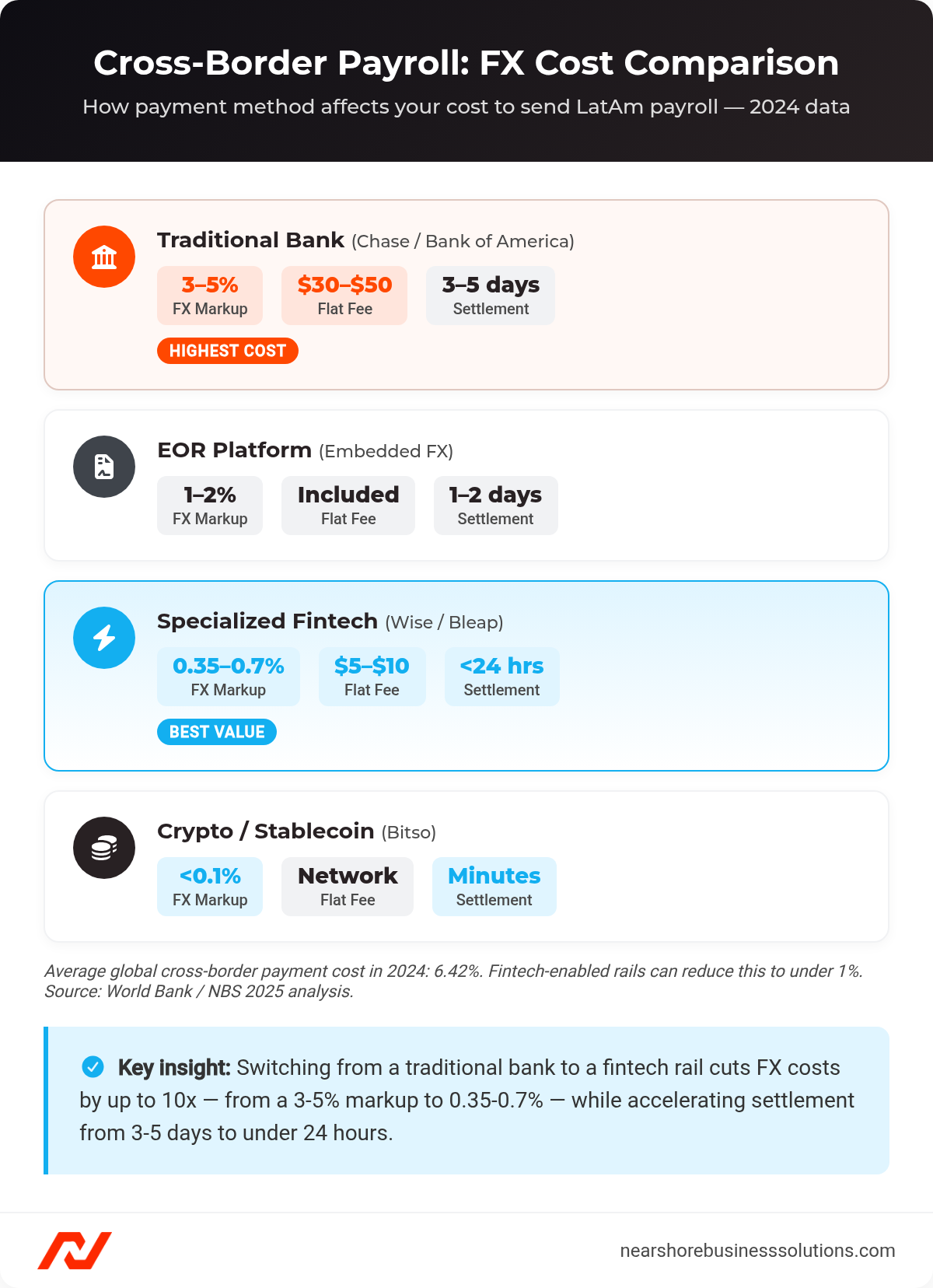
Cross-border payroll FX cost and settlement time compared across traditional banks, EOR platforms, fintech rails, and stablecoin options.
| Payment Method | FX Markup | Flat Fee | Settlement Time |
|---|---|---|---|
| Traditional Bank (Chase/BoA) | 3.0-5.0% | $30-$50 | 3-5 days |
| Specialized FX (Wise/Bleap) | 0.35-0.7% | $5-$10 | Under 24 hours |
| EOR Platform (Embedded) | 1.0-2.0% | Included | 1-2 days |
| Crypto/Stablecoin (Bitso) | Under 0.1% | Network fee | Minutes |
Instant settlement eliminates FX surprises. You know exact costs at payment time, not 3-5 days later.
What Taxes Must You Pay When Paying International Employees?
You must withhold income tax from employee paychecks according to local tax brackets in each jurisdiction. Employer social security contributions range from 5% (Chile) to 47% (Brazil). EOR providers handle withholding automatically. Direct entities must build internal processes per jurisdiction.
What Are Social Security and Insurance Contribution Requirements?
Brazil’s FGTS requires 8% of gross salary deposited monthly into a severance fund. Across LatAm, employer contributions range from 5% (Chile) to 47% (Brazil). Most countries fall in the 17-29% range. Mexico and Argentina sit in the middle at 17-25%.
How Do Tax Treaties Affect Payroll Tax Obligations?
Tax treaties prevent double taxation but rarely eliminate employer payroll obligations. Treaties primarily address income tax treatment for employees, not employer-side contributions. Consult local tax advisors in each jurisdiction to determine applicable treaty benefits.
What Benefits Are Required When You Pay International Employees?
Statutory benefits in Latin America are non-negotiable. Minimum vacation, 13th month bonuses, and severance are required by law in every major LatAm market.
What Are Statutory Benefits by Country?
Five core LatAm markets each have distinct statutory benefit requirements.
| Country | 13th Month Bonus | Vacation Premium | Severance | Other |
|---|---|---|---|---|
| Mexico | Aguinaldo (min 15 days) | 25% of vacation pay | 3 months + 20 days/year | Food allowances |
| Brazil | 13th month salary | Standard | 40% of FGTS balance | Mandatory food allowances |
| Argentina | SAC (June/Dec) | Standard | Varies | Multiple statutory benefits |
| Colombia | Prima de Servicios (1 month) | Standard | 30 days first year | Parafiscal contributions |
| Chile | Standard | Standard | Capped at 11 months | Health contributions |
Minimum vacation days: Mexico 12, Brazil 30, Argentina 14-35, Colombia 15, Chile 15. Maternity leave runs 12-18 weeks. Paternity leave runs 5-15 days. All are statutory minimums.
Most LatAm countries mandate employer contributions to public health systems. Mexico requires IMSS enrollment. Brazil and Chile allow employees to direct contributions to private providers. Argentina and Colombia use mixed public-private systems.
What Documentation Do You Need to Pay International Employees?
You need hyper-localized employment contracts, payroll records, and work authorization documents for each jurisdiction. Standard US contracts do not satisfy Latin American legal requirements.
What Employment Contracts Are Required for International Hires?
Hyper-localized, local-language agreements are required. IP assignment clauses must use immediate assignment language: “The Employee hereby assigns…” Future-tense language (“shall assign”) is legally insufficient in most LatAm jurisdictions. Register IP assignments with INAPI in Chile or INPI in Brazil to ensure they are valid against third parties.
Maintain payroll registers, tax withholding records, benefit contribution receipts, and employment contracts. Brazil requires localized data processing registries for LGPD compliance. Peru’s 2025 data privacy law imposes fines up to $70,000 for failing to inform employees about data processing. EOR providers handle work authorization verification. Direct entities must establish collection processes before first payroll.
How Do You Choose the Right Solution to Pay International Employees?
Your headcount in a single jurisdiction determines your method. EOR is optimal for 1-20 employees. Direct entity becomes cost-effective at 20 or more hires.
What Factors Should You Consider When Selecting an International Payroll Method?
Three factors drive the decision: headcount and growth trajectory in each jurisdiction, capital expenditure capacity (direct entities require $50,000+ upfront), and IP protection needs. Contractors provide contractual protection only. EOR provides high protection. Direct entities provide absolute protection. Also assess HRIS integration with Workday, Rippling, or HiBob.
How Do Costs Compare Between EOR, Payroll Providers, and Entities?
EOR recurring fees converge with direct entity operational costs at 15-20 employees in a single jurisdiction. Digital-first platforms (Remote, Deel, Oyster HR) run $349-$699 per employee per month. Full-service EOR with physical hubs costs ~$1,000. Enterprise-grade managed services (Velocity Global, G-P) run $1,500+.
Full-service models at ~$1,000 per employee achieve retention rates as high as 98%. Digital EOR platforms show churn rates as high as 30% in the first year. Replacing a senior engineer costs $75,000-$150,000, so higher retention offsets premium pricing.
What Questions Should You Ask EOR and Payroll Providers?
Ask five categories of questions before selecting a provider.
- Entity model: Owned entities or aggregator partners? What is your in-country partner reliance?
- Integration: Which HRIS platforms? What is your API sync frequency?
- Payments: Settlement speed? Direct connectivity to SPEI, PIX, and Bre-B?
- Support: Dedicated or pooled account management?
- Compliance: Who owns compliance liability during labor audits?
What Are Multi-Country Payroll Solutions?
Multi-country payroll solutions manage employee compensation across multiple jurisdictions through unified platforms that handle local compliance, tax withholding, and payments.
What Is the Difference Between Multi-Country Payroll and EOR Services?
Multi-country payroll processes payments for your existing legal entities. EOR services become the legal employer. Deel operates as a contractor plus EOR hybrid with acquired local entities in 100+ countries. Remote emphasizes owned-entity infrastructure and acts as direct employer without third-party partners. Oyster HR relies more on in-country partners in certain regions, which can affect payroll cutoff consistency. A single API routes payments through SPEI, PIX, or stablecoin rails automatically, reducing FX costs from the 6.42% global average to under 1%.
What Are the Common Challenges in Paying International Employees?
Three challenges consistently trip up US companies: navigating labor law changes, managing payroll timing, and avoiding misclassification.
What Compliance Mistakes Do Companies Make When Paying International Employees?
Five mistakes generate the most liability.
- Using US-centric contracts instead of hyper-localized local-language agreements
- Using future-tense IP assignment language instead of immediate assignment
- Failing to register IP assignments with INAPI (Chile) or INPI (Brazil)
- Not mapping HR policies to jurisdiction-specific notification requirements (just translating them)
- Treating long-term integrated workers as contractors despite subordination and fixed schedules
Automate payroll runs to meet local statutory deadlines regardless of your time zone. Brazil’s 24-hour severance payment requirement does not accommodate US business hours. Partner with local legal counsel or EOR providers who maintain per-jurisdiction compliance expertise.
What Are the Best Practices for Paying International Employees?
The best practice is to move from a transactional to a structural approach. Plan progression from contractors to EOR to direct legal entities as headcount stabilizes in each jurisdiction. Adopt a Substance over Form compliance mindset: structure working relationships to reflect legal classification, not just contract language.
How Often Should You Audit International Payroll?
Conduct quarterly audits for EOR arrangements to verify correct benefit calculations and tax remittances. Run annual audits for owned entities aligned with local tax filing deadlines. Audit contractor relationships every 6 months. Subscribe to local labor law newsletters and monitor Brazil’s Diario Oficial and Mexico’s DOF for regulatory changes.
Which Method Is Most Cost-Effective to Pay International Employees?
Chile and Colombia offer the lowest total loaded costs for senior engineers. Mexico and Argentina sit in the middle. Brazil has the highest employer burden but still delivers 60-68% savings versus the US.
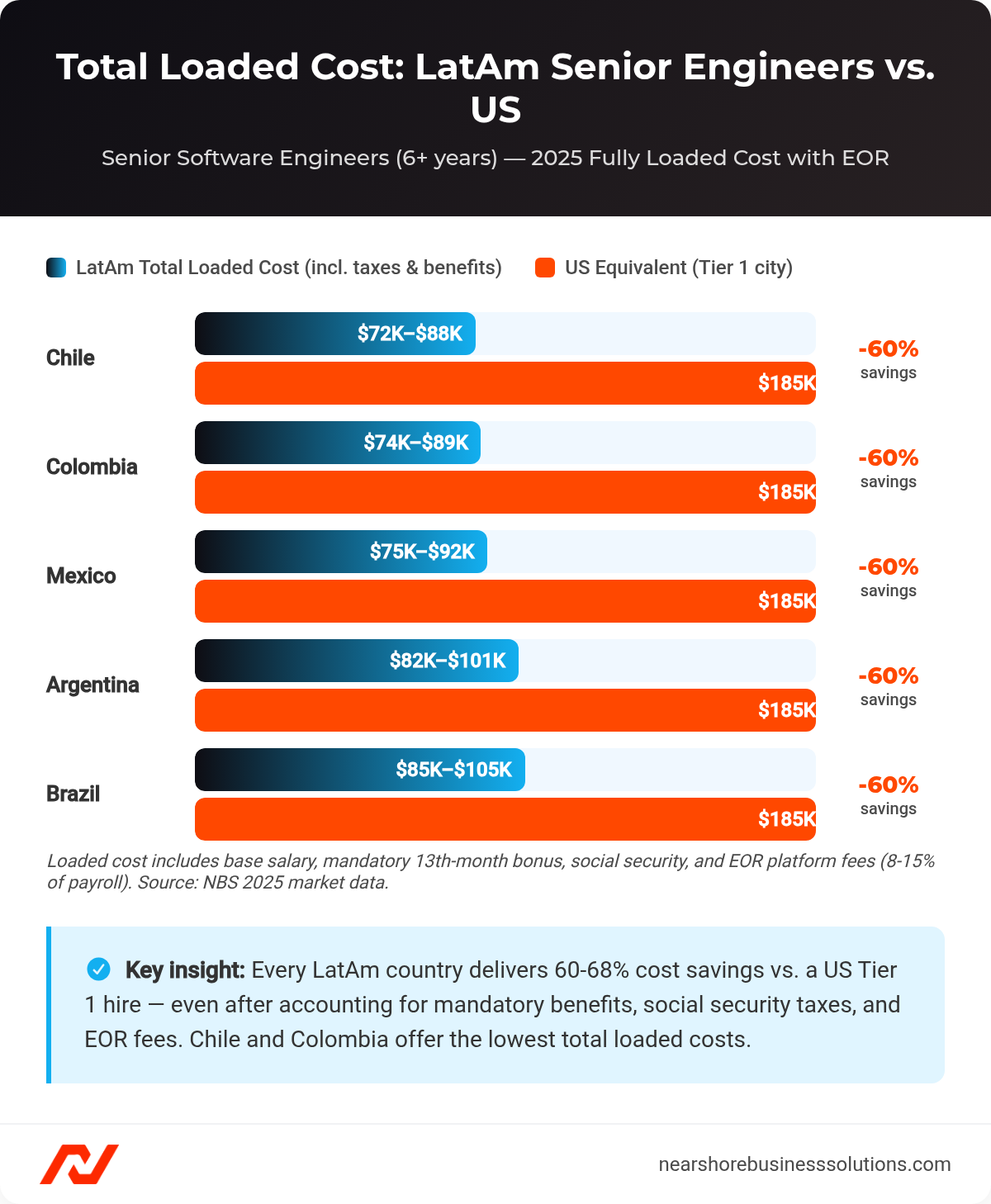
Total loaded cost for senior LatAm engineers across five countries versus the US equivalent, including all mandatory benefits and EOR fees.
What Is the Total Loaded Cost for Senior Engineers by Country?
Total loaded costs account for base salary, mandatory bonuses, social security taxes, and EOR overhead. US equivalent cost for a senior engineer is $185,000 in a Tier 1 city.
| Country | Base Salary Range | Total Loaded Cost | Cost Savings vs. US |
|---|---|---|---|
| Mexico | $55,000-$70,000 | $75,000-$92,000 | 60-68% |
| Brazil | $53,000-$68,000 | $85,000-$105,000 | 60-68% |
| Argentina | $63,000-$75,000 | $82,000-$101,000 | 60-68% |
| Colombia | $51,000-$65,000 | $74,000-$89,000 | 60-68% |
| Chile | $61,000-$72,000 | $72,000-$88,000 | 60-68% |
The 2025 market shows wage compression. Senior developer salaries in LatAm are rising at twice the US rate, driven by global competition for AI and DevOps specialists.
What Does the Severance Liability Look Like by Country?
Severance is a major cost driver, especially in Brazil and Mexico. Plan these costs before terminating without cause.
| Country | Severance Formula (Termination Without Cause) |
|---|---|
| Mexico | 3 months integrated salary + 20 days salary per year of service |
| Brazil | 40% penalty of total FGTS balance for senior-level terminations |
| Colombia | Under 10x min wage: 30 days first year; over 10x min wage: 20 days first year (both increase annually) |
| Chile | Capped at 11 months salary for indefinite contracts |
For detailed guidance on managing remote engineering teams once you’ve set up payroll, see our guide to hiring remote developers in Latin America.
Frequently Asked Questions About Paying International Employees
Here are the most common questions US tech leaders ask about paying international employees in Latin America.
How Long Does It Take to Start Paying International Employees?
Through an EOR, you can have employees legally paid within 1-2 weeks. A direct entity takes 3-6 months. Contractor arrangements are active within 1-3 days, but misclassification risk increases over time.
Do I Need a Local Legal Entity to Hire International Employees?
No. An EOR becomes the legal employer on your behalf and handles all payroll, tax, and compliance. Consider a direct entity when you exceed 15-20 employees in a single jurisdiction.
What If an International Employee Does Not Work Out?
Termination without cause triggers statutory severance. Mexico requires 3 months salary plus 20 days per year of service. Brazil requires a 40% FGTS penalty. Chile caps severance at 11 months. EOR providers handle termination compliance.
How Do I Pay International Employees in Their Local Currency?
Use specialized FX platforms (Wise, Bleap) at 0.35-0.7% markup or an EOR with embedded FX at 1.0-2.0% markup. Both settle in under 48 hours. Brazil’s PIX and Mexico’s SPEI enable near-instant settlement for payroll and severance payments.
What Is the Difference Between EOR and a Payroll Provider?
An EOR becomes the legal employer and assumes all compliance liability. A PEO processes payroll for your existing legal entities with shared compliance responsibility. Use EOR when you have no local entity. Use a PEO once you have established your own entity.
How Do I Protect My IP When Hiring International Employees?
Use hyper-localized contracts with immediate assignment language (“The Employee hereby assigns…”). Register the IP assignment with INAPI in Chile or INPI in Brazil. Future-tense language (“shall assign”) is legally insufficient in most LatAm jurisdictions.
Do I Need to Provide Equipment to International Employees?
Equipment obligations vary by jurisdiction. Many EOR platforms manage equipment shipping and inventory as part of their service for employees in Guadalajara, Medellin, Buenos Aires, Bogota, and Santiago.
Ready to Build Your Latin America Engineering Team?
Nearshore Business Solutions sources and vets developers from Mexico City, Guadalajara, Monterrey, Bogota, Medellin, Buenos Aires, and Santiago. We screen for technical skills, English fluency, and US work style fit. Our acceptance rate is 16%.
Every placement includes a 90-day replacement guarantee. You receive pre-vetted candidates in 2-4 weeks.
Get a free consultation to discuss your hiring needs and receive a custom quote.