
How to Hire in Uruguay in 2026: The Complete Employer’s Guide
Uruguay pairs Latin America’s most stable economy with a highly educated, English-capable workforce and GMT-3 alignment with U.S. teams, making it one of the region’s safest markets to build a remote team.
Get a Free ConsultationThis guide covers what U.S. companies need to know before hiring in Uruguay: salary ranges, hiring models, labor law, payroll, taxes, and total employer cost, whether you engage independent contractors, use an Employer of Record, or set up a local entity.
Why Hire in Uruguay?
Uruguay combines political stability, a skilled bilingual workforce, and strong digital infrastructure, making it one of Latin America’s most reliable markets for building a remote team.
Political & Economic Stability
Uruguay is consistently ranked among the most stable and least corrupt countries in Latin America, with strong rule of law and transparent governance. That stability makes it easier to plan long-term operations and retain top talent.
Educated, Bilingual Talent
A 98% literacy rate and a well-regarded university system produce a steady pipeline of technical and professional talent. English proficiency ranks among the highest in Latin America, especially in tech, finance, and business roles.
Time Zone Alignment
Uruguay runs on GMT-3, giving teams strong real-time overlap with U.S. Eastern and Central hours. That shared workday supports live standups, pair programming, and same-day client response.
World-Class Digital Infrastructure
Uruguay has some of the highest internet penetration in the region (over 90%) and near-universal fiber coverage, so remote teams work with reliable, high-speed connectivity.
Free-Zone & Tax Incentives
Programs like Uruguay XXI and the Zonas Francas regime (Ley 15.921) offer tax incentives that have attracted global software and shared-services operations, anchoring a mature technology export sector.
Cultural Compatibility
Uruguayan professionals are known for reliability, professionalism, and close cultural alignment with North American and European business norms, which makes integrating distributed teams straightforward.
Key Stats About Hiring in Uruguay
Understanding Uruguay’s labor force and digital infrastructure helps you evaluate its potential as a remote hiring destination.
The Most In-Demand Roles to Hire in Uruguay
Uruguay has built one of Latin America’s most mature technology and services ecosystems, home to global players like Globant and the fintech unicorn dLocal. Montevideo anchors the talent base, with a young, highly educated workforce across engineering, data, finance, sales, marketing, support, and operations.
Software Development & Engineering
Uruguay’s software export sector is one of the strongest per capita in the region, producing software engineers and developers well-versed in agile delivery, cloud platforms, and modern frameworks.
- React
- Angular
- Vue.js
- UI/UX
- PWA
- Accessibility
- Performance
- Node.js
- Python
- Java
- .NET
- Spring Boot
- Microservices
- REST APIs
- PostgreSQL
- MERN / MEAN
- Ruby on Rails
- PHP / Laravel
- Serverless
- iOS (Swift)
- Android (Kotlin)
- React Native
- Flutter
- AWS
- Azure
- GCP
- CI/CD
- Kubernetes
- Docker
- Terraform
- SRE
- Manual QA
- Selenium
- Cypress
- Playwright
- Performance testing
- Security testing
Data, AI & Analytics
Graduates with strong quantitative training and hands-on experience in modern data and machine-learning tooling.
- Data analysts
- BI
- Data engineers
- Data scientists
- ML engineers
- Business analysts
- Product analysts
- Marketing analytics
- Web analytics
Finance, Fintech & Accounting
A deep bench of finance talent fluent in international standards, strengthened by Uruguay’s growing fintech sector and cross-border payments industry.
- Staff accountants
- AP / AR
- QuickBooks
- Xero
- Tax
- FP&A
- Budget analysis
- Controllers
- Treasury
- Investment analysis
- Payments ops
- Compliance
- Risk & fraud
- Reconciliation
Sales & Business Development
Sales professionals with strong communication skills and experience selling into North American and European markets.
- Outbound prospecting
- Lead qualification
- Cold outreach
- Salesforce
- HubSpot
- B2B closing
- Enterprise accounts
- Sales managers
- Territory reps
- Partnerships
- Market expansion
- Strategic alliances
- Channel sales
Marketing & Creative Services
A bilingual creative pool that blends analytical marketing with execution across English and Spanish-speaking markets.
- Performance marketing
- Marketing automation
- Email marketing
- CRO
- Organic SEO
- Google Ads
- PPC
- Technical SEO
- Copywriting (EN/ES)
- Video & motion
- Graphic design
- Content strategy
Customer Support & Success
A strong destination for support operations thanks to high English proficiency, a neutral accent, and time-zone alignment with North America.
- Bilingual support
- Technical support
- Chat & email
- Tier 1 & 2
- CSMs
- Onboarding
- Account management
- Retention
- Executive assistants
- Calendar & email
- Data entry
- Research
Operations & Project Management
Organized operators experienced in running complex projects across multiple time zones.
- Agile / Scrum
- Technical PMs
- PMO
- Program managers
- Product owners
- Supply chain
- Logistics
- Ops analysts
- Process improvement
Design & User Experience
A design community recognized for a user-centered, product-minded approach.
- UI/UX
- Product design
- Visual design
- Interaction design
- Design research
- Figma
- Sketch
- Adobe XD
Why These Roles Thrive in Uruguay
The depth and quality of Uruguayan talent stem from several structural factors.
Strong Educational Infrastructure
Institutions such as the Universidad de la República and ORT Uruguay feed a steady pipeline of engineers, analysts, and specialists, backed by early national programs like Plan Ceibal that put technology in every classroom.
Mature Tech & Fintech Ecosystem
Uruguay is the birthplace of Globant and the fintech unicorn dLocal, and it sustains one of the highest software-export rates per capita in Latin America, creating a deep, experienced talent market.
High English Proficiency
Uruguay ranks among the top countries in Latin America on the EF English Proficiency Index, with Montevideo scoring in the “high proficiency” band, so bilingual collaboration comes naturally.
Cost-Effective Talent
Salaries typically run 40-70% below comparable U.S. positions while maintaining high quality standards, offering strong value even in a higher-wage regional market.
Cultural Alignment
Uruguayan professionals share business values with North American companies, including a strong work ethic, reliability, and a collaborative, low-friction communication style.
Monthly Salary Ranges in Uruguay (USD)
Uruguay sits at the higher end of Latin American wages, reflecting its skilled, English-capable workforce, yet still offers substantial savings versus U.S. and European rates.
| Role | Entry Level | Mid-Level | Senior Level |
|---|---|---|---|
| Software Developer (Full-stack) | $2,000-$2,800 | $2,900-$4,000 | $4,200-$6,000 |
| Front-end Developer | $1,800-$2,500 | $2,600-$3,600 | $3,700-$5,000 |
| Back-end Developer | $1,900-$2,700 | $2,800-$3,900 | $4,000-$5,500 |
| DevOps / Cloud Engineer | $2,200-$3,000 | $3,100-$4,200 | $4,300-$6,200 |
| Data Scientist / Analyst | $1,800-$2,500 | $2,600-$3,700 | $3,800-$5,500 |
| QA Engineer | $1,500-$2,100 | $2,200-$3,000 | $3,100-$4,200 |
| Sales Development Rep (SDR) | $1,100-$1,500 | $1,600-$2,100 | $2,200-$2,800 |
| Account Executive | $1,400-$1,900 | $2,000-$2,700 | $2,800-$3,600 |
| Digital Marketer | $1,200-$1,700 | $1,800-$2,400 | $2,500-$3,200 |
| Financial Analyst / Accountant | $1,300-$1,800 | $1,900-$2,600 | $2,700-$3,500 |
| Customer Support Agent | $1,000-$1,400 | $1,500-$1,900 | $2,000-$2,600 |
| Project Manager | $1,900-$2,600 | $2,700-$3,600 | $3,700-$5,000 |
These figures reflect indicative gross monthly compensation and may vary by skill set, seniority, and English proficiency. Hiring through an Employer of Record or a direct contract can also influence final cost. For benchmarks across the region, see our LATAM developer salary guide.
Same business hours, 40-70% lower cost, and the region’s most stable economy paired with top-tier English. That is why U.S. teams build nearshore teams in Uruguay.
3 Legal Ways to Hire in Uruguay
When deciding how to hire in Uruguay, companies have three primary pathways: engaging independent contractors, using Employer of Record (EOR) services, or establishing a local legal entity.
Hiring Contractors
The fastest way to onboard talent, especially for short-term or project-based work. Contractors operate as self-employed individuals who manage their own taxes and benefits, and you pay them per invoice against a clear statement of work.
- Flexibility for short-term or fluctuating workloads
- Cost-effective, with no obligation to provide benefits
- Minimal paperwork and no local entity required
- Misclassification risk if the contractor works like an employee
- Less control than with full-time employees
- May not attract talent seeking stability and benefits
Use a written contract covering scope, payment terms, IP, and confidentiality. Uruguayan authorities can reclassify a contractor as an employee based on the real working relationship, so structure it carefully.
Employer of Record (EOR)
An Employer of Record acts as the legal employer for your Uruguayan staff, so you can hire full-time employees without opening a local entity. The EOR runs payroll, withholds and remits BPS contributions and income tax, administers benefits, and keeps you compliant.
- Ensures compliance with Uruguayan labor law
- Compliant onboarding in days, not months
- Handles HR, payroll, aguinaldo, and benefits
- Monthly service fee per employee adds to cost
- Less direct control, since the EOR is the legal employer
Ideal for testing the Uruguayan market or hiring a small team. A Professional Employer Organization (PEO) is a related co-employment model that shares HR responsibilities rather than acting as sole legal employer.
Local Entity
Forming a local entity lets you hire employees directly and run operations independently. It suits companies planning a substantial, long-term presence in Uruguay.
- Direct control over hiring, payroll, and terms
- Strengthens local brand and market presence
- Supports strategic growth for teams planning to scale
- Setup takes several weeks and ongoing administration
- Higher registration, legal, and compliance costs
- Requires navigating local tax and regulatory rules
Makes sense once you are committed to a sizable team and want full operational control, but budget for the upfront time and cost.
Employment Compliance When You Hire in Uruguay
Hiring employees in Uruguay requires adherence to a clear, worker-protective legal framework. Understanding contract types, statutory benefits, and payroll obligations is essential to staying compliant.
Understanding Uruguayan Labor Law
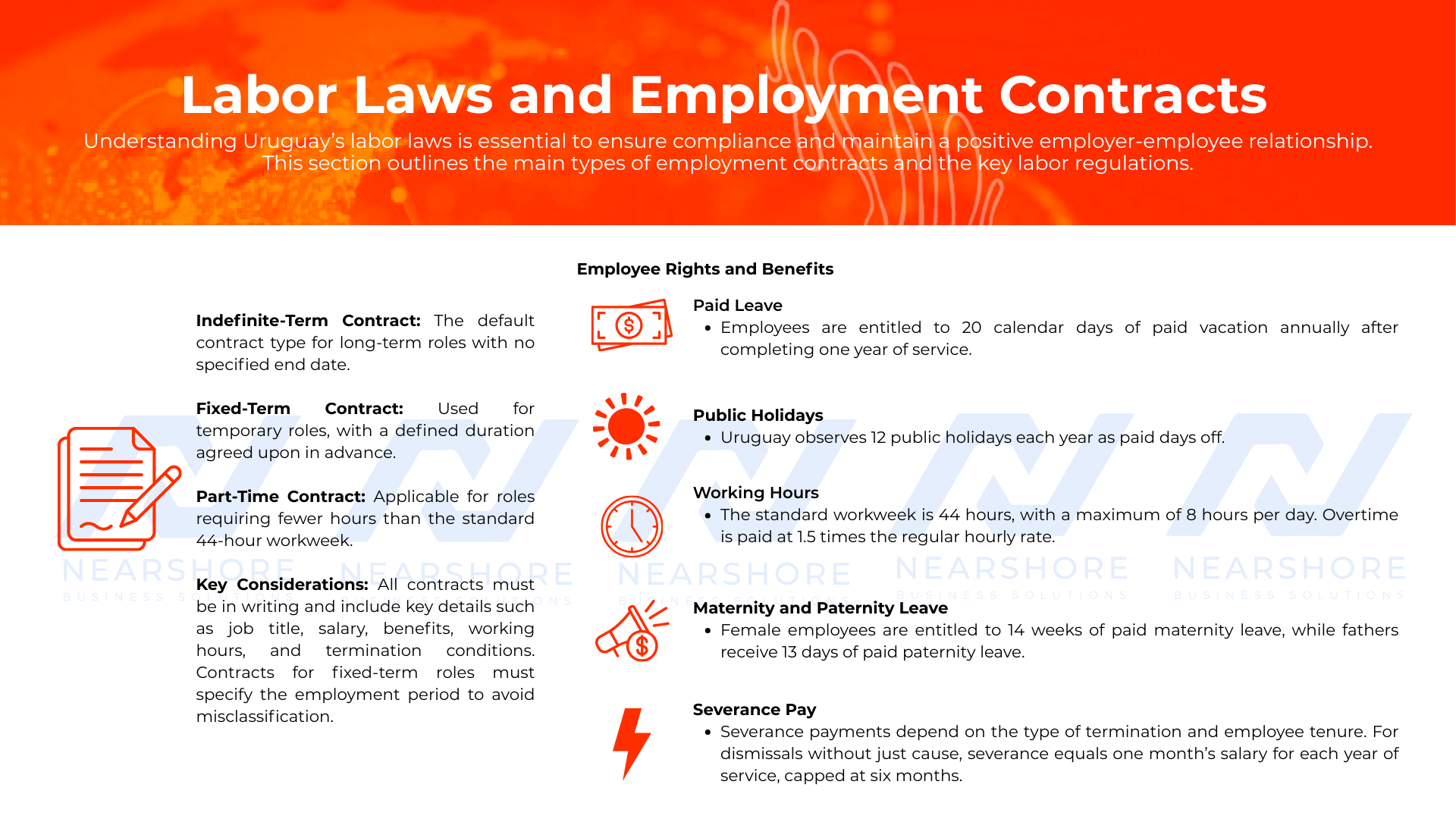
Employment in Uruguay is governed by a body of labor law and sector-specific collective agreements negotiated through the Wage Councils (Consejos de Salarios). All contracts should be in writing and clearly specify the role, salary, working hours, benefits, and termination conditions.
Indefinite-Term Contracts
The default for permanent roles, with no fixed end date. Offers employees the greatest stability and is preferred for long-term positions.
Fixed-Term Contracts
Used for temporary or project work. The contract must clearly define the employment period to avoid reclassification as indefinite.
Part-Time Contracts
For roles requiring fewer hours than the standard 44-hour workweek, offering flexibility for both parties.
Statutory Benefits & Leave Requirements in Uruguay
Employers must provide these minimum benefits to all full-time employees.
View the full statutory benefits table
| Benefit / Leave | Statutory minimum |
|---|---|
| Working hours | 44 hours per week, maximum 8 hours per day; overtime paid at 1.5x the regular hourly rate |
| Annual leave | 20 calendar days of paid vacation per year after one year of service |
| Vacation salary (salario vacacional) | An extra vacation bonus paid before the annual leave, on top of regular pay |
| Public holidays | 12 official holidays observed each year as paid days off |
| Annual bonus (aguinaldo) | 13th-salary equivalent, paid in two installments: half in June, half in December |
| Maternity leave | 14 weeks paid |
| Paternity leave | 13 days paid |
| Severance (dismissal without cause) | One month’s salary per year of service, capped at six months |
Mandatory Contributions & Payroll Deductions in Uruguay
Employers and employees both contribute to Uruguay’s social security system (BPS) based on gross monthly salary.
| Contribution | Employer share | Employee share |
|---|---|---|
| Pension (BPS – jubilación) | 7.5% | 15% |
| Health insurance (FONASA) | 5% | 3%-8% (varies by income & dependents) |
| Labor reconversion fund (FRL, unemployment) | 0.125% | 0.125% |
| Total social security | ~12.625% | ~18.1%+ |
On top of social security, employers withhold personal income tax (IRPF) from wages at progressive rates from 10% to 36%. Companies operating inside a free-trade zone (Zona Franca) are exempt from most national taxes, though BPS social-security contributions still apply. Contribution details are administered by the Banco de Previsión Social (BPS) and the tax authority (DGI).
How to Set Up a Business to Hire in Uruguay
For companies planning a long-term presence with direct hiring, establishing a legal entity is the path. Uruguay’s process is relatively straightforward compared with much of the region.
Simplified Stock Company (S.A.S.)
The preferred structure for foreign investors, offering flexibility, limited liability, and simple governance. Can be formed by a single shareholder.
Limited Liability Company (S.R.L.)
Requires at least two partners, with liability limited to capital contributions. Suits small to medium-sized businesses.
Corporation (S.A.)
A more formal structure with stricter governance and reporting, typically chosen by larger operations or those raising significant capital.
Registration Steps
- Verify the company name — confirm availability through Uruguay’s Public Registry.
- Draft and notarize bylaws — define the company’s structure, purpose, and governance.
- Register with the Public Registry — submit incorporation documents to obtain your business registration number.
- Obtain a Tax Identification Number (RUT) — register with the tax authority (DGI) and enroll with BPS.
- Open a corporate bank account — required for operations and payroll processing.
The process typically takes several weeks. Working with local legal and accounting professionals helps navigate requirements and avoid common pitfalls. Investment-promotion agency Uruguay XXI offers guidance to foreign companies entering the market.
Ongoing Compliance Requirements
Once your entity is operational, maintaining compliance with local regulations is essential.
Annual & Monthly Obligations
- Corporate income tax (IRAE) — filed annually on taxable profits at 25%.
- VAT (IVA) — declared monthly at the 22% standard rate (10% reduced rate on select goods).
- Financial statements — prepared and filed annually.
- Social security — remit monthly BPS contributions for employees on time.
Key Compliance Risks
- Worker misclassification — treating employees as contractors carries back-pay and penalty exposure.
- Late contributions — missed BPS or tax deadlines lead to fines and interest.
- Data protection — Uruguay’s data-privacy law requires consent and safeguards for employee personal data.
- Collective agreements — sector Wage Council terms can set minimums above the national floor.
How to Legally Terminate Employees in Uruguay
Uruguayan law does not require “just cause” to dismiss, but termination without cause triggers a statutory severance payment. Documenting the process and final settlement protects both parties.
Severance Pay (despido)
For dismissal without just cause, employers pay one month’s salary for each year of service, capped at six months’ salary. Dismissal for proven serious misconduct (notoria mala conducta) can remove the severance obligation.
Notice & Process
There is no long statutory notice period, but terminations should be documented in writing. Fixed-term contracts follow the terms and end date defined in the agreement.
Final Payments
On termination, settle all outstanding amounts: unpaid salary, the proportional aguinaldo, accrued vacation plus vacation salary (salario vacacional), and any severance due.
Mutual Termination
Agree mutual separations in writing with clear terms on the final settlement. A documented agreement helps avoid later labor claims.
Frequently Asked Questions About Hiring in Uruguay
How much does it cost to hire employees in Uruguay?
The 2026 national minimum wage is UYU 25,383 per month (approximately $630 USD) as of July, up from UYU 24,572 in January. Skilled professionals typically earn between $1,000 and $6,000 USD monthly depending on role and experience. On top of base salary, budget for employer social-security contributions of about 12.625% (BPS pension, FONASA health, and the labor fund) plus statutory extras like the aguinaldo (a 13th-salary equivalent) and vacation salary, which raise the total employer cost well above base pay.
What is the best way to hire in Uruguay?
It depends on your timeline and plans. For fast, compliant hiring of full-time staff, use an Employer of Record (EOR), which can onboard employees in days without a local entity. For short-term or project work, engage independent contractors. For a substantial, long-term presence, form a local entity such as a Simplified Stock Company (S.A.S.). Most companies start with an EOR or contractors and move to an entity once the team scales.
Can I hire employees in Uruguay without setting up a local entity?
Yes. Using an Employer of Record (EOR), you can hire full-time Uruguayan employees without incorporating. The EOR is the legal employer and handles payroll, BPS contributions, income-tax withholding, benefits, and the mandatory aguinaldo, while you direct the employee’s daily work. This enables compliant hiring in days rather than the weeks an entity setup requires.
How do I pay independent contractors in Uruguay?
Independent contractors in Uruguay invoice you for their services and are responsible for their own taxes and social-security registration. Put a written contract in place covering scope, deliverables, payment terms, IP ownership, and confidentiality, then pay by international bank transfer or a contractor-payment platform against each invoice. The key risk is misclassification: if a contractor works set hours, exclusively for you, and under your direction like an employee, Uruguayan authorities can reclassify the relationship. Many companies use a contractor-of-record or Employer of Record service to pay contractors compliantly.
How do I hire contractors in Uruguay?
Draft a clear independent-contractor agreement that specifies scope of work, deliverables, payment schedule, and duration. Contractors should have autonomy over how they work, use their own tools, and typically serve multiple clients. They handle their own tax and social-security obligations. To stay on the right side of misclassification rules, avoid treating them like employees with fixed schedules, exclusivity, or day-to-day supervision.
What is the difference between an EOR and a PEO in Uruguay?
An Employer of Record (EOR) becomes the full legal employer of your workers in Uruguay and takes complete responsibility for payroll, taxes, benefits, and compliance, which is ideal when you have no local entity. A Professional Employer Organization (PEO) operates as a co-employer that shares HR and compliance responsibilities with your company, and it generally works best when you already have some local infrastructure. For most U.S. companies entering Uruguay without an entity, the EOR model is the more common fit.
How much does an EOR cost in Uruguay?
EOR providers typically charge a monthly fee per employee, either a flat rate (often in the $200-$600 range) or a percentage of salary, on top of the employee’s gross pay and mandatory employer contributions (about 12.625% for BPS). The fee covers payroll processing, tax and social-security remittance, benefits administration, aguinaldo handling, and compliance. Exact pricing depends on headcount, salary levels, and the scope of services.
What is the minimum wage in Uruguay in 2026?
Uruguay’s national minimum wage (Salario Mínimo Nacional) is UYU 24,572 per month from January 1, 2026, rising to UYU 25,383 (approximately $630 USD) from July 1, 2026. Note that most workers are covered by sector-specific minimums set by the Wage Councils (Consejos de Salarios), which are generally higher than the national floor.
What are the mandatory employer contributions in Uruguay?
Employers contribute roughly 12.625% of each employee’s gross salary to social security: 7.5% for pension (BPS), 5% for health insurance (FONASA), and 0.125% for the labor reconversion fund (FRL). Employees contribute a larger share, about 18% or more (15% pension, 3-8% FONASA depending on income and dependents, plus 0.125% FRL). Employers also withhold personal income tax (IRPF) at progressive rates from 10% to 36%.
What are the mandatory bonuses (aguinaldo) in Uruguay?
Uruguay requires an annual bonus known as the aguinaldo, equal to a 13th month of salary, paid in two installments: half by June and half in December. Employees are also entitled to a vacation salary (salario vacacional), an additional payment made before their annual leave. Both must be factored into your total compensation planning.
Do free trade zones exempt software companies from tax in Uruguay?
Yes. Companies established inside Uruguay’s free-trade zones (Zonas Francas, under Ley 15.921) are exempt from most national taxes, including corporate income tax (IRAE), VAT, and net-worth tax, which has made Uruguay a hub for software and shared-services exporters. Social-security contributions to BPS still apply for employees. Uruguay also offers separate incentives for software and technology exports outside the free-zone regime. Specialized tax advice is essential to structure this correctly.
What are the risks of misclassifying workers as contractors in Uruguay?
If authorities determine that a contractor is functionally an employee, your company can be liable for back payment of benefits, unpaid BPS contributions, the June and December aguinaldo, accrued vacation and vacation salary, severance, and fines. Uruguayan labor courts look at the real nature of the relationship, including subordination, exclusivity, fixed schedules, and who provides the tools, rather than the label on the contract.
How long does it take to set up a company in Uruguay?
Entity formation typically takes several weeks. A Simplified Stock Company (S.A.S.) is the most common and flexible option for foreign investors. The process covers name verification through the Public Registry, drafting and notarizing bylaws, registration, obtaining a Tax Identification Number (RUT) from the DGI and enrolling with BPS, and opening a corporate bank account. If you need to start hiring sooner, an EOR bridges the gap in days.
What is the standard workweek and overtime pay in Uruguay?
The standard workweek in Uruguay is 44 hours, with a maximum of 8 hours per day. Work beyond those limits is overtime, compensated at 1.5 times the regular hourly rate. Employees are also entitled to 20 calendar days of paid vacation after one year of service and 12 paid public holidays.
How many vacation days are employees entitled to in Uruguay?
Employees are entitled to 20 calendar days of paid vacation annually after completing one year of service, plus a vacation salary (salario vacacional) paid before the leave. Uruguay also observes 12 public holidays each year as paid days off, some of which are “movable” to the nearest Monday to create long weekends.
Why do U.S. companies hire workers from Uruguay?
U.S. companies hire from Uruguay for stability, talent, time zone, and cost. It is the most politically and economically stable country in the region, with strong rule of law, top-tier English proficiency, and a mature software and fintech ecosystem that gave rise to Globant and dLocal. Uruguay runs on GMT-3 for real-time overlap with U.S. business hours, and salaries run 40-70% below comparable U.S. roles, making it a low-risk first market for a nearshore team.
How does an EOR handle compliance and payroll for engineers hired in Uruguay?
An Employer of Record becomes the legal employer, so it runs Uruguayan payroll, withholds and remits BPS contributions (pension 7.5%, FONASA 5%, FRL 0.125%) and income tax, pays the aguinaldo and vacation salary, and keeps you compliant with local labor law, while your team directs the engineers’ daily work. For U.S. companies hiring senior developers, that means no local entity, compliant contracts in days, and a single monthly invoice covering salary, benefits, and employer taxes.
How does Uruguay compare to other nearshore locations like Argentina or Chile?
Uruguay offers the region’s strongest macroeconomic and political stability, top-tier English, and a stable currency environment, though its wages sit toward the higher end of Latin America. Argentina brings a larger, lower-cost talent pool with more currency volatility, while Chile offers a mature, stable market with a comparable cost profile. All three run on similar time zones with good U.S. overlap. For side-by-side detail, see our guides to hiring in Argentina and hiring in Chile.
Ready to Hire in Uruguay?
Whether you are hiring your first role in Uruguay or scaling an entire team, we support U.S. companies at every stage of the hiring journey. Tell us what roles you are hiring for, and we will help you understand market availability, salary ranges, and the best hiring model for your team.
Get a Free ConsultationEnd-to-end recruiting for remote hires in Uruguay, including market benchmarking, vetting, and candidate selection.
Local, country-specific recruitment for companies building teams directly in Uruguay.
An embedded recruiting model where our team operates as an extension of yours for ongoing hiring needs.
Dedicated nearshore talent that integrates into your workflows so you scale teams quickly and predictably.