
How to Hire in Brazil in 2026: The Complete Employer’s Guide
Brazil is Latin America’s largest talent market, with 110 million workers, mature tech hubs, and GMT-3 hours that keep your team in sync with the U.S. workday.
Get a Free ConsultationThis guide covers what U.S. companies need to know before hiring in Brazil: salary ranges, hiring models, the CLT labor code, compliance, and total employer cost, whether you engage contractors, use an Employer of Record, or set up a local entity.
Why Hire in Brazil?
Brazil combines the region’s deepest talent base, real-time collaboration hours, and mature digital infrastructure, which is why it anchors so many nearshore hiring strategies.
Skilled Talent Pool
Brazil produces around 100,000 STEM graduates every year, backed by a strong university system with top programs in engineering, IT, and finance. Tech, marketing, and customer service teams draw on a high volume of professionals with international experience.
Cost-Effective Salaries
Salary levels run 50-70% lower than in the U.S. for comparable roles, and operational costs drop further in secondary cities like Recife, Curitiba, and Porto Alegre.
Time Zone Alignment
Brazil operates on GMT-3 with no daylight saving time, sitting just one to two hours ahead of U.S. Eastern Time. Standups, sprint reviews, and support shifts happen in real time.
Remote Work Readiness
Internet penetration exceeds 80%, remote work culture is mature in technology and digital services, and telework is formally regulated under Law 14.442/2022.
Cultural Compatibility
Brazilian professionals work in Western business norms closely aligned with U.S. corporate practice, with an adaptable, collaborative style and a strong creative streak.
Government Support
Sustained investment in tech education and digital transformation, with programs through SENAI, SEBRAE, and state-level initiatives that keep the talent pipeline growing.
Key Stats About Hiring in Brazil
Understanding Brazil’s labor force and digital infrastructure helps you evaluate it as a remote hiring destination.
The Most In-Demand Roles to Hire in Brazil
Brazil’s workforce spans a broad range of professional skill sets, with particularly strong representation in technology, business services, and digital industries. São Paulo anchors Latin America’s largest tech ecosystem, while Rio de Janeiro, Belo Horizonte, Curitiba, Porto Alegre, and Recife each sustain deep talent pools of their own.
Software Development & Engineering
Brazil’s developer community is the region’s largest, producing software engineers and developers experienced in agile delivery, cloud platforms, and modern frameworks.
- React
- Angular
- Vue.js
- UI engineering
- Node.js
- Python
- Java
- PHP
- REST APIs
- MERN / MEAN
- Product teams
- Startups to enterprise
- Android
- iOS
- React Native
- AWS
- Azure
- CI/CD
- Kubernetes
- Manual QA
- Test automation
- Performance testing
Data, AI & Emerging Tech
Strong quantitative graduates and a fintech-heavy startup scene have built deep benches in data engineering, machine learning, and blockchain.
- Machine learning engineers
- Data scientists
- MLOps
- Data engineers
- BI & analytics
- Data pipelines
- Smart contracts
- Web3
- Fintech platforms
Sales & Business Development
Sales professionals with international client experience who cover North American markets in real time from GMT-3.
- Outbound prospecting
- Lead qualification
- CRM (Salesforce, HubSpot)
- Account executives
- B2B sales
- Account management
Marketing & Creative
A large digital economy has produced marketers and creators who combine analytical rigor with strong execution.
- Digital marketing
- SEO / SEM
- Paid media
- Social media managers
- Community
- Copywriting
- Video editing
- Graphic design
Finance & Professional Services
Finance and operations professionals experienced with international standards, many serving U.S. clients from shared-services hubs.
- Accountants
- Bookkeepers
- Financial analysts
- HR specialists
- Recruiters
- Project managers
- Administrative assistants
Customer Support & Operations
A major BPO market with customer service professionals covering U.S. business hours without night shifts.
- Customer service reps
- Technical support
- Tier 1 & 2
- Virtual assistants
- Operations coordinators
- BPO professionals
Why These Roles Thrive in Brazil
The depth and quality of Brazilian talent stem from several structural factors.
Strong Educational Infrastructure
Universities such as USP (Universidade de São Paulo), Unicamp, UFRJ, UFMG, and ITA produce elite engineering and computer science graduates, while SENAI’s technical schools feed a steady pipeline of applied technology skills.
Mature Tech Ecosystem
São Paulo hosts Latin America’s largest startup and enterprise tech scene, home to global players like Nubank and iFood. Professionals arrive with product, fintech, and scale-up experience.
Unmatched Scale
With roughly 110 million workers, Brazil’s labor force is larger than the rest of South America’s tech markets combined, so specialized and senior roles that are scarce elsewhere remain fillable here.
Government Support
SENAI, SEBRAE, and state-level innovation programs invest in tech education, entrepreneurship, and digital transformation, expanding the employable talent pool every year.
Remote Work Culture
Widespread broadband, a formal telework law (14.442/2022), and years of distributed-team practice mean Brazilian professionals onboard into remote workflows without friction.
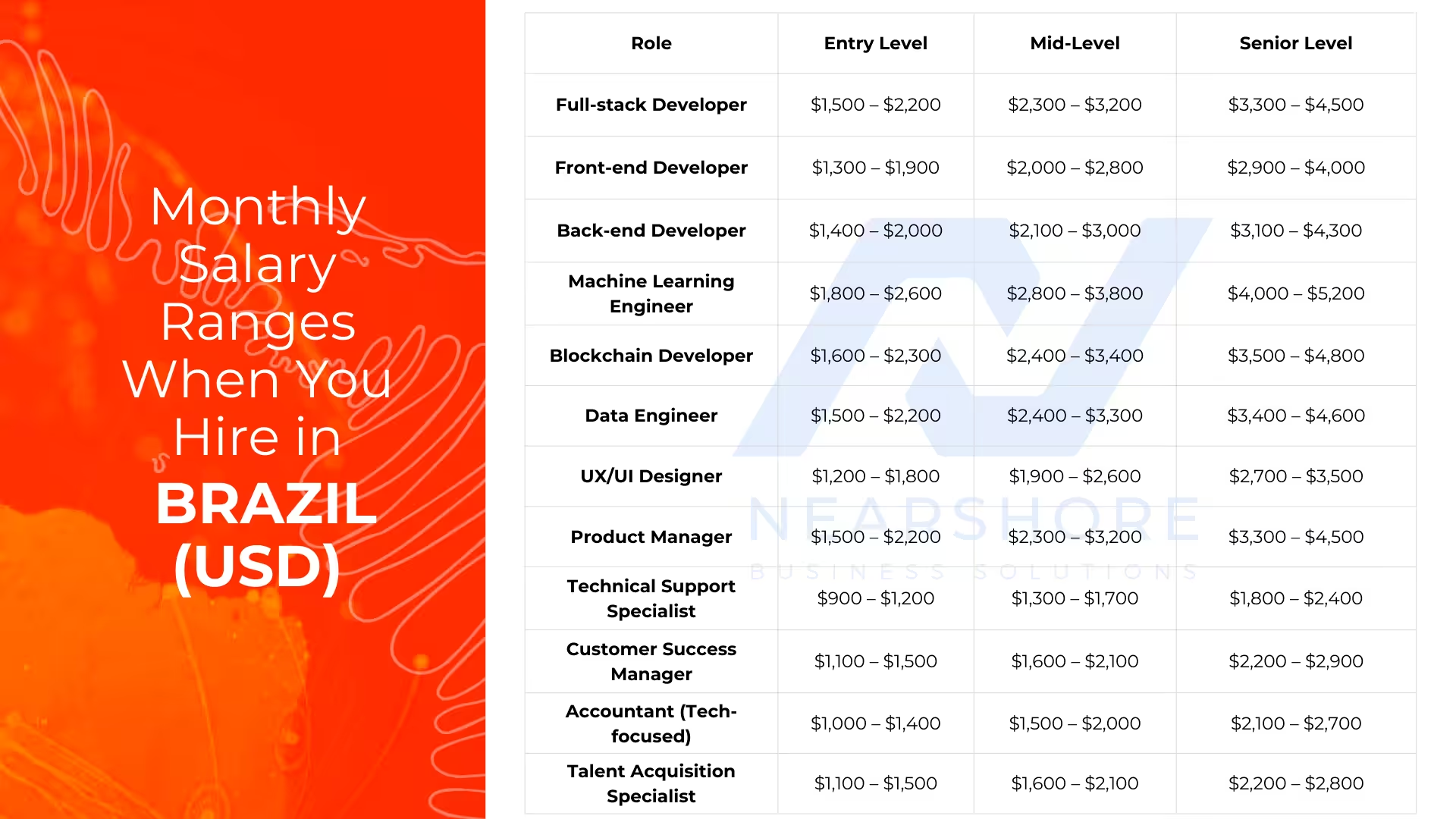
Monthly Salary Ranges in Brazil (USD)
Below are average gross monthly salaries in USD for popular roles, by experience level. Rates vary by region, skill set, and language proficiency.
View the full salary table
| Role | Entry Level | Mid-Level | Senior Level |
|---|---|---|---|
| Full-stack Developer | $1,500-$2,200 | $2,300-$3,200 | $3,300-$4,500 |
| Front-end Developer | $1,300-$1,900 | $2,000-$2,800 | $2,900-$4,000 |
| Back-end Developer | $1,400-$2,000 | $2,100-$3,000 | $3,100-$4,300 |
| Machine Learning Engineer | $1,800-$2,600 | $2,800-$3,800 | $4,000-$5,200 |
| Blockchain Developer | $1,600-$2,300 | $2,400-$3,400 | $3,500-$4,800 |
| Data Engineer | $1,500-$2,200 | $2,400-$3,300 | $3,400-$4,600 |
| UX/UI Designer | $1,200-$1,800 | $1,900-$2,600 | $2,700-$3,500 |
| Product Manager | $1,500-$2,200 | $2,300-$3,200 | $3,300-$4,500 |
| Technical Support Specialist | $900-$1,200 | $1,300-$1,700 | $1,800-$2,400 |
| Customer Success Manager | $1,100-$1,500 | $1,600-$2,100 | $2,200-$2,900 |
| Accountant (Tech-focused) | $1,000-$1,400 | $1,500-$2,000 | $2,100-$2,700 |
| Talent Acquisition Specialist | $1,100-$1,500 | $1,600-$2,100 | $2,200-$2,800 |
These salaries reflect gross monthly compensation and vary by city, skill set, and English proficiency. Hiring through an Employer of Record (EOR) or direct contract also influences final cost. For benchmarks across the region, see our LATAM developer salary guide.
Same business hours, 50-70% lower cost, and the deepest talent pool in Latin America. That is why U.S. teams put Brazil at the top of their nearshore shortlist.
3 Legal Ways to Hire in Brazil
Companies can choose from three common models depending on their goals, risk profile, and long-term strategy: independent contractors, an Employer of Record, or a local entity.
Hiring Independent Contractors
Independent professionals manage their own taxes and benefits, typically invoicing through their own PJ (pessoa jurídica) or MEI entity. Best suited for short-term or project-based work.
- Quick setup, lower cost, no legal entity needed
- Flexibility for project-based work
- Minimal administrative burden
- Misclassification risk under the CLT
- Limited control over work arrangements
- No statutory benefits, harder to retain top talent
Brazilian labor courts look at the actual relationship, not the contract label. Contractors who work fixed schedules, report to your managers, and serve you exclusively can be reclassified as employees, with back pay, benefits, and fines owed retroactively.
Employer of Record (EOR)
An Employer of Record acts as the legal employer for your Brazilian team, handling CLT compliance, payroll, eSocial reporting, and benefits while you manage the daily work.
- Fully compliant with the CLT (Consolidação das Leis do Trabalho)
- Hire in days without a local entity
- Benefits, payroll, and tax filings managed for you
- Service fees add to employment costs
- Less direct control over employment terms
The most popular route for companies testing the Brazilian market or hiring a handful of full-time employees without setting up a company.
Local Entity
Establishing a Brazilian company (usually an LTDA) lets you hire employees directly and manage operations internally. Best for companies committed to long-term scale in-country.
- Full control over hiring and operations
- Strong brand presence in the market
- Ideal for long-term growth and larger teams
- Registration takes 4-8 weeks plus ongoing overhead
- Higher setup and compliance costs
- Requires local expertise in CLT and tax rules
Watch permanent establishment: revenue-generating activity or a fixed presence in Brazil can trigger local corporate tax obligations even before you incorporate.
Employment Compliance When You Hire in Brazil
Brazil has one of the most detailed labor systems in Latin America. Employment is governed by the Consolidação das Leis do Trabalho (CLT), which regulates contracts, benefits, terminations, and compliance.
Understanding Brazilian Labor Law
Every employee must be registered in eSocial, the government’s unified payroll and tax reporting platform, and employers must issue signed work contracts detailing role, salary, hours, and benefits. Collective bargaining agreements negotiated by sector unions apply automatically to covered roles and can add obligations beyond the CLT, including annual salary adjustments.
Indefinite-Term Contract
The default and most common contract for ongoing roles and permanent positions. No end date; full CLT protections apply, including notice and severance rules.
Fixed-Term Contract
Limited to a maximum of two years, used for temporary projects and defined engagements. A probation (experience) contract of up to 90 days is a common special case.
Intermittent Contract
Introduced by the 2017 labor reform for irregular work. Employees are paid only for hours worked, suited to seasonal or variable demand.
Statutory Benefits & Leave Requirements in Brazil
Employers must provide these minimums to all CLT employees. Collective bargaining agreements often add more.
| Benefit / Leave | Statutory minimum |
|---|---|
| Working hours | 44 hours per week standard (usually 8 hours/day) |
| Overtime pay | 150% of the normal rate on weekdays, 200% on Sundays and holidays |
| Probation period | Up to 90 days (contrato de experiência) |
| Paid vacation | 30 days per year after each 12 months worked, plus a vacation bonus of 1/3 of monthly salary |
| 13th-month salary | One extra month’s pay per year, paid in two installments (November and December) |
| Sick leave | Employer pays the first 15 days; INSS covers from day 16 |
| Maternity leave | 120 days paid (extendable to 180 under the Empresa Cidadã program) |
| Paternity leave | 5 days paid (extendable to 20 under Empresa Cidadã) |
| Transportation voucher | Mandatory unless waived by the employee; employer may deduct up to 6% of salary |
| Meal / food allowance | Commonly required by collective bargaining agreements |
Mandatory Contributions & Payroll Deductions in Brazil
Employers contribute to social security and the FGTS severance fund on top of gross salary, and withhold employee taxes through monthly eSocial reporting.
| Contribution | Employer share | Employee share |
|---|---|---|
| INSS (social security) | 20% | 7.5%-14% (progressive) |
| FGTS (severance fund) | 8% | – |
| Work-risk insurance (RAT) | 1%-3% | – |
| Income tax (IRRF) | – | 0%-27.5% progressive, withheld at source |
Budget roughly 30% on top of gross salary for employer payroll contributions. With the 13th-month salary and vacation bonus accruals, the full loaded cost typically lands 40% or more above base salary, still 50-70% below comparable U.S. hires. Sector-specific training levies can apply to some industries.
How to Set Up a Business to Hire in Brazil
For companies planning a long-term presence with direct employee hiring, establishing a legal entity is the end state.
LTDA (Sociedade Limitada)
The most popular structure: limited liability, flexible governance, and since 2019 it can be formed with a single partner. The default choice for small and mid-sized foreign operations.
S.A. (Sociedade Anônima)
A corporation structure for larger operations with complex capital needs, boards, or plans to raise investment in Brazil.
Branch Office
A branch of the foreign parent requires federal government authorization, making it slow and costly. Almost all foreign employers incorporate an LTDA instead.
Registration Steps
- Register with the Commercial Registry — file articles of association with the state Junta Comercial.
- Obtain a CNPJ — the corporate tax ID from Receita Federal, required for all financial and legal transactions.
- Complete state and municipal registrations — as applicable to your activity and location.
- Register as an employer with eSocial and FGTS — mandatory before the first hire.
- Open a corporate bank account — for payroll and tax payments (Banco do Brasil, Bradesco, Itaú, Santander).
The process typically takes 4-8 weeks depending on the state and document readiness. Foreign shareholders must appoint a legal representative resident in Brazil, so most companies work with local counsel from day one.
Ongoing Compliance Requirements
Operating in Brazil means continuous reporting across employment, tax, and data protection.
Recurring Obligations
- eSocial declarations — monthly payroll, tax, and employment reporting on the government platform.
- SPED digital bookkeeping — electronic accounting and fiscal records filed with Receita Federal.
- Corporate taxes — annual IRPJ (corporate income tax) and CSLL (social contribution on profits).
- Financial statements — prepared annually and kept in digital form.
Key Compliance Risks
- Employee misclassification — Brazil’s specialized labor courts routinely reclassify contractors; keep contracts and working practices aligned.
- Collective bargaining agreements — sector union agreements apply automatically and change annually; missing an adjustment creates liability.
- LGPD data protection — Brazil’s general data protection law requires consent, clear notice, and security measures for employee data, with significant fines for violations.
- Documentation — formal contracts and complete records are the main defense in a litigious labor environment.
How to Legally Terminate Employees in Brazil
Terminations follow specific CLT procedures and carry real financial obligations. Incorrect dismissals can result in reinstatement claims or penalties, so documentation and legal review are recommended for every case.
Notice Period
Termination without just cause requires 30 days’ notice plus 3 days per year of service, capped at 90 days (Law 12.506/2011). Notice can be worked or paid in lieu. Resigning employees owe 30 days’ notice.
Severance Without Just Cause
The employee receives their FGTS balance plus a 40% employer penalty on all FGTS deposits, pro-rated 13th salary, unused and pro-rated vacation with the 1/3 bonus, and payment for any unworked notice.
Mutual Agreement (Art. 484-A)
Both parties can agree to end the contract: the FGTS penalty drops to 20%, the notice indemnity is halved, and the employee may withdraw 80% of their FGTS balance. Requires a written agreement.
Just Cause
Reserved for serious misconduct defined in the CLT. Takes effect immediately with no severance package, but the bar is high and labor courts scrutinize these dismissals closely.
Frequently Asked Questions About Hiring in Brazil
How much does it cost to hire an employee in Brazil?
Skilled professionals in technology, engineering, and finance typically earn $900-$5,200 USD per month depending on role and seniority, against a 2026 minimum wage of BRL 1,621 (~$300 USD). On top of gross salary, employers pay roughly 30% in payroll contributions (INSS 20%, FGTS 8%, work-risk insurance 1-3%), and the 13th-month salary and vacation bonus accruals bring the full loaded cost to about 40% or more above base. Even fully loaded, total costs run 50-70% below comparable North American hires.
What is the minimum wage in Brazil in 2026?
The federal minimum wage rose to BRL 1,621 per month on January 1, 2026 (roughly $300 USD), a 6.79% increase over the 2025 floor of BRL 1,518. Some states set higher regional floors, and collective bargaining agreements frequently establish higher category minimums. Skilled remote roles pay far above the minimum: entry-level developers start around $1,300-$1,500 USD monthly.
What is the average salary in Brazil?
IBGE’s continuous household survey puts average monthly earnings around BRL 3,500 (roughly $650 USD), but remote-friendly professional roles pay well above that. Mid-level developers earn $2,000-$3,200 USD monthly, machine learning engineers reach $2,800-$3,800, and customer-facing roles like technical support run $1,300-$1,700. São Paulo, Rio de Janeiro, and Curitiba command higher salaries than secondary cities like Recife or Porto Alegre.
What is the best way to hire employees in Brazil?
It depends on timeline and strategy. An Employer of Record (EOR) is the fastest compliant route: it handles CLT compliance, payroll, eSocial registration, and benefits so you can hire full-time employees in 3-7 business days without an entity. Independent contractors suit genuine project-based work but carry misclassification risk. A local entity (usually an LTDA) makes sense for long-term operations at scale. Most companies start with an EOR to test the market before committing to entity formation.
Can I hire a full-time employee in Brazil without a legal entity or local office?
Yes. An Employer of Record (EOR) acts as the legal employer under the CLT, running payroll, eSocial reporting, INSS contributions, FGTS deposits, the 13th salary, 30 days’ vacation, and mandatory benefits while you direct the daily work. That lets you compliantly employ a developer or any full-time hire in Brazil within 3-7 business days, with no local office. The alternative, engaging the person as an independent contractor, only works if they genuinely operate independently.
How do I hire independent contractors in Brazil?
Most Brazilian contractors invoice through their own registered business (a PJ, pessoa jurídica, or MEI for small operations) and handle their own taxes. Use a services agreement covering scope, deliverables, payment terms, and confidentiality. The critical risk is misclassification: Brazilian labor courts look past the contract at the real relationship, and contractors who work set schedules under your direction, exclusively for you, can be reclassified as CLT employees, triggering retroactive benefits, contributions, and fines.
How do I pay contractors in Brazil?
Contractors invoice you (typically through their PJ entity) and receive payment by international wire or a cross-border payment platform, converting to BRL on receipt. They are responsible for their own income tax and social security. Keep invoices (notas fiscais) and the services agreement on file: consistent documentation of an independent relationship is your main protection if classification is ever questioned.
What are the key labor laws when hiring in Brazil?
Under the CLT: a 44-hour standard workweek; overtime at 150% (weekdays) and 200% (Sundays/holidays); 30 days’ paid vacation plus a 1/3 vacation bonus; a 13th-month salary paid in November and December; FGTS deposits of 8% of salary; 120 days’ paid maternity leave and 5 days’ paternity leave (each extendable under Empresa Cidadã); transportation vouchers; and mandatory eSocial registration. Collective bargaining agreements add category-specific requirements, including annual salary adjustments.
What benefits am I required to provide employees in Brazil?
Mandatory benefits include 30 days of paid vacation plus the 1/3 vacation bonus, the 13th-month salary, FGTS severance-fund deposits (8% of salary), INSS social security enrollment, paid sick leave (employer covers the first 15 days), 120 days’ maternity and 5 days’ paternity leave, and transportation vouchers unless waived. Meal or food allowances are commonly required by collective bargaining agreements, and many employers add private health insurance to stay competitive.
How long does it take to hire employees in Brazil?
Using an EOR: 3-7 business days after selecting a candidate. Contractors: 1-3 days once the agreement is signed. Local entity: 4-8 weeks to incorporate (Junta Comercial registration, CNPJ from Receita Federal, eSocial and FGTS employer registration, bank account), after which individual hires take 1-2 weeks.
Do I need to pay taxes when hiring employees in Brazil?
Yes. Employers pay INSS social security (20% of payroll), FGTS deposits (8%), and work-risk insurance (1-3%), roughly 30% on top of gross salary. Employers also withhold the employee’s INSS (7.5-14%, progressive) and income tax (IRRF, 0-27.5% progressive) and report everything monthly through eSocial. Companies with a local entity additionally file IRPJ and CSLL corporate taxes. An EOR takes on all of these obligations as the legal employer.
How does an Employer of Record actually work when hiring in Brazil?
In plain terms: the EOR is the employer on paper, you are the employer in practice. The EOR signs a CLT employment contract with your hire, registers them in eSocial, runs monthly payroll with all withholdings, deposits FGTS, pays the 13th salary and vacation bonus, and administers benefits. You interview, select, and manage the person day to day, and pay the EOR a single monthly invoice covering salary, employer costs, and a service fee. If you later open your own entity, employees can transfer to it.
How do I hire engineers in Brazil for a US company and stay compliant on payroll?
The standard pattern: source and vet the engineers (directly or through a nearshore recruiter), then employ them through an Employer of Record so payroll runs under the CLT from day one, with INSS, FGTS, IRRF withholding, and eSocial reporting handled in-country. Your U.S. company signs one services agreement with the EOR, avoids permanent-establishment exposure, and pays in USD. Compliant setup takes about a week per hire, versus 4-8 weeks to incorporate an entity.
How do I recruit in Brazil?
Effective recruiting in Brazil combines local job boards and LinkedIn with referral networks in the major hubs, plus structured screening for English proficiency, which varies more than technical skill. Salary benchmarking matters: offers are evaluated against CLT packages including the 13th salary and benefits, not just base pay. Many U.S. companies use a nearshore recruiting partner for market mapping, vetting, and compensation guidance; agencies typically charge a placement fee tied to the role’s salary, while embedded models like Recruitment as a Service use a flat monthly fee.
How do I terminate an employee in Brazil?
Termination without just cause requires notice of 30 days plus 3 days per year of service (capped at 90), payment of the FGTS balance plus a 40% penalty, pro-rated 13th salary, and unused vacation with the 1/3 bonus. Mutual-agreement termination under Article 484-A halves the notice indemnity and reduces the FGTS penalty to 20%. Just-cause dismissal eliminates severance but is limited to serious misconduct and closely scrutinized by labor courts. Document every step; procedural errors can lead to reinstatement claims.
Do Brazilian professionals speak English?
Portuguese is the official language, and English proficiency varies widely, so language screening is a standard part of recruiting in Brazil. Proficiency is strongest among developers, professionals in São Paulo’s tech ecosystem, and anyone with multinational or startup experience. In practice, U.S. companies interview in English and test written communication during vetting; the talent pool is deep enough that strong English plus strong technical skills is a filter Brazil can absorb better than any other LatAm market.
Why do US companies hire workers from Brazil?
Scale, cost, and time zone. Brazil has Latin America’s largest labor force (~110 million) and produces about 100,000 STEM graduates a year, so senior and specialized roles stay fillable. Salaries run 50-70% below comparable U.S. roles. And GMT-3 sits only 1-2 hours ahead of U.S. Eastern Time with no daylight saving, so teams collaborate live all day. A mature startup ecosystem, led by companies like Nubank and iFood, means candidates arrive with product and scale-up experience.
How does Brazil compare to other nearshore markets like Colombia or Argentina?
Brazil offers the region’s largest talent pool and strongest tech ecosystem, at salary levels similar to or slightly above its neighbors, with a more detailed labor code (the CLT) that makes an EOR or strong local counsel more valuable. Colombia offers GMT-5 alignment with U.S. Eastern and a large bilingual Spanish-speaking pool; Argentina offers strong English proficiency and deep senior engineering talent. See our guides to hiring in Colombia and hiring in Argentina for side-by-side detail.
Ready to Hire in Brazil?
Whether you are hiring your first role in Brazil or scaling an entire team, we support U.S. companies at every stage of the hiring journey. Tell us what roles you are hiring for, and we will help you understand market availability, salary ranges, and the best hiring model for your team.
Get a Free ConsultationEnd-to-end recruiting for remote hires in Brazil, including market benchmarking, vetting, and candidate selection.
Local, country-specific recruitment for companies building teams directly in Brazil.
An embedded recruiting model where our team operates as an extension of yours for ongoing hiring needs.
Dedicated nearshore talent that integrates into your workflows so you scale teams quickly and predictably.