Staff augmentation onboarding takes nearshore engineers from day-zero access to production-ready contributor in 30 days. Without a structured plan, augmented engineers take 4-6 weeks to reach 80% productivity vs. 2-3 weeks for FTEs (BCG, 2023).
LATAM staff augmentation delivers vetted engineers at 40-60% lower cost than US equivalents. The onboarding gap is where most companies lose that advantage. Fewer than 20% of organizations maintain a structured onboarding program for contingent workers on par with their FTE programs (SAP Fieldglass, 2023). Only 29% of employees strongly agree their organization runs an effective onboarding process at all (Gallup/Workhuman, 2023).
This guide covers the full 30-day plan: pre-start provisioning, Week 1 context loading, Weeks 2-3 contributor graduation, and Week 4 production deployment.
Why Does Traditional Contractor Onboarding Fail Augmented Engineers?
Traditional contractor onboarding fails because it confuses compliance with context. Most companies nail the compliance layer: NDAs signed, badge access granted, policy decks acknowledged. Then they stop. Nearshore engineers don’t fail because they lack a signed NDA. They fail because nobody gave them the architectural context, team norms, and async communication skills needed to write meaningful code.
The result is the “two-week silence” pattern: contractors sit idle because nobody loaded them with enough context. They have Slack access but no mental model of which service talks to which database. They can log into GitHub but don’t know the branching strategy, the deploy cadence, or who owns the module they’re supposed to touch.
What Does the Onboarding Gap Cost in Dollars?
The onboarding gap costs $35,000-$50,000 per failed engagement. That is the cost of a contractor who churns within 90 days due to poor onboarding (2024 global contractor workforce data). An improperly onboarded engineer also reduces a 5-person team’s sprint velocity by 15-25% for 2-3 sprints due to support burden and rework. A structured augmentation onboarding plan saves approximately $5,100 per engineer in the first month versus ad-hoc onboarding. For a team of 5 augmented engineers, that is over $25,000 in recovered productivity.
What Is Time-to-First-PR and Why Does It Matter?
Time-to-first-PR is the only onboarding KPI that measures what matters: productive output. Checklist completion percentage is a vanity metric. One FinTech company achieved an average time-to-first-PR of 2.5 days across 15 hires using a structured 30-day onboarding plan. It retained 100% of those 15 augmented engineers past the 6-month mark. The plan in this guide builds around three milestones: first commit (can they navigate the codebase?), first ship (can they land a change in production?), and first incident response (can they operate independently under pressure?).
How Do Structured and Ad-Hoc Onboarding Programs Compare?
Structured onboarding produces 82% greater new hire retention and over 70% greater productivity vs. ad-hoc approaches (Brandon Hall Group, 2022). The table below shows what separates best-practice augmentation onboarding from the typical contractor experience.
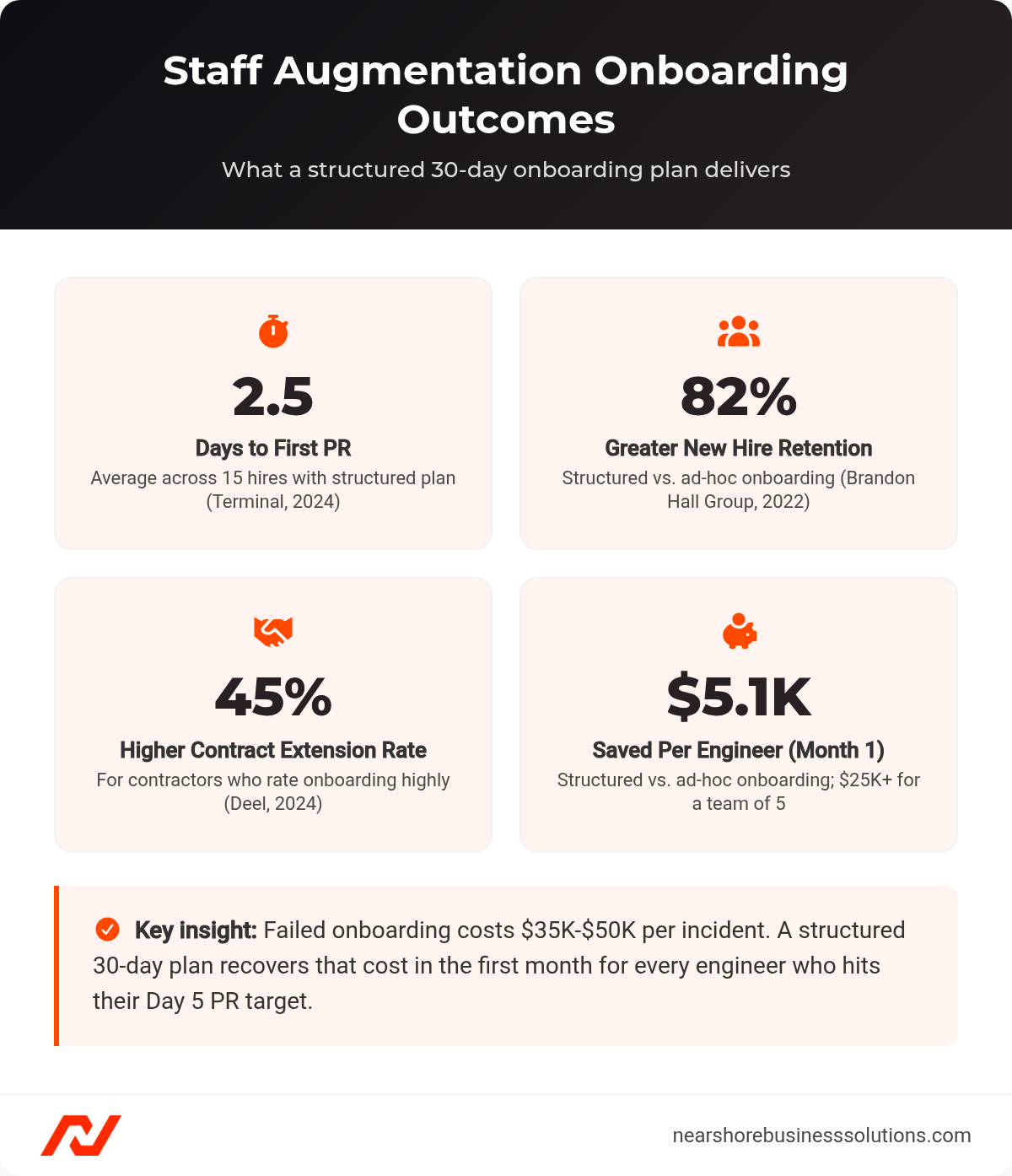
Key outcomes from a structured 30-day staff augmentation onboarding plan, benchmarked against industry data.
| Typical Contractor Onboarding | Effective Staff Augmentation Onboarding |
|---|---|
| Confluence dump with 200+ unorganized pages | Structured Notion runbook: repo map, service ownership matrix, architecture decisions |
| Slack invite with “ask your manager” | Assigned onboarding buddy with daily 15-minute syncs for Weeks 1-2 |
| Unstructured “explore the codebase” | Pre-recorded Loom walkthroughs of architecture and deploy flow |
| No assigned work for the first week | Curated first issue tagged good-first-issue, scoped to under one day |
| Checklist completion as metric | Time-to-first-PR as the only KPI |
Microsoft’s research found that new hires with onboarding buddies were 36% more satisfied. 97% of those hires said their buddy helped them become productive faster (HBR, 2019). HubSpot’s async Loom videos reduced repetitive questions by 40% and cut live onboarding meeting time by 5-7 hours per new hire (HubSpot/Loom, 2023).
What Should You Prepare Before the Engineer’s Start Date?
Pre-start preparation in the three to five days before the start date is the highest-leverage window in the entire onboarding plan. Best-practice companies complete 90% of provisioning before Day 1 (Okta, 2024). Three workstreams run in parallel during pre-boarding: SSO provisioning and RBAC scoping, async documentation assembly, and onboarding buddy assignment.
Each workstream has a single owner and a deadline of 48 hours before start date. A verification step confirms every link resolves before Day 1.
How Do You Configure SSO and RBAC for Nearshore Contractors?
Use an Identity Provider (Okta, Azure AD, or JumpCloud) to automate the provisioning chain. Create a “Nearshore Contractor” user group. SAML/SCIM federation automatically provisions access across every tool when a contractor joins that group. The average company takes 3-5 business days to provision a new contractor (Okta, 2024). Best-practice reduces this to under 4 hours by completing all six steps before Day 1.
Complete each item before Day 1:
- SSO provisioning across the core toolchain. GitHub/GitLab, CI/CD platform, cloud console (read-only initially), observability tools, Slack, and project management. Zero standalone passwords.
- RBAC scoped to the team’s repos and services. Access should be time-bound (auto-revoked at contract end), scope-limited, and routed through a PAM system like Teleport or HashiCorp Boundary for production access.
- VPN or zero-trust network access configured and tested from an external IP, not just your office network.
- Local development environment documented. Pinned runtime versions, Docker setup, environment variables with example values, and a single
make setupcommand that builds the local stack in under 30 minutes. - Sandbox environment provisioned for safe Day 1 experimentation.
- Calendar invites sent for all Week 1 ceremonies with video links and agendas.
For SOC 2 or HIPAA compliance, use AWS IAM Roles with temporary credentials instead of long-lived access keys (AWS Well-Architected Framework, 2024). One published HealthTech case study focused Days 1-3 on security and HIPAA training. Engineers received production data access only after a structured assessment. The result: zero access-related security incidents in the first 12 months while engineers still shipped code in Week 1.
How Do You Build a Notion Runbook That Loads Context Asynchronously?
A Notion runbook is the primary interface between the contractor and your organization’s tribal knowledge. Organizations with strong documentation cultures report approximately 30% faster ramp-up time and a 20% reduction in “how-to” questions directed at senior staff (CircleCI, 2023). GitLab’s standard: if the answer isn’t in the runbook, the runbook has a bug (GitLab Handbook, 2024).
Structure the runbook around five sections:
- Week 1 Checklist with Daily Goals. Day 1: environment setup, run tests locally. Day 2: read architecture overview, push a branch that passes CI. Day 3: pick up the
good-first-issue, open a draft PR. Day 5: ship the fix to staging. - Company and Team Context. Org chart, team mission, business metrics, and a product overview written for engineers, not investors.
- Technical Documentation Hub. Architecture diagrams, service dependency map, coding standards, and CI/CD process from commit to production.
- Tooling and Access Guide. A single table: tool name, purpose, access method, and verification link.
- Key Contacts with Context. Photos, roles, timezones, working hours, and what each person is the right contact for.
When a contractor asks a question that should have been documented, the answer goes into the runbook before the Slack thread closes.
How Do You Select and Brief an Onboarding Buddy?
An onboarding buddy is a designated first responder who shortens the time from question to unblocked. After 90 days, employees with buddies reported 23% more internal network connections (Microsoft, HBR, 2019). For nearshore engineers, those connections determine whether they know who to loop into a PR review or guess wrong for two days.
The buddy’s sprint commitment is typically reduced by 15-20% during Weeks 1-2 to protect this time.
Selection criteria: senior individual contributor (not team lead), same feature area, at least 2 hours of timezone overlap, and voluntary. Buffer’s 3-buddy model (Leader Buddy, Role Buddy, Culture Buddy) provides a useful framework. The Culture Buddy carries particular value for nearshore engineers: async norms and feedback directness transfer in minutes through deliberate conversation vs. months through osmosis (Buffer Open Blog, 2023).
How Do You Structure Days 1-7 for a Nearshore Engineer?
Days 1-7 are structured around a single measurable outcome: a merged commit on a production codebase by Friday. Every activity in the first seven days maps to that milestone and nothing else.
What Should Happen on Day 1?
Day 1 isn’t orientation. It is the dress rehearsal for shipping. Run this checklist sequentially:
- Verify all access works (30 minutes). If something fails, the buddy escalates immediately. Access failures on Day 1 cost more than the 30-minute check.
- Consume 2-3 pre-recorded Loom walkthroughs (60-90 minutes). Cover local environment setup, CI/CD pipeline, core architecture, and production bug triage flow. A 5-minute Loom transfers more usable context than a 30-minute text document because engineers can pause and rewind (Loom/HubSpot, 2023).
- Meet the onboarding buddy synchronously (30 minutes). Walk through the first issue, PR review norms, and the async communication contract for the team.
- Receive the curated first issue. Scoped to under one day, touching one service, exercising the full development loop.
- Set up the local development environment using runbook instructions.
- Make the first local build and test pass.
What Is README-First Codebase Exploration and Why Does It Work?
README-first exploration means an engineer begins every unfamiliar service by reading its README before touching any code. GitLab is the primary champion of this practice. Their standard: if the answer isn’t in the documentation, the documentation has a bug (GitLab Handbook, 2024). Shopify enforces the same internally, treating a current, accurate README as a feature of the code itself. Organizations with strong README-first cultures report approximately 30% faster ramp-up time for new engineers and a 20% reduction in “how-to” questions directed at senior staff (CircleCI, 2023).
For a nearshore engineer in Days 2-5, README-first exploration is the fastest path to service ownership. Key questions to answer from the README: what endpoints does this service expose, what databases does it own, what calls it, and who is the current maintainer?
How Do You Get a Nearshore Engineer to Their First PR by Day 5?
Time-to-first-PR benchmarks from DX (2023): excellent is under 24 hours (Shopify and GitLab target Day 1), average is 2-4 days, and poor is beyond 5 days. Your plan targets: PR opened by Day 3, merged by Day 5.
Mornings in Days 2-5: README-first codebase exploration across 2-3 core services. Afternoons: build toward the first PR. Day 2: branch and write initial code. Day 3: push a draft PR. Day 4: address review comments. Day 5: PR passes CI and merges.
Daily buddy syncs (15 minutes) ask three questions: What did you ship? Where are you stuck? What is your plan for the next four hours? Zapier pairs syncs with pair programming and customer support ticket exposure. Their new hire NPS consistently averages above +80 (Zapier Blog, 2023).
Why Is the First Code Review More Than a Quality Gate?
The first code review is the densest context-loading opportunity in the onboarding arc. The reviewer should over-comment with context: “We use a circuit breaker here because the payments service has a p99 latency of 800ms.” An approve-only “LGTM” on the first PR wastes the best teaching moment in Week 1.
By Day 7, reverse the direction: the contractor reviews a teammate’s PR to surface knowledge gaps. Bidirectional code review at Day 7 is a reliable signal that Week 1 context loading worked. For long-term engagement patterns, see our guide to staff augmentation retention.
What Should Nearshore Engineers Accomplish in Weeks 2-3?
Weeks 2-3 are the transition from assigned contributor to team-integrated engineer. The metric that signals success is the large majority of questions asked in public channels rather than direct messages.
How Do You Graduate an Engineer from Curated Issues to Full Backlog Autonomy?
Progression works in three stages: Week 1 = assigned issues, Week 2 = self-selected from a curated shortlist, Week 3 = full backlog access. GitLab expects new hires to contribute independently within 30 days (GitLab Public Handbook, 2024). The engineer is ready for full autonomy when they can:
- Describe service dependencies without referencing the runbook
- Have submitted 3+ merged PRs
- Have participated in at least one planning session
- Have resolved at least one code review comment thread independently
- Ask the large majority of questions in public channels rather than DMs
Managing distributed teams requires deliberate async communication design. That design has to be built in Weeks 2-3, not assumed.
How Do You Include Nearshore Engineers in Team Rituals Without Timezone Friction?
The LATAM staff augmentation market reached USD 15.6 billion in 2023, growing at 12.5% CAGR, driven largely by timezone alignment with US teams (Nearshore Americas, 2024). Use that overlap with async-first rituals: threaded standups posted by 10am engineer local time, recorded planning sessions with a 24-hour comment window, and retro boards open async before the live session. Inclusion in retros is required.
See the nearshore team implementation guide for timezone strategies, async communication cadences, and sprint integration patterns.
How Do You Measure Whether Your Augmentation Onboarding Plan Is Working?
Five metrics at Day 21 indicate whether onboarding worked.
| Signal | Target at Day 21 | What It Indicates |
|---|---|---|
| Time-to-first-PR | PR opened by Day 3-5 | Access and context loading worked |
| PRs merged | 5+ merged PRs | Sustained contribution velocity |
| Code review participation (as reviewer) | Reviewed 3+ teammate PRs | Architectural understanding developing |
| Questions in public channels vs. DMs | 80%+ in public channels (NBS benchmark) | Async communication fluency |
| Onboarding buddy confidence rating | 4/5 or higher | Readiness signal across all dimensions |
That same FinTech team saw velocity dip only 10% during the first sprint, recovering to baseline by sprint two. Organizations with strong onboarding processes experience 82% greater new hire retention and 70%+ greater productivity (Brandon Hall Group, 2022).
What Should Happen in Days 22-30 to Confirm Full Engineering Velocity?
Days 22-30 close the onboarding arc with two milestones no checklist item can substitute: first ship to production and first incident response.
What Does “First Ship” Mean and How Do You Confirm It?
First ship means a user-facing feature or meaningful backend change deployed through the full CI/CD pipeline, not a config change. HealthTech engineers in that case study reached squad-productive status within 21 days vs. a previous average of 45 days (published case study, 2024). A missed first-ship deadline usually points to gaps in the onboarding plan: insufficient context loading, unclear deploy process, or overly restrictive RBAC.
How Do You Use a Simulated Incident to Build Operational Context?
Run a simulated incident using a past real incident as the scenario. Walk through the runbook escalation path end-to-end. Operational context (who owns what service, where to find logs, how to roll back) is the final layer that separates a contributor from a team member. It is especially critical for nearshore engineers who shadow on-call during off-hours for the core team.
What Happens After Day 30 When Onboarding Ends?
By Day 30, the engineer should have full backlog autonomy, operational context to shadow on-call, and established relationships with 3+ team members. Contractors who rate their onboarding experience highly have a 45% higher contract extension rate beyond 6 months. Poor onboarding is the #1 reason cited for early contractor churn (2024 global contractor workforce data). The onboarding buddy relationship formally offboards at Day 30.
What Is the Complete 30-Day Staff Augmentation Onboarding Checklist?
The complete 30-day checklist maps every onboarding milestone to a single owner and a success signal you can verify without asking the engineer directly.
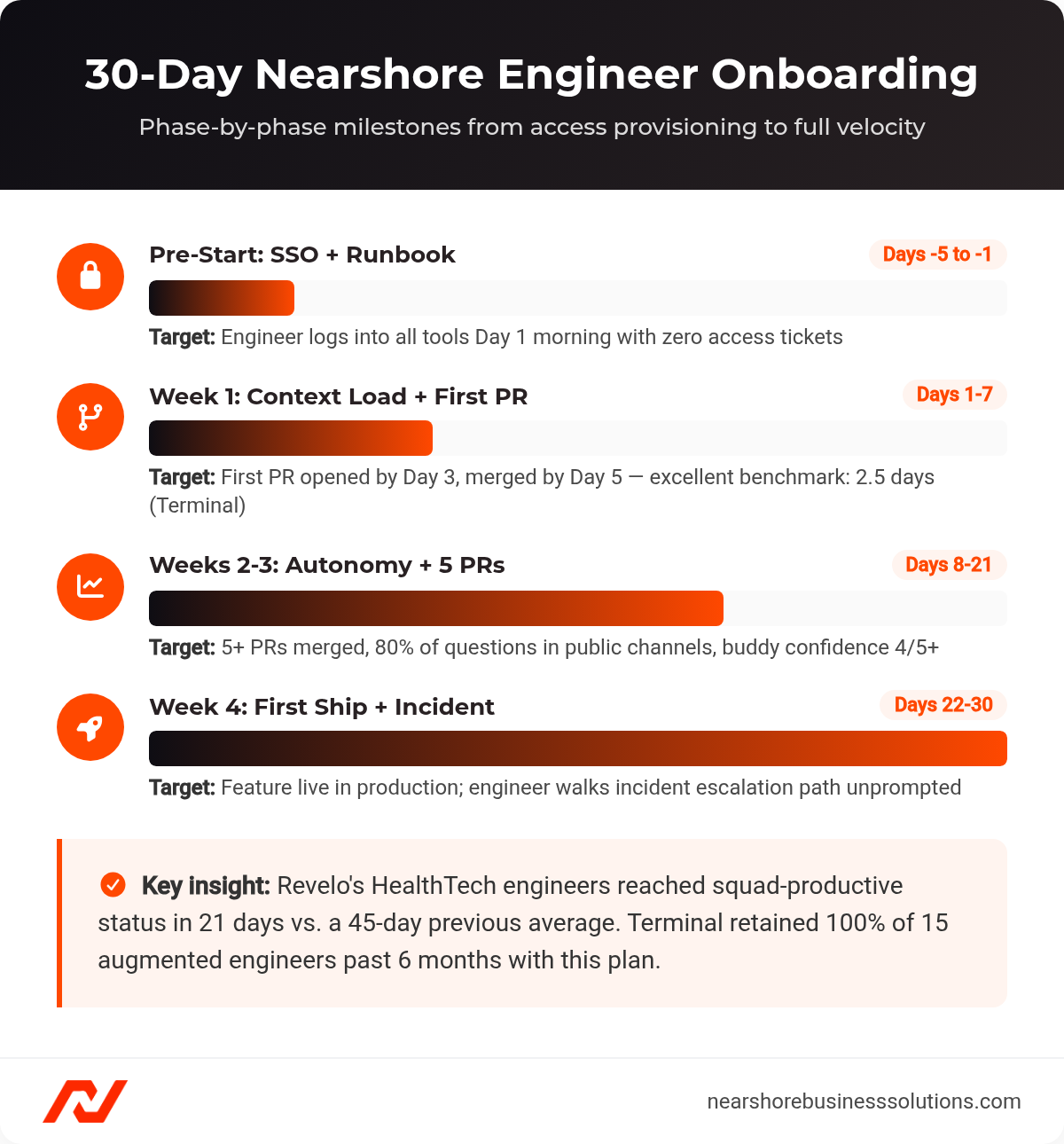
30-day nearshore engineer onboarding timeline with phase milestones and success signals.
| Phase | Key Milestones | Owner | Success Signal |
|---|---|---|---|
| Pre-Start (5-3 days before) | SSO provisioning, RBAC scoped, Notion runbook built, buddy assigned, Loom walkthroughs recorded, first issue selected | Engineering Manager + IT/Security | Engineer logs into all systems Day 1 morning with zero access tickets |
| Week 1 (Days 1-7) | Setup verified, architecture walkthroughs consumed, daily buddy syncs, first PR opened by Day 3 and merged by Day 5 | Onboarding Buddy | Time-to-first-PR under 5 days; engineer can name 3 core services and their owners |
| Weeks 2-3 (Days 8-21) | Self-selected issues, 5+ PRs merged, code reviews given, async standup participation, first retro attended | Buddy and Team Lead | Buddy confidence at 4/5 or higher; 80%+ questions in public channels (NBS benchmark) |
| Week 4 (Days 22-30) | Feature shipped to production, incident response participation, buddy formal offboarding | Team Lead and Engineer | Feature live in production; engineer walks incident escalation path unprompted |
A structured augmentation onboarding plan saves approximately $5,100 per engineer in the first month versus ad-hoc onboarding. For a team of 5 augmented engineers, that is over $25,000 in recovered productivity. The cost of a failed onboarding that leads to 90-day churn runs between $35,000 and $50,000 per incident (2024 global contractor workforce data).
Frequently Asked Questions About Staff Augmentation Onboarding
How Long Does It Take to Onboard a Nearshore Engineer?
A structured 30-day plan gets nearshore engineers to full productivity. Critical milestones: first PR by Day 3-5, 5+ merged PRs by Day 21, production ship by Day 30. Companies with structured plans see sprint velocity recover to baseline by the second sprint (2024 nearshore onboarding benchmarks).
What Is the Biggest Onboarding Mistake Engineering Teams Make?
Confusing access provisioning with context loading. Granting GitHub access on Day 1 does not mean an engineer knows the branching strategy, service ownership, or deploy process. Structured async context transfer through a Notion runbook and Loom walkthroughs closes that gap in the first 48 hours.
What If the Engineer Is Not Productive by Day 30?
A missed Day 30 milestone almost always points to a gap in the onboarding plan, not the engineer. Audit the runbook quality, RBAC scoping, and buddy availability first. Scope and service complexity are the most common causes of delayed first ship.
How Do You Handle SOC 2 or HIPAA Compliance for Nearshore Contractors?
Use AWS IAM Roles with temporary credentials and time-bound RBAC tied to contract end date. For HIPAA-regulated environments, defer production data access until after a structured compliance assessment in Days 1-3. Published HealthTech case study: zero access-related incidents in 12 months while engineers shipped in Week 1.
Does NBS Help With the Onboarding Process After Placement?
Yes. NBS provides a 90-day replacement guarantee and supports both the engineering manager and the placed engineer throughout. Our staff augmentation service includes structured handoff documentation to accelerate Day 1 readiness.
Ready to Onboard Your First Nearshore Engineer in 30 Days?
Nearshore Business Solutions places vetted engineers from Colombia, Mexico, and Argentina. We handle sourcing, vetting, and placement. You get pre-screened your first candidates within 3 business days with a 90-day replacement guarantee.
Talk to our team about building a custom onboarding plan for your augmented engineers.